
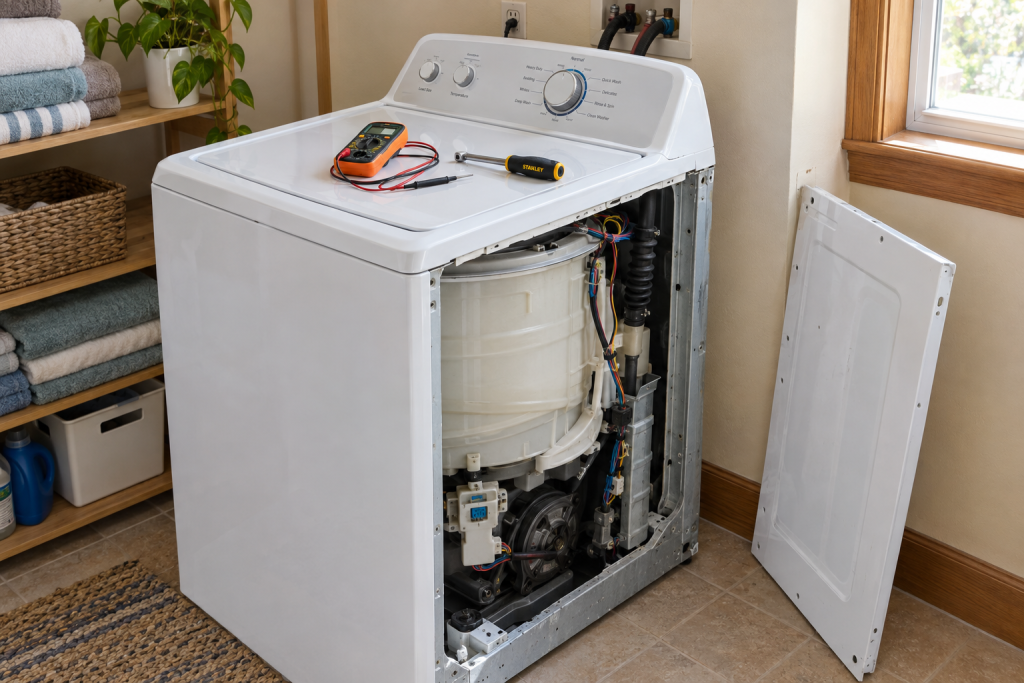
Most washing machine failures come down to six or seven cheap parts: the lid or door switch, the drain pump, the water inlet valve, the drive belt, the motor coupler, the door boot, and the suspension. You can diagnose almost all of them with a multimeter, a nut driver and an hour, and the parts usually cost $15 to $80. This guide walks you through each symptom, from a washer that won’t start to one that shakes across the floor, and tells you exactly where to stop and call a technician.
Quick steps: fix a washing machine
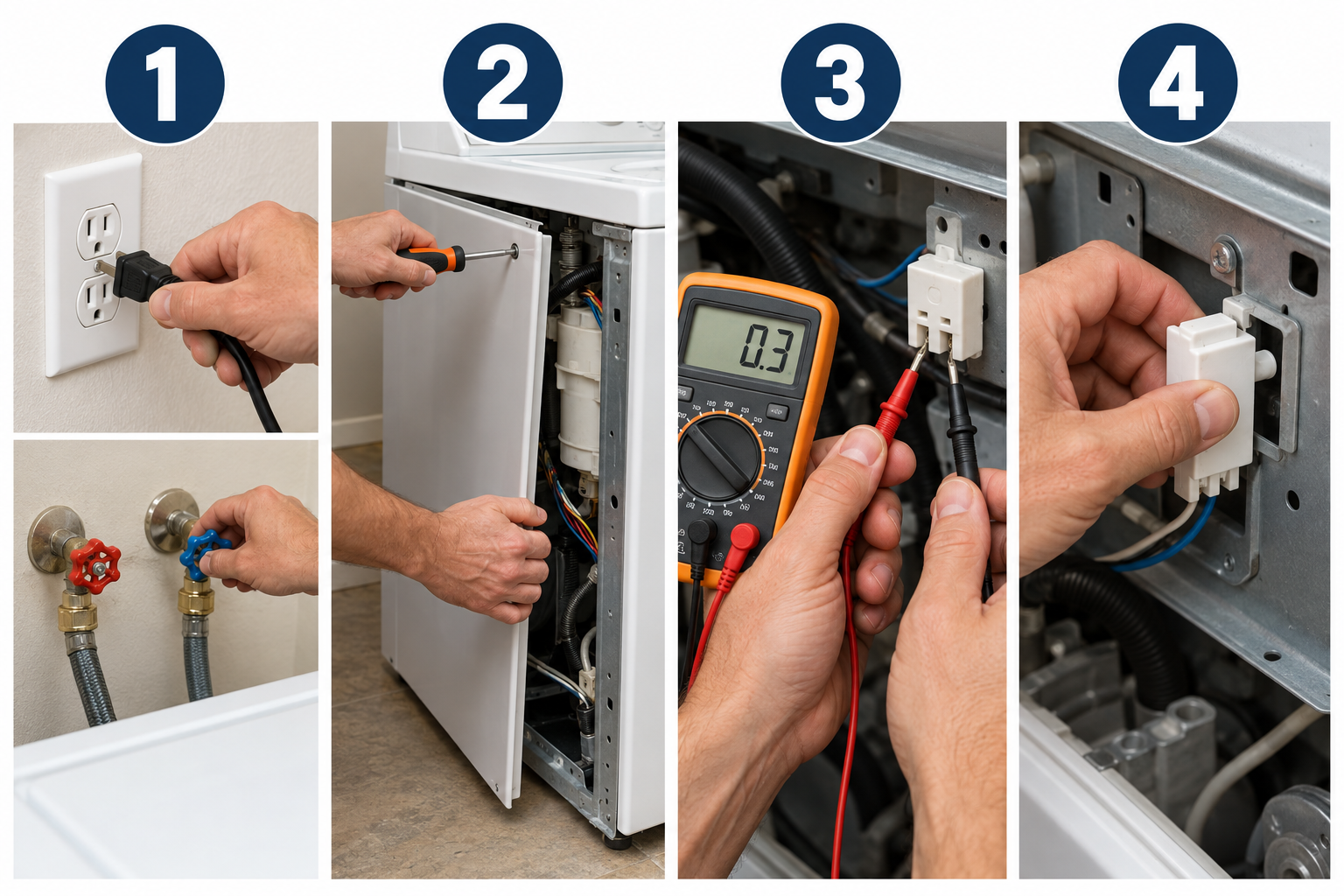
- Unplug the washer and shut off both water supply valves.
- Match the symptom (no power, no fill, no drain, no spin, leak, noise) to the likely part.
- Clear the easy stuff first: clogged pump filter, kinked drain hose, blocked inlet screens, unbalanced load.
- Pull the cabinet panel and test the suspect switch, valve or pump with a multimeter.
- Order the exact part by model number and swap it.
- Reconnect water, run an empty rinse-and-spin cycle and watch for leaks.
- Level the washer and check the drain hose height before loading laundry.
Tools and materials
- Multimeter with continuity and ohms setting
- 1/4 in and 5/16 in nut drivers (most cabinet and bracket screws)
- Phillips and flat screwdrivers, plus a Torx T20 for many front-loaders
- Needle-nose pliers and channel-lock pliers (hose clamps)
- Putty knife (releases spring clips on older Whirlpool and Kenmore top-loaders)
- Flashlight and a smartphone for photos of wiring before you unplug anything
- Shallow baking pan, old towels and a wet/dry vacuum for trapped water
- Replacement part ordered by full model number (lid switch, pump, valve, belt, coupler, boot, rods or shocks)
- Washing machine cleaner tablets or 1 cup chlorine bleach for odor problems
- Rubber anti-vibration pads (optional, about $20 a set)
Safety first
Unplug the machine before removing any panel, not just switch it off. Close both hot and cold supply valves before touching a fill hose. Front-loaders weigh 180 to 250 lb because of concrete counterweights, so get a second person before tipping one.
Match the symptom to the part
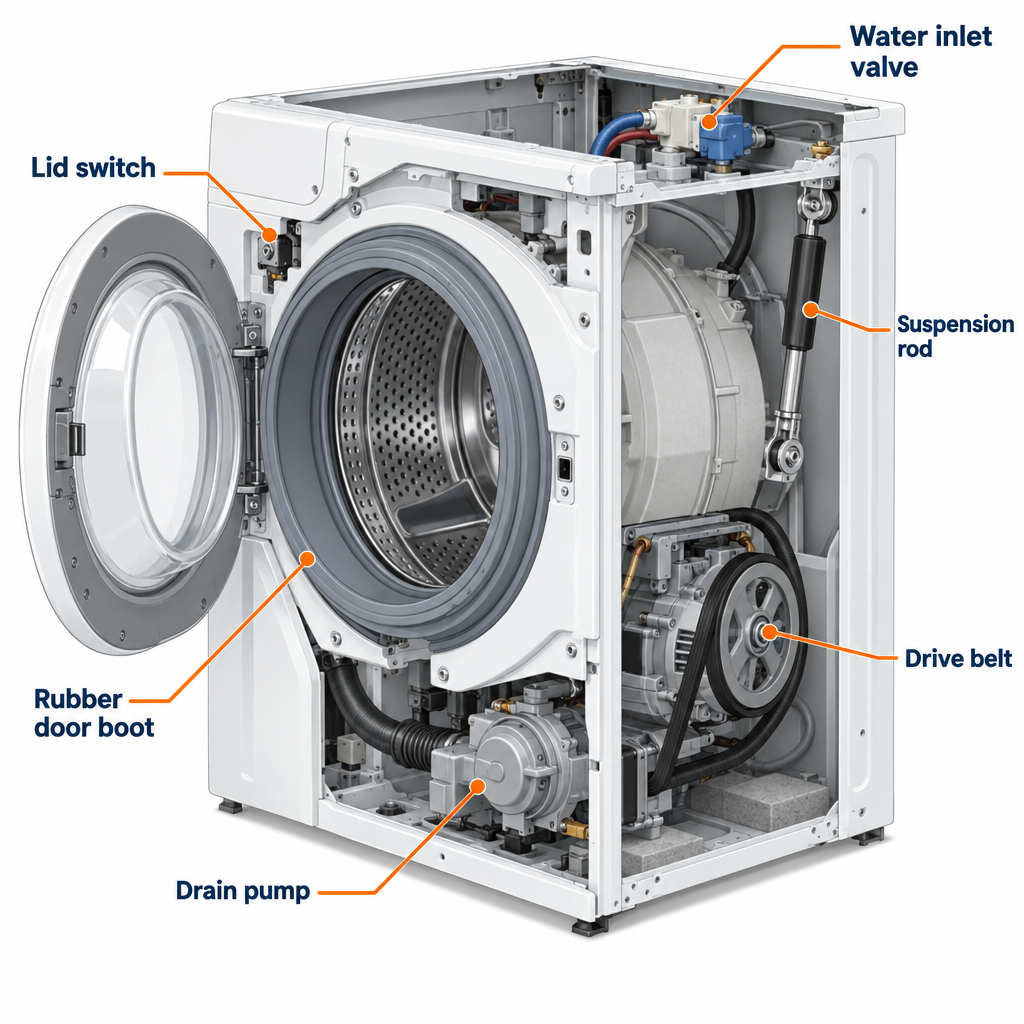
Before you open anything, narrow down the fault. Nine out of ten washer calls fall into one of these buckets, and each one points to a short list of parts.
| Symptom | Most likely cause | Typical fix | DIY? |
|---|---|---|---|
| Dead, no lights, no sound | Tripped breaker, bad outlet, failed lid/door switch, blown thermal fuse | Reset breaker, test outlet, replace switch or fuse | Yes |
| Hums but won’t start | Motor coupler (top-load), seized pump, failed start capacitor | Replace coupler or pump | Yes |
| Won’t fill or fills slowly | Closed valves, clogged inlet screens, bad inlet valve solenoid | Clean screens, replace valve | Yes |
| Fills but won’t agitate | Broken coupler, worn agitator dogs, failed lid switch | Replace coupler, dogs or switch | Yes |
| Won’t drain, water sits in tub | Clogged pump filter, kinked hose, failed drain pump | Clear filter, replace pump | Yes |
| Drains but won’t spin | Lid switch, drive belt, clutch, shift actuator, door lock | Test and replace | Yes |
| Leaks from the front | Torn door boot, oversudsing, dispenser overflow | Replace boot, use less detergent | Yes |
| Leaks from the back or under | Fill hoses, drain hose, pump housing, tub seal | Replace hose or pump; tub seal is a pro job | Mostly |
| Banging or walking in spin | Unbalanced load, bad suspension rods or shocks, unlevel feet | Rebalance, replace rods/shocks, level | Yes |
| Grinding or roaring in spin | Tub bearings | Bearing kit (3-4 hours) or replace machine | Pro / advanced |
| Smells musty or like sewage | Mold in boot or tub, biofilm, dry trap in standpipe | Clean cycle, bleach, leave door open | Yes |
Print the model number from the sticker inside the lid, on the door frame or on the back panel. Every part you order needs that number, not just the brand.
Step 1: Unplug it and check the basics
Pull the plug and close the two water valves behind the machine. If the valves are the old gate type and haven’t moved in years, turn them gently. A valve stem that weeps when you turn it needs a new valve before you go further, and that is a 15-minute plumbing job with a pair of quarter-turn replacements.
Now rule out the free fixes. Check the breaker in the panel; a laundry circuit is usually a 20-amp single pole. Plug a lamp into the outlet to prove it has power. Look behind the washer for a drain hose that got crushed when the machine walked backward, which is a common cause of both “won’t drain” and “leaks on the floor.”
Open the lid or door and spin the drum by hand. A top-load basket should turn with light resistance. A front-load drum that grinds, wobbles or sounds like marbles rolling has bearing damage, and you can skip straight to the repair-or-replace section.
Check the load, too. A single soaked bath mat or a comforter in a top-loader will stop the spin on most machines because the imbalance sensor or the off-balance switch trips. Redistribute it and try a rinse-and-spin before you pull a single screw.
Step 2: Fix a washer that won’t start
If the outlet is live and the machine is dead, the usual suspects are the lid switch on a top-loader, the door lock on a front-loader, or a thermal fuse on the control board or motor harness.
Top-load lid switch. On older Whirlpool, Kenmore, Maytag and Roper direct-drive machines, the switch sits under the top panel near the lid hinge. Slide a putty knife about 2 inches in from each front corner of the cabinet to pop the spring clips, then tilt the cabinet forward. Unplug the switch’s connector and test for continuity across the two switch terminals with the lid closed (or the plunger pressed). No continuity means a dead switch. Parts run $15 to $40 and the swap takes 20 minutes.
Front-load door lock. When you press Start and nothing happens, listen for the click of the door lock engaging. No click usually means the lock assembly failed, though a damaged door latch hook or a bad wiring connection can mimic it. Remove the two or three Torx screws around the latch area inside the door opening, pull the lock out, and test it for continuity across the switch contacts. Locks cost $25 to $70 depending on brand.
Thermal fuse and control board. Some machines carry a one-time thermal fuse inline on the power supply. If the fuse is open, it blew for a reason, often a shorted motor or a pump that drew too much current. Replace the fuse only after you find and fix the cause, or you’ll blow the new one on the first cycle.
A washer that hums for a few seconds and then quits has power but can’t turn the motor. On direct-drive top-loaders that means a broken motor coupler, covered in Step 5. On front-loaders a humming motor with no drum movement often points to a seized drain pump or a jammed drum, so check for a sock or underwire wedged between the drum and tub.
Step 3: Fix a washer that won’t fill or fills slowly
A slow fill almost always starts at the inlet screens. Turn off the valves, unscrew both fill hoses from the back of the washer and pull out the small cone or disc screens inside the inlet ports with needle-nose pliers. Rinse them, or replace them if they’re crusted with scale. Inlet screen sets cost under $10.
While the hoses are off, run each one into a bucket and open the valve. You should get a strong, full stream. A weak stream from one hose means a partly closed valve, a kinked hose, or sediment in the supply line. Most washers need at least 20 psi to open the inlet valve properly; a well system with a waterlogged pressure tank can starve the washer even when the faucets seem fine.
If water pressure is good and the screens are clean, test the water inlet valve. It’s the two-solenoid block where the fill hoses attach. Unplug the machine, remove the back or top panel, and measure resistance across each solenoid’s two terminals. You should see a reading in the hundreds of ohms (the exact spec is printed on the tech sheet taped inside the cabinet or on the valve itself). An open circuit, or a reading wildly off from the other solenoid, means the valve is dead. If only cold fills but hot doesn’t, the hot solenoid failed, or the hot supply is shut.
Replacing the valve takes about 30 minutes. Two screws hold it to the cabinet, each outlet hose has a spring clamp you squeeze with channel-locks, and the wiring is push-on spade terminals. Photograph the connections first because the hot and cold wires look alike. Valves cost $20 to $60.
Two other fill problems are worth knowing. A washer that fills with no water selected or keeps filling after the cycle ends has a valve stuck open by grit; replace it immediately, because it will flood the laundry room. And a washer that fills, pauses, then fills again in short bursts is usually fine, since modern HE machines meter water in stages.
Step 4: Fix a washer that won’t drain
Standing water in the drum is the single most common washer complaint, and most of the time the fix costs nothing.
Clear the drain pump filter (front-loaders). Open the small access door at the bottom front of the cabinet, or remove the lower kick panel (two or three screws along the bottom edge). You’ll see a round cap about 3 inches across. Slide a shallow baking pan under it, have towels ready, and turn the cap counterclockwise slowly. Expect a quart or more of dirty water. Pull the filter and clear coins, hairpins, pet hair and lint. Rinse it, check the pump impeller behind it spins freely with a finger, and screw the filter back in hand-tight.
Pro tip
Before you open the pump filter, run the drain hose into a bucket on the floor (lower than the washer) to siphon out most of the water. A full front-load tub can hold 3 to 5 gallons, and no baking pan catches that. On machines without a filter door, a wet/dry vacuum on the drain hose end empties the tub in two minutes.
Check the drain hose. Pull the washer out and inspect the corrugated hose for kinks, especially where it bends over the standpipe. The hose end should sit 30 to 96 inches above the floor on most models, and several brands including Whirlpool want at least 39 inches. A hose shoved too far down a standpipe can siphon water out mid-cycle, which looks like “won’t fill” but is actually “won’t stop draining.” Pull it back so no more than about 6 to 8 inches sits in the pipe, and use the plastic hook that came with the machine.
Clear the standpipe. If the washer pumps hard but water backs up and spills out of the standpipe, the problem is the house drain, not the washer. Lint builds up in the trap over years. Snake it with a 25-foot hand auger from the top. A lint trap sock on the hose end, about $5 for a pack, keeps it from coming back.
Test and replace the drain pump. On top-loaders the pump is belt-driven or bolted to the front of the motor; on front-loaders it’s a small electric pump at the bottom front. With power off, disconnect the pump’s two-wire plug and measure resistance across the terminals. An open circuit means a burned winding. If the motor reads fine but the impeller is cracked or wobbles, replace the pump anyway. Pumps cost $30 to $80, and the job is two hose clamps, two or three screws and a plug. Keep the baking pan under the tub-to-pump hose because it holds another pint.
A pump that runs but moves little water has usually chewed a bra underwire or a sock into its impeller. Pull the hose off the inlet side and look.
Step 5: Fix a washer that won’t spin or agitate
Here the symptom splits by machine type, so find your category first.
Direct-drive top-loaders (Whirlpool, Kenmore, Roper, Estate, many Maytag Centennial). If the washer fills and drains but the basket never moves, the motor coupler is the number one suspect. It’s a three-piece plastic and rubber coupling between the motor and the transmission, and it’s designed to shear before the transmission does. Tilt the cabinet forward, unclip the pump from the motor (two spring clips), remove the two motor retaining clips, and pull the motor back. Broken coupler halves fall out on the floor. New couplers cost $8 to $20 and the repair takes 45 minutes. If the coupler is fine and the agitator moves but the spin doesn’t, look at the clutch and the lid switch.
Belt-drive top-loaders (newer Whirlpool, Maytag, GE, Speed Queen, most Samsung and LG top-loads). A worn or stretched belt slips during spin and gives you a wet load with a hot rubber smell. Tip the machine back onto a folded moving blanket and inspect the belt under the tub. Belts run $10 to $30 and change in 20 minutes. If the belt is good, the shift actuator (the small motor that moves the machine between agitate and spin modes on Whirlpool-style designs) is the next likely failure; it’s about $40 and bolts on under the tub with two screws.
Front-loaders. No spin usually means one of four things: the door lock reports “unlocked,” the drive belt snapped, the motor control board failed, or the unbalance sensor is stopping the cycle. Remove the back panel to check the belt. A belt that’s off the pulley but intact points to a bad bearing or broken spider arm that let the drum shift. Machines with universal motors (older Bosch, some Frigidaire and Electrolux) also use carbon brushes that wear out after roughly 7 to 12 years, or 5 to 10 years under heavy use; they’re $15 to $30 a pair and slide out from the sides of the motor.
Any machine that spins only with a small load has worn suspension. Covered in Step 7.
Also test the lid switch or door lock again, even if the machine starts. Many designs will fill and agitate with a failed switch but refuse to spin, because the spin lockout is the safety-critical function.
Pro tip
Look for the folded tech sheet taped inside the cabinet or the control console. It shows the wiring diagram, the ohm values for every solenoid and sensor, and the button sequence to enter diagnostic mode. Diagnostic mode on most Whirlpool, Maytag, Samsung and LG machines will run each component on demand and display stored error codes, which turns a two-hour guessing game into ten minutes.
Step 6: Fix a leaking washing machine
Find where the water shows up before you touch anything. Dry the floor, run a short cycle with the panels off, and watch with a flashlight. Leaks move along hoses and cabinet edges, so the puddle rarely sits under the actual fault.
Leak at the back. Nine times out of ten this is a fill hose. Rubber hoses harden and split after 5 years; replace both with braided stainless hoses, about $15 to $30 each, and use the new washers that come with them. Hand-tighten plus a quarter turn with pliers is enough. A drain hose that has slipped off the standpipe or cracked at the bend also leaks here.
Leak at the front of a front-loader. The door boot (the big rubber gasket) tears from years of zipper and underwire abuse, and it traps grit in its folds that keeps the door from sealing. Pull the outer spring clamp with a flat screwdriver, peel the boot back and inspect the whole fold. Boots cost $50 to $150 by brand, and replacing one takes about an hour because the inner clamp spring is awkward. Leaks only during the wash phase, with foam at the door, mean too much detergent. HE machines want 2 tablespoons of HE detergent, not a capful.
Leak at the front of a top-loader. Usually an overfill or a splash problem: a tub that fills past the top of the agitator means a bad water level pressure switch or a clogged pressure hose. Pull the small clear hose off the switch and blow it out.
Leak from the middle or under the machine. Check the tub-to-pump hose, the pump housing seams and the tub-to-drain hose connection. On top-loaders, water that leaks only during agitate and leaves a rusty ring points to a failed tub seal and center post, which is a 3-hour job involving the transmission. On front-loaders, water from the rear center of the outer tub means the tub bearing seal has gone, and the bearing is next.
Leak from the detergent dispenser. Pull the drawer, scrub the cavity, and check the small hose from the inlet valve to the dispenser for cracks. A blocked dispenser overflows out the front edge of the drawer.
Pro tip
Lay paper towels under the suspected area and run a cycle. Wet spots tell you the exact timing (fill, wash, drain or spin) and position of the drip, and that alone usually names the part. A fill-only leak is a valve or hose, a drain-only leak is the pump or drain hose, and a spin-only leak points to the drain pump or drain hose first, with the tub seal as the other main suspect.
Step 7: Fix a loud or shaking washer
Noise diagnosis is about when the noise happens.
Banging during spin, machine walks. Start by leveling it. Tip the washer, screw all four leveling feet in, then adjust until a torpedo level reads true front-to-back and side-to-side, with no rock when you push on diagonal corners. Tighten the lock nuts up against the cabinet base. Rubber anti-vibration pads under each foot help on wood floors.
If a level machine still walks, the suspension is done. Top-loaders use four suspension rods with a spring and cup at the top; a worn set lets the basket sag to one side and hit the cabinet. Pull the top panel, unhook each rod from the corner bracket and tub, and replace them as a set of four for $30 to $60. Front-loaders use two shock absorbers (sometimes four) at the bottom and two springs at the top. Push the drum down and let go; it should bounce once and stop. If it keeps bouncing, replace the shocks, $30 to $80 for a pair, each held by a pin or bolt at each end.
Grinding, roaring or a jet-engine sound in spin that gets louder with speed. That’s the tub bearing. Confirm by spinning the drum by hand with the belt off; you’ll feel roughness and hear rumble, and the drum will move up and down on its shaft when you lift the front edge. On most front-loaders, the bearing is pressed into the rear tub half and the job means pulling the whole tub, splitting it, pressing out the old bearing and seal, and reassembling. Parts cost $50 to $150, but this is a major repair, so a pro quote usually lands well above the $150 to $450 range that covers most washer fixes. For a machine over 7 years old, bearings usually mean a new washer.
Squeal or chirp during spin. Dry belt, worn idler pulley, or on direct-drive machines a worn clutch pad. Belts and clutches are cheap; replace rather than treat.
Rattle or clatter during drain. Something in the pump. See Step 4.
Click or tick as the drum turns. A coin or bra underwire between the drum and tub. Shine a flashlight through the drum holes while rotating it. Fishing one out through the boot on a front-loader is doable; on many top-loaders you need to pull the agitator and basket.
Thump at the start of each agitation stroke on a top-loader. Worn agitator dogs (the small plastic cams in the top of a dual-action agitator). Pop the cap, pull the dispenser cup, unbolt the agitator, and swap the four dogs for about $10.
Step 8: Fix a smelly washer and read the error codes
A musty washer is a biofilm problem, not a mechanical one. Run the manufacturer’s tub clean cycle with a washer cleaner tablet, or a hot cycle with 1 cup of chlorine bleach in an empty drum. On a front-loader, pull back the boot and wipe the fold with a bleach-dampened rag; black mold hides there. Then leave the door and detergent drawer open between loads, and cut detergent to the HE dose. Excess detergent feeds the slime.
A sewage smell that only appears when the washer drains is a dry or partially clogged standpipe trap, or a drain hose shoved so far down the standpipe that it bypasses the trap’s air gap. Pull the hose back and run water down the standpipe.
Modern machines also tell you what’s wrong, if you know the code. These are the most common ones across major brands.
| Code | Brand | Meaning | First thing to check |
|---|---|---|---|
| OE | LG | Drain error | Pump filter, drain hose kink |
| UE | LG | Unbalanced load | Redistribute, check shocks |
| IE | LG | Inlet/fill error | Supply valves, inlet screens |
| dE | LG | Door error | Latch, door lock |
| LE | LG | Motor locked / overload | Load size, motor hall sensor |
| 5C / 5E / nd | Samsung | No drain | Pump filter, drain hose |
| 4C / 4E | Samsung | No fill | Supply valves, inlet screens |
| dC / UE | Samsung | Unbalanced | Load, suspension |
| dE / dC | Samsung | Door open/unlocked | Latch, door lock |
| F21 | Whirlpool, Maytag (front-load) | Long drain | Pump filter, drain hose |
| F20 | Whirlpool, Maytag (front-load) | No fill | Supply valves, inlet screens |
| Sud / SD | Whirlpool, Maytag | Oversudsing | Detergent dose, pressure hose |
| F5 E2 | Whirlpool, Maytag | Door lock fault | Door lock assembly |
Codes vary by model year, so confirm against the tech sheet or the manual before ordering anything. A code that comes back after you fix the obvious cause usually points at the sensor or board that reports it.
What washing machine parts cost
These are typical US retail prices for name-brand or OEM parts from appliance parts suppliers. Generic parts run cheaper but fail sooner, especially pumps and valves.
| Part | Parts cost (DIY) | Typical pro repair (parts + labor) | DIY time |
|---|---|---|---|
| Lid switch (top-load) | $15-40 | $120-200 | 20-30 min |
| Door lock (front-load) | $25-70 | $150-250 | 30-45 min |
| Water inlet valve | $20-60 | $150-250 | 30 min |
| Drain pump | $30-80 | $175-300 | 45-60 min |
| Drive belt | $10-30 | $125-200 | 20-45 min |
| Motor coupler | $8-20 | $125-200 | 45 min |
| Agitator dogs | $5-15 | $100-150 | 15 min |
| Suspension rods (set of 4) | $30-60 | $175-300 | 45-60 min |
| Shock absorbers (pair) | $30-80 | $200-325 | 60 min |
| Door boot (front-load) | $50-150 | $225-400 | 60-90 min |
| Water level pressure switch | $20-50 | $150-225 | 30 min |
| Drive motor | $100-250 | $300-500 | 60-90 min |
| Main control board | $100-300 | $300-550 | 30 min |
| Tub bearing and seal kit | $50-150 | $350-600 | 3-4 hours |
Most independent technicians charge a service call or diagnostic fee of $75 to $150 that is credited toward the repair if you proceed. Big-box retailer repair programs tend to run higher.
Repair or replace?
The rule most techs use is simple: if the repair costs more than half of what a comparable new machine costs, and the washer is past the middle of its life, replace it. Standard washers last around 10 to 14 years, with most of the cheap parts failing between years 5 and 8.
| Situation | Recommendation |
|---|---|
| Under 5 years old, any single part under $300 installed | Repair |
| 5-10 years old, lid switch, pump, valve, belt, coupler, suspension | Repair, especially DIY |
| 5-10 years old, control board or motor over $300 | Compare to a new machine at $600-900; usually replace |
| Over 8 years old, tub bearings or transmission | Replace |
| Any age, rusted outer tub, cracked drum spider, or multiple faults at once | Replace |
| Any age, machine still under manufacturer warranty (usually 1 year parts and labor, some brands longer on motors) | Call the manufacturer first, do not open it |
A new mid-range top-loader runs about $600 to $900 and a front-loader $800 to $1,300. Factor delivery, haul-away and new fill hoses into the comparison.
Troubleshooting: when the fix didn’t take
| Symptom after repair | Likely cause | Fix |
|---|---|---|
| New lid switch, still won’t spin | Wrong switch for the model, or the actuator pin on the lid is broken | Check part number, replace lid pin |
| New pump, still drains slowly | Clogged drain hose or standpipe, or hose pushed too far into the pipe | Snake standpipe, pull hose back |
| New inlet valve, still fills slowly | Low house pressure, blocked supply valve, kinked fill hose | Test flow into a bucket, replace valves |
| New belt squeals | Belt not seated in pulley groove, or tensioner/idler worn | Reseat belt, replace idler |
| New coupler breaks within weeks | Transmission seized or pump locked, forcing the coupler to shear | Spin transmission shaft by hand; replace pump or transmission |
| New boot still leaks | Inner clamp not seated, or boot folded under at the bottom | Remove and reseat, check drain hole alignment |
| Level machine still walks | Shipping bolts never removed (new machine), or soft floor | Remove the 4 bolts from the back; add plywood pad |
| New shocks, still bangs | Top springs stretched, or a bearing failure letting the drum drop | Replace springs, check drum play |
| Error code returns immediately | Sensor or harness fault, not the part the code names | Check connectors, test the sensor per tech sheet |
| Odor returns in two weeks | Door closed between loads, too much detergent, cold-water-only washing | Leave door open, reduce dose, run a monthly hot clean cycle |
When to call a pro
Call an appliance repair technician for tub bearings, transmission or gearcase replacement, a cracked outer tub, or any control board fault you can’t pin down in diagnostic mode. Call a plumber if the standpipe backs up after you snake it, if a supply valve won’t shut off or leaks at the stem, or if you need a new laundry box. Call an electrician if the breaker trips with the washer unplugged, the outlet reads under 110 volts, or there is any burning smell at the receptacle. Do not open a machine that is still under manufacturer warranty; the service call is free and opening the cabinet can void it.
FAQ
Is it worth it to repair a washing machine?
Yes, when the washer is under about 8 years old and the fault is one of the common cheap parts: lid switch, door lock, drain pump, inlet valve, belt, coupler, suspension or boot. Those repairs cost $15 to $80 in parts if you do them yourself and $120 to $400 from a technician. It stops being worth it when the quote passes half the price of a new machine, which happens with bearings, transmissions, main control boards on older units, or more than one failure at once.
What is the average cost to fix a washing machine?
A professional repair in the US typically lands between $150 and $350, including a diagnostic fee of $75 to $150 that most shops credit toward the work. Simple jobs like a lid switch or belt come in around $120 to $200. Pumps, valves and door boots run $175 to $400. Motors, control boards and bearing kits reach $300 to $600, which is where replacement starts to make more sense. The same repairs done yourself usually cost only the part.
What is the most common problem with a washing machine?
Drain problems. A clogged pump filter, a sock or coin in the pump, or a kinked drain hose causes more service calls than any other fault, and the fix is usually free. Right behind it are lid switch and door lock failures that stop the spin, and worn suspension that makes the machine bang and walk during spin. Leaking fill hoses round out the top four, and all of them are DIY repairs.
Who should I call to fix a washing machine?
For a washer under warranty, call the manufacturer’s service line; they dispatch an authorized technician at no charge for covered faults. For an out-of-warranty machine, call an independent appliance repair technician, who usually charges less than factory service and will quote parts and labor before starting. For drain backups at the standpipe or supply valve problems, call a plumber. For breaker or outlet problems, call an electrician. If your home warranty covers appliances, file the claim first, since the plan picks the technician.