
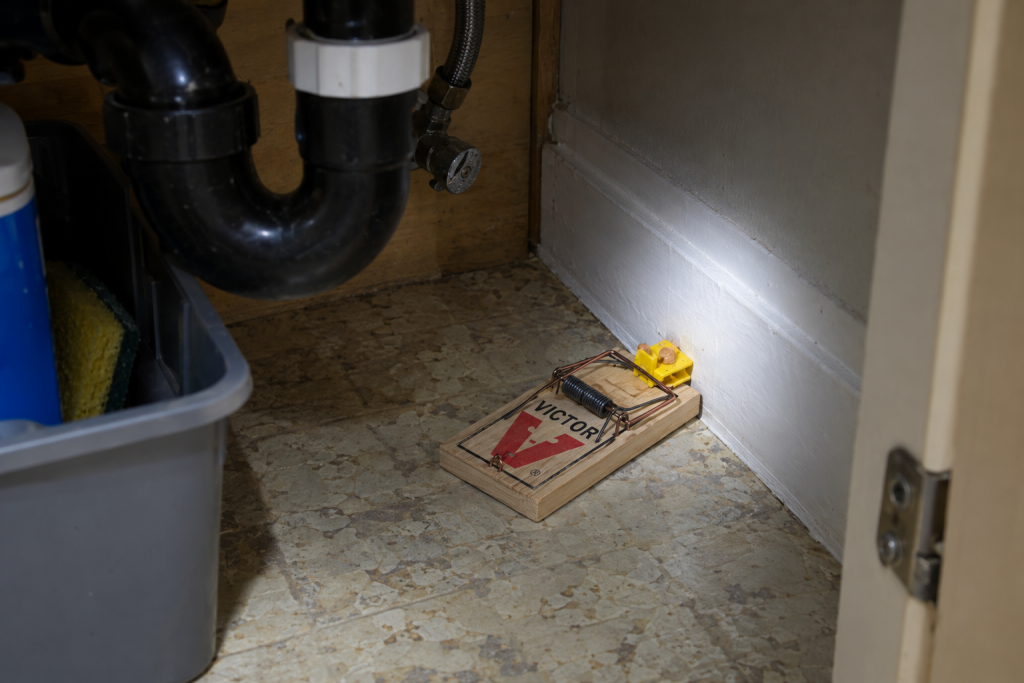
Snap traps for mice work when you place them tight against the wall where mice already run, trigger end facing the wall, with a pea-sized smear of peanut butter pressed into the bait cup. Set six to a dozen traps at once instead of one or two, check them every morning, and most houses are clear within three nights.
Quick steps: set snap traps for mice
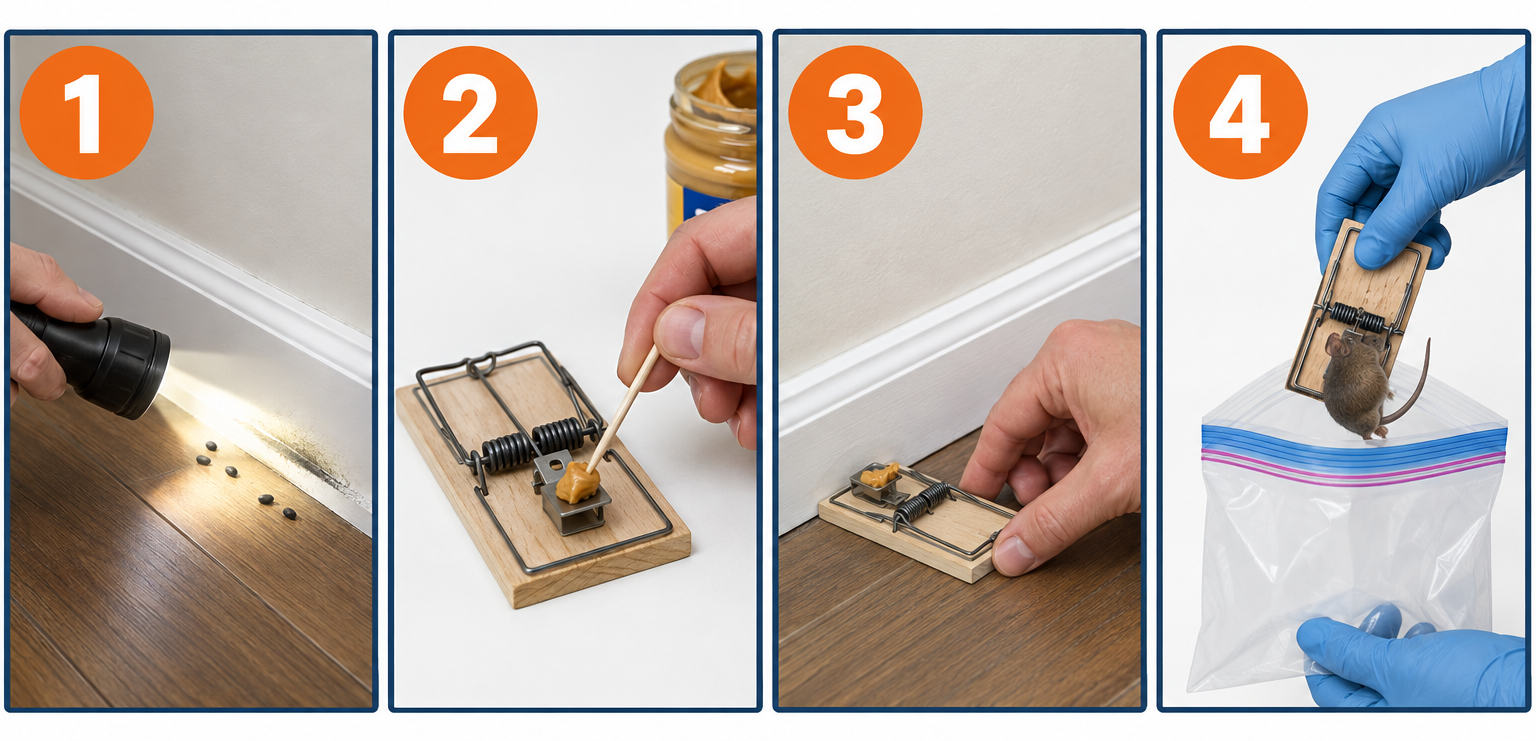
- Find the runways: droppings, rub marks and gnaw damage along walls, under the sink and behind the stove.
- Buy 6-12 traps, either classic wood Victor traps or plastic Tomcat Press ‘N Set style.
- Smear a pea-sized dab of peanut butter into the bait cup, no more.
- Set each trap with the trigger end touching the wall, perpendicular to it.
- Space traps every 2-3 feet along active walls, two in a row at hot spots.
- Check every morning, drop caught mice in a sealed bag, reset with fresh bait.
- Keep trapping until you go 5 straight nights with no catch and no new droppings.
- Seal entry gaps with steel wool and caulk so you never do this again.
Tools and materials
- Mouse snap traps, 6-12 (Victor M325 wood traps or Tomcat Press ‘N Set plastic traps)
- Creamy peanut butter (or hazelnut spread, bacon grease, cotton ball for nesting bait)
- Disposable nitrile gloves
- Flashlight
- Zip-top gallon bags for disposal
- Spray bottle with 1 part bleach to 10 parts water
- Paper towels
- Coarse steel wool (#0 or #1) and silicone caulk for sealing gaps
- Optional: a toothpick or craft stick for baiting
Safety first
Keep fingers clear of the kill bar when you set the trap, and keep set traps out of reach of kids, dogs and cats. Wear gloves to handle traps, dead mice and droppings. Mouse droppings and urine can carry hantavirus and salmonella, so never sweep or vacuum dry droppings; wet them with disinfectant first.
Step 1: Find where the mice actually run
Mice hug walls. They have poor eyesight and navigate by whisker contact, so they follow baseboards, pipe runs and the backs of cabinets instead of crossing open floor. A trap in the middle of the kitchen floor catches nothing.
Take a flashlight and look along the floor-wall seam in the kitchen, pantry, laundry room, utility closet and garage. You are looking for four things:
- Droppings. Mouse droppings are dark, about the size of a grain of rice (roughly 1/4 inch) with pointed ends. Fresh ones are soft and shiny; old ones are dry and gray.
- Rub marks. Greasy dark smudges along a wall or pipe where fur has brushed the same path hundreds of times.
- Gnaw marks. Paired tooth grooves on cardboard, pet food bags, door bottoms or wiring insulation.
- Nesting material. Shredded paper, insulation or fabric packed into a corner or inside a drawer.
Hold the flashlight low and nearly flat to the floor. The raking light shows rub marks and droppings you would miss looking straight down.
The biggest hot spots in most houses are behind the stove and refrigerator, under the kitchen sink where the drain and supply lines come through the wall, around the water heater, behind the washer, and anywhere a dryer duct exits. A loose or damaged clothes dryer vent flap outside is one of the most common mouse doors in a house, so check it while you are at it.
Pick your trap spots now, before you buy anything. Count the active walls and plan on a trap every 2-3 feet along each one. In a typical kitchen plus laundry area that is 8-12 traps. That sounds like a lot for “a mouse,” but you almost never have one mouse, and the first night is when you catch the most. Mice are curious, not cautious, so hit them hard before they get wise to the traps.
Step 2: Choose a snap trap that fits the job
There are two broad types, and both work. Pick based on how you feel about handling them.
Classic wood traps. The Victor M325 and similar wood-base traps are the cheapest option, usually around $1-2 each in multipacks. The expanded plastic trigger version (the yellow “cheese” pedal) is far more sensitive than the old bare metal trigger and is the one to buy. They are not reusable in any practical sense for most people; toss the whole thing with the mouse. Downside: setting them takes a little nerve the first few times, and they can go off on your fingers if you are clumsy.
Plastic “press to set” traps. Tomcat Press ‘N Set, the Victor Power-Kill mouse trap and similar jaw-style traps set by squeezing or pressing a tab, with no exposed spring bar near your fingers. They run roughly $3-5 per trap. You release the mouse by squeezing again, so you never touch it, and you can reuse them for years. They are also easier to set in tight spots like the back of a cabinet.
Skip the bigger rat-sized traps for mice. A mouse weighs under an ounce and often will not depress a rat trigger. Likewise, if you see droppings the size of a raisin (1/2 to 3/4 inch) with blunt ends, you have rats, not mice, and this method changes; see the pro section below.
Glue boards and poison have real drawbacks compared to a snap trap. Glue boards leave the animal alive and suffering, and poison means a mouse dies inside a wall and stinks for two weeks. Snap traps are instant, cheap, and you know exactly what you caught and where.
Step 3: Bait with a pea-sized dab, not a glob
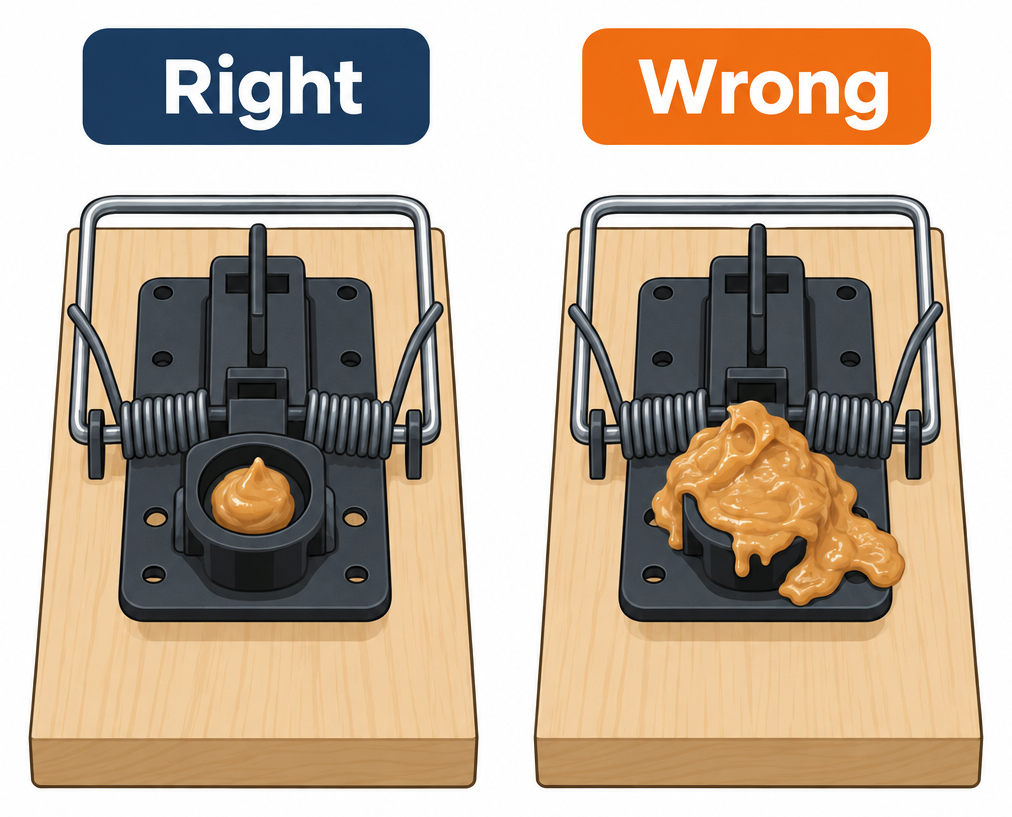
Overbaiting is the number one mistake. A mouse can lick a thick wad of peanut butter off the sides without ever pushing the trigger. You want it to have to work its nose right into the bait cup.
Use a toothpick or the corner of a craft stick to press a dab the size of a pea into the center of the trigger or bait cup. On a wood trap, push it into the little well in the plastic pedal. On a Tomcat or Victor plastic trap, fill the small cup only halfway.
Good baits, in order of reliability:
- Creamy peanut butter
- Hazelnut spread
- Bacon grease or a crumb of cooked bacon tied on with thread
- A cotton ball or short piece of dental floss, tied to the trigger
That last one surprises people. In winter, a female mouse building a nest will pull hard on nesting material, which trips the trap every time. Mix bait types across your traps; if the mice are ignoring peanut butter they will often take the cotton.
Wear your nitrile gloves while baiting. That is for your hygiene, not scent control. House mice live in your kitchen and are not scared of human smell. Gloves matter because you will be handling the same traps after they have been chewing and defecating on them.
Pro tip
If you set traps and get nothing for two nights, do not move them. Instead, leave them baited but unset for two or three nights so the mice learn the trap is a free meal, then set them all on one night. You will often catch several at once.
Step 4: Set and place the traps
Setting a wood trap: Hold the trap by the base with your thumb and fingers well away from the kill bar. Pull the bar back with your other hand, hold it down with your thumb, and lay the locking arm over it. Hook the tip of the arm into the notch on the trigger pedal. Ease your thumb off slowly. If it snaps, no harm done, reset it. If the arm will not stay in the notch, the trigger is set too “hair,” so press the notch slightly deeper onto the arm.
Setting a plastic trap: Press the tab or squeeze the back until it clicks. Done.
Placement is everything. Set the trap perpendicular to the wall with the trigger or bait end touching the baseboard. A mouse running along the wall then hits the trigger head-on whether it comes from the left or the right. A trap set parallel to the wall can go off and throw the mouse clear instead of pinning it.
Along a long active wall, put a trap every 2-3 feet. At the hottest spots, behind the stove or under the sink, set two traps side by side with the triggers facing the wall. A mouse that jumps the first often lands on the second.
Other good spots:
- Inside the base cabinet under the sink, against the back wall near the pipe penetrations
- On top of the water heater or furnace platform
- Along the garage wall behind stored boxes
- On the ledge of the sill plate in the basement or crawlspace
- Inside a drawer or pantry where you found droppings
Lay a sheet of newspaper or a piece of cardboard under traps on nice flooring. Snapped mice sometimes bleed a little, and a trap that goes off can skid a few inches.
Do not set traps in the open where a dog or toddler can reach them. If pets are a problem, put the traps inside a shoebox with a mouse-sized hole cut in the end, or inside a cabinet, or run them only at night in a closed room.
Step 5: Check every morning and reset
Mice are nocturnal, so check traps first thing each morning with gloves on and a zip-top bag in hand.
For a wood trap, drop the whole trap and mouse into the bag, seal it, put it in a second bag and into the outdoor trash. For a reusable plastic trap, hold it over the bag and squeeze to release the mouse, then spray the trap with the bleach solution, wipe, re-bait and reset. Mice are not put off by the smell of a previous mouse. If anything, the scent makes the spot more attractive.
Reset every tripped trap and re-bait any trap that has been licked clean. Peanut butter dries out in two or three days, so refresh it even if nothing has touched it.
Keep a tally. A normal small infestation goes something like 3-4 mice the first night, 1-2 the second, maybe one on the third, then nothing. Keep all traps set and baited until you have five straight nights of no catches and no fresh droppings. That usually means you got them all. Then leave two or three baited traps in place permanently in the garage and under the sink as an early warning.
Pro tip
Put a little flour or baby powder on a piece of cardboard against the wall in a suspect area. Fresh footprints the next morning tell you exactly which walls are still active, so you can move traps where they will catch something.
Step 6: Clean up and seal them out
Once trapping stops, clean every area that had droppings. Wet droppings, nests and urine stains thoroughly with the bleach solution (1 part household bleach to 10 parts water, mixed fresh). Let it sit 5 minutes, then wipe up with paper towels and bag them. Never dry-sweep or vacuum droppings; that puts dust in the air you then breathe. If mice were living in carpet, under a sofa or in an upholstered chair, disinfect first and then steam carpets and fabric to finish the job.
Wash your gloved hands, then your bare hands, with soap and water afterward.
Now find the holes. A mouse fits through any gap about 1/4 inch, roughly the diameter of a pencil. Walk the outside of the house at ground level and check:
- Where the dryer duct, AC lines, hose bibs, cable and gas lines pass through the wall
- Garage door weatherstripping, especially the bottom corners
- Gaps under exterior doors and around the threshold
- Foundation vents and crawlspace doors
- Where siding meets the foundation
Pack any gap with coarse steel wool or copper mesh, then seal over it with silicone caulk or expanding foam so it cannot be pulled out. Mice can chew through plain foam but will not chew steel wool. Replace a chewed door sweep with a new aluminum and rubber sweep (about $10-15). Inside, do the same under the sink and behind appliances where pipes come through drywall.
Finally, take away the food. Pet food and birdseed in sealed plastic or metal bins, no dog bowl left out overnight, crumbs swept behind the toaster. A mouse that has nothing to eat moves on.
Troubleshooting
| Symptom | Likely cause | Fix |
|---|---|---|
| Bait gone, trap not sprung | Too much bait, or old-style metal trigger | Use a pea-sized dab pressed into the cup; switch to expanded plastic trigger traps |
| Traps sprung, no mouse | Trap set parallel to wall, or mouse too light for the trigger | Set perpendicular with trigger at the wall; use mouse traps, not rat traps |
| Nothing touched for 3 nights | Wrong location, or trap-shy mice | Move traps to walls with fresh droppings; pre-bait unset for 2-3 nights |
| Catching every night for over a week | Large population or new mice coming in | Double the trap count; seal entry points now, not later |
| Mouse caught by tail or leg | Trap went off late because bait was on the edge | Center the bait in the cup; use two traps side by side |
| Droppings in a new room | Mice relocating from trapped areas | Follow the droppings and set traps on that wall too |
| Dead-animal smell in a wall | A poisoned mouse, or a trapped one dragged a trap into a gap | Stop using poison; anchor traps with a zip tie or set them inside a box |
When to call a pro
Call a licensed pest control company if you are still catching mice after two weeks of 10 or more traps, if you find droppings in more than three rooms or in the attic, if you see activity in daylight (a sign of heavy numbers), or if the droppings are rat-sized. Rats are trap-shy and need a different approach. Also call a pro if you find chewed wiring, which is a fire risk, and have an electrician check any damaged circuits.
FAQ
How many snap traps for mice do I need?
Plan on 6-12 for a typical house, spaced 2-3 feet apart along the walls where you found droppings. One or two traps almost never clears an infestation, because you catch the boldest mouse the first night and the rest learn to avoid the spot.
What is the best bait for a snap trap?
Creamy peanut butter is the most reliable, but only in a pea-sized dab pressed firmly into the bait cup. Hazelnut spread and bacon grease are close behind. In winter, a cotton ball tied to the trigger catches nesting females that ignore food.
Should I wear gloves so the mice don’t smell me?
Wear gloves, but for your own protection rather than scent. House mice are already living with your smell and do not avoid traps you have touched. Gloves keep droppings, urine and dead mice off your skin.
Do snap traps work better than poison?
For most homes, yes. A snap trap kills instantly and lets you remove the body. Poison often means a mouse dies inside a wall and the smell lasts a week or more, and it puts pets and kids at risk. Save poison for professionals with tamper-resistant bait stations.
How do I know the mice are gone?
Five straight nights with empty traps and no fresh droppings in the areas you cleaned. Leave a few baited traps in the garage and under the sink permanently so you catch the next one before it settles in.
Can I reuse a snap trap after it catches a mouse?
Plastic jaw-style traps like the Tomcat Press ‘N Set are meant to be reused; release the mouse into a bag, spray the trap with bleach solution, wipe and re-bait. Wood traps can be reused, but most people throw the trap away with the mouse because they cost a dollar or two.