
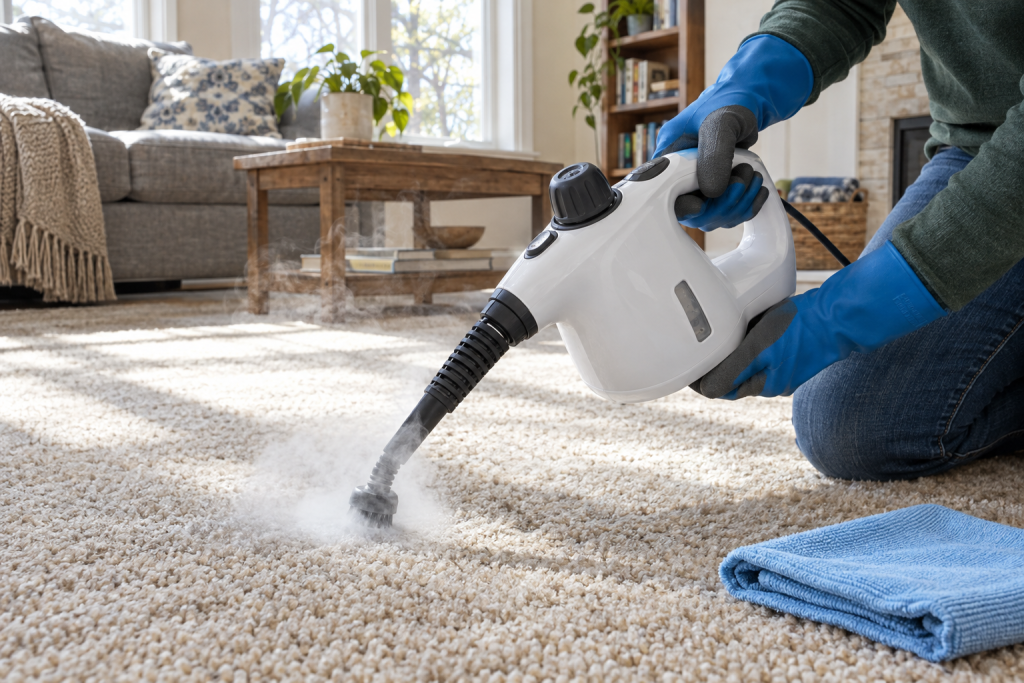
A steam cleaner strips grease, mildew and ground-in grime using nothing but water heated past 200°F, so you can scrub less and skip most chemicals. The method is the same on every surface: heat up, test a hidden spot, work in slow passes, and wipe the loosened dirt away before it dries back on. Carpet is the one exception, where a dry-vapor steamer sanitizes and spot-cleans but a hot-water extractor does the deep clean.
Quick steps: cleaning with a steamer
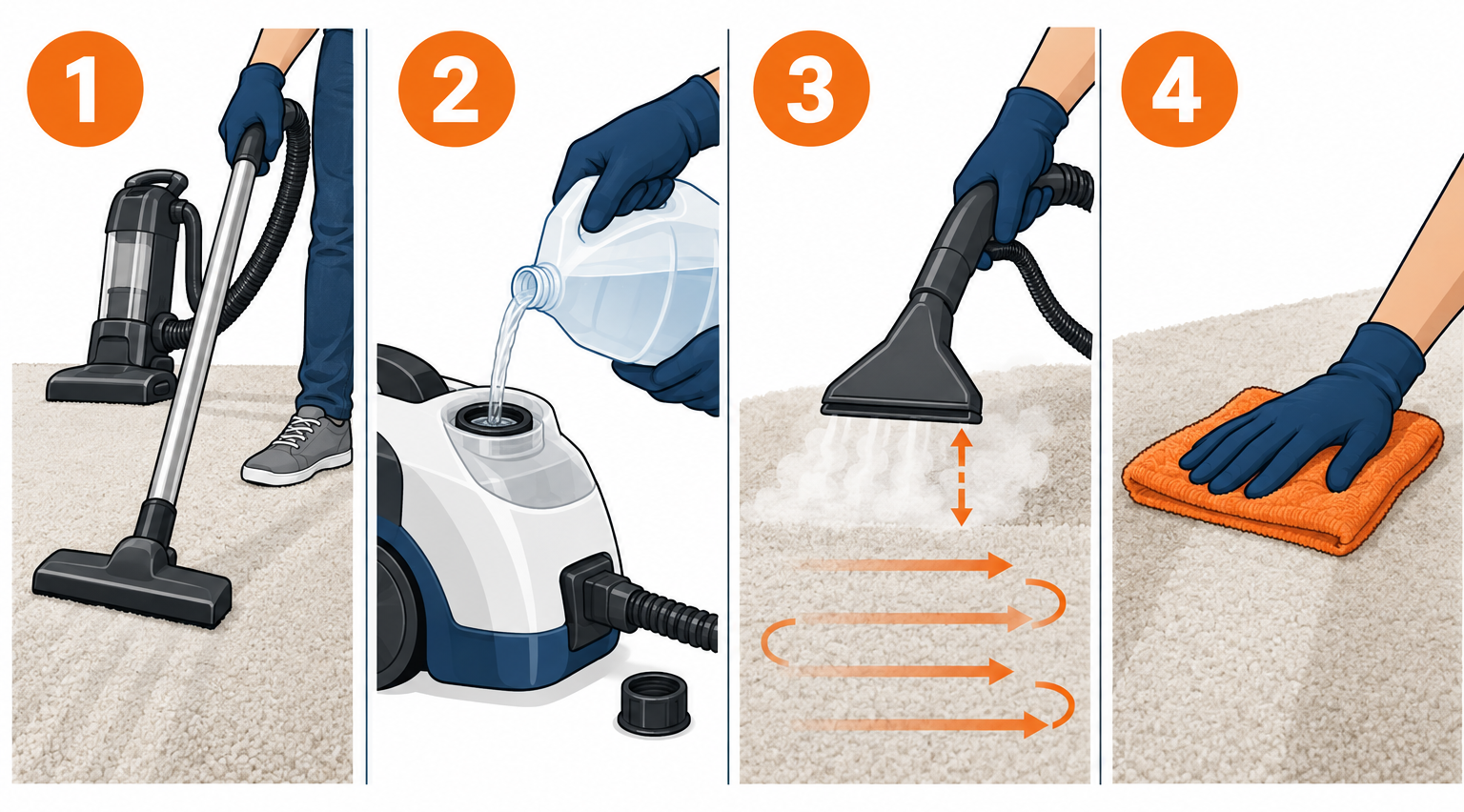
- Vacuum or dust the surface so steam hits grime, not loose debris.
- Fill the tank with distilled water and let it heat 3-10 minutes.
- Test a hidden 2-inch patch and check for marks, lifting or swelling.
- Hold the nozzle 1-3 inches off the surface and move in slow, overlapping passes.
- Wipe each section with a dry microfiber cloth immediately, while the dirt is still wet.
- Let the steamer cool fully, drain the tank, and store it empty.
Tools and materials
- Dry-vapor steam cleaner, handheld (Bissell SteamShot class) or canister (McCulloch MC1275, Dupray Neat class)
- Hot-water carpet extractor, owned or rented (Rug Doctor, Bissell Big Green) for wall-to-wall carpet
- Distilled water, 1 gallon per hour of canister use
- Nylon detail brushes (round, 1 inch) and a brass brush for cast-iron grill grates
- Jet nozzle, squeegee head and triangle floor head with cotton or microfiber pad
- 8-10 microfiber cloths, 16×16 inch
- Plastic scraper for ovens and stovetops
- Box fan or two for drying carpet and upholstery
- Heat-resistant gloves (silicone or leather)
Calculators for this job
Safety first
Steam exits the nozzle above 200°F and will burn skin in under a second, so wear gloves and keep the jet pointed away from you. Never unscrew a pressurized boiler cap, keep steam off outlets, switches and plugged-in appliances, and don’t steam painted surfaces in a pre-1978 home without a lead test.
Step 1: Match the steamer to the job
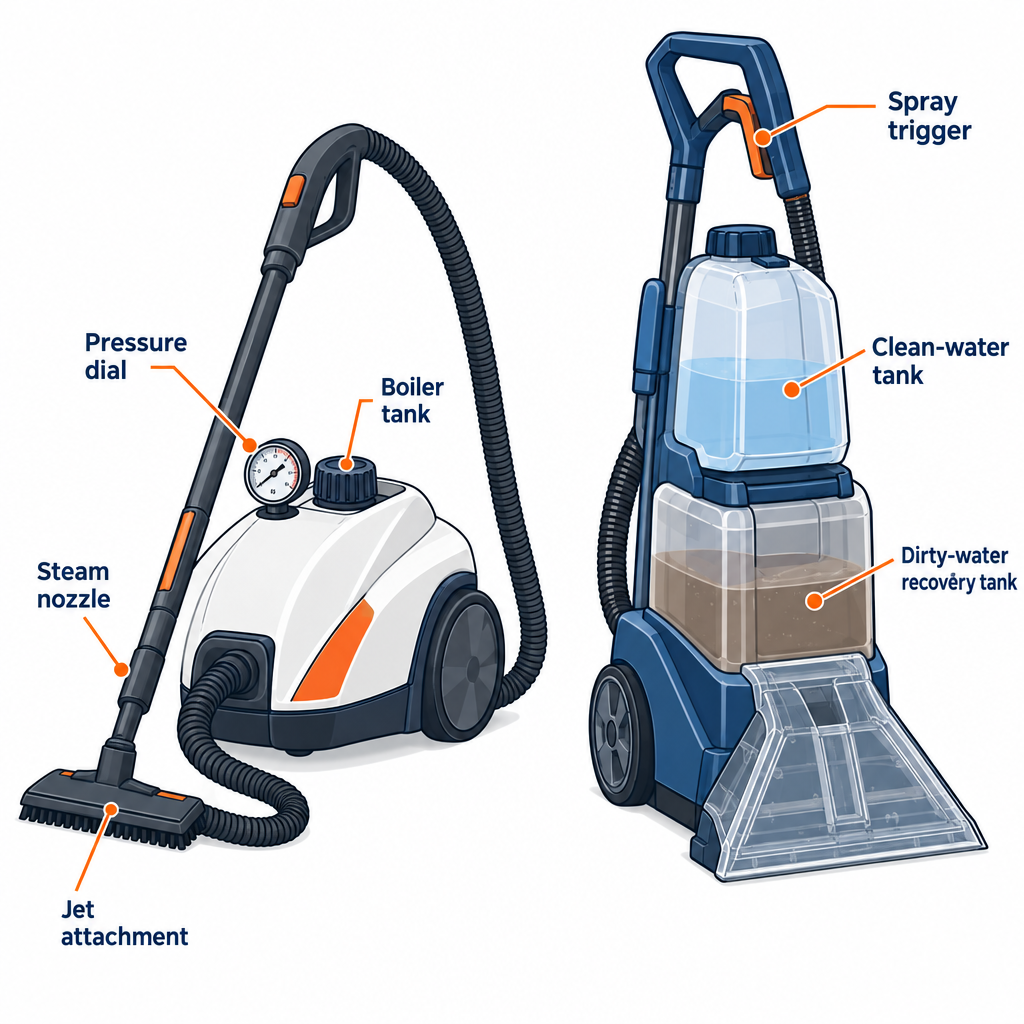
There are two machines sold under the “steam cleaner” name and they do different work. A dry-vapor steamer boils water in a sealed tank and pushes low-moisture steam through a nozzle. It sanitizes, melts grease and loosens dirt, but it doesn’t suck anything up. A carpet “steam cleaner” from Bissell, Hoover or Rug Doctor is really a hot-water extractor: it sprays warm water and detergent into carpet, then vacuums the dirty water back out.
For hard surfaces, upholstery and carpet spot-cleaning, you want the dry-vapor type. Handheld units like the Bissell SteamShot heat in 3-5 minutes, give you 10-15 minutes of steam, and cost about $35-60. A canister steamer with a 1-1.5 liter boiler heats in 8-12 minutes, runs 45-90 minutes on a fill, and holds steadier pressure, which matters on grout and ovens. Expect $150-250 for a decent one.
For wall-to-wall carpet, rent a hot-water extractor from Home Depot, Lowe’s or a grocery store for roughly $27-45 a day plus $15-35 in cleaning solution. If you have pets or kids, buying a mid-range upright extractor at $150-300 pays off within three cleanings.
Skip steam entirely on these: unsealed hardwood, laminate and engineered floors (steam swells the core), silk, velvet and any upholstery tagged “S” or “X” on its care label, wallpaper you want to keep, popcorn ceilings, and cold window glass in winter. Marble, travertine and limestone tolerate quick passes only when they’re freshly sealed, so if water darkens the stone in a hidden spot, don’t steam it.
Step 2: Fill, heat and test
Use distilled water. Tap water leaves mineral scale inside the boiler that clogs the nozzle within a few months, and the manual’s “tap water is fine” line usually comes with a descaling schedule nobody follows. A gallon of distilled runs about $1.50 and covers a full afternoon.
Fill to the marked line, never past it, and screw the cap down until it stops. Plug in, switch on, and wait for the ready light. On a canister unit that’s 8-12 minutes. Set the steam dial to low for fabrics and painted walls, medium for sealed floors and counters, high for grout, ovens and grills.
Before you touch any surface, hold the nozzle away and pulse the trigger for two seconds. The first burst is condensed water, not steam, and it will leave a wet splash on whatever’s in front of it.
Now test. Pick a hidden 2-inch patch, give it the same pass you plan to use, wipe it, and wait five minutes. You’re checking for lifted finish, dulled sheen, swelling, color transfer on the cloth, or a water ring. Any of those means lower the setting, move faster, or stop.
Pro tip
Keep a dry microfiber in your off hand the entire time. Steam loosens dirt but gravity and evaporation put it right back; wiping within 10 seconds of the pass is what actually removes it.
Step 3: Cleaning carpet with a steam cleaner
Cleaning carpet with a steam cleaner means two separate jobs, and most people only do one. The dry-vapor steamer handles spots, odors and sanitizing. The extractor handles the deep soil that makes traffic lanes look grey.
Start by vacuuming slowly in two directions. An extractor pulls out soil that’s wet and loose, not dry grit buried at the base of the pile, so a thorough vacuum pass does half the work. Pretreat traffic lanes and stains with the extractor’s solution and let it sit 10 minutes.
Run the extractor in 3-foot lanes. Pull the trigger on the forward pass only, release it, then pull the machine back over the same lane without spraying to recover water. Do two dry passes for every wet pass. Overlap lanes by 2 inches. When the recovery tank water runs nearly clear, you’re done with that area.
Drying takes 6-12 hours. Point a box fan across the room, keep the HVAC fan on, and stay off the carpet in socks or shoes until it’s dry. Walking on damp carpet drives dirt back in and leaves footprints that set.
For spot-cleaning with the dry-vapor steamer, fit the jet nozzle, hold it an inch above the stain, and steam for 5-10 seconds. Blot immediately with a folded white cloth. Repeat until the cloth comes up clean. This works on coffee, pet urine, mud and most food stains on nylon, polyester and olefin carpet. It also kills dust mites and the bacteria behind pet odor, which an extractor’s lukewarm water doesn’t.
Wool carpet is the exception. Prolonged heat and moisture can shrink the backing and felt the fibers, so limit steam to 3-second bursts and skip the extractor unless the manufacturer rates it for wool.
Pro tip
After extracting, run the machine over the carpet once more with plain hot water and no solution. Leftover detergent is sticky and attracts dirt, which is why freshly cleaned carpet sometimes looks worse within a month.
Step 4: Upholstery and mattresses
Check the tag under the cushion first. “W” means water-based cleaning is fine and steam is safe. “S” means solvent only, and steam will leave rings. “W/S” tolerates light steam on low. “X” means vacuum only.
Use the fabric attachment with a microfiber cover and the lowest steam setting. Hold it 3-4 inches off the fabric and sweep continuously. Never park the nozzle on one spot; that’s how you get a wet patch that dries into a water ring.
Work one cushion at a time and wipe with a dry cloth as you go. Mattresses get the same treatment with a 5-minute dwell per side before you flip and dry. Two hours with a fan and a window open and the fabric is dry enough to use.
Leather is a no. Even on low, steam dries out the finish and can crack it within a year.
Step 5: Ceramic tile and grout lines
This is where a steam cleaner earns its money. Grout is porous, and steam pushes into the pores where a mop can’t reach.
Fit the jet nozzle with a round nylon brush, turn steam to high, and hold the brush half an inch off the grout line. Move about 1 inch per second along the line while scrubbing in short strokes. Dirty water will bead up on the tile beside the grout. Wipe it before it dries or it’ll leave a grey film.
For a floor, work in a 3×3 foot section, do the grout lines first, then switch to the triangle head with a pad and do the tile faces on medium. A 50-square-foot bathroom takes 30-40 minutes.
Grout that’s been sealed within the last year will shed water and clean fast. If grout darkens instantly when steam hits it, the sealer is gone and you should reseal 24 hours after cleaning, once it’s fully dry. Steam is also safe on epoxy grout and on porcelain and ceramic tile, glazed or not.
Step 6: Hardwood, vinyl and cement floors
Sealed hardwood with an intact polyurethane finish handles light steam on low, using the floor head and a microfiber pad, moving at a walking pace. The test is a drop of water: if it beads for a minute, the seal is good. If it soaks in and darkens the wood within 30 seconds, the finish is worn and steam will raise the grain and cup the boards.
Even on sealed hardwood, keep moving. Steam pooling on one spot for 10 seconds can cloud the finish. Most flooring manufacturers void the warranty on any steam use, so this is your call.
Sheet vinyl and glued-down LVP are fine on medium. Click-lock luxury vinyl plank is riskier because steam can migrate into the joints and lift the planks. Use low and move quickly.
Cement and sealed concrete floors in garages and basements take high steam without complaint. Use the floor head without a pad, steam a 4-foot strip, and squeegee the dirty water toward a drain or shop vac it up. Oil stains need a 20-second steam dwell and a stiff brush, and heavy ones won’t fully lift without degreaser.
Step 7: Kitchen surfaces
Stainless steel appliances
Fit the squeegee head or a cloth-covered nozzle on medium. Steam a 2-foot section, then wipe with the grain of the brushed finish using a dry microfiber. Fingerprints, cooking grease and water spots come off without any spray. Avoid the control panel and any display; moisture behind the glass is a service call.
Fridge and freezer
Empty it, pull the shelves and drawers, and turn the thermostat off. Steam the door gaskets with the jet nozzle and a nylon brush, folding each pleat open; this is where mold hides. Do the interior walls on medium, wiping as you go. Shelves go in the sink and get the same treatment. In the freezer, steam melts frost buildup along the back wall in a couple of minutes, so have a towel on the floor.
Oven and stove
Run the oven on high steam with the jet nozzle 1 inch off the surface. Baked-on carbon softens after 15-20 seconds of dwell, then a plastic scraper takes it off in sheets. Do the door glass last, holding steam on the grease haze for 10 seconds, then scraping with a razor at a low angle. Racks come out and get steamed over the sink.
Gas stovetops: pull the grates and burner caps first, steam the enamel surface, and keep steam off the igniters. Glass cooktops take medium steam and a scraper for burnt-on sugar.
Sinks and faucets
The jet nozzle with a nylon brush clears the scale ring at the base of a faucet and the gunk in the drain flange in about a minute each. Steam the aerator from the outside, or unscrew it and steam it in your hand with gloves on. Caulk lines around the sink get a quick pass on low; too much heat softens silicone.
Counters and cupboards
Laminate, quartz and sealed granite are fine on medium with a cloth-covered nozzle. Butcher block only if it’s finished with polyurethane, never oiled. Cabinet doors above the stove collect a sticky grease film; steam on low with a cloth over the nozzle, then wipe immediately. Painted cabinets can soften, so test the inside of one door first. Thermofoil cabinets are off limits because the vinyl face delaminates with heat.
BBQs and grills
Heat the grill for 10 minutes, shut it off, let it cool so the grates are warm but touchable, then steam them on high with a brass brush. Grease liquefies and drips into the catch pan. Porcelain-coated and stainless grates both tolerate this. Do the inside of the lid and the firebox walls the same way, then empty the grease trap.
Step 8: Walls and ceilings
Painted drywall in satin, semi-gloss or eggshell takes a quick pass on low with a cloth-covered head, 6-8 inches off the wall, moving constantly. Flat and matte paint can burnish or show streaks, so test behind a door. This is the fastest way to deal with the grease film on kitchen walls and the handprints around light switches, but turn off the breaker and cover the switch plate before steaming near it.
Wooden paneling with a varnished finish cleans like sealed hardwood: low, fast, and wiped. Raw or oiled wood will raise its grain.
Wallpaper is the one place where steam is a removal tool, not a cleaning tool. A pass that would barely dampen paint will soften wallpaper paste and lift seams. If that’s the goal, a wallpaper steamer plate held 20-30 seconds per section does it.
Ceilings follow the wall rules, with an extension wand and the squeegee head covered in cloth. Keep the tank below you and expect drips, so wear safety glasses. Never steam a popcorn or textured ceiling. The texture sloughs off wet, and in homes built before 1980 that texture may contain asbestos.
Step 9: Drain and store
Unplug and let the unit sit 30 minutes before touching the cap. Pour out the remaining water, and once a month run a cup of white vinegar through a canister boiler, let it sit an hour, then rinse twice. Store the tank empty with the cap loose. A steamer put away full grows mineral scale and a sour smell by the next use.
Troubleshooting
| Symptom | Likely cause | Fix |
|---|---|---|
| Nozzle spits water instead of steam | Not fully heated, or tank overfilled | Wait for the ready light; fill only to the line |
| Weak or pulsing steam | Mineral scale in boiler or nozzle | Vinegar soak, poke the nozzle with a paper clip, switch to distilled |
| Grey streaks on tile after cleaning | Dirty water dried before wiping | Re-steam and wipe within 10 seconds |
| Water rings on upholstery | Nozzle held still, steam too high | Low setting, keep moving, dry with fan |
| Carpet smells musty days later | Over-wet, slow drying | Extra dry passes, fans, dehumidifier under 50% RH |
| Carpet re-soils within weeks | Detergent residue | Rinse pass with plain water |
| Cloudy spots on hardwood | Steam dwelled on worn finish | Stop steaming; buff with finish restorer or refinish |
| Grout looks clean wet, dirty dry | Stains have penetrated unsealed grout | Oxygen bleach paste overnight, then reseal |
| Paint rubbed off wall | Flat paint or steam too close | Low setting, 8 inches away, touch up |
| Grill grates still crusted | Grates too cold | Warm grates for 10 minutes first |
When to call a pro
Call a carpet cleaning company if the carpet has pet urine that’s reached the pad (the smell returns within a week), if wool or antique rugs need cleaning, or if water has been under the carpet for more than 48 hours and the pad smells. Call a flooring contractor if steam has cupped or clouded hardwood. Call an asbestos abatement contractor before touching a textured ceiling in a pre-1980 home, and a lead-safe certified painter before steaming peeling paint in a pre-1978 home.
FAQ
Does a steam cleaner really clean without chemicals?
Yes, for grease, grime, mildew and most food stains. Steam above 200°F dissolves oils and kills the bacteria and mold that cause odors. It won’t remove dye stains like red wine on light carpet, rust, or hard-water scale on glass, which still need a specific chemical.
How often should I steam clean carpet?
Deep-extract high-traffic carpet every 6-12 months, more often with pets or allergies. Spot-steam stains as they happen. Twice a year is the standard recommendation for most homes, and quarterly extraction only makes sense for high-traffic or pet households.
Can I put vinegar or cleaner in the steam cleaner tank?
No. Anything but water corrodes the boiler, damages seals and voids the warranty. Apply cleaners to the surface separately if you need them, then steam.
Is steam safe on sealed granite and quartz?
Quartz is fine on medium. Sealed granite is fine for short passes. If water darkens the granite within a minute in a test spot, the sealer is worn, so reseal before steaming.
Why does my steamer leave the floor wet?
Too much steam on a nonporous surface, or the pad is saturated. Lower the setting, swap the pad every 150 square feet, and move at a steady walking pace rather than scrubbing back and forth.
Will steam kill dust mites and bed bugs?
Dust mites die at 130°F, so a slow pass over a mattress on medium kills them along with their allergen-carrying waste. Bed bugs die at about 120°F, and steam kills what it touches, but eggs tucked in seams survive a quick pass. Steam helps, but an infestation needs a pest control company.