
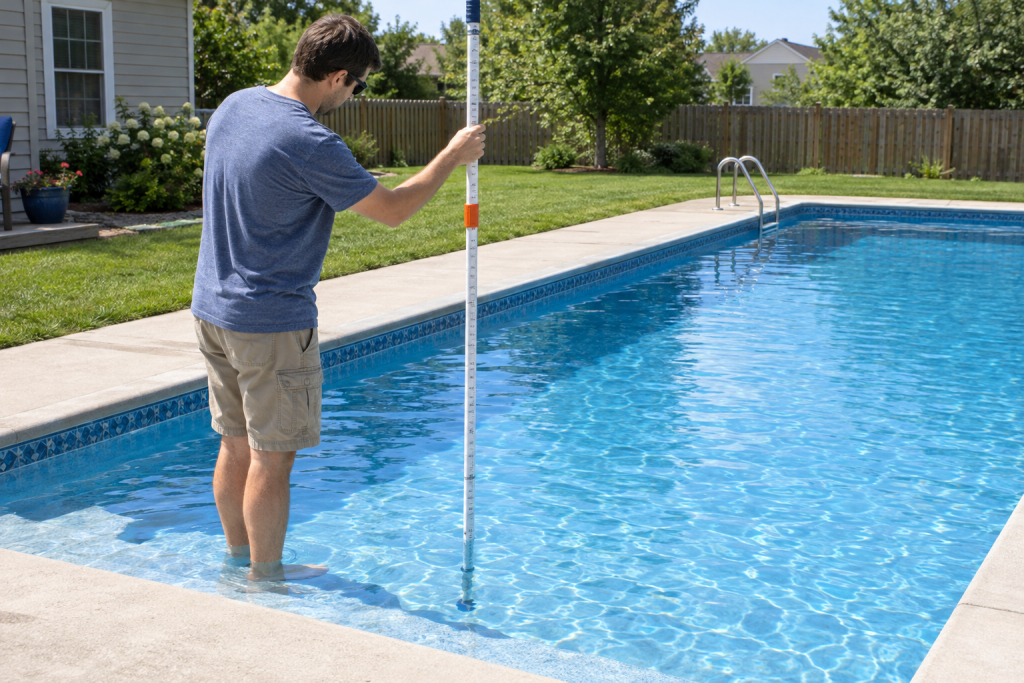
This pool volume calculator turns five numbers into the gallons, liters and cubic feet of water your pool actually holds, so chemical doses, heater sizing and fill costs stop being guesses. You need a tape measure, the length and width of the water (or the diameter for a round pool), and the water depth at the shallow end and the deep end. Pick Rectangle, Round or Oval, enter the measurements in feet, and the answer updates instantly.
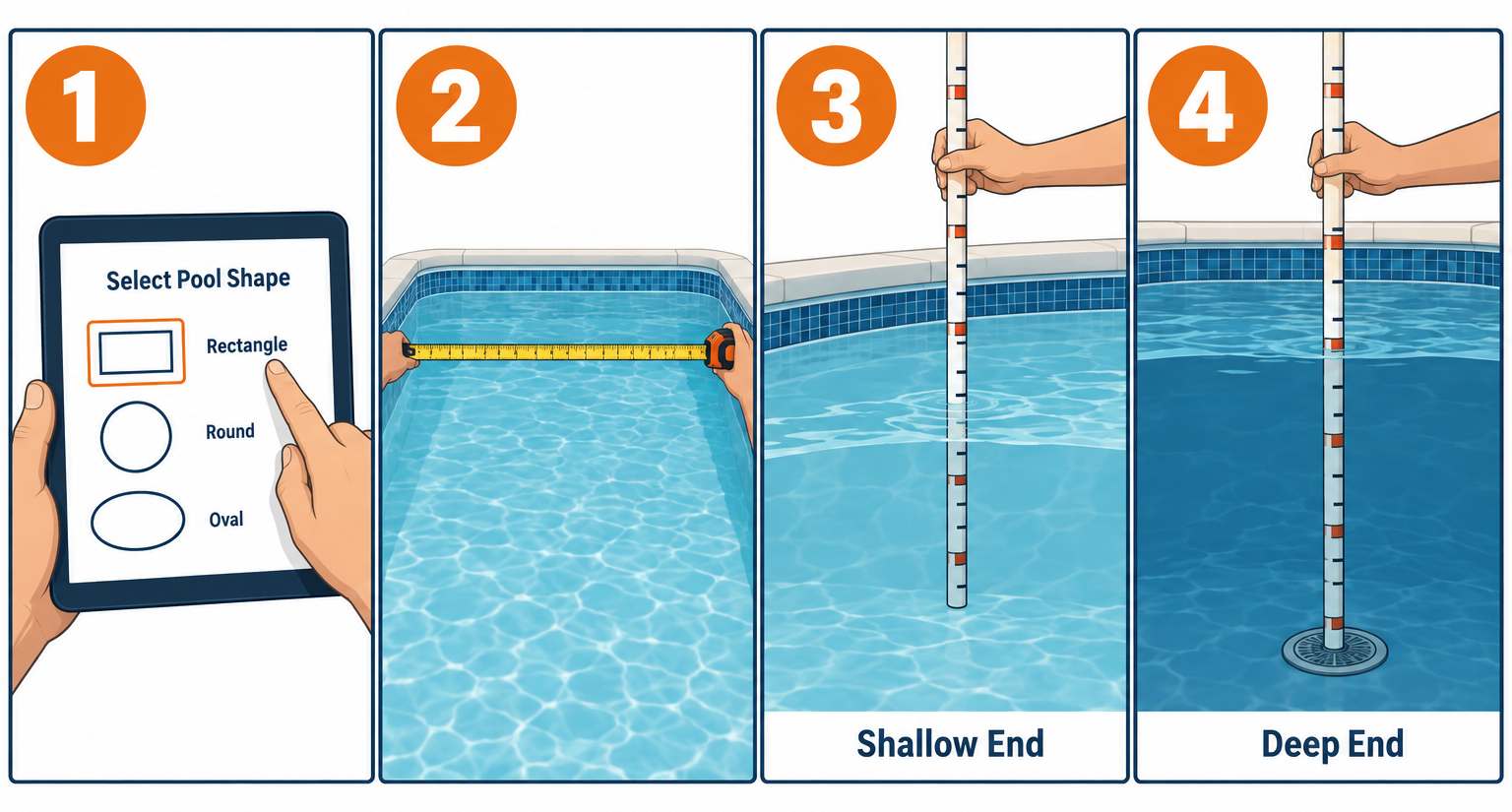
Quick steps: use the pool volume calculator
- Pick the Pool shape that matches your water outline: Rectangle, Round or Oval.
- Measure Length (ft) and Width (ft) at the water line, not the coping or deck.
- Measure Shallow end depth (ft) from the water surface to the floor with a pole.
- Measure Deep end depth (ft) the same way at the deepest usable point.
- Enter decimals for inches (6 in = 0.5 ft, 3 in = 0.25 ft).
- Read the gallons, write it on the pump timer or inside the equipment pad lid.
Tools and materials
- 25 ft or longer tape measure (a 100 ft open-reel tape for large pools)
- Telescoping pool pole with 1 ft marks, or a 10 ft length of 1/2 in PVC marked with tape
- Permanent marker or a label for the equipment pad
- Water meter reading (optional cross-check on a fresh fill)
Safety first
Measure depth from the deck or the top step with a pole. Never lean over the deep end to read a tape, and keep the pump off while you are reaching into the water near the main drain or skimmer.
How to use the pool volume calculator
Each field matters, and the two depth fields cause most of the wrong answers. Here is what every input means and how to measure it properly.
Pool shape
The calculator offers three outlines. Choose the one that matches the water, not the deck.
- Rectangle covers most in-ground vinyl, fiberglass and gunite pools, including ones with rounded corners. Rounded corners cost you less than 2 percent, so ignore them.
- Round is the shape of nearly every above-ground pool and many spas. You enter the diameter in the Length field.
- Oval fits above-ground ovals and many fiberglass shells with pinched ends. Length is the long axis, Width is the short axis.
Kidney and freeform pools are not on the list because no single formula fits them. The fix is in the mistakes section below, and it takes two passes through the calculator.
Length (ft) and Width (ft)
Measure across the water surface, inside edge to inside edge. The brochure size of a pool is almost always the outside of the shell or the deck cut, and it runs 6 to 12 inches larger than the water. A “16 x 32” vinyl liner pool often measures 15.5 by 31.5 at the water line. That difference alone is roughly 550 gallons.
For a round pool, run the tape across the widest point through the center, then take a second reading 90 degrees from the first. If they differ, your pool is slightly out of round. Average the two and enter that in Length (ft).
For an oval, measure the longest straight run end to end for Length and the widest point for Width. Many above-ground ovals are listed by frame size, for example 15 x 30, but hold water at about 14.5 by 29.5.
Shallow end depth (ft)
This is the water depth, not the wall height and not the depth marker tile. Drop a marked pole straight down about 2 ft in from the shallow wall where the floor is flat and read where the water line hits. On a 52 inch above-ground wall the water normally sits 4 to 6 inches below the rim, so the real depth is around 3.8 to 4 ft, not 4.33.
A flat-bottom pool uses the same number for both depth fields. The calculator averages them and gets the same depth back.
Deep end depth (ft)
Measure at the deepest usable point, usually over the main drain. On a sport or play pool with a gentle slope, that reading is the whole story. On a diving pool with a hopper, the deepest reading only covers a small area, and entering it straight overstates the volume. The tip in the formula section shows how to correct for it.
Common measuring mistakes
- Reading the depth off the tile markers. Those are set for the design, not the fill level.
- Measuring to the top of the coping instead of the water surface.
- Entering inches as a decimal the wrong way (3 ft 6 in is 3.5 ft, not 3.6).
- Using the deck or liner size from paperwork instead of the water line.
- Including the tanning ledge area at full width when it holds 10 inches of water.
Pro tip
Scratch the finished gallon figure onto a strip of duct tape and stick it inside the timer box or on the filter tank. Every pool tech who visits will dose from it, and you will not re-measure every spring.
The swimming pool volume calculator formula
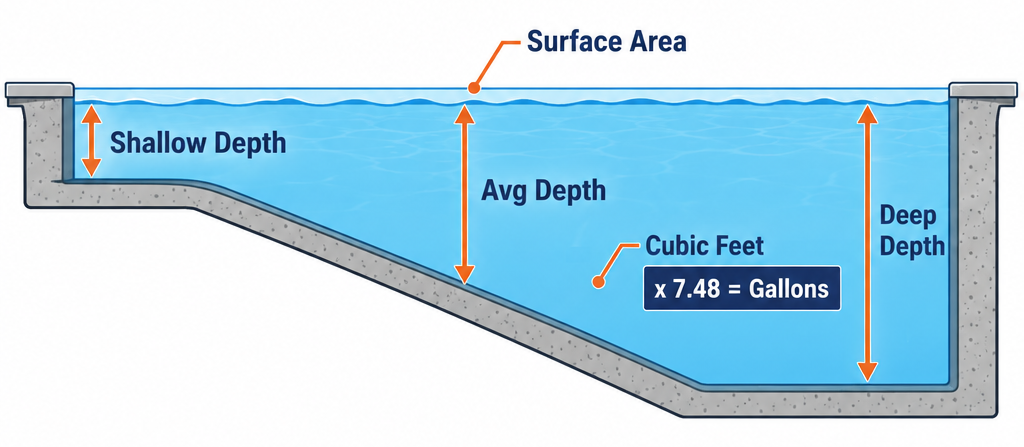
Every result on this page comes from the same four lines of math. Once you can see them, you can check the calculator by hand or run a shape it does not offer.
Average depth = (Shallow end depth + Deep end depth) / 2
Pool floors slope in a straight line between the two ends on most pools, so the simple average of the two depths is the true average over the whole floor.
Surface area by shape:
- Rectangle: Length x Width
- Round: pi x (Diameter / 2)^2
- Oval: pi x (Length / 2) x (Width / 2)
Cubic feet = Surface area x Average depth
Gallons = Cubic feet x 7.48 (one cubic foot of water is 7.48052 US gallons, and the calculator uses the full figure)
Liters = Gallons x 3.785 (one US gallon is 3.78541 liters)
The 7.48 and 3.785 figures are the whole trick. Any volume in cubic feet becomes gallons through that first constant, which is why a “square footage calculator” style area measurement plus one depth number gets you most of the way there.
Worked example with the default inputs
The calculator loads with a Rectangle, Length 32, Width 16, Shallow end depth 3.5 and Deep end depth 6. Walk the formula:
- Average depth = (3.5 + 6) / 2 = 9.5 / 2 = 4.75 ft
- Surface area = 32 x 16 = 512 sq ft
- Cubic feet = 512 x 4.75 = 2,432 cu ft
- Gallons = 2,432 x 7.48052 = 18,193 gallons
- Liters = 18,193 x 3.78541 = 68,867 liters
Those five numbers are exactly what the calculator displays. If you round the constant to 7.48 by hand you get 18,191, which is a two gallon difference nobody doses for.
Second worked example: a 30 x 15 oval
Say you own an above-ground oval sold as 15 x 30, and the water measures 30 ft long by 15 ft wide. The floor is dished, 3 ft at the shallow wall and 5 ft in the center hopper. Choose Oval and enter Length 30, Width 15, Shallow 3, Deep 5.
- Average depth = (3 + 5) / 2 = 4 ft
- Surface area = pi x (30 / 2) x (15 / 2) = 3.1416 x 15 x 7.5 = 353.4 sq ft
- Cubic feet = 353.4 x 4 = 1,413.7 cu ft
- Gallons = 1,413.7 x 7.48052 = 10,575 gallons
- Liters = 10,575 x 3.78541 = about 40,023 liters
Notice the oval holds about 21.5 percent less than a rectangle of the same outside dimensions (30 x 15 x 4 x 7.48 = 13,464 gallons). That is why shape is the first field, and why running an oval as a rectangle wrecks every chemical dose that follows.
Pro tip
On a diving pool with a hopper, drop the pole at the exact midpoint of the pool’s length and read that depth. If the formula’s average is deeper than your midpoint reading, lower the Deep end depth entry until the average matches the midpoint. On a typical 3.5 to 8 ft hopper pool that trims 8 to 12 percent of phantom water.
Pool water volume calculator: quick reference by size
These tables are computed with the same formula and the full 7.48052 constant, so they match what you will see on the page. Depths are water depths.
Rectangular pools
| Water-line size | Surface area | 3.5 to 6 ft (avg 4.75) | 3 to 8 ft (avg 5.5) |
|---|---|---|---|
| 12 x 24 | 288 sq ft | 10,233 gal | 11,849 gal |
| 14 x 28 | 392 sq ft | 13,929 gal | 16,128 gal |
| 15 x 30 | 450 sq ft | 15,990 gal | 18,514 gal |
| 16 x 32 | 512 sq ft | 18,193 gal | 21,065 gal |
| 18 x 36 | 648 sq ft | 23,025 gal | 26,661 gal |
| 20 x 40 | 800 sq ft | 28,426 gal | 32,914 gal |
Round above-ground pools at 4 ft of water
Enter the diameter in Length (ft) and 4 in both depth fields.
| Diameter | Surface area | Cubic feet | Gallons | Liters |
|---|---|---|---|---|
| 15 ft | 176.7 sq ft | 707 | 5,288 | 20,017 |
| 18 ft | 254.5 sq ft | 1,018 | 7,614 | 28,822 |
| 21 ft | 346.4 sq ft | 1,385 | 10,364 | 39,232 |
| 24 ft | 452.4 sq ft | 1,810 | 13,536 | 51,239 |
| 27 ft | 572.6 sq ft | 2,290 | 17,132 | 64,852 |
| 30 ft | 706.9 sq ft | 2,827 | 21,151 | 80,065 |
If your round pool holds 3.75 ft of water instead of 4, multiply the gallon figure by 0.9375. Volume scales straight with depth on a flat-bottom pool.
Buying chemicals and water by the gallon
The whole point of estimating pool volume is that every product label is written per 10,000 gallons. Once you know your number, ordering is arithmetic.
How suppliers list products
- Granular chlorine shock (calcium hypochlorite, 65 to 73 percent) comes in 1 lb bags, cases of 12 or 24, and 25 to 50 lb buckets. Expect $5 to $9 per 1 lb bag at a pool store, less by the case.
- Liquid chlorine (sodium hypochlorite, 10 to 12.5 percent) sells in 1 gallon jugs, 2.5 gallon jugs and 4 gallon cases, typically $3 to $8 per gallon depending on region and supplier. It loses strength within weeks, so do not stockpile a season’s worth.
- Trichlor tablets come in 3 inch pucks sold by weight, in 5 to 50 lb buckets. Prices moved a lot after 2021, so check the current per-pound rate before committing to a 50 lb bucket.
- Pool salt for chlorine generators ships in 40 lb bags at roughly $8 to $15 each, and some yards sell it by the pallet of 50 bags with a delivery minimum.
- Muriatic acid (31.45 percent) is $8 to $14 per gallon and is sold by the gallon or in 2-packs.
Dose table per 10,000 gallons
Scale these by your calculator result. For the default 18,193 gallon pool, multiply every dose by 1.82.
| Product | Dose per 10,000 gal | Effect |
|---|---|---|
| Cal-hypo shock, 65 percent | 1 lb | Raises free chlorine about 7.8 ppm |
| Liquid chlorine, 12.5 percent | 10 fl oz | Raises free chlorine about 1 ppm |
| Dichlor, 56 percent | 1 lb | Raises free chlorine about 6.6 ppm and adds 5 ppm CYA |
| Pool salt | 83 lb | Raises salt about 1,000 ppm |
| Sodium bicarbonate | 1.4 lb | Raises total alkalinity about 10 ppm |
| Cyanuric acid (stabilizer) | 13 oz by weight | Raises CYA about 10 ppm |
Rounding up matters more with salt than anything else. To bring the default pool from 0 to 3,200 ppm you need 18,193 x 8.34 lb per gallon x 0.0032, which is 485 lb, or thirteen 40 lb bags with a few pounds spare. Buy thirteen, not twelve, because the generator will not fire below its low-salt cutoff and you will be back at the store.
With chlorine, buy 10 percent extra over the calculated shock dose. Breakpoint chlorination on green water burns through more than the label suggests, and the article on “shock in pool” walks the dosing in detail. With acid, buy less than you think and add in two rounds. Overshooting pH down is far more expensive to correct than coming up short.
Water delivery and fill cost
Municipal water is billed per 1,000 gallons or per hundred cubic feet (748 gallons). Rates vary by city, but $4 to $10 per 1,000 gallons covers most of the US, so filling the default pool from a hose runs about $75 to $185 before sewer charges. Ask your utility about a pool-fill credit; many will waive the sewer portion once per year if you call first.
Trucked water is sold by the load. A standard tanker typically carries around 6,000 gallons, though haulers run trucks anywhere from 2,000 to 8,000 gallons, and a load typically costs $200 to $600 depending on distance from the fill station. Divide your calculator result by the truck capacity and round up: the 18,193 gallon pool is three full loads with the hose topping off the last foot. Have the hauler bring one load short rather than one over, since the spill goes in your yard.
Mistakes that leave you short or over-buying
Most volume errors come from the input, not the math. These are the ones that show up in service calls.
- Treating the deck size as the water size. A 20 x 40 deck cut usually holds a 19 x 39 water line, which is 5 percent less water and a full pound of shock difference on a big dose.
- Entering wall height as depth. Above-ground pools with 52 inch walls hold about 46 to 48 inches of water. Entering 4.33 ft instead of 3.9 ft adds roughly 10 percent to every dose.
- Running a kidney pool as a rectangle. Measure the longest length, then the width at the wide lobe and the narrow lobe. Run the calculator twice as Oval, once with each width, and average the two results. That lands within 5 percent of the industry kidney formula.
- Ignoring the hopper. Covered in the tip above; it adds 8 to 12 percent of water that is not there.
- Forgetting attached spas and spillover ledges. A 7 ft round spa at 3 ft deep is 864 gallons. Run it as a separate Round calculation and add it if the spa shares the pool’s water.
- Counting the tanning ledge at full depth. Measure the ledge as its own rectangle at 0.8 ft and the main pool without it, then add.
- Rounding depth to whole feet. A half foot on a 512 sq ft pool is 1,915 gallons.
Cross-checking your answer
Two field checks catch bad inputs. On a fresh fill, read your water meter before and after; the difference in cubic feet times 7.48 is your volume to within a few percent. On an existing pool, test free chlorine, add a measured amount of 12.5 percent liquid chlorine, circulate for an hour and retest. If 20 fl oz raised a pool by 1 ppm, the pool holds about 20,000 gallons. A result more than 15 percent off the calculator means you measured the wrong thing, almost always the depth.
When to call a pro
If your pool has an irregular floor with multiple benches, a vanishing edge trough, or an in-floor cleaning system with large plumbing volume, hire a pool service company to meter a drain-and-fill or dose-test the volume. A heater or chlorine generator sized off a bad volume figure is a warranty and permit problem you do not want.
FAQ
How do I calculate my pool volume?
Measure the length and width of the water in feet, measure the shallow and deep end water depths, and run the numbers: average depth times surface area times 7.48 gives gallons. For a 16 x 32 pool that is 3.5 ft shallow and 6 ft deep, that is 4.75 x 512 x 7.48, or about 18,193 gallons. The calculator above does the arithmetic and converts to liters.
How many gallons is a 40×20 pool?
A 20 x 40 rectangle with 3.5 and 6 ft depths holds 28,426 gallons. With a 3 ft shallow end and 8 ft deep end it holds 32,914 gallons. If your 40 x 20 is the deck size, measure the water line, since it is probably closer to 19 x 39 and about 1,400 gallons less.
What is the volume of a 16×32 pool?
With the common 3.5 to 6 ft depth profile, a 16 x 32 pool holds 18,193 gallons, 68,867 liters, or 2,432 cubic feet. A 3 to 8 ft diving profile holds 21,065 gallons, and a flat-bottom version scales straight with whatever depth you measure.
How many gallons is my 15×30 pool?
If it is a 15 x 30 rectangle at 3.5 to 6 ft, 15,990 gallons. If it is a 15 x 30 oval above-ground at 4 ft of water, it is pi x 15 x 7.5 x 4 x 7.48, which is 10,575 gallons. Check which shape you have before dosing, because the two answers differ by more than 5,000 gallons.
Does a volume of a swimming pool calculator work for above-ground pools?
Yes. Pick Round, enter the diameter in Length (ft), and enter the water depth in both depth fields. A 24 ft round pool with 4 ft of water holds 13,536 gallons. Measure the water depth, not the wall height.
How do I use a calculator for pool volume on a kidney-shaped pool?
Run it twice as Oval using the longest length each time, once with the wide-lobe width and once with the narrow-lobe width, then average the two gallon figures. For most kidney pools that lands within 5 percent of the true volume, which is tighter than the accuracy of a chemical test kit.
Why does my pool volume calculator result not match the number my pool builder gave me?
Builders usually quote the design volume off the plans at the full design depth, and some round up to the next 1,000 gallons for heater sizing. Your water line is lower than the design elevation and your deck cut is larger than the water. A 5 to 10 percent difference is normal; more than that means one of you measured depth wrong.
How many liters is my pool?
Multiply gallons by 3.785. The default 18,193 gallon pool is 68,867 liters. If you buy chemicals labeled per 10,000 liters, divide your liter figure by 10,000 and multiply the label dose by that.
Can I size a pool heater or pump from this volume?
Pump sizing uses volume: a residential pool should turn over its full volume in 8 to 10 hours, so divide gallons by 480 to 600 to get the gallons per minute you need. For the default pool that is 30 to 38 gpm. Heater sizing uses surface area more than volume, since heat loss happens at the surface, so note the Surface area figure the calculator reports as well.