
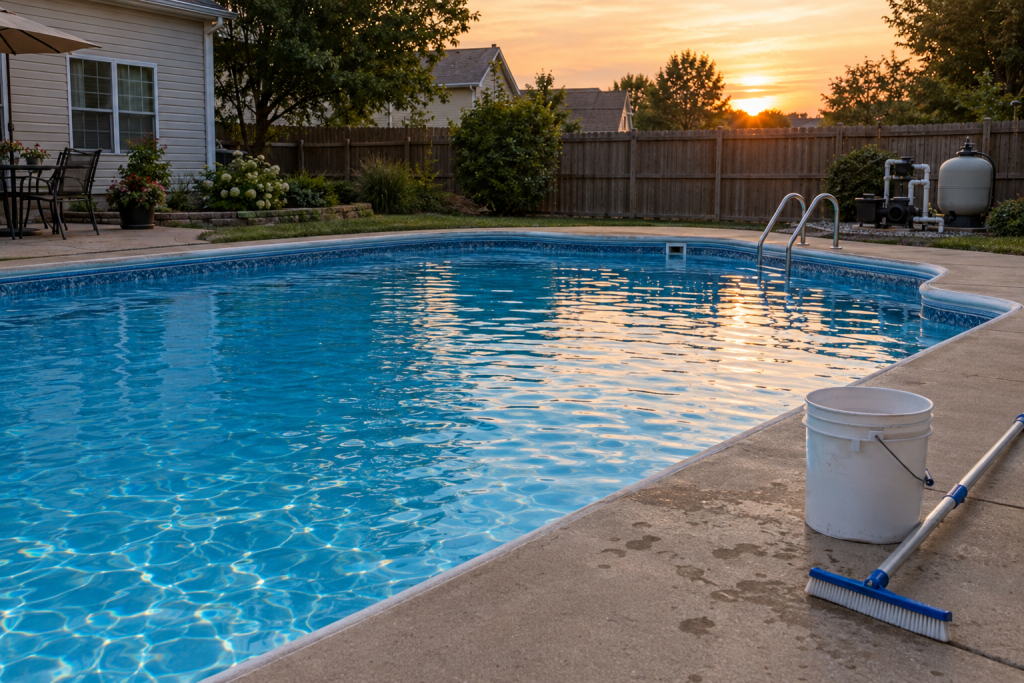
To shock a pool, you raise free chlorine to roughly 10 ppm (higher if your stabilizer is high) by adding about 1 pound of calcium hypochlorite or 1 gallon of 12.5% liquid chlorine per 10,000 gallons, at dusk, with the pump running. Then you circulate for 8 to 24 hours and swim once free chlorine tests at 5 ppm or less. The whole job takes about 30 minutes of hands-on work and one overnight wait.
Quick steps: shock a pool
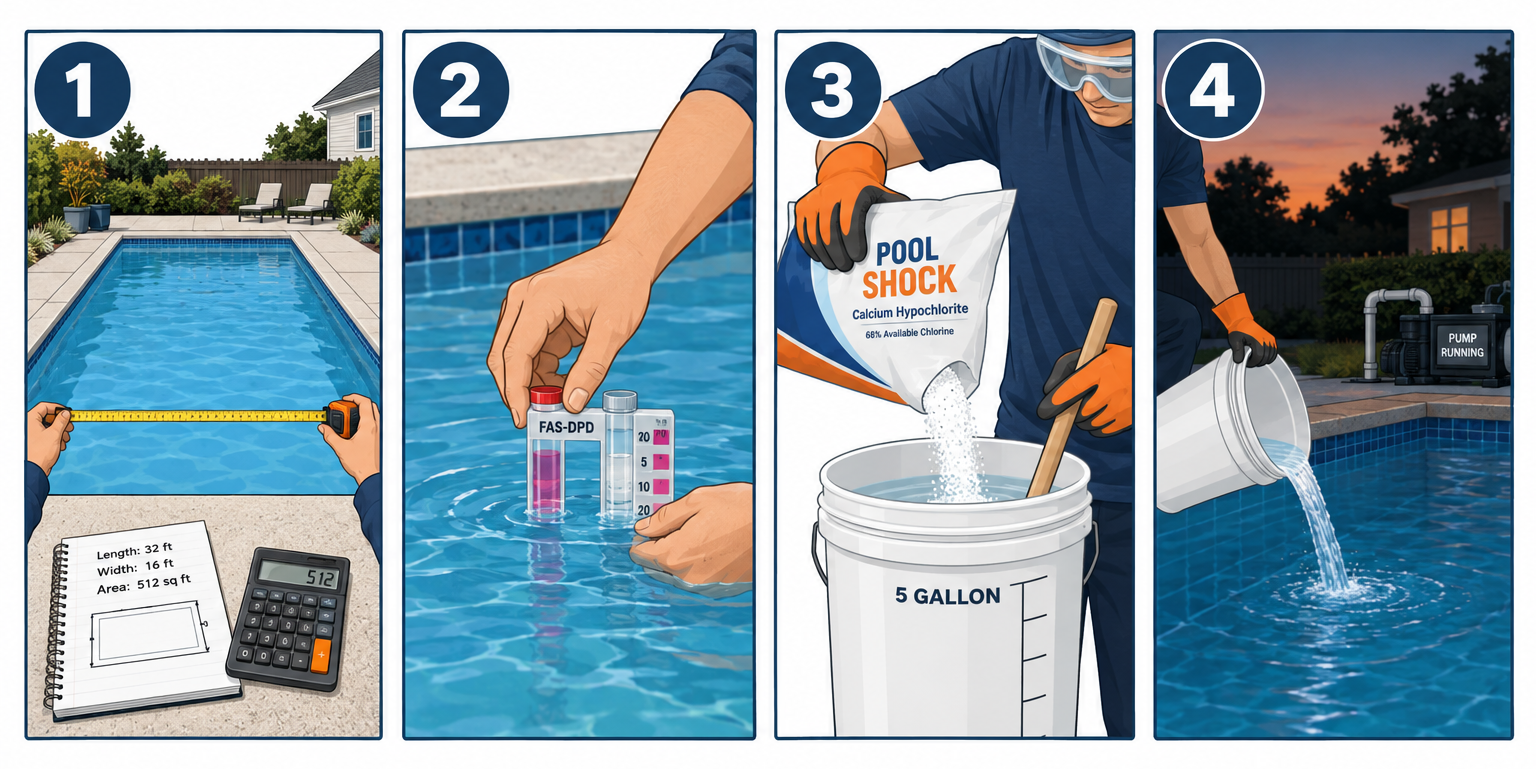
- Calculate your pool volume in gallons.
- Test free chlorine, combined chlorine, pH and cyanuric acid.
- Pick a shock type and work out the dose for a 10 ppm rise (or 40% of your CYA reading).
- Brush walls, empty skimmer baskets, adjust pH to 7.2-7.4, start the pump.
- Pre-dissolve granular shock in a bucket of pool water, or pour liquid directly, walking the deep end at dusk.
- Run the filter overnight, retest in the morning, swim when free chlorine is 5 ppm or less.
Tools and materials
- Pool shock: calcium hypochlorite 65-73% (1 lb bags), or 12.5% liquid chlorine (sodium hypochlorite), or sodium dichlor 56% for stabilizer-poor pools
- FAS-DPD test kit (Taylor K-2006 or equivalent) for reading chlorine above 10 ppm
- 5-gallon plastic bucket, dedicated to pool chemicals only
- Wooden paint stir stick or a clean plastic paddle
- Chemical splash goggles and nitrile or rubber gloves
- Pool brush on a telescoping pole (nylon for vinyl, stainless for plaster)
- Muriatic acid (31.45%) or dry acid, for lowering pH beforehand
- Tape measure, for calculating volume the first time
- Kitchen scale, if your shock comes in a tub rather than pre-weighed bags
Calculators for this job
Safety first
Wear goggles and gloves, stand upwind, and never add water to shock. Always add shock to water. Never mix calcium hypochlorite with dichlor, trichlor tablets or any other chemical, including residue in a scoop or bucket, because the combination can ignite or release chlorine gas. Keep the skimmer and any in-line chlorinator holding tablets out of the shock path entirely.
Step 1: Work out how many gallons you’re treating
Every dose on a shock label is per 10,000 gallons, so a wrong volume means a wrong dose. Measure once, write the number on the inside of the equipment pad door, and you never do it again.
Measure length and width in feet, then average the depth. For a pool that slopes from 3 feet to 8 feet, the average is 5.5 feet, not the deep end number.
Use the multiplier that matches your shape:
| Pool shape | Formula | Example |
|---|---|---|
| Rectangle or square | Length x Width x Average depth x 7.5 | 32 x 16 x 5.5 x 7.5 = 21,120 gal |
| Round | Diameter x Diameter x Average depth x 5.9 | 24 x 24 x 4 x 5.9 = 13,594 gal |
| Oval | Long axis x Short axis x Average depth x 6.7 | 30 x 15 x 4.5 x 6.7 = 13,568 gal |
| Kidney or freeform | (Widest width + Narrowest width) x Length x Average depth x 3.8 | (20 + 12) x 36 x 5 x 3.8 = 21,888 gal |
Round down to the nearest thousand for dosing. Underdosing slightly and adding a second round is cheap. Overdosing by 30% because you guessed the depth wrong just wastes money and extends the swim wait.
Above-ground pools are easier. A 24-foot round above-ground with 52-inch walls holds about 13,500 gallons filled to the skimmer line, and most manufacturers print the capacity in the manual.
Step 2: Test the water and set your target chlorine level
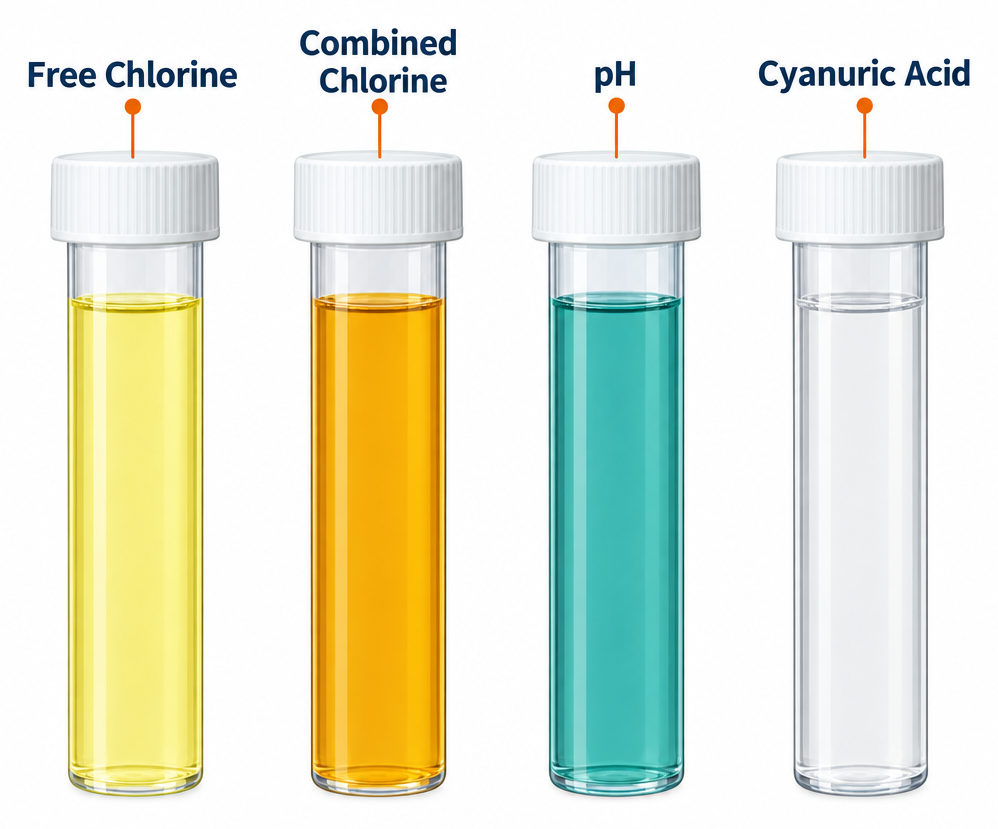
Shocking blind is the most common mistake in pool care, right ahead of shocking at noon. Four numbers tell you whether you need to shock and how far you need to push the chlorine.
Free chlorine (FC) is the active sanitizer. Combined chlorine (CC) is chlorine that has already attached itself to sweat, urine, sunscreen and dead algae. Those chloramines are what cause the “pool smell” and burning eyes. A healthy pool reads 0 to 0.2 ppm CC. Anything above 0.5 ppm is a shock trigger.
pH needs to sit at 7.2 to 7.4 before you shock. At pH 7.2 about 65% of your chlorine exists as hypochlorous acid, the form that actually kills things. At pH 8.0 that drops to about 22%. Same dose, a third of the killing power. Lower pH first with muriatic acid, run the pump 30 minutes, retest.
Cyanuric acid (CYA) is stabilizer, and it changes your target. CYA shields chlorine from sunlight, but it also slows chlorine down. The higher your CYA, the higher you have to push FC for the shock to do anything.
| CYA reading | Shock target (free chlorine) | Notes |
|---|---|---|
| 0 ppm (fresh fill, indoor pool) | 10 ppm | Chlorine burns off fast in sun, so shock at night |
| 30 ppm | 12 ppm | Ideal range for most outdoor pools |
| 40 ppm | 16 ppm | |
| 50 ppm | 20 ppm | Common ceiling for well-managed pools |
| 70 ppm | 28 ppm | Heavy trichlor tablet users land here |
| 90 ppm or higher | 36 ppm and up | Drain and refill part of the pool first, shocking is nearly futile |
That rule of thumb, shock level equals about 40% of CYA, is what separates a shock that clears algae from one that just wastes a bag. If your CYA is 100 ppm from years of trichlor pucks, dumping in one pound per 10,000 gallons gets you nowhere. Replace a third of the water, bring CYA down to 40 or 50, then shock.
A note on test strips: most strips max out at 10 ppm free chlorine, so they cannot tell you whether you hit 16 or 20. Yellow OTO drop kits bleach out at high levels and read falsely low. An FAS-DPD kit counts drops, each drop equals 0.5 ppm (0.2 ppm on the small sample), and it reads accurately up to 50 ppm. If you own a pool, you should own one. Also test CC when you test FC; FAS-DPD gives you both.
Pro tip
Before buying shock, do an overnight chlorine loss test. Test FC after sunset, then again before sunrise with no swimmers in between. A drop of 1 ppm or less means your water is clean and you don’t need to shock at all. A drop of 2 ppm or more with no sun means something in the water is eating chlorine, and shocking is the fix.
Step 3: Choose the right type of shock and calculate the dose
“Shock” is a dose, not a product. Any chlorine source added in a large enough quantity to hit your target shocks the pool. Whether the bag says shock it, super shock, burn out or power shock, flip it over and read the active ingredient line. That tells you what you’re actually buying.
| Shock type | Active ingredient | Strength | Dose for +10 ppm per 10,000 gal | Side effects | Best for |
|---|---|---|---|---|---|
| Cal-hypo granular | Calcium hypochlorite | 65-73% available chlorine | 1.25 lb (1 lb raises FC about 7.8 ppm) | Adds about 7 ppm calcium hardness per lb per 10,000 gal, raises pH slightly, clouds water briefly | Plaster and gunite pools, algae outbreaks, the default choice |
| Liquid chlorine | Sodium hypochlorite | 10-12.5% | 0.8 gal (1 gal of 12.5% raises FC about 12 ppm) | Adds a little salt, no calcium, no stabilizer, no cloudiness, loses strength in storage | Vinyl liners, fiberglass, salt pools, anyone who shocks often |
| Dichlor granular | Sodium dichloro-s-triazinetrione | 56-62% | 1.5 lb (1 lb raises FC about 6.7 ppm) | Adds about 9 ppm CYA per 10 ppm FC, slightly acidic, dissolves fast | New fills with zero CYA, hot tubs, above-ground pools with low stabilizer |
| Non-chlorine shock | Potassium monopersulfate (MPS) | Not chlorine | 1 lb (oxidizes contaminants, does not raise FC) | Swim 15 minutes after, raises sulfates over time, no algae kill | Weekly maintenance oxidizing, indoor pools, spas, pools used nightly |
A few judgment calls, since the label won’t make them for you.
If you have algae, use chlorine. Non-chlorine shock oxidizes sweat and oils but does not kill algae or bacteria. It’s a maintenance product, not a rescue product.
If your calcium hardness is already above 400 ppm, skip cal-hypo. Every pound you add bumps hardness, and high calcium is what leaves scale on tile lines and clouds the water. Use liquid chlorine instead.
If your CYA is already 50 or higher, never use dichlor. It will creep CYA past the point where chlorine works, and the only fix is draining.
If your pool is a vinyl liner above-ground, liquid chlorine or pre-dissolved cal-hypo only. Undissolved cal-hypo granules sitting on vinyl bleach white spots into the liner in about 20 minutes.
On cost, liquid chlorine is usually cheapest per ppm. At typical pool-store pricing in the $5 to $8 per gallon range, you’re paying well under a dollar for each ppm of free chlorine in a 10,000-gallon pool. One-pound cal-hypo bags run roughly $5 to $8 each, so a 20,000-gallon pool needs about 2 pounds, or roughly $10 to $16 of shock, to reach 10 ppm. Dichlor costs more per ppm and carries the CYA penalty. Buy cal-hypo in 1-pound bags rather than a bucket unless you have a dry, cool, detached place to store it. An opened bucket in a humid shed loses strength and becomes a fire risk.
Example dose calculation
Say you have 18,000 gallons, CYA at 40, FC at 1 ppm, CC at 1.2 ppm. Your shock target is 16 ppm, so you need a 15 ppm rise.
With 65% cal-hypo: 15 ppm divided by 7.8 ppm per pound, times 1.8 (for 18,000 gallons) equals about 3.5 pounds. Round to 3.5 or 4 one-pound bags.
With 12.5% liquid: 15 ppm divided by 12 ppm per gallon, times 1.8, equals about 2.25 gallons.
Shock dosing by pool size
For a 10 ppm rise in free chlorine. Scale up proportionally if your CYA table target is higher.
| Pool volume | Cal-hypo 65% | Liquid chlorine 12.5% | Dichlor 56% |
|---|---|---|---|
| 5,000 gal | 10 oz (about 2/3 lb) | 1.6 quarts | 12 oz |
| 10,000 gal | 1.3 lb | 3.2 quarts (0.8 gal) | 1.5 lb |
| 15,000 gal | 1.9 lb | 1.2 gal | 2.25 lb |
| 20,000 gal | 2.6 lb | 1.6 gal | 3 lb |
| 25,000 gal | 3.2 lb | 2 gal | 3.75 lb |
| 30,000 gal | 3.9 lb | 2.4 gal | 4.5 lb |
These numbers assume fresh product. Liquid chlorine loses roughly half its strength in six months in a hot garage. A bag of cal-hypo that has gone hard and clumped has absorbed moisture and lost potency. When in doubt, dose, test after two hours, and add more.
Step 4: Prep the pool so the shock can actually work
Chlorine only kills what it can reach. Ten minutes of prep roughly doubles the effectiveness of the dose.
Brush everything. Walls, floor, steps, the tile line, behind ladders, around light niches, inside the skimmer throat. Algae grows a slime layer that chlorine has to burn through. Brushing exposes it. Use a stainless brush on plaster or concrete, nylon on vinyl and fiberglass.
Skim and empty baskets. Leaves and bugs in the skimmer basket and pump basket are organic load. Every leaf consumes chlorine that should be going after what’s in the water.
Backwash or clean the filter if the pressure gauge is 8 to 10 psi over its clean reading. A dirty filter can’t catch the dead algae the shock is about to produce, and the pool stays cloudy for days.
Lower pH to 7.2-7.4. For a 20,000-gallon pool, roughly 20 to 25 ounces of 31.45% muriatic acid drops pH from 7.8 to 7.4. Pour it slowly into the deep end with the pump running, wait 30 minutes, retest. Cal-hypo nudges pH upward, so starting low keeps you in range through the treatment.
Turn off the salt generator, automatic chlorinator and any ozone or UV system. You’ll be measuring chlorine manually tonight, and tablet feeders cannot be anywhere near cal-hypo.
Pull off the solar blanket and keep it off until FC drops back below 5 ppm. High chlorine eats the bubble plastic, and the cover traps the chlorine gas that off-gasses during shocking.
Set the pump to run continuously, on filter, not recirculate. You want 100% of the water passing through the filter media to collect the dead material.
Wait for sunset, or at least for the pool to be in full shade. UV from direct sun destroys about half of unstabilized chlorine within an hour or two. Shocking at 2 p.m. in July throws away most of your dose before it does any work. Dusk gives the chlorine 10 to 12 hours of darkness to kill, then the sun burns down the excess so you can swim sooner.
Pro tip
If you’re fighting algae, vacuum to waste before shocking rather than after. Set the multiport valve to Waste, vacuum the loose algae straight out of the pool, then refill and shock. You remove most of the organic load before the chlorine ever meets it, and the dose goes much further.
Step 5: Add the shock the right way
The method depends on whether you’re using granular or liquid.
Granular cal-hypo or dichlor
Fill a clean 5-gallon bucket about two-thirds full with pool water. Put your goggles and gloves on now. Add one pound of shock to the water, never the other way around, and stir with a wooden stick until the granules dissolve. Cal-hypo takes 2 to 5 minutes in warm water and up to 10 in water below 65°F. A little white residue at the bottom is inert calcium and is normal.
Walk the perimeter and pour the solution slowly in front of a return jet in the deep end, so the current carries it across the pool. Repeat for each pound. Rinse the bucket in the pool when you’re done, then turn it upside down somewhere it won’t be used for anything else.
Only pour the sediment if your pool is plaster. On vinyl or fiberglass, leave the last inch in the bucket and dump it in the grass away from anything you care about. If any granules do land on the floor, brush them off the surface immediately.
Broadcasting dry granules straight into the deep end is fine for plaster pools in a pinch. Do it with the pump running, throw underhand across the water surface in an arc, and brush the floor five minutes later to disperse anything that settled. Never do this on vinyl, fiberglass or painted surfaces.
Liquid chlorine
Pour directly into the pool, slowly, walking along the deep end with the jug about a foot above the water. Keep it away from the skimmer and out of the path of any ladder or light fixture where it might pool before mixing. 12.5% sodium hypochlorite is strong enough to etch stainless and bleach fabric, so wear old clothes and rinse the jug and your hands afterward.
What never to do
Don’t pour anything through the skimmer. If you have a tablet chlorinator in line, trichlor and cal-hypo meeting in that housing can explode. Even without a chlorinator, concentrated shock running through the pump and heater corrodes the heat exchanger.
Don’t add two different granular products in the same session. Don’t use the scoop from the trichlor bucket in the cal-hypo bag. Don’t shock and add algaecide at the same time, because high chlorine destroys most algaecides. Wait until FC drops under 5 ppm before adding algaecide, if you use it at all.
Don’t add stabilizer, clarifier or calcium increaser the same evening. Shock first, let it work, then correct the other chemistry.
Step 6: Circulate, retest and clear it to swim
Leave the pump running all night. In the morning, test FC and CC with the FAS-DPD kit before the sun has been on the water for more than an hour.
For a maintenance shock on a pool that wasn’t badly fouled, you’re done if CC reads 0.5 ppm or less and FC dropped no more than 1 or 2 ppm overnight. The pool is swimmable as soon as FC drops to 5 ppm or below, which usually happens by mid-afternoon on a sunny day. On a cloudy day or at CYA 50 or higher, it may take 24 to 36 hours.
For an algae shock, keep going. Retest FC at breakfast, lunch and dinner. Every time it drops more than a couple of ppm below your target, add enough chlorine to bring it back. Brush daily. Keep the filter running 24 hours a day and clean it whenever pressure climbs 8 to 10 psi. Repeat until three things are true: the water is clear, CC is 0.5 or less, and the overnight loss is 1 ppm or less. A light green pool clears in 2 to 3 days. A swamp can take a week.
The expected result of a correct shock is simple. Clear water you can see the main drain through. No chlorine smell. CC under 0.5. And a free chlorine reading that holds steady overnight because there is nothing left in the water for it to fight.
Once you’re there, let the sun bring FC down to your normal range of 2 to 4 ppm (or 7.5% of your CYA, whichever is higher), turn the salt cell or chlorinator back on, and clean the filter one more time.
Cloudiness from cal-hypo usually clears in 24 to 48 hours of filtration. If the water is milky from dead algae, a dose of clarifier at the label rate speeds the filter along. If pH climbed above 7.8 after shocking, bring it back down. High pH is a common reason the pool stays hazy.
Shocking for specific problems
The basic procedure doesn’t change, but the dose, repetition and prep do.
Green algae
Brush hard, vacuum to waste, lower pH, then shock to 40% of CYA. Double the dose on the first night if you can’t see the bottom of the shallow end. Hold that level with retests three times a day until the overnight loss test passes. Expect the water to go from green to grey-blue to cloudy blue to clear over two to four days. Clean the filter at the end, and if you have a sand filter older than five years that just can’t clear it, the sand is probably channeled and due for replacement.
Mustard (yellow) algae
Looks like pollen or sand on shaded walls and brushes off easily, then comes right back. It’s chlorine-resistant and lives on everything that touched the water: brushes, toys, floats, the solar cover, swimsuits. Shock to a higher target (about 60% of CYA instead of 40%), throw every float and toy into the shallow end during the treatment so they get sanitized, and run the washing machine with the swimsuits on hot. Hold shock level for at least 24 hours after it stops reappearing.
Black algae
Dark spots with a hard crust, rooted into plaster, usually in the deep end or on steps. Brushing with a stainless brush to break the crust is non-negotiable, because chlorine can’t get through it otherwise. Some people rub a trichlor tablet directly on each spot wearing gloves. Shock to a high target, brush twice a day, expect a week or more. Black algae on a vinyl pool is rare and usually means something else is growing.
After a party or heavy swim day
Ten swimmers for an afternoon add a surprising amount of sweat, sunscreen and urine. Test that evening. If CC is 0.5 or above, shock to 10 ppm with liquid chlorine or do a non-chlorine MPS shock so the pool is swimmable the next morning.
After heavy rain or a storm
Rain brings in dust, pollen, nitrogen and debris. Skim, empty baskets, test pH (rain is acidic and usually drops it) and shock the next evening if CC is up or if the water looks dull.
Chlorine smell and burning eyes
That smell is combined chlorine, not too much free chlorine. The fix is more chlorine, not less. The classic breakpoint rule says raise FC to 10 times the CC reading. For 1.5 ppm CC that’s 15 ppm FC. In practice shocking to your CYA-based target handles it, and the smell is gone the next day.
Opening the pool in spring
Remove the cover, fill to the middle of the skimmer, run the pump, balance pH and alkalinity, then shock. Water that sat all winter at 50°F with the cover on often has a low chlorine demand and clears with a single dose. Water that was uncovered and turned green needs the full algae procedure.
Closing the pool in fall
Shock about a week before you close, after the last swim, with the water at 65°F or below so algae growth has already slowed. Let FC drop under 5 ppm before putting the winter cover on, because high chlorine degrades the cover material. Cal-hypo dissolves slowly in cold water, so pre-dissolve and stir longer than you’d expect.
Opening a pool after a dead animal
Remove the animal with a net, then shock to at least 10 ppm and hold it for 30 minutes of circulation, 24 hours if it was a raccoon (raccoon feces can carry a roundworm that chlorine kills very slowly). Clean the filter and net afterward. Keep swimmers out until FC is back down.
Salt pools, hot tubs and indoor pools
Salt pools still need shocking. The “boost” or “super chlorinate” setting on the generator typically runs the cell at 100% for 24 hours, which adds maybe 2 to 4 ppm over a day. That’s a nice maintenance bump, not a shock. For algae or high CC, add liquid chlorine or pre-dissolved cal-hypo exactly as above, and turn the cell off until FC returns to normal. Keep cal-hypo use modest, since salt pools often already run high calcium.
Hot tubs get a different approach because of the volume and temperature. Doses are measured in ounces. A 400-gallon spa needs about 1 ounce (roughly 2 level tablespoons) of dichlor to raise FC 10 ppm, or 1 to 2 ounces of MPS for a non-chlorine shock. Dichlor is the right choice in a spa because the water gets drained every three to four months anyway, so CYA creep isn’t a problem. Leave the cover open for 20 to 30 minutes after shocking so the off-gassing chlorine doesn’t eat the underside of the cover. Hot water burns chlorine fast, so expect to be back in within a few hours.
Indoor pools have no sun to burn off excess chlorine, so shock on the lighter side (10 ppm with CYA at zero) and plan on 24 to 48 hours before the level drops to swimmable. Ventilate the room. Non-chlorine MPS shock is popular for indoor pools because it won’t close the pool for a day.
How often you need to shock
Ignore the “every week, no matter what” advice on the bag. It sells shock. The honest answer is: shock when a test tells you to.
| Trigger | Action |
|---|---|
| Combined chlorine at 0.5 ppm or higher | Shock to target |
| Overnight chlorine loss greater than 1 ppm | Shock to target |
| Visible algae, slippery walls, dull water | Full algae procedure |
| Heavy swimmer load (party, kids all day) | Shock or MPS that evening |
| After a storm or runoff into the pool | Test, shock if CC or clarity is off |
| Spring opening and fall closing | Shock both times |
| Water temperature climbs above 85°F for a week | Test more often, shock if CC climbs |
For a typical backyard pool used by a family through summer, that works out to roughly every one to two weeks in July and August, and once a month or less in cooler shoulder months. A pool that holds its chlorine overnight and reads zero CC doesn’t need shock, and adding it anyway just raises calcium or CYA for nothing.
Troubleshooting
| Symptom | Likely cause | Fix |
|---|---|---|
| Water went cloudy right after adding shock | Undissolved cal-hypo, or calcium hardness already high | Run the filter 24-48 hours, add clarifier, switch to liquid chlorine next time if CH is over 400 |
| Water turned green or teal within an hour of shocking | Copper in the water (copper algaecide, heater corrosion, well water) oxidized | Add a metal sequestrant at label rate, test for copper, stop using copper algaecide |
| Brown, tea-colored or rust-tinted water | Iron in fill water oxidized | Metal sequestrant, run filter, consider a pre-filter on the fill hose |
| FC reads zero the next morning | Algae still alive, or CYA is zero and sun burned it off, or dose was too small | Brush, re-dose to target, test three times a day, confirm you shocked at dusk |
| FC won’t rise no matter how much you add | Strips maxed at 10 ppm, OTO kit bleached out, or product expired | Use an FAS-DPD kit, buy fresh shock, test CYA for a very high reading |
| Still smells like chlorine after shocking | CC still above 0.5, didn’t reach breakpoint | Retest, shock again to 10x CC or 40% of CYA |
| White flakes or powder on the pool floor | Undissolved cal-hypo or calcium scale forming at high pH | Brush, vacuum, lower pH to 7.4, pre-dissolve next time |
| Bleached white spots on the vinyl liner | Granules sat on the liner | Permanent; always pre-dissolve or use liquid on vinyl |
| Still cloudy after 48 hours | Dirty filter, high pH, high calcium, dead algae overload | Clean or backwash filter, lower pH, add clarifier or floc, check filter media age |
| pH jumped to 8.0 after shocking | Cal-hypo raises pH | Muriatic acid to bring pH back to 7.4 |
| Algae came back within a week | Didn’t hold shock level long enough, filter never cleaned, high phosphates | Full procedure again until overnight loss passes, clean filter, test phosphates |
| Pump lost prime or pressure spiked after shock | Filter clogged with dead algae | Backwash or clean the filter, check the pump basket |
| Eye and skin irritation after swimming | Swam while FC still above 5 ppm, or pH off | Wait longer, retest FC and pH before swimming |
When to call a pro
Call a pool service company if two complete rounds of shocking with a clean filter still can’t clear the water, which usually points to dead filter media, channeled sand, torn DE grids or a failed multiport valve. Call a pool plumber or heater technician if the heater starts leaking or tripping after shock, since shock running through a corroded heat exchanger can finish it off. Black algae that has rooted through old plaster usually needs an acid wash or replaster, and that’s a plaster contractor job that includes draining the pool safely so it doesn’t pop out of the ground. And if the pump, light or any equipment trips the GFCI or shocks you in the water, call a licensed electrician before anyone swims again. That last one is not a pool guy’s job.
FAQ
How long after shocking a pool can you swim?
When free chlorine tests at 5 ppm or less and pH is between 7.2 and 7.8. With a standard 10 ppm shock added at dusk, that’s usually by the following afternoon. Higher doses for algae, high CYA, or cloudy weather can push it to 24 to 36 hours. Non-chlorine MPS shock is swimmable after about 15 minutes of circulation.
How much shock do I need for a 10,000-gallon pool?
About 1.3 pounds of 65% cal-hypo, 1 gallon of 12.5% liquid chlorine, or 1.5 pounds of dichlor to raise free chlorine by 10 ppm. If your cyanuric acid is 40 or 50 ppm, increase the dose to hit 16 or 20 ppm respectively.
Can I shock a pool during the day?
You can, but you’ll lose most of the dose to sunlight before it finishes working. Chlorine without stabilizer loses roughly half its strength per hour in direct sun. Shock at dusk, or at minimum when the pool is fully shaded, and the chlorine gets 10 to 12 hours to do its job.
What is the difference between pool shock and chlorine?
Nothing chemically. Shock is a large dose of chlorine, not a different substance. Bags labeled shock are usually cal-hypo or dichlor in a one-pound size convenient for dosing. Liquid chlorine, the same sodium hypochlorite in bleach but at 10 to 12.5% strength, works as shock when you add enough of it.
Can you put too much shock in a pool?
Yes, but the consequences are mild compared to too little. Very high free chlorine fades vinyl liners, bleaches swimsuits and degrades solar covers, and you’ll wait an extra day or two to swim. The real damage from overusing shock is cumulative: calcium hardness climbs with cal-hypo, cyanuric acid climbs with dichlor. Test, dose to a target and stop.
What if it rains right after I shock the pool?
A light rain doesn’t matter. A heavy downpour dilutes the water, drops pH and adds debris, so test the next morning and top up chlorine if FC fell well below target. Runoff from lawns or planters carries fertilizer and dirt, which can feed algae, so skim and re-brush after a big storm.
Can I use household bleach to shock a pool?
Plain, unscented bleach at 6% sodium hypochlorite works, but it takes about twice as much as 12.5% pool chlorine for the same result, and the “splashless” and scented versions contain additives you don’t want in the pool. A 10,000-gallon pool needs about 1.7 gallons of 6% bleach for a 10 ppm rise. Pool-store liquid chlorine is almost always cheaper per ppm.
Should I shock my pool every week?
Only if testing says so. Shock when combined chlorine is 0.5 ppm or higher, when overnight chlorine loss is above 1 ppm, after heavy use or storms, when you see algae, and at opening and closing. A well-balanced pool with adequate daily chlorine often goes a month without needing it.
Why did my pool turn green after shocking it?
Metals. Copper from an algaecide, a corroding heater or well water oxidizes at high chlorine levels and tints the water green or teal. Iron turns it brown. A metal sequestrant at the label dose usually clears it within a day, and you should stop using copper-based products.
Does a saltwater pool need shock?
Yes. The generator’s boost mode adds a few ppm over a day, which is not enough to kill algae or break down chloramines. Use liquid chlorine or pre-dissolved cal-hypo, turn the cell off during the treatment, and turn it back on when free chlorine returns to normal.