
This sand calculator turns three measurements (length, width and depth) into the cubic yards, tons and 50 lb bags you need to order, plus the cost if you enter a price per ton. Measure the area in feet, decide on the depth in inches, pick your sand type, and the results above update instantly.
Quick steps: use the sand calculator
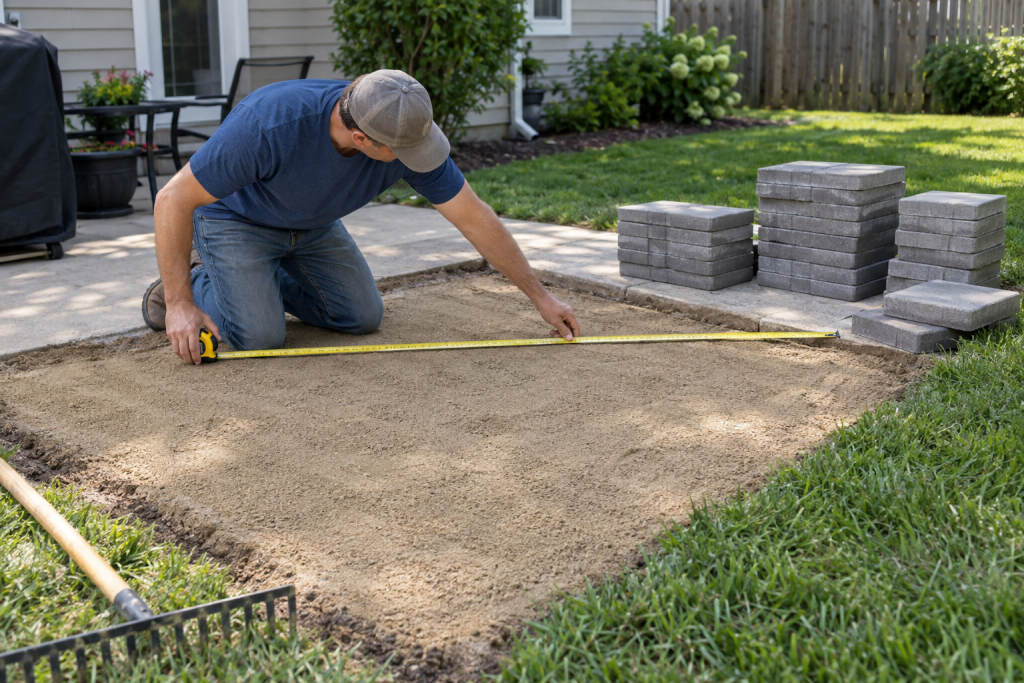
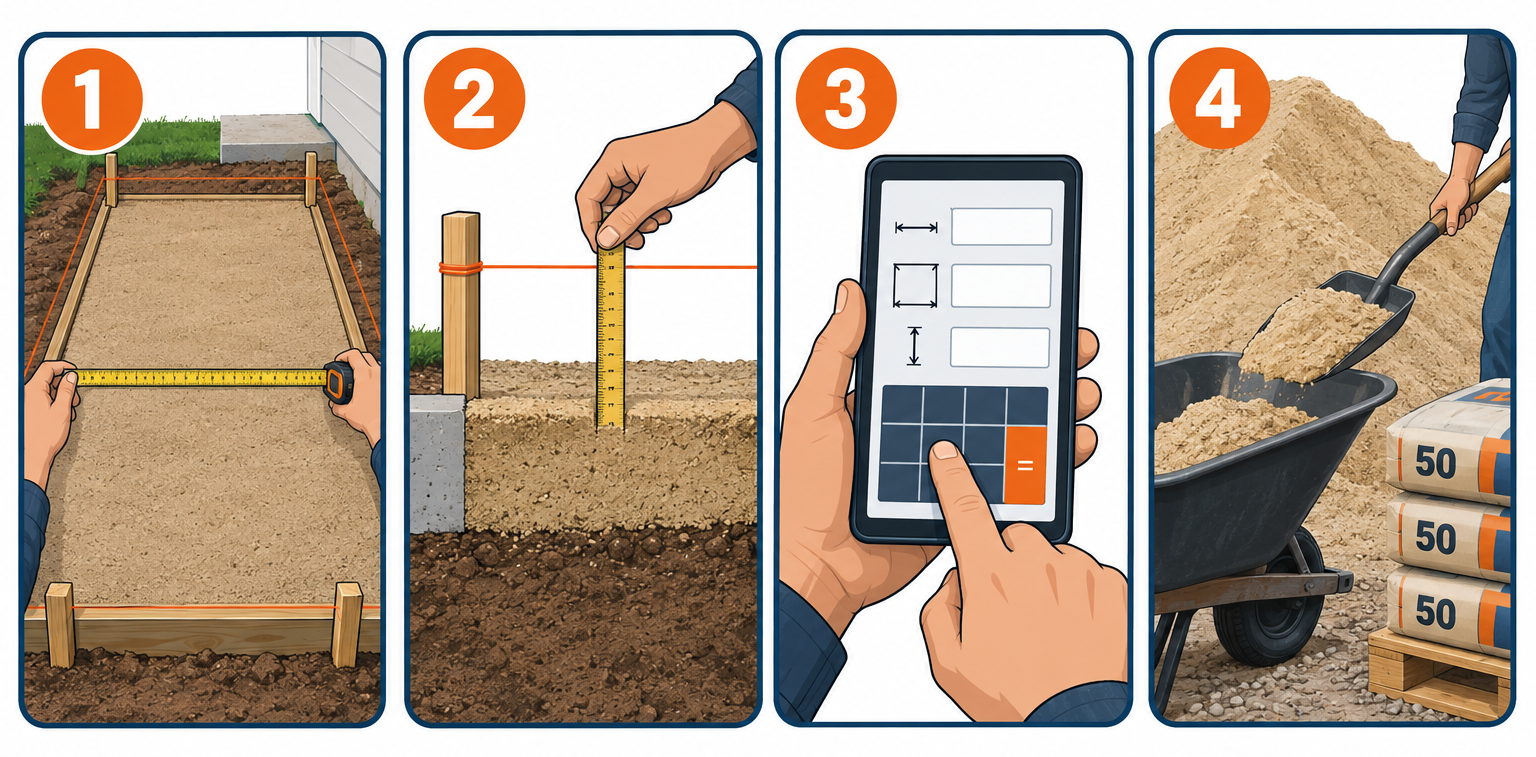
- Measure the length and width of the area in feet with a 25 ft tape.
- Decide the depth in inches: 1 in for paver bedding, 2 in for a sandbox top-up, 4 in or more for fill.
- Enter Length (ft), Width (ft) and Depth (in) in the calculator fields.
- Choose the Material: fill or utility, concrete, play or masonry sand.
- Leave Weight per cubic yard (tons) at the default unless your supplier gives you a different figure.
- Add your Price per ton if you have a quote, then read off cubic yards, tons and bags.
How to use the sand calculator
Every field in the calculator maps to something you measure on site or read off a supplier’s quote. Here is what each one wants and how to get it right.
Length (ft) and Width (ft)
Measure the outside edges of the area in feet, not inches. A 20 ft by 10 ft rectangle is the default, which is a typical small patio or a long driveway strip. If your tape reads 18 ft 6 in, enter 18.5, not 18.6. Six inches is half a foot, so convert inches to decimals by dividing by 12.
For an L-shaped or stepped area, split it into rectangles, run each one separately and add the cubic yards together. Circles are easier than they look: measure the diameter, then enter 0.785 times the diameter for both length and width. A 12 ft round sandbox becomes 9.42 ft by 9.42 ft, which gives the same 113 sq ft as the true circle. If the footprint is genuinely irregular, a “square footage calculator” will get you an accurate area, and you can back into equivalent length and width from there.
Depth (in)
This is the thickness of the sand layer, entered in inches. The default is 2 in. Common depths by job:
| Job | Depth to enter | Why |
|---|---|---|
| Paver bedding over compacted base | 1 in | Thicker bedding shifts and ruts under foot traffic |
| Leveling sand under a pool or shed | 1 to 2 in | Only needs to fill low spots and bed the liner |
| Sandbox | 6 to 12 in | Deep enough to dig without hitting the bottom |
| Utility trench bedding around pipe | 4 to 6 in | Code typically calls for bedding below and cover above the pipe |
| Fill under a slab or walkway | 4 in and up | Match the elevation you need to raise |
Measure depth from the top of whatever the sand sits on (compacted gravel, landscape fabric, subgrade) to the finished sand surface. If you are filling a low area, drive stakes at the corners, run a string line at finished grade and measure down at several points. Average the readings and enter that number.
Material
The dropdown changes the weight the calculator uses, which changes the tons result but not the cubic yards. Fill or utility sand and concrete sand default to 1.35 tons per cubic yard. Play sand and masonry sand default to 1.3 tons per cubic yard because they are finer, cleaner and slightly lighter per yard when dry.
Pick the sand you will actually buy. Concrete sand (coarse, sharp, ASTM C33 graded) is the right bedding for pavers. Masonry sand is fine and rounded, good for mortar and leveling but too soft to lock pavers. Play sand is washed and screened for sandboxes. Fill or utility sand is unwashed, cheapest and fine for trench bedding and bulk fill.
Weight per cubic yard (tons)
Leave this at the default unless your supplier quotes a different figure. Some yards sell concrete sand at 1.4 tons per yard, and wet sand straight off a pile can weigh 1.5 tons per yard or more. If a supplier tells you “our sand runs 2,800 lb a yard,” divide by 2,000 and enter 1.4.
Bag size
The calculator counts 0.5 cu ft bags, which is the size most big-box stores sell as a 50 lb bag of play sand, all-purpose sand or paver sand. A few brands sell 60 lb bags that still fill about 0.5 cu ft, so the count holds. The bag result is cubic feet divided by 0.5, rounded up to the next whole bag.
Price per ton (optional)
Enter the per-ton price from a bulk quote and the calculator multiplies it by the tons result. If your supplier prices by the cubic yard instead, multiply their yard price by the cubic yards result yourself. Leave the field at 0 if you only want quantities.
Measuring mistakes that throw the result off
- Mixing units: entering 20 ft by 10 ft by 2 ft instead of 2 in gives you 12 times too much sand.
- Measuring inside the paver border instead of outside it, which drops the area by a foot of width on a typical patio.
- Taking one depth reading at the deepest spot and applying it to the whole area.
- Forgetting that pavers cover sand: for a patio, measure the whole paver footprint, not just the exposed sand.
The sand calculator formula, step by step
The calculator uses one volume formula and two conversions. Nothing here needs more than a phone calculator to check by hand.
Cubic feet = Length (ft) x Width (ft) x Depth (in) / 12
Dividing depth by 12 converts inches to feet so all three dimensions match. Multiply them and you get volume in cubic feet.
Cubic yards = Cubic feet / 27
A cubic yard is 3 ft by 3 ft by 3 ft, or 27 cubic feet. Suppliers sell bulk sand by the cubic yard or the ton, so this is the number you order with.
Tons = Cubic yards x Weight per cubic yard
The default weight is 1.35 tons per yard for fill and concrete sand, 1.3 for play and masonry sand. Multiply by 2,000 to get pounds.
Bags = Cubic feet / 0.5
Each 50 lb bag holds about half a cubic foot. Round up.
Worked example with the default inputs
Length 20 ft, Width 10 ft, Depth 2 in, fill sand at 1.35 tons per yard.
- Cubic feet: 20 x 10 x (2 / 12) = 200 x 0.1667 = 33.3 cu ft
- Cubic yards: 33.3 / 27 = 1.23 cu yd
- Cubic meters: 1.23 x 0.7646 = 0.94 m³
- Weight: 1.23 x 1.35 = 1.67 tons, or 3,333 lb
- Bags: 33.3 / 0.5 = 66.7, rounded up to 67 bags
That matches the calculator’s output: 1.23 cubic yards, 33.3 cubic feet, 0.94 cubic meters, 1.67 tons (3,333 lb) and 67 bags. If you had entered $45 per ton, the cost line would read about $75.
Second worked example: bedding sand for a 16 x 12 paver patio
Say you are laying pavers on a 16 ft by 12 ft patio over compacted crushed stone. Bedding sand goes down at 1 in, and you choose concrete sand at 1.35 tons per yard.
- Cubic feet: 16 x 12 x (1 / 12) = 192 x 0.0833 = 16 cu ft
- Cubic yards: 16 / 27 = 0.59 cu yd
- Weight: 0.59 x 1.35 = 0.80 tons, or about 1,600 lb
- Bags: 16 / 0.5 = 32 bags
So a 192 sq ft patio needs 0.59 cubic yards, 0.8 tons or 32 bags of concrete sand for the bedding layer. Most suppliers will round that order to a full ton or a full yard, which is useful anyway because the screed board always pushes a little sand into the base. The 4 in to 6 in crushed stone under that sand is a separate order; run it through a “gravel calculator” since stone weighs about 1.4 tons per yard and the depth is different.
Quick reference: sand by area and depth
All figures below use the calculator formula with fill or concrete sand at 1.35 tons per cubic yard. Bags are 0.5 cu ft, rounded up.
| Area | Depth | Cubic feet | Cubic yards | Tons | 50 lb bags |
|---|---|---|---|---|---|
| 100 sq ft | 1 in | 8.3 | 0.31 | 0.42 | 17 |
| 100 sq ft | 2 in | 16.7 | 0.62 | 0.83 | 34 |
| 100 sq ft | 4 in | 33.3 | 1.23 | 1.67 | 67 |
| 200 sq ft | 1 in | 16.7 | 0.62 | 0.83 | 34 |
| 200 sq ft | 2 in | 33.3 | 1.23 | 1.67 | 67 |
| 200 sq ft | 4 in | 66.7 | 2.47 | 3.33 | 134 |
| 300 sq ft | 1 in | 25.0 | 0.93 | 1.25 | 50 |
| 300 sq ft | 2 in | 50.0 | 1.85 | 2.50 | 100 |
| 300 sq ft | 4 in | 100.0 | 3.70 | 5.00 | 200 |
| 500 sq ft | 1 in | 41.7 | 1.54 | 2.08 | 84 |
| 500 sq ft | 2 in | 83.3 | 3.09 | 4.17 | 167 |
| 500 sq ft | 4 in | 166.7 | 6.17 | 8.33 | 334 |
A handy rule from this table: one cubic yard of sand covers 324 sq ft at 1 in, 162 sq ft at 2 in and 81 sq ft at 4 in.
Sand for pavers calculator: bedding and joint sand
Searches for a paver sand calculator usually mean one of two things, and they need different math.
Bedding sand
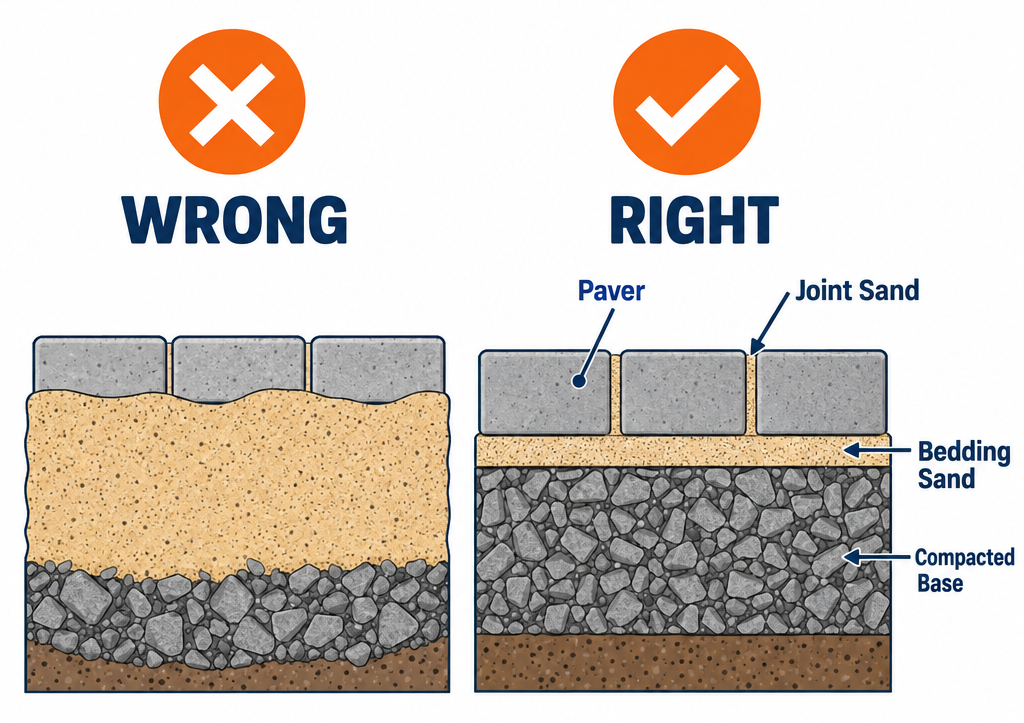
Enter the full paver footprint as Length and Width, set Depth to 1 in and choose Concrete sand. That is the layer you screed flat with two 1 in pipes and a straight 2×4 before setting pavers. Do not go deeper to fix a low base. Bedding thicker than about 1.5 in compacts unevenly under the plate compactor and the pavers settle in a wave pattern within a season.
Pro tip
Screed in sections you can reach from outside, pull your pipes, fill the grooves by hand and never step on screeded sand. One footprint in 1 in of bedding leaves a dip that shows up as a rocking paver after the first winter.
Polymeric sand calculator
Joint sand only fills the gaps between pavers, so the calculator’s area formula overshoots badly if you enter the full patio. A practical estimate: enter the full area with Depth set to the paver thickness (2 3/8 in for most residential pavers), then take about 5 percent of the cubic feet result for 1/8 in joints on standard 6 in by 9 in pavers. For the 16 x 12 patio, that is 16 x 12 x (2.375 / 12) = 38 cu ft, times 0.05 is 1.9 cu ft, or four 50 lb bags. Wider joints, tumbled pavers with chamfered edges, or small units like 4 in cobbles can double that.
Check the coverage printed on the bag before buying. Manufacturers rate a 50 lb bag at roughly 50 to 100 sq ft for narrow joints and as little as 20 to 30 sq ft for wide joints. Our “polymeric sand” guide covers the install details, including why the pavers must be bone dry before you sweep it in.
How much does a yard of sand weigh?
A cubic yard of dry sand weighs about 2,600 to 2,700 lb, which is 1.3 to 1.35 tons. That is what the calculator uses. Moisture is the big variable: sand from an uncovered pile after rain can hold enough water to push a yard past 3,000 lb, and saturated sand can approach 3,400 lb. That matters for two reasons. If you buy by the ton, you are paying for water. If you haul it yourself, a half-ton pickup is done at about half a yard.
| Material option | Default tons per cu yd | Pounds per cu yd (dry) | Typical use |
|---|---|---|---|
| Fill or utility sand | 1.35 | 2,700 | Trench bedding, raising grade, backfill |
| Concrete sand | 1.35 | 2,700 | Paver bedding, concrete mix, drainage layers |
| Play sand | 1.30 | 2,600 | Sandboxes, play areas |
| Masonry sand | 1.30 | 2,600 | Mortar, leveling pools and pavers in tight spots |
For comparison, crushed stone runs about 1.4 tons per yard and topsoil about 1.0 to 1.2 tons per yard. If a supplier quotes a yard of sand well under 1.2 tons, they are measuring loosely or the material is not what you think.
Buying and ordering sand
Bulk by the ton or yard
Landscape yards and aggregate suppliers sell bulk sand by the ton or by the cubic yard, and some quote both. Ask which unit the price is in before you compare. Bulk concrete or fill sand commonly runs $25 to $60 per ton picked up at the yard, with masonry and play sand toward the higher end and some metro areas above that. Delivery is extra, typically $50 to $150 for a local drop, and many suppliers set a minimum of 1 to 3 yards or charge a flat fee under that. Call to verify both the price and the minimum before you schedule a truck; sand prices move with fuel costs and the quote on the website is often months old.
Bags from the hardware store
A 50 lb bag of play sand or all-purpose sand usually costs $4 to $8, and paver or leveling sand about the same. Polymeric sand is a different product entirely at $55 to $90 per 50 lb bag. Bags make sense up to roughly a third of a yard (about 18 bags) or when you cannot get a truck to the site. Beyond that the math favors bulk fast.
| Quantity | Bags needed | Bag cost at $6 each | Bulk cost at $45/ton plus $75 delivery |
|---|---|---|---|
| 0.31 cu yd (100 sq ft at 1 in) | 17 | $102 | $94 (but likely under the minimum) |
| 0.62 cu yd (200 sq ft at 1 in) | 34 | $204 | $113 |
| 1.23 cu yd (calculator default) | 67 | $402 | $150 |
| 3.09 cu yd (500 sq ft at 2 in) | 167 | $1,002 | $263 |
Bulk also arrives in one pile instead of 67 bags you have to lift twice. The trade-off is the pile lands where the driver can tip it, so clear a spot on the driveway and put a tarp down first.
How much extra to order
Add 5 to 10 percent on a simple rectangle and 10 to 15 percent on irregular shapes, trench work or anything over a crushed stone base. Sand works down into the voids of an open-graded base, the screed pushes some into the gravel, and a plate compactor settles loose sand by roughly 10 percent. For the 1.23 yard default, ordering 1.35 to 1.5 yards covers it. Many yards will only sell in half-yard or whole-ton increments anyway, so round up to the next unit and keep the spare for joint sweeping or next year’s sandbox top-up.
Pro tip
Order bedding sand and base stone on the same truck if the supplier can split the load. You pay one delivery fee, and the sand pile is right there when you finish compacting the base instead of three days later.
Safety first
A loaded dump truck weighs 25 tons or more. Keep it off concrete driveways, septic tanks and lawn with shallow utilities, and have the sand dumped at the curb if in doubt. Wear gloves and lift bags with your legs; 67 bags is over a ton and a half of repeated lifting.
Common mistakes that cause running short or over-buying
- Entering depth in feet. Depth is inches in this calculator. A 2 ft entry returns 14.8 yards instead of 1.23.
- Using the 2 in default for paver bedding. Bedding is 1 in. Doubling it wastes sand and sets up settlement problems.
- Measuring only the exposed sand on a sandbox. Measure the inside of the frame, and use the depth from the bottom of the frame or liner to about 2 in below the top rail.
- Ignoring that a dump truck delivers a heaped, loose yard. Loose sand compacts. A 1 yard delivery becomes about 0.9 yard once you plate-compact it.
- Ordering by ton from a wet pile. You can lose 10 to 15 percent of your volume to water weight. Ask if the sand is covered or quote by the yard instead.
- Forgetting the base is a different material. Pavers need 4 to 6 in of compacted crushed stone under 1 in of sand. Running the full 6 in through the sand calculator over-orders sand and leaves you with no base.
- Rounding each rectangle down before adding. Keep two decimals per section and round once at the end.
- Skipping the string line on fill jobs. If the subgrade dips 2 in in the middle, an average depth measurement catches it. One corner reading does not.
The same volume logic applies to other materials on a hardscape job. A “concrete calculator” handles the footings and slab, and an “asphalt calculator” uses the same length, width and depth inputs with a much heavier weight per yard, so do not reuse the sand tonnage for either.
When to call a pro
If the sand is bedding for a retaining wall over 3 to 4 ft, a driveway that takes vehicle loads, or trench bedding around gas, sewer or water lines, bring in a licensed hardscape contractor, excavator or plumber. Those jobs usually need a permit, an engineered base and inspection before backfill, and sand depth is the least of the design questions.
FAQ
How do I calculate sand for pavers?
Measure the paver footprint in feet, multiply length by width by 1 in divided by 12, then divide by 27 for cubic yards. A 16 x 12 patio needs 16 cu ft, 0.59 cu yd or about 0.8 tons of concrete sand for bedding. Order about 10 percent extra because some sand migrates into the stone base during screeding.
How much does a yard of sand weigh?
A cubic yard of dry sand weighs roughly 2,600 to 2,700 lb (1.3 to 1.35 tons), which is what the calculator uses. Wet sand can weigh 3,000 lb or more per yard, so if you are hauling it, a half-ton pickup safely carries about half a yard.
How many 50 lb bags of sand are in a cubic yard?
About 54. A 50 lb bag holds roughly 0.5 cu ft, and a cubic yard is 27 cu ft, so 27 divided by 0.5 equals 54 bags. The calculator rounds up, so 1.23 cubic yards shows 67 bags.
How many tons of sand do I need for a sandbox?
For an 8 ft by 8 ft sandbox filled 8 in deep with play sand: 8 x 8 x (8 / 12) = 42.7 cu ft, divided by 27 is 1.58 cu yd, times 1.3 is 2.05 tons, or 86 bags. Most families go 6 in deep instead, which drops it to 1.19 cu yd and about 1.5 tons.
Does the sand calculator work for polymeric sand?
Not directly, because joint sand only fills the gaps between pavers. Enter the area with depth equal to paver thickness, then take about 5 percent of the cubic feet for narrow 1/8 in joints, or follow the coverage rate on the bag. A 200 sq ft patio with standard pavers typically needs 3 to 5 bags.
How much sand do I need per square foot?
At 1 in deep, each square foot needs 0.0833 cu ft, which is 1/324 of a cubic yard. At 2 in it is 1/162 of a yard, and at 4 in it is 1/81. Put another way, one cubic yard covers 324, 162 or 81 sq ft at those depths.
Should I buy sand by the ton or the cubic yard?
Buy by the yard if you can, especially from an uncovered pile, because the volume is what you actually place and water weight does not inflate a yard. If the supplier only sells by the ton, the calculator’s 1.35 tons per yard converts your order, and you should mention the sand is for bedding so they load dry material.
How much extra sand should I order?
Add 5 to 10 percent for simple rectangles and 10 to 15 percent for irregular areas, trench bedding or sand laid over open-graded stone. Compaction settles loose sand by about 10 percent on its own, so a job that calculates to 1.23 yards is safely covered by a 1.5 yard order.