
This btu calculator tells you the cooling capacity your room needs in BTU per hour, converts it to tons, and rounds to the nearest air conditioner size you can buy. Measure the room’s length, width and ceiling height, note the sun exposure, count the people who use it, and say whether it is a kitchen. The result works for window units, portable units and ductless mini splits.
Quick steps: use the btu calculator
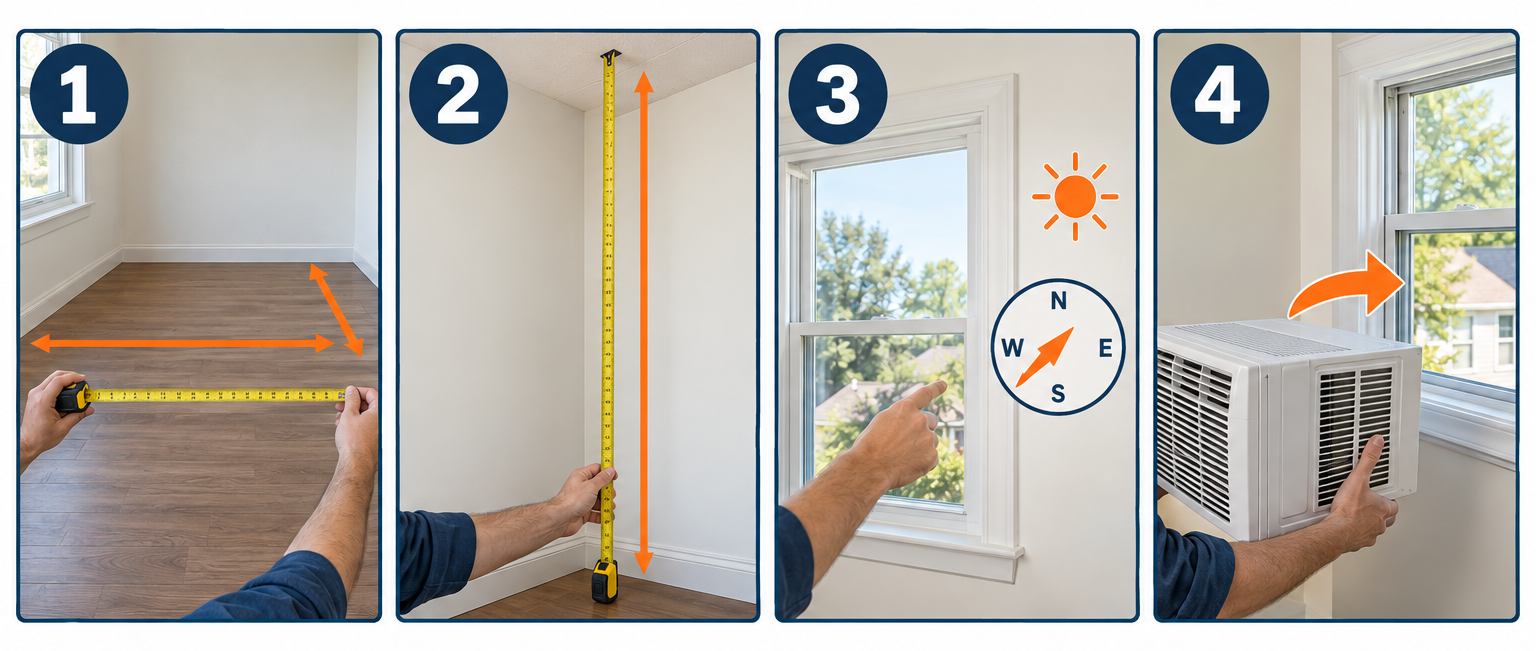
- Measure the room’s length and width at floor level with a tape measure, in feet.
- Measure floor to ceiling in one spot and enter it as Ceiling height (ft).
- Pick the Sun exposure that matches the room’s windows: Normal, Heavily shaded or Very sunny.
- Enter the number of People who regularly use the room at the same time.
- Set Is it a kitchen? to Yes if the room has a range or oven in it.
- Read the BTU result and tons, then buy the next standard size up from that number.
Tools and materials
- 25 ft tape measure (a laser measure works faster in cluttered rooms)
- Notepad or phone to record length, width and height
- Compass or a phone compass app to confirm which way the windows face
How to use the btu calculator
The six fields map directly to the things that add heat to a room: floor area, air volume, solar gain, body heat and cooking. Here is exactly what to measure for each one and where people go wrong.
Room length (ft) and Room width (ft)
Measure wall to wall across the floor, not along the baseboard where trim can throw you off by an inch or two. Round to the nearest half foot. The default is 16 by 14, which is a typical primary bedroom or small living room.
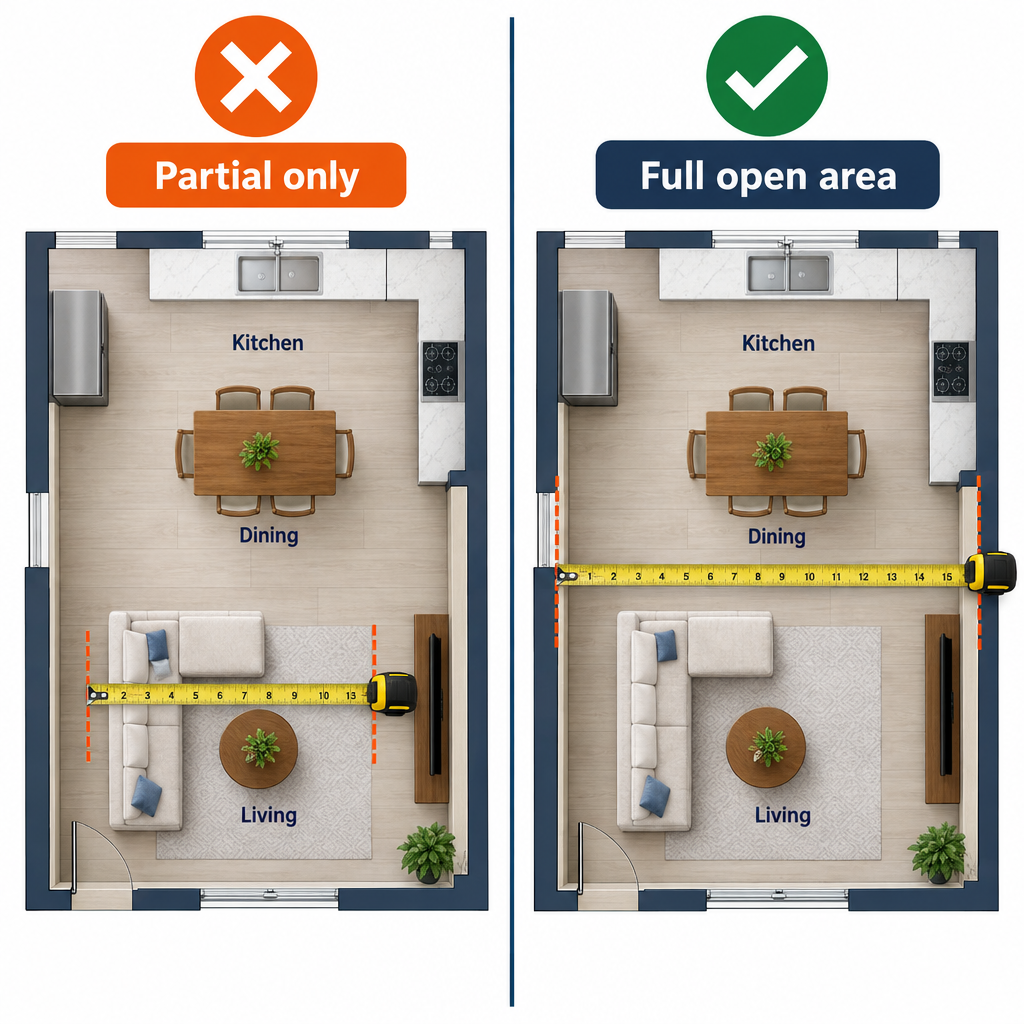
For an L-shaped room, split it into two rectangles, add the areas, and enter the total as one dimension with 1 as the other (for example, 310 and 1). A “square footage calculator” makes that split easy if the shape is awkward. For an open-plan space where the kitchen, dining and living area share air with no door, measure the whole open area. A unit sized for just the living room will run constantly and never catch up.
Ceiling height (ft)
Stand a tape measure in the middle of the room and read floor to ceiling. Most homes built after 1990 have 8 ft ceilings on the ground floor, often 9 ft, and some great rooms hit 12 to 18 ft. The calculator scales the result up above 8 ft because you are cooling volume, not floor area. A 10 ft ceiling means 25% more air to cool than the same footprint at 8 ft.
For a vaulted or cathedral ceiling, enter the average height. If the low wall is 8 ft and the peak is 14 ft, use 11.
Sun exposure
This is the field people guess at, and it swings the answer by 20% between the two extremes.
- Very sunny: large south- or west-facing windows with no shade, or a room that gets direct afternoon sun. Top-floor rooms under a dark roof with little attic insulation belong here too.
- Normal: a mix of orientations, modest window area, or windows with blinds that stay closed in the afternoon.
- Heavily shaded: north-facing windows, a room shaded by trees or a neighboring building, or a basement.
If the room is sunny in the morning only (east-facing), Normal is the right pick. Morning sun is lower intensity and you are rarely fighting it during peak afternoon heat.
People who regularly use the room
Count the people who are in the room at the same time during the hottest part of the day, not everyone who ever walks through. A home office is 1. A family room where four people watch TV in the evening is 4. Each adult at rest gives off roughly 400 to 600 BTU per hour of sensible and latent heat, which is why the calculator adds 600 BTU for every person beyond two.
Is it a kitchen?
Set this to Yes only if the cooking appliances are in the room you are cooling. A range, oven and refrigerator together dump thousands of BTU into the space while you cook, so the calculator adds a flat 4,000 BTU. A dining room next to a closed kitchen is No.
Measuring mistakes that skew the result
The three errors that cause the most misfits are measuring only part of an open floor plan, entering the ceiling height as 8 when it is actually 9 or 10, and marking a sunny room as Normal because it has curtains. Curtains help, but only if someone closes them before the sun hits. Size for the room as it is actually used.
The air conditioner btu calculator formula
The calculator starts from the ENERGY STAR room air conditioner sizing chart, which assigns a base BTU rating to a range of floor areas. It then applies adjustments for ceiling height, sun, people and cooking, and converts the answer to tons.
Step 1: Base BTU from floor area. Multiply Room length by Room width to get square feet, then look up the range in this chart.
| Floor area (sq ft) | Base BTU/hr | Tons |
|---|---|---|
| 100 to 150 | 5,000 | 0.42 |
| 150 to 250 | 6,000 | 0.50 |
| 250 to 300 | 7,000 | 0.58 |
| 300 to 350 | 8,000 | 0.67 |
| 350 to 400 | 9,000 | 0.75 |
| 400 to 450 | 10,000 | 0.83 |
| 450 to 550 | 12,000 | 1.00 |
| 550 to 700 | 14,000 | 1.17 |
| 700 to 1,000 | 18,000 | 1.50 |
| 1,000 to 1,200 | 21,000 | 1.75 |
| 1,200 to 1,400 | 23,000 | 1.92 |
| 1,400 to 1,500 | 24,000 | 2.00 |
| 1,500 to 2,000 | 30,000 | 2.50 |
| 2,000 to 2,500 | 34,000 | 2.83 |
Step 2: Ceiling height. If the ceiling is over 8 ft, the base number is scaled up in proportion to the extra volume. A 10 ft ceiling multiplies by 10 ÷ 8, or 1.25. Ceilings at or below 8 ft get no change.
Step 3: Sun exposure. Heavily shaded subtracts 10%. Very sunny adds 10%. Normal leaves the number alone.
Step 4: People. Add 600 BTU for each person beyond two. Two people or fewer adds nothing.
Step 5: Kitchen. Add a flat 4,000 BTU if the room is a kitchen.
Step 6: Tons. Divide the total by 12,000. One ton of cooling equals 12,000 BTU per hour.
Step 7: Nearest standard unit. Round to the closest size that manufacturers actually sell.
Worked example with the default inputs
Room length 16 ft, Room width 14 ft, Ceiling height 8 ft, Sun exposure Normal, 2 people, not a kitchen.
- Area: 16 × 14 = 224 sq ft.
- Base BTU: 224 falls in the 150 to 250 band, so 6,000 BTU.
- Ceiling: 8 ft, no change. Still 6,000.
- Sun: Normal, no change. Still 6,000.
- People: 2, nothing over two, add 0. Still 6,000.
- Kitchen: No, add 0. Still 6,000.
- Tons: 6,000 ÷ 12,000 = 0.5.
Result: cooling capacity for 224 sq ft is 6,000 BTU, 0.5 tons, nearest standard unit 6,000 BTU. That is a small window unit on a standard 115 V outlet.
Second worked example: a sunny great room
Room length 20 ft, Room width 18 ft, Ceiling height 10 ft, Sun exposure Very sunny, 4 people, not a kitchen.
- Area: 20 × 18 = 360 sq ft.
- Base BTU: 360 falls in the 350 to 400 band, so 9,000 BTU.
- Ceiling: 10 ÷ 8 = 1.25. 9,000 × 1.25 = 11,250.
- Sun: Very sunny, add 10%. 11,250 × 1.10 = 12,375.
- People: 4 people is 2 over two. 2 × 600 = 1,200. 12,375 + 1,200 = 13,575.
- Kitchen: No, add 0. Total 13,575 BTU.
- Tons: 13,575 ÷ 12,000 = 1.13.
Result: about 13,600 BTU, 1.13 tons, nearest standard unit 14,000 BTU. Notice that the same footprint at 8 ft with normal sun and two people would need only 9,000. Height, sun and bodies pushed it up by more than 50%.
A kitchen example
A 12 by 12 kitchen (144 sq ft) with an 8 ft ceiling, Normal sun, 2 people. Base is 5,000 BTU from the 100 to 150 band. Add 4,000 for the kitchen: 9,000 BTU, 0.75 tons. A 5,000 BTU unit would keep up at midnight and lose badly at dinnertime.
Pro tip
If a room sits right at a band boundary, such as 250 or 350 sq ft, re-measure before you trust the answer. One foot of width can shift the base number by 1,000 BTU. When in doubt, use the higher band for a west-facing room and the lower band for a shaded one.
Quick-reference AC BTU chart for common rooms
Every number below comes from the same formula with an 8 ft ceiling and two people. Use the three columns to see how much sun exposure alone moves the answer.
| Room (ft) | Area (sq ft) | Heavily shaded (−10%) | Normal | Very sunny (+10%) | Tons (normal) |
|---|---|---|---|---|---|
| 10 × 10 | 100 | 4,500 | 5,000 | 5,500 | 0.42 |
| 10 × 12 | 120 | 4,500 | 5,000 | 5,500 | 0.42 |
| 12 × 12 | 144 | 4,500 | 5,000 | 5,500 | 0.42 |
| 12 × 14 | 168 | 5,400 | 6,000 | 6,600 | 0.50 |
| 14 × 16 | 224 | 5,400 | 6,000 | 6,600 | 0.50 |
| 15 × 18 | 270 | 6,300 | 7,000 | 7,700 | 0.58 |
| 16 × 20 | 320 | 7,200 | 8,000 | 8,800 | 0.67 |
| 18 × 20 | 360 | 8,100 | 9,000 | 9,900 | 0.75 |
| 20 × 22 | 440 | 9,000 | 10,000 | 11,000 | 0.83 |
| 20 × 25 | 500 | 10,800 | 12,000 | 13,200 | 1.00 |
| 24 × 25 | 600 | 12,600 | 14,000 | 15,400 | 1.17 |
| 25 × 30 | 750 | 16,200 | 18,000 | 19,800 | 1.50 |
| 30 × 36 | 1,080 | 18,900 | 21,000 | 23,100 | 1.75 |
For a 9 ft ceiling multiply the result by 1.125. For 10 ft multiply by 1.25. For 12 ft multiply by 1.5. Then add 600 per extra person and 4,000 for a kitchen.
Buying the right unit once you have the number
Air conditioners are sold by BTU per hour for window and portable units and by tons for mini splits and central systems. The math is the same: 12,000 BTU equals 1 ton. A “1.5-ton mini split” and an “18,000 BTU mini split” are the same capacity.
Standard sizes you can actually buy
Window units come in a fairly fixed ladder: 5,000, 6,000, 8,000, 10,000, 12,000, 14,000 to 15,000, 18,000 and 24,000 BTU. Single-zone mini splits run 9,000, 12,000, 18,000, 24,000 and 36,000 BTU. Central air comes in half-ton steps from 1.5 to 5 tons.
When your result lands between sizes, go up one step, not two. A result of 13,575 BTU means a 14,000 BTU unit, not 18,000. Oversizing by a full size or more is the most expensive mistake in this whole process, and the next section explains why.
Power and plugs
Most window units up to about 12,000 BTU run on a standard 115 V outlet and draw under 12 amps, so a regular 15 amp bedroom circuit handles one unit as long as nothing else heavy shares it. Units of 15,000 BTU and above, and nearly all 18,000 and 24,000 BTU window units, require 230 V and a dedicated circuit with a NEMA 6-15, 6-20 or 6-30 receptacle. Check the plug type on the box before you buy. If the room has no 230 V outlet, that is an electrician visit before the unit goes in.
Mini splits are hardwired to a dedicated breaker, typically 15 to 25 amps at 230 V for sizes up to 24,000 BTU. Central systems need their own breaker sized to the condenser nameplate.
Safety first
Never run a window or portable air conditioner on an extension cord or a power strip. The sustained compressor draw overheats light-gauge cords and is a common cause of house fires. If the cord will not reach, move the unit or add an outlet.
Efficiency ratings that change the bill
Window and portable units carry a CEER rating (Combined Energy Efficiency Ratio). Mini splits and central systems carry SEER2. Higher is better in both cases. A 12,000 BTU window unit at CEER 12 uses about 1,000 watts while cooling; one at CEER 10 uses about 1,200 watts for the same cooling. Over a summer of 600 run hours at a typical 16 cents per kWh, that difference is roughly $19. ENERGY STAR units are generally the better long-term buy, and a mini split at SEER2 20 or higher will cool a room on roughly half the electricity of an older window unit.
Portable units are the exception to the simple rules. Single-hose portables pull room air to cool the compressor and blow it outside, which sucks warm air in from the rest of the house. They deliver noticeably less real cooling than their rating, so size one at least one step above the calculator’s answer or buy a dual-hose model.
Realistic US prices
| Unit type | Capacity | Typical equipment price | Installed cost |
|---|---|---|---|
| Window AC | 5,000 to 6,000 BTU | $150 to $300 | DIY, $0 to $150 for a bracket |
| Window AC | 8,000 to 10,000 BTU | $250 to $450 | DIY |
| Window AC | 12,000 to 15,000 BTU | $400 to $700 | DIY, plus electrician if 230 V is needed |
| Window AC | 18,000 to 24,000 BTU | $600 to $1,100 | DIY with helper, 230 V circuit required |
| Portable AC (dual hose) | 10,000 to 14,000 BTU | $400 to $800 | DIY |
| Ductless mini split | 12,000 BTU (1 ton) | $800 to $1,800 | $2,500 to $5,000 |
| Ductless mini split | 18,000 to 24,000 BTU | $1,200 to $2,800 | $3,500 to $7,000 |
| Central AC | 2 to 3 tons | $2,500 to $5,000 | $5,000 to $12,000 |
Prices vary by brand, efficiency rating and region, and installed mini split and central costs swing most with labor rates and how much electrical work is needed. A 230 V dedicated circuit for a large window unit typically adds $300 to $800 depending on the panel’s distance from the room.
Pro tip
Buy a window unit with a smart or “eco” compressor mode and a real thermostat, not a cold-to-hot dial. A unit that cycles on a temperature setpoint runs about 20% fewer hours than one left on a dial setting, and it keeps humidity under control because it does not overshoot.
Common mistakes that cause undersizing or oversizing
Oversizing “to be safe.” A unit that is too big cools the air fast and shuts off before it has run long enough to pull moisture out. You get a cold, clammy room, more compressor starts, and a shorter equipment life. The classic sign is 65% relative humidity with the thermostat satisfied. Oversizing also costs more up front and often forces a 230 V circuit you did not need.
Undersizing by ignoring the ceiling. A 9 or 10 ft ceiling is the most common thing people forget. The air at the top of a tall room still heats up and still mixes down, and the unit has to handle all of it.
Cooling only part of an open plan. If the living room opens into the kitchen with no door, enter the whole area and set Is it a kitchen? to Yes. The unit will try to cool the entire connected space whether you want it to or not.
Treating a top-floor room like any other. A bedroom directly under an attic with less than R-30 insulation gains serious heat through the ceiling. Treat it as Very sunny even if the windows face north. If the attic is a real problem, adding insulation is cheaper than a bigger AC and makes the smaller unit work.
Counting the wrong people. Four kids in the room for ten minutes is not four people. Four adults every evening from six to ten is.
Ignoring leaky windows and old construction. The ENERGY STAR chart assumes a reasonably tight, insulated room. For a pre-1960 house with single-pane windows and no wall insulation, step up one size, or weatherstrip and add window film first.
Forgetting the unit’s own waste heat. A portable unit’s compressor sits inside the room. A window unit’s sits outside. That difference alone is a few hundred BTU of effective capacity in the window unit’s favor.
Mixing heating and cooling BTU. Furnace and radiator BTU ratings describe heat output and are sized to a different load, mainly winter design temperature and insulation, not solar gain. Do not use a cooling number to buy a heater or the reverse.
When to call a pro
If the result is over 24,000 BTU, or you are cooling more than one room, the job is a Manual J load calculation by an HVAC contractor, not a room chart. Call a licensed HVAC tech for any mini split or central system (refrigerant handling requires EPA 608 certification), and an electrician for any new 230 V circuit or panel work. Permits are usually required for both.
FAQ
What size air conditioner do I need for a 12 by 12 room?
A 12 by 12 room is 144 sq ft, which falls in the 100 to 150 band on the chart, so the base answer is 5,000 BTU with an 8 ft ceiling, normal sun and two people. Very sunny bumps it to 5,500, and most people buy a 6,000 BTU unit in that case. If the room is a kitchen, add 4,000 for a total of 9,000 BTU.
How many BTU per square foot does an air conditioner need?
The chart works out to roughly 20 to 35 BTU per square foot, with small rooms at the high end because a 5,000 BTU unit is the smallest practical size. A 224 sq ft room at 6,000 BTU is about 27 BTU per square foot. Do not use a single per-square-foot number across every room size; use the banded chart, then adjust for sun, ceiling height, people and cooking.
How do I convert BTU to tons for a mini split or central AC?
Divide BTU by 12,000. A 13,575 BTU result is 1.13 tons, so you would buy an 18,000 BTU (1.5-ton) mini split if 14,000 is not available in that line, or a 14,000 BTU window unit. Going the other way, a 2-ton system delivers 24,000 BTU per hour.
Does the btu calculator for ac work for portable units?
Yes, with one caveat. Single-hose portables lose a large share of their rated capacity by pushing conditioned room air out the exhaust, so pick a unit at least one size larger than the calculator says, or choose a dual-hose model and use the result as is.
Can I use this air conditioning btu calculator for a whole house?
Add the connected open areas together for a single zone, but the chart tops out at 2,500 sq ft and does not account for ductwork, number of floors, wall insulation or local design temperatures. For a central system or a multi-zone mini split, have a contractor run a Manual J calculation. The calculator is still useful to sanity-check their proposal: a 3-ton quote for a 1,200 sq ft single-story house is likely oversized.
Why does a bigger AC not cool better?
An oversized unit reaches the thermostat setpoint quickly, shuts off, and never runs long enough to condense moisture out of the air. The room reads 72 °F but feels sticky, and the frequent starts wear out the compressor. The right size runs longer cycles, dries the air and uses less electricity overall.
How much does a 9 ft or 10 ft ceiling change the answer?
The calculator scales the base BTU by ceiling height divided by 8. A 9 ft ceiling adds 12.5%; a 10 ft ceiling adds 25%; a 12 ft ceiling adds 50%. A 320 sq ft room needing 8,000 BTU at 8 ft needs 10,000 BTU at 10 ft.
Does the room’s insulation affect the BTU number?
The ENERGY STAR chart assumes an average, reasonably insulated room with normal window area. Poor attic insulation, single-pane windows or uninsulated walls push the real load higher. Set Sun exposure to Very sunny for a top-floor room under a hot attic, and consider weatherstripping and insulation before buying a larger unit.
What is the difference between heating BTU and cooling BTU?
Both measure heat energy per hour, but the loads are different. Cooling capacity has to handle solar gain, body heat, appliances and humidity. Heating output has to replace heat lost through walls, windows and air leaks at the coldest expected outdoor temperature. A room that needs 6,000 BTU of cooling in July may need 12,000 BTU of heat in January in a cold climate, so size each one separately.