
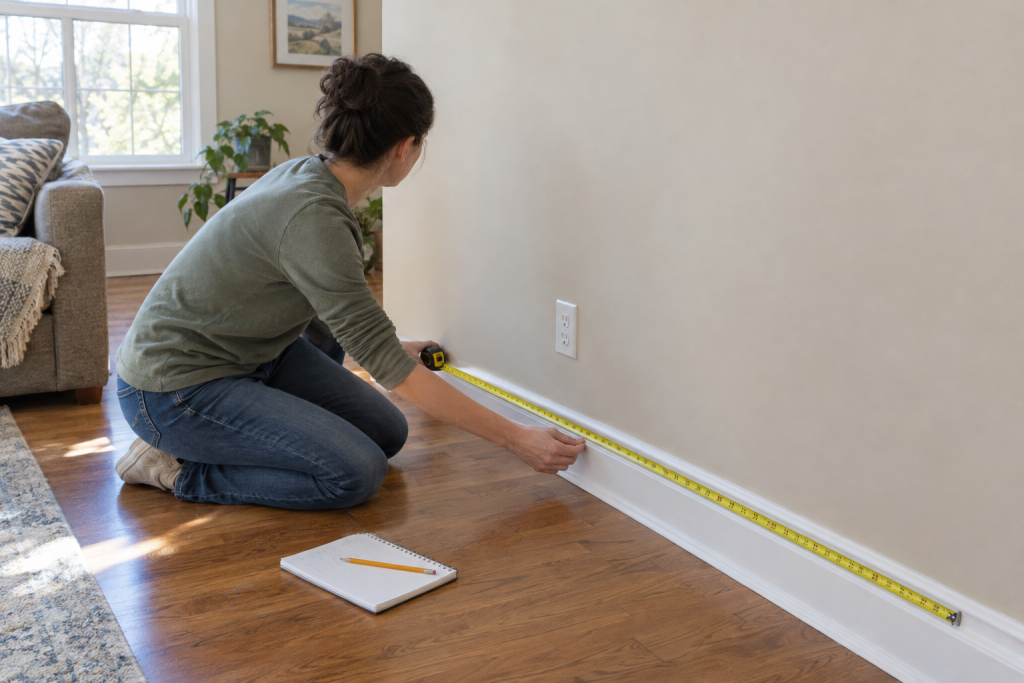
This paint calculator turns four tape-measure numbers into the exact gallons you need, the number of cans to put in your cart, and how much primer to add for one coat. Measure the room’s length, width and wall height, count the doors and windows, and the calculator does the subtraction, the coat math and the rounding for you.
Quick steps: use the paint calculator
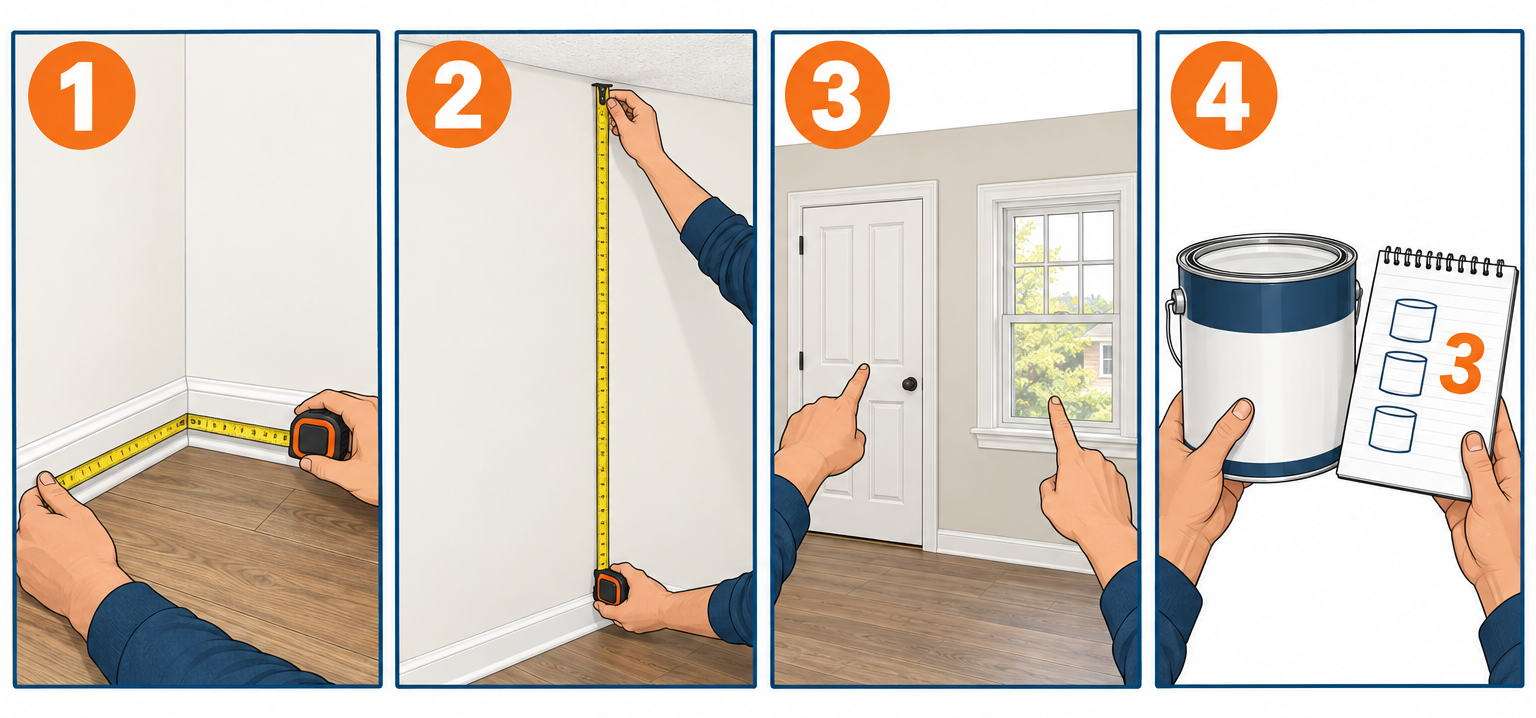
- Measure the longest wall and the next wall over, in feet, and enter them as Room length (ft) and Room width (ft).
- Measure floor to ceiling at one spot and enter it as Wall height (ft).
- Count every door and window opening in the room and enter them under Doors and Windows.
- Set Include the ceiling? to Yes if the ceiling gets the same paint, otherwise leave it at No.
- Leave Coats at 2 and Coverage per gallon (sq ft) at 350 unless your can says otherwise.
- Read Paint needed, Buy, and Primer, then round quarts up to the next can size.
Tools and materials
- 25 ft tape measure or laser distance measure
- Pencil and notepad, or your phone’s notes
- Step stool for ceiling height in rooms over 9 ft
- Paint can label or product data sheet (for the coverage figure)
How to use the paint calculator
Each field maps to one measurement. Get those right and the output is reliable to within a quart.
Room length (ft) and Room width (ft)
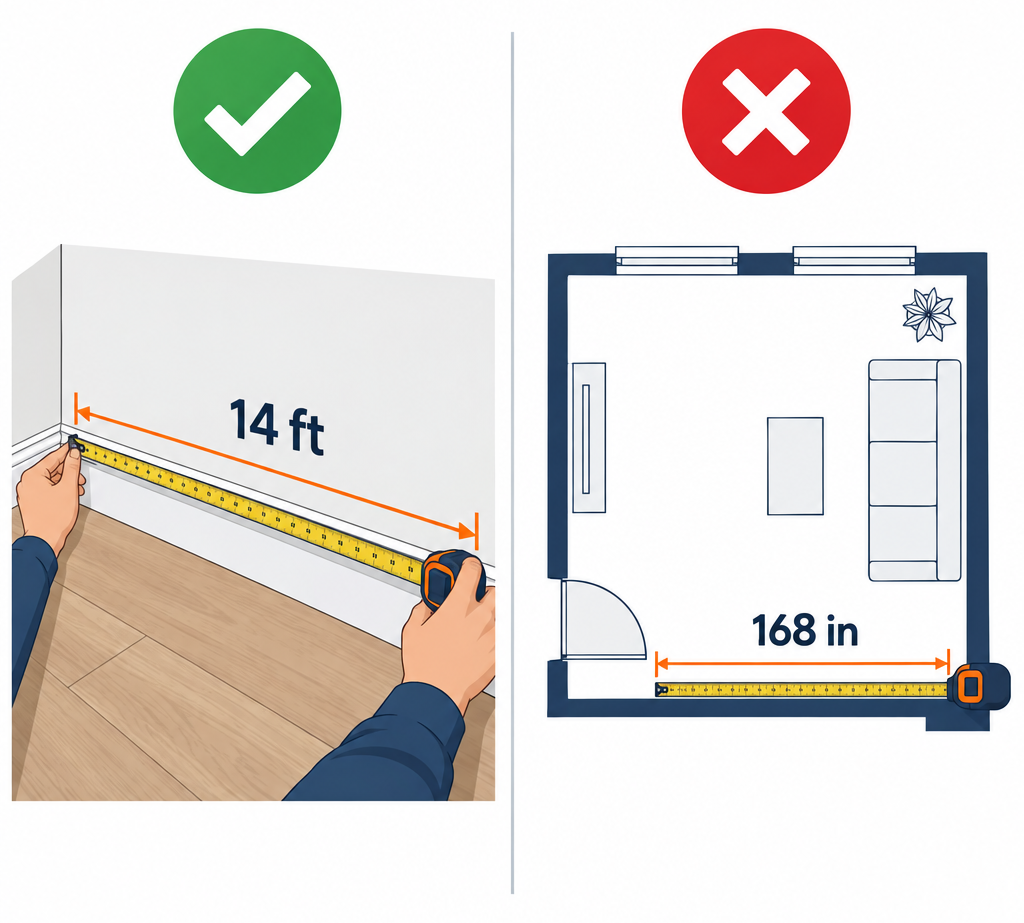
Measure along the baseboard from corner to corner on two walls that meet. For a rectangular room, those two numbers are all you need. Enter decimals rather than inches: 14 feet 6 inches is 14.5, and 12 feet 3 inches is 12.25.
For an L-shaped room, measure the whole outline instead. Add up every wall segment to get the perimeter, then enter half of that as the length and 0 as the width, since the formula doubles length plus width. A room with a 52 ft perimeter would be entered as length 26, width 0. If the shape is awkward, a square footage calculator will help you break it into rectangles first.
Closets and alcoves count if they get painted. A standard 24 inch deep reach-in closet adds about 10 to 12 linear feet of wall to the perimeter.
Wall height (ft)
Measure from the top of the baseboard to the ceiling, or floor to ceiling if the baseboard is coming off. Most post-1990 homes have 8 ft or 9 ft ceilings on the main floor. Older homes often run 8 ft 6 in (enter 8.5), and vaulted rooms need an average height: measure the low wall and the peak, add them, and divide by two.
Doors
Count every door opening, including closet doors, pocket doors and the opening to a hallway with no door in it. The calculator removes 21 sq ft for each one, which matches a standard 30 inch by 80 inch interior door with its trim. Double closet doors or a 6 ft sliding patio door count as two.
Windows
Count each window and the calculator removes 15 sq ft per window, a good match for a typical 3 ft by 5 ft double-hung. If you have a 6 ft picture window or a bay, count it as two or three. If you have a tiny bathroom window, count it as one anyway; the half-square-foot difference is noise.
Include the ceiling?
Leave this at No if the ceiling is staying white or getting a dedicated flat ceiling paint you’ll buy separately. Select Yes when the ceiling is getting the same color and sheen as the walls, which is common in dark, moody rooms and increasingly in bedrooms. When it is set to Yes, the calculator adds length times width to the paintable area.
Coats
Two is the right default for almost every job. One coat only works when you are repainting the same color with the same sheen over a clean, sound surface. Going from a dark color to a light one, or painting a strong red, orange or yellow, often needs three. Set the field to match.
Coverage per gallon (sq ft)
Most interior wall paints claim 350 to 400 sq ft per gallon on a smooth, previously painted surface. The 350 default is the conservative end of that range. Check the back of your can and enter the number printed there, then drop it by 50 to 100 sq ft if the walls are textured (knockdown, orange peel, skip trowel), heavily patched, or bare drywall that was never primed.
Common measuring mistakes
- Measuring in inches and entering the number as feet. A 168 inch wall is 14 ft, not 168 ft.
- Using the floor area for the walls. Floor area tells you the ceiling, not the walls.
- Forgetting the hallway opening or closet doors in the Doors count.
- Measuring wall height to the top of the crown molding when the crown stays unpainted.
- Entering the coverage from a primer can or an exterior can for interior topcoat.
The paint calculator formula, written out
Every number on the page comes from this sequence. Nothing is hidden, so you can check it with a pencil.
Wall area = 2 × (Room length + Room width) × Wall height
That is the room’s perimeter multiplied by the height, which gives the gross wall area before openings.
Subtract 21 sq ft per door and 15 sq ft per window.
Openings don’t get paint, so they come off the gross area.
If Include the ceiling? is Yes, add Room length × Room width.
Paint needed (gallons) = Paintable area × Coats ÷ Coverage per gallon
Buy = Paint needed rounded up to the next whole gallon.
Primer (one coat) = Paintable area ÷ Coverage per gallon
The calculator assumes primer covers the same as paint and that you prime once.
Worked example with the default inputs
Room length 14, Room width 12, Wall height 8, Doors 1, Windows 2, ceiling No, Coats 2, Coverage 350.
- Perimeter: 2 × (14 + 12) = 2 × 26 = 52 ft
- Gross wall area: 52 × 8 = 416 sq ft
- Subtract the door: 416 − 21 = 395 sq ft
- Subtract two windows: 395 − (2 × 15) = 395 − 30 = 365 sq ft paintable area
- Paint needed: 365 × 2 ÷ 350 = 730 ÷ 350 = 2.09, which displays as 2.1 gallons
- Buy: round 2.1 up to 3 gallons
- Primer: 365 ÷ 350 = 1.04, which displays as 1 gallon
So a typical 14 by 12 bedroom with 8 ft ceilings needs 2.1 gallons for two coats, you buy 3 gallons, and one coat of primer takes 1 gallon. In practice you could buy two gallons and a quart for the topcoat if the store carries that color in quarts, which saves roughly the price of three-quarters of a gallon.
Second worked example: a 16 by 20 living room, ceiling included
Room length 20, Room width 16, Wall height 9, Doors 2, Windows 3, ceiling Yes, Coats 2, Coverage 400 (a higher-quality paint that lists 400 sq ft on the can).
- Perimeter: 2 × (20 + 16) = 2 × 36 = 72 ft
- Gross wall area: 72 × 9 = 648 sq ft
- Subtract two doors: 648 − (2 × 21) = 648 − 42 = 606 sq ft
- Subtract three windows: 606 − (3 × 15) = 606 − 45 = 561 sq ft
- Add the ceiling: 20 × 16 = 320 sq ft, so 561 + 320 = 881 sq ft paintable area
- Paint needed: 881 × 2 ÷ 400 = 1,762 ÷ 400 = 4.4 gallons
- Buy: round 4.4 up to 5 gallons
- Primer: 881 ÷ 400 = 2.2 gallons, so you’d buy 3 gallons or two gallons plus a quart
Notice how the ceiling added 320 sq ft and pushed the order from 3 gallons to 5. Ceilings are the single most common thing people leave out when they ask how much paint they need, and they are usually a quarter to a third of the total area.
Quick-reference table: common room sizes
All rows use 8 ft walls, 1 door, 2 windows, 2 coats and 350 sq ft per gallon, exactly like the default. The last two columns add the ceiling.
| Room size (ft) | Wall area (sq ft) | Paint needed, walls only | Buy | Paint needed, walls + ceiling | Buy |
|---|---|---|---|---|---|
| 10 × 10 | 269 | 1.5 gal | 2 gal | 2.1 gal | 3 gal |
| 10 × 12 | 301 | 1.7 gal | 2 gal | 2.4 gal | 3 gal |
| 12 × 12 | 333 | 1.9 gal | 2 gal | 2.7 gal | 3 gal |
| 12 × 14 | 365 | 2.1 gal | 3 gal | 3.0 gal | 4 gal |
| 14 × 16 | 429 | 2.5 gal | 3 gal | 3.7 gal | 4 gal |
| 16 × 20 | 525 | 3.0 gal | 3 gal | 4.8 gal | 5 gal |
| 20 × 24 | 653 | 3.7 gal | 4 gal | 6.5 gal | 7 gal |
Check the 12 × 14 row against the worked example above: 365 sq ft, 2.1 gallons, buy 3. The 16 × 20 row at exactly 3.0 gallons is a reminder that a result landing right on a whole number leaves you zero margin. Buy a quart extra for touch-ups.
For 9 ft ceilings, add about 12 percent to the wall-only figures. For 10 ft ceilings, add 25 percent.
Pro tip
Skip the tape on the floor and run a laser measure wall to wall at chest height. It reads the true dimension in under a second per wall, and you can point it at the ceiling for height without a stool. A $30 laser measure pays for itself on the first room because you’ll actually measure every wall instead of guessing the back one.
Buying and ordering paint
Units suppliers use
US paint sells in quarts, gallons and 5-gallon buckets. Sample pots run 8 oz, enough for about 16 to 20 sq ft, which is a swatch, not a wall. Custom-tinted quarts cost disproportionately more than gallons, usually 45 to 60 percent of the gallon price for a quarter of the paint, so two gallons and a quart only beats three gallons when the third gallon would mostly sit on a shelf.
Gallons vs 5-gallon buckets
Once the calculator’s Buy number hits 5 or more, price a 5-gallon bucket. Most brands sell their mainstream lines in fives at a per-gallon price 10 to 20 percent below single gallons, and the bucket is tinted as one batch so you get perfect color consistency across every wall. The downsides: a full bucket weighs about 55 lb, it’s harder to pour, and leftover paint in a half-empty bucket skins over faster than in a sealed gallon can.
How much extra to order, and why
Order the calculator’s Buy figure plus one quart for touch-up. Paint tinted today will not match paint tinted next year, even in the same color code, because tint bases change and the paint on your wall fades. A sealed quart in a closet solves that.
Add a full extra gallon, not a quart, if any of these apply:
- You’re spraying rather than rolling. Airless sprayers waste 20 to 30 percent to overspray and hose fill.
- The walls are bare new drywall or fresh joint compound and you’re using a paint-and-primer product instead of a separate primer.
- You’re painting a textured surface with a 3/4 inch nap roller, which loads far more paint than a 3/8 inch nap on smooth walls.
- The color change is drastic and you set Coats to 2 but suspect it needs 3.
Realistic US price ranges
Big-box house brands and entry lines (Glidden, Valspar, Behr Premium Plus, Sherwin-Williams Ovation at Lowe’s) generally land in the $25 to $45 per gallon range. Mid-tier lines like Behr Marquee or Valspar Signature run $45 to $65. Premium store-brand paints from Sherwin-Williams and Benjamin Moore dealers (SuperPaint, Duration, Emerald, Regal Select, Aura) list from roughly $60 to over $100 a gallon, though Sherwin-Williams runs 30 to 40 percent off sales so often that paying list is a mistake. Interior primer runs $20 to $40 a gallon. Exterior paint sits $10 to $20 above the equivalent interior line.
To turn the calculator into an interior paint cost calculator, multiply the Buy number by your gallon price, then add the Primer gallons times the primer price. For the default room with a $45 paint and a $25 primer: 3 × $45 + 1 × $25 = $160 in materials, plus roughly $30 to $60 for rollers, a tray, tape, a drop cloth and a brush if you don’t own them.
Which coverage figure to trust
Lowe’s, Sherwin-Williams and Benjamin Moore all publish their own paint calculators, and they use the same wall-minus-openings logic as this one. The difference is the coverage assumption each brand plugs in, which is usually tuned to their own product’s data sheet. If you already know which can you’re buying, enter the coverage printed on that label into Coverage per gallon (sq ft) here and the results will line up with the brand’s own estimate.
Common mistakes that leave you short or over-bought
| Mistake | What happens | Fix |
|---|---|---|
| Using floor square footage as wall area | Order comes in at roughly a third of what you need | Use perimeter × height, which the calculator does for you |
| Forgetting the ceiling | Run out two-thirds of the way through the job | Set Include the ceiling? to Yes and recheck |
| Trusting 400 sq ft on textured walls | A gallon covers 250 to 300 and you’re a gallon short | Lower Coverage per gallon to 275 to 300 |
| Leaving Coats at 1 over a color change | Streaky, patchy finish, then a second trip to the store | Set Coats to 2, or 3 for deep reds and yellows over white |
| Counting a double closet as one door | Over-buys by about a quart on small rooms | Count each leaf of a double door |
| Buying a bucket for a 2-gallon room | Three gallons of a color you’ll never use again | Buy singles under 5 gallons |
| Skipping the touch-up quart | Later repairs show as mismatched patches | Always keep one sealed quart per color |
| Measuring with trim installed, painting with trim removed | Slightly short on the wall below the baseboard line | Measure the surface you’ll actually paint |
Pro tip
Box your gallons. Pour every can of the same color into one clean 5-gallon bucket, stir, then pour back into the cans. Each gallon is tinted separately at the store, and two cans can differ by a shade you’ll only notice on the wall where they meet. Boxing costs five minutes and ends that problem.
Safety first
Homes built before 1978 can have lead paint under the current coat. Don’t sand or scrape without testing first with a $10 swab kit. Open windows or run a box fan exhausting out for any job, even with low-VOC paint, and use a proper stepladder rather than a chair for cutting in at the ceiling.
Using the calculator for exterior house paint
The same math works outside. Enter the house’s length and width as the footprint, the height from the foundation to the eave as Wall height, and count exterior doors, garage doors (count a 16 ft garage door as four doors) and windows. Leave the ceiling at No. Two-story homes take the full height to the eave, typically 18 to 20 ft, and gable ends add roughly half the gable’s width times its height each.
Exterior coverage depends on the siding. Smooth fiber cement or previously painted lap siding takes about 300 to 350 sq ft per gallon, so set Coverage to 325. Rough-sawn cedar and shingles drink paint and often land near 175 to 225 sq ft per gallon on the first coat, while rough stucco and unpainted block can drop to 100 to 200 sq ft per gallon. Trim, fascia and soffits are usually priced as a separate color, and a 2,000 sq ft two-story house typically needs 10 to 15 gallons of body color for two coats plus 2 to 3 gallons of trim.
For an exterior house paint cost calculator, multiply those gallons by $45 to $80 per gallon of exterior paint, then add primer for any bare or chalky areas at roughly one gallon per 300 sq ft.
When to call a pro
Call a painting contractor for anything over a single-story exterior, for stairwells and rooms with ceilings above 12 ft, and for any pre-1978 home where a lead test comes back positive. A licensed lead-safe renovator (EPA RRP certified) is required for disturbing lead paint. Expect pro interior rates of $2 to $6 per sq ft of wall for labor and paint, and $1.50 to $4 per sq ft for exterior.
Primer: when the one-coat figure applies
The calculator’s Primer (one coat) number assumes you’re priming every surface you paint. That’s correct for bare drywall, bare wood, patched walls with more than a few spots of joint compound, glossy surfaces being switched to flat or eggshell, and any color change going from dark to light. It’s overkill for a same-color repaint over sound paint, where you can skip primer entirely and spot-prime patches from a quart.
If you’re using a self-priming paint such as Behr Marquee or Sherwin-Williams Duration over bare drywall, treat the first coat as the primer and set Coats to 3 instead of buying separate primer. The paint-and-primer math comes out the same and you avoid a second product.
Pro tip
Tint your primer. Ask the counter to add half the colorant formula to a white primer. A gray-tinted primer under a deep navy or a tinted primer under a saturated red can drop you from three topcoats to two, which on a 365 sq ft room saves a full gallon of $60 paint.
FAQ
How much paint do I need for a 12 by 12 room?
With 8 ft ceilings, one door and two windows, a 12 by 12 room has 333 sq ft of wall. Two coats at 350 sq ft per gallon is 1.9 gallons, so buy 2 gallons plus a quart for touch-ups. Adding the ceiling brings it to 477 sq ft and 2.7 gallons, so buy 3.
How does this compare to the SW paint calculator or the Lowe’s paint calculator?
They all calculate perimeter times height, subtract doors and windows, and divide by a coverage figure. Brand calculators assume their own product’s coverage, usually 350 to 400 sq ft per gallon. Enter the figure from the can you plan to buy into Coverage per gallon (sq ft) and this calculator will match theirs.
Is this a paint calculator for square feet of wall or floor?
Wall area. The calculator builds wall square footage from the room’s length, width and height, which is what paint actually goes on. Floor square footage only matters for the ceiling, and that gets added automatically when you select Yes under Include the ceiling?
How many square feet does a gallon of paint cover?
Manufacturers rate most interior wall paints at 350 to 400 sq ft per gallon per coat on smooth, previously painted drywall. Real-world coverage drops to 250 to 300 on textured walls, bare drywall, or when spraying. Primer is typically rated 300 to 400 sq ft.
How do I estimate paint coverage for two coats?
Multiply the paintable area by 2 and divide by the coverage per gallon. The default 14 by 12 room has 365 sq ft, so 365 × 2 ÷ 350 = 2.1 gallons. The calculator does this automatically when Coats is set to 2.
How much does it cost to paint a room?
Materials for an average 12 by 14 bedroom run about $100 to $200 depending on paint grade: 3 gallons at $30 to $60 each plus a gallon of primer and supplies. Hiring it out typically costs $300 to $800 for walls only, more with ceilings and trim. Use the calculator’s Buy figure times your local gallon price for an exact materials number.
Should I buy a 5-gallon bucket or single gallons?
Buy a bucket when the calculator says 5 or more gallons; it’s cheaper per gallon and tinted as one batch. Under 5 gallons, buy singles and box them together before you start.
Does the paint calculator work for trim, doors and cabinets?
Not directly, since trim is measured in linear feet rather than wall area. As a rule, a quart of trim paint covers about 75 to 100 linear feet of 3.5 inch baseboard and casing with two coats, and a standard interior door takes about a quarter of a quart per side per coat. For a whole room’s trim and a couple of doors, one gallon is almost always enough.
What if my result lands exactly on a whole gallon?
Buy one more quart. A result of exactly 3.0 gallons assumes perfect coverage, zero waste in the tray and no third coat on a stubborn corner. The quart covers the gap and becomes your touch-up stock afterward. The same logic applies before any interior painting job: a little extra in a sealed can is cheaper than a second trip and a mismatched batch.