
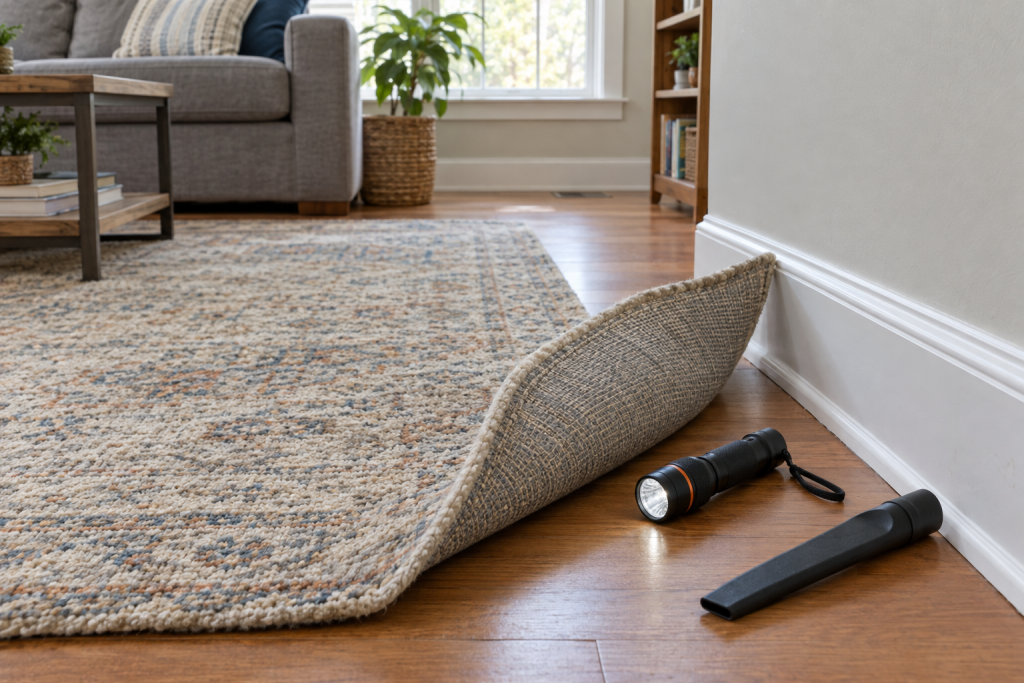
You get rid of carpet beetles by finding the larvae’s food source, vacuuming it out, killing every egg and larva with heat, cold, or hot washing, and then treating the cracks and edges where they hide with a labeled residual insecticide. Adults you see at windows are not the problem; the hairy brown larvae chewing wool, leather, and lint under your furniture are. Expect a serious afternoon of work, then two to three months of monitoring before you can call it done.
Quick steps: get rid of carpet beetles
- Confirm it’s carpet beetles by finding larvae or shed skins, not just adults.
- Track the larvae to the food source: wool, pet hair, lint, dead insects, nests.
- Vacuum every edge, void, and underside in the affected rooms, then bag the debris outside.
- Wash, dry-clean, heat, or freeze every infested fabric item.
- Spray a bifenthrin or deltamethrin product into cracks, carpet edges, and closet corners.
- Dust wall voids and under-carpet gaps with diatomaceous earth or deltamethrin dust.
- Set pheromone and sticky traps, then recheck weekly for 8-12 weeks.
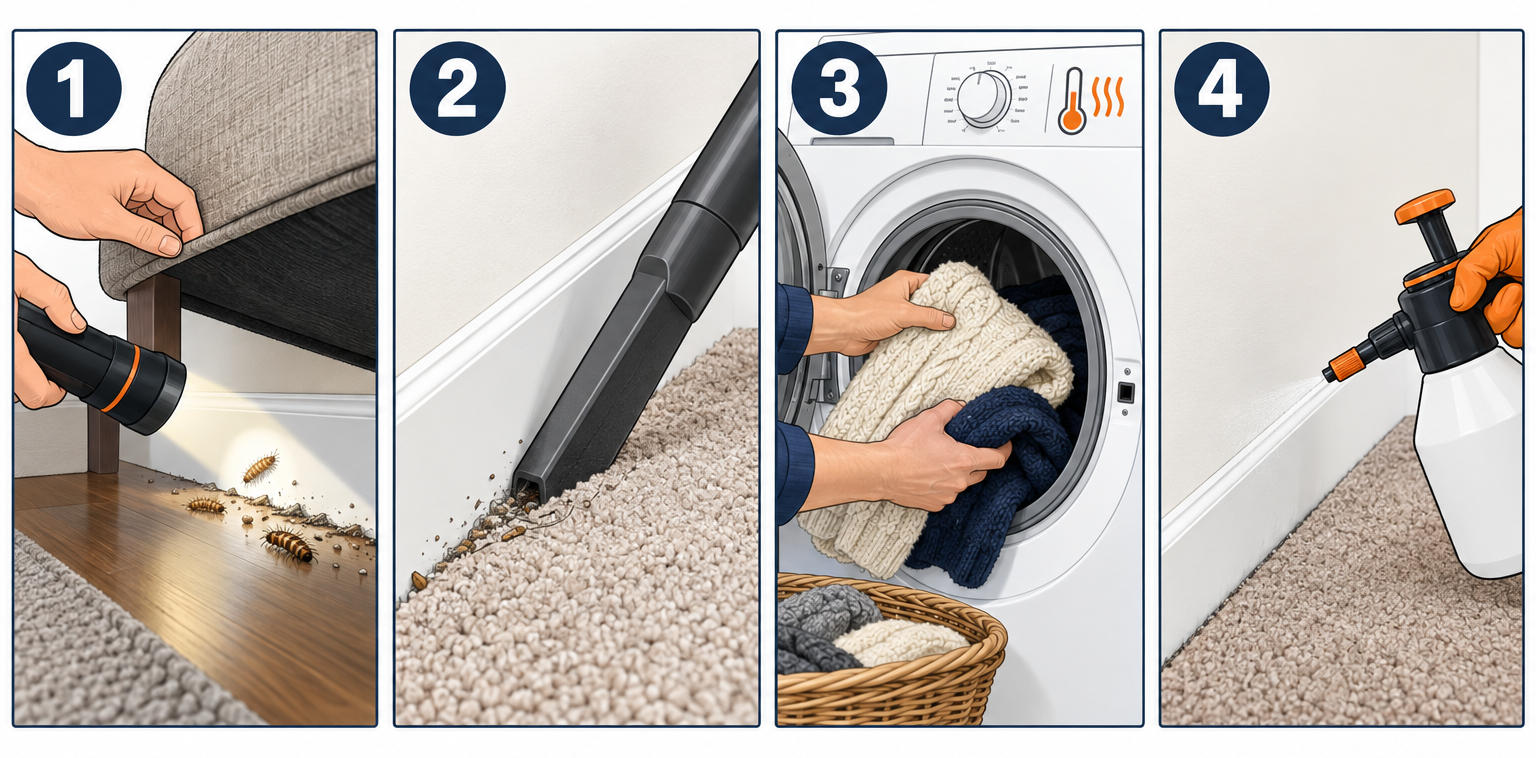
Tools and materials
- Vacuum with crevice tool and HEPA bag (or canister you can empty outdoors)
- Bright flashlight or headlamp
- Stiff brush and a screwdriver for lifting carpet edges and vent covers
- Washing machine with a 120°F+ hot cycle and a dryer with a high-heat setting
- Heavy trash bags and zip-top or vacuum-seal storage bags
- Bifenthrin concentrate (Talstar P, Bifen IT) or ready-to-use bifenthrin spray labeled for carpet beetles
- 1-gallon pump sprayer if using concentrate
- Deltamethrin dust (Delta Dust) or food-grade diatomaceous earth with a hand duster
- Carpet beetle pheromone traps and clear sticky traps
- Nitrile gloves, N95 mask, safety glasses
- Optional: handheld or upright steam cleaner
Safety first
Pyrethroid sprays and dusts are low-risk when used as labeled, but keep people and pets off treated surfaces until dry, wear gloves and an N95 when dusting, and never apply to bedding, clothing, or food surfaces. Diatomaceous earth is a lung irritant in any form, so mask up.
Step 1: Confirm it’s carpet beetles and which species
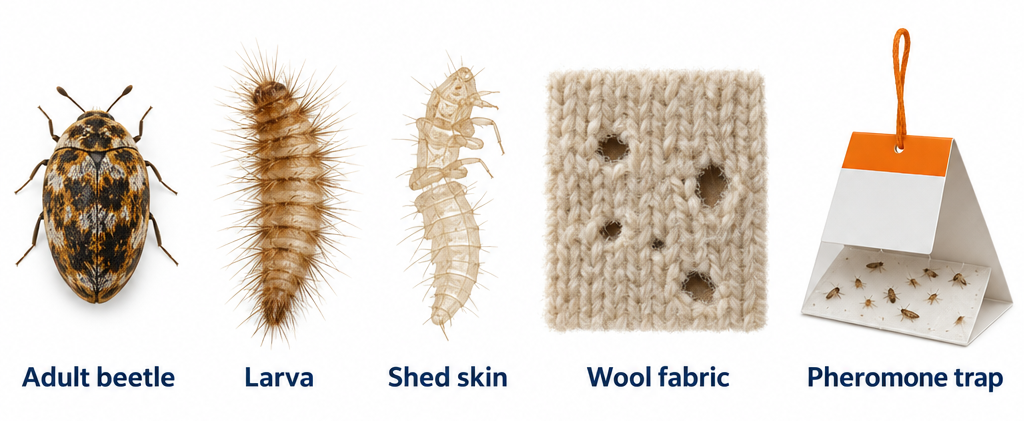
Adults are the easy part to spot and the least useful. They are small oval beetles, 1/16 to 3/16 inch long, that show up on windowsills and light fixtures in spring because they want to get outside and feed on pollen. Seeing a few adults means you have a breeding population somewhere in the house. It doesn’t tell you where.
Larvae are what you need to find. They are hairy, bristly, and slow, usually 1/8 to 1/2 inch long depending on species and age. Most people describe them as tiny fuzzy caterpillars or little brown worms with stripes. They avoid light, so you’ll find them under furniture, along baseboards, inside closets, and in the fold of a rug rather than out in the open.
The giveaway is shed skins. Each larva molts several times as it grows, leaving behind a hollow, translucent copy of itself. Piles of these in a drawer corner or under a sofa cushion confirm carpet beetles even if you never see a live larva. You’ll also see small, irregular holes in wool or silk with no webbing. Clothes moth damage comes with silky threads and tubes; carpet beetle damage is clean.
| Species | Adult appearance | Larva appearance | Larval stage length | Favorite food |
|---|---|---|---|---|
| Varied carpet beetle (Anthrenus verbasci) | 1/16 to 1/8 in, rounded, mottled white, brown, and yellow scales | 1/4 in, stubby, banded tan and brown, tufts of bristles at the rear | Roughly 9 months to 2 years, longer when food is poor | Wool, feathers, dead insects, lint, dried pet food |
| Black carpet beetle (Attagenus unicolor) | 1/8 to 3/16 in, oval, shiny black or very dark brown | Up to 1/2 in, carrot-shaped, golden to reddish brown, long tail of hairs | About 6 months to nearly 2 years | Wool, hair, fur, stored grains and cereals |
| Furniture carpet beetle (Anthrenus flavipes) | 1/8 in, rounded, white and dark mottling, sometimes orange scales | 1/4 in, broad, white to dark brown bands, very bristly | Several months to 2 years | Upholstery padding, horsehair, leather, silk |
| Common carpet beetle (Anthrenus scrophulariae) | 1/8 in, black with white scales and a line of orange-red down the back | 1/4 in, reddish brown, dense bristles | Around 2 to 3 months in warm conditions, longer when cool | Wool carpets, felt, feathers, dead insects |
Species matters a little. Black carpet beetle larvae roam further and get into pantries and pet food more often. Varied and furniture carpet beetle larvae tend to stay close to one rich food source. All four die to the same treatments, so don’t lose sleep over a perfect ID. Just get a good look at the larva so you know what to hunt.
One more thing to rule out. If you have itchy red welts and no bites you can explain, carpet beetle larvae may be the cause. Their bristles cause a rash in some people that looks a lot like bed bug bites. Check mattress seams for black fecal specks and blood spots before you blame bed bugs. If the seams are clean and you find shed skins under the bed, you’ve got your answer.
Step 2: Find the larvae’s food source
This is the step most people skip, and it’s why sprays fail. Carpet beetle larvae eat keratin: wool, silk, fur, feathers, hair, leather, and the bodies of dead insects. They also eat the dust and lint made of those things. Somewhere in your house there’s a concentration of that material, and the larvae are living in it. Kill the larvae you can see without removing the source and new ones hatch in a few weeks.
Grab a flashlight and work room by room, starting where you found larvae or damage. Get on the floor. Larvae feed in dark, undisturbed spots, so look in this order:
- Under and behind furniture that hasn’t moved in months, especially sofas and beds
- Along baseboards and under the edges of wall-to-wall carpet where the tack strip is
- Inside floor registers and cold-air returns, where pet hair and lint collect
- Closet floors and corners, and inside any stored wool, cashmere, or down
- Dresser drawers with sweaters, scarves, or felt hats
- Under area rugs, particularly wool or jute rugs on a hard floor
- Upholstered furniture seams, especially antique pieces with horsehair stuffing
- Behind the washer and dryer where lint accumulates
- Taxidermy, dried flowers, feather pillows, and wool blankets in the linen closet
- Window frames, attic corners, and light fixtures full of dead flies or ladybugs
Pay attention to anything dead. A forgotten mouse in a wall, a bird nest in the eaves or a bathroom vent, or an old wasp nest in the attic can support hundreds of larvae that eventually wander into living space. If you find larvae coming from a wall or ceiling with no obvious food nearby, that’s usually the explanation. Rodent nests count too, which is one reason to deal with mice quickly with snap traps for mice rather than letting a problem linger behind the walls.
Pet owners should look at pet beds, grooming spots, and anywhere a dog or cat sheds heavily. Dry pet food stored in an open bag is a common black carpet beetle food, and so is birdseed.
Mark each find. A sticky note or a photo per spot gives you a treatment map for the next three steps. Most homes have one or two real hotspots plus a few stray larvae that walked there from the hotspot.
Pro tip
Tap the edge of a suspect rug or sweater over a white sheet of paper. Larvae, shed skins, and the sand-like fecal pellets fall out and show up instantly against the white. It beats staring into dark wool with a flashlight.
Step 3: Vacuum everything they can eat
Vacuuming is the single most effective part of carpet beetle control because it removes larvae, eggs, shed skins, and the food all at once. Do it thoroughly, not quickly. A pass with the beater bar down the middle of the room does almost nothing.
Fit the crevice tool and work the edges of every room on your map. Push it hard into the gap between carpet and baseboard, along both sides of the tack strip, and into the corners of closets. Go slowly; the suction needs a second or two on each inch to pull larvae out of the pile. Pull up floor registers and vacuum as far into the duct as the hose reaches.
Move furniture. Vacuum the floor under it and the underside of the piece itself, including the dust cover fabric on the bottom of sofas and chairs. Use the upholstery tool in every seam and under every cushion. Pull dresser drawers all the way out and vacuum the cavity behind them. Vacuum closet shelves, the top of the baseboard, and the floor under hanging clothes.
Flip area rugs and vacuum both sides. If a wool rug is heavily infested, take it outside, beat it, and vacuum it there. Larvae love the back of a rug where it meets a hard floor because nobody looks.
When you’re done, take the vacuum outside. Pull the bag or empty the canister into a trash bag, tie it tight, and put it in the outdoor bin. Larvae survive just fine inside a vacuum and will crawl back out. Wipe the canister with a damp cloth.
For heavily infested carpet, a pass with a steam cleaner after vacuuming kills anything the vacuum missed. Larvae and eggs die quickly above about 120°F and a steamer delivers well over 200°F at the nozzle. Move slowly, about one inch per second, so the heat soaks into the pile. If you plan to steam carpets as part of a general deep clean, do it after vacuuming and before you spray so you don’t wash away the residual.
Expect this step to take two to three hours for a few rooms. That’s normal. The payoff is that you’ve removed most of the population before any chemical touches the house.
Step 4: Treat infested items with washing, heat, or cold
Every fabric item from a hotspot needs treatment, not just the ones with visible holes. Eggs are about 1/50 of an inch and nearly invisible on wool. Assume anything stored with an infested item carries eggs.
Sort items into four piles and use the table to decide what each gets.
| Method | What it kills | How to do it | Time | Best for |
|---|---|---|---|---|
| Hot wash and dry | All stages | Wash at 120°F or hotter, dry on high for at least 30 minutes | 1.5-2 hours per load | Cotton, synthetics, washable wool blends, bedding |
| Dryer only, high heat | All stages | Run dry items on the hottest setting for 30-45 minutes | 45 minutes | Clean items that just need treatment, pillows, stuffed animals |
| Dry cleaning | All stages | Tell the cleaner you suspect carpet beetles; the solvent and pressing heat kill larvae and eggs | 2-5 days | Wool suits, cashmere, silk, structured coats |
| Freezing | All stages when done long enough | Bag items airtight, freeze at 0°F for a minimum of one week, two weeks to be sure | 7-14 days | Delicates, taxidermy, feather items, anything that can’t take heat or solvent |
| Steam | Larvae and eggs on surfaces | Slow pass with a garment or carpet steamer | Minutes per item | Rugs, upholstery, curtains, mattress seams |
| Discard | Everything | Bag it outside, straight to the trash | Immediate | Cheap, badly damaged, or heavily infested items |
Washing works because of the dryer as much as the water. If your water heater is set to 120°F, which is the common default, the wash alone is marginal. The high-heat dryer cycle is what guarantees the kill. Don’t skip it for items that can take it.
Freezing in a household freezer is slower than most online advice admits. Many home freezers run around 0°F, which is the number you want, but a packed freezer with a big bundle of wool takes a day or more just to get the center cold. A week is the minimum you should trust. Two weeks covers you if your freezer runs warm or the item is bulky. Put items in a sealed bag first so condensation doesn’t soak them when they come out.
Dry cleaning is the right call for anything structured or expensive. Mention carpet beetles at drop-off so the cleaner knows to inspect and bag the item. A typical wool coat runs $15 to $30.
For leather, which larvae chew along the flesh side and seams, brush off any debris, wipe with a damp cloth, and run a steamer across the surface at a distance. Leather can’t go in the dryer and doesn’t like freezing. Heavily infested leather usually isn’t worth saving.
Once items are clean, keep them out of the hotspot rooms until you finish Step 5. Store them in sealed plastic bins or vacuum-seal bags. Cardboard boxes and dry-cleaner plastic don’t count; larvae chew through both.
Pro tip
Run the dryer on high with an empty drum for five minutes before and after treating infested items. The pre-heat gets the drum hot so the full cycle counts, and the post-heat cooks any larvae that fell into the lint trap or the gap around the drum.
Step 5: Spray cracks, edges, and voids with a residual insecticide
With the food removed and the items treated, a residual spray handles the larvae still walking around and the eggs that hatch over the next few weeks. You’re not fogging rooms. You’re putting a thin band of product exactly where larvae travel: carpet edges, baseboards, closet floors, under furniture, inside drawer cavities, and around floor registers.
Pick a product that lists carpet beetles on the label. Bifenthrin is the most common active ingredient in both pro concentrates and hardware-store sprays. Talstar P and Bifen IT are concentrates you mix at a label range of 0.25 to 1 fluid ounce per gallon for Talstar P or 0.18 to 1 fluid ounce per gallon for Bifen IT, with the 1-ounce rate reserved for heavy infestations; one quart makes 32 to 96 gallons depending on the rate and costs roughly $40 to $50. Ready-to-use sprays like Ortho Home Defense, which combines bifenthrin with zeta-cypermethrin, cost $10 to $17 per gallon and work fine for a couple of rooms. Deltamethrin and cyfluthrin products do the same job. Follow the label rates and reapplication limits exactly. More spray is not more effective; it’s just more residue.
Work in this order so you don’t walk through wet product:
- Pull back carpet edges with a flathead screwdriver where you can and spray the tack strip and the gap under the baseboard.
- Spray a 2-inch band along every baseboard in the affected rooms.
- Spray the floor and lower walls of closets, inside emptied drawers and the dresser cavities, and under and behind furniture.
- Spray the underside of sofas and chairs, not the cushions or arms people touch.
- Spray around floor registers and the inside lip of the duct.
Keep it to a light, even wet coat. Pyrethroids dry to an invisible film that keeps killing for several weeks indoors on undisturbed surfaces. Let everything dry, usually one to two hours, before people or pets come back in. Don’t spray clothing, bedding, mattresses, or food-prep areas, and don’t spray areas you just vacuumed if you intend to steam them later.
Dust is for places spray can’t reach. Pull outlet and switch covers on walls where you suspect a nest and puff a small amount of deltamethrin dust (Delta Dust, about $25 to $35 for a pound that stays good for up to three years) into the void. Do the same into the gap between carpet and tack strip, behind kick plates under cabinets, and into attic corners where dead insects pile up. Deltamethrin dust is waterproof and stays active for months in dry voids.
Food-grade diatomaceous earth is a non-chemical option for the same voids. It works by abrading the larva’s waxy coating, which takes days rather than hours, and it stops working if it gets damp. Use a hand duster so you lay down a barely visible film. A thick pile of DE is a mess larvae walk around. A 4-pound bag runs $10 to $20.
Boric acid dust under the edges of wall-to-wall carpet is an old pest-control standby that still works, but it’s toxic if pets lick it off their paws, so keep it in voids rather than open floor.
Fogger “bombs” are a waste of money here. The mist settles on the tops of surfaces, and larvae are under things, inside things, and behind things. Save your $12.
Pro tip
Spray closet floors and the bottom 6 inches of closet walls, then let it dry fully before anything goes back in. Closets are the number one place carpet beetles rebound, and that dried band stops larvae migrating from a missed sweater into every other garment.
Step 6: Set traps and monitor for 8 to 12 weeks
Traps won’t eliminate carpet beetles, but they tell you whether the treatment worked and where survivors are. That’s worth $15.
Pheromone traps for carpet beetles use a lure that attracts adult males of varied, furniture, and some black carpet beetles. Place one in each treated closet, one under the bed in each affected bedroom, and one near the main hotspot. A pack of two to six traps costs $10 to $25 and lures last two to three months.
Clear sticky traps work for larvae. Put them flat against the baseboard in closets and behind furniture so larvae crawling the edge walk onto them. Check both kinds of trap once a week and write down the count. The numbers should drop to near zero within four to six weeks. If a trap keeps catching larvae in the same spot, you missed a food source within a few feet of it.
Keep vacuuming the edges of hotspot rooms weekly during this period. New larvae hatch over two to three weeks from eggs the first round missed, and weekly vacuuming catches them before they’re big enough to do damage or wander. Re-spray edges once at the four to six week mark if traps still show activity, staying inside the label’s reapplication limit.
Adults appearing at windows in spring after a full treatment is not failure. Some adults fly in from outdoors every year to lay eggs on whatever wool or lint they can find. That’s why Step 7 matters more than any spray.
Step 7: Keep carpet beetles from coming back
Prevention is mostly housekeeping with a few targeted upgrades. Carpet beetles are everywhere outdoors, and adults will get in. Whether their eggs turn into a problem depends on what’s available to eat.
Store all wool, cashmere, silk, fur, feathers, and down in sealed plastic bins or vacuum-seal bags, clean. Larvae are drawn to sweat, food stains, and skin oils on worn items, so never store a garment dirty. Cedar chests and cedar blocks smell nice but the oil loses potency within months and never did much against beetles anyway. Airtight is what works.
Vacuum under furniture and along baseboards monthly, not just the traffic lanes. Pull floor registers once or twice a year and vacuum the duct as far as you can reach. Clean behind the dryer and wipe out the lint path. These are the spots where the keratin-rich lint piles up.
Deal with dead insects. Clean out window tracks, light fixtures, and attic corners in late summer when cluster flies, ladybugs, and boxelder bugs die in bulk. A tray of dead insects is a buffet.
Remove nests. Bird nests in eaves, dryer vents, and bathroom fan hoods should go as soon as the birds leave, and the vent should get a screened cover. Old wasp nests in the attic get bagged and tossed. If you find a dead rodent, bag it, and go after the rest with traps.
Check what comes into the house. Secondhand wool rugs, antique upholstered furniture, thrift-store sweaters, dried flower arrangements, and taxidermy all carry carpet beetles. Inspect, then freeze or dry-clean before they join the household.
Seal the easy entry points. Repair window screens, caulk gaps around window frames, and weatherstrip exterior doors. Adults are small, but closing the obvious holes cuts the spring flight.
Pet owners get extra chores: wash pet beds monthly on hot, vacuum the pet’s favorite shedding spots weekly, and store dry food in a sealed container rather than the bag.
What carpet beetle control costs
| Item | Typical US cost | Notes |
|---|---|---|
| Bifenthrin concentrate (Talstar P or Bifen IT, 32 oz) | $40-50 | Makes 32-96 gallons depending on label rate; lasts years |
| Ready-to-use bifenthrin spray (1 gal) | $10-17 | Enough for 2-3 rooms of edges and closets |
| Deltamethrin dust (1 lb) | $25-35 | Waterproof; use in voids and under carpet edges |
| Food-grade diatomaceous earth (4 lb) | $10-20 | Non-chemical alternative for dry voids |
| Hand duster | $8-15 | Needed to apply dust thinly |
| 1-gallon pump sprayer | $15-30 | Only if using concentrate |
| Pheromone traps (pack of 2-6) | $10-25 | Lures last 2-3 months |
| Clear sticky traps (pack of 10-20) | $8-15 | Monitor larvae along baseboards |
| Vacuum-seal or airtight storage bags | $15-30 | Long-term storage for wool and down |
| Dry cleaning | $15-30 per garment | Coats and suits |
| Steam cleaner rental | $30-50 per day | Rugs and upholstery; optional |
| Pro pest control visit | $150-350 | Usually one treatment plus a follow-up; more for severe or multi-room jobs |
A typical DIY job for one or two affected rooms runs $40 to $120 depending on whether you buy concentrate or ready-to-use spray and how much dry cleaning you need. A pro visit in most US markets lands between $150 and $350 for a standard inspection and crack-and-crevice treatment, often with one follow-up included. Severe infestations with multiple rooms or structural sources cost more.
Troubleshooting: when carpet beetle control doesn’t take
| Symptom | Likely cause | Fix |
|---|---|---|
| Larvae keep showing up in the same closet after treatment | A missed infested garment or an untreated item put back in the closet | Empty the closet again, treat every item, spray the floor and lower walls, and keep it empty for a week |
| Larvae appear from a wall, ceiling, or light fixture | Nest or dead animal in the void | Find and remove the nest, then dust the void with deltamethrin dust |
| Adults at windows every spring, no larvae found | Normal seasonal flight from outdoors | Vacuum them up, check storage, no treatment needed unless larvae appear |
| Sticky traps catch larvae in one spot for weeks | Food source within a few feet that you haven’t found | Lift carpet, pull the register, move the furniture, and check inside upholstery |
| Holes in clothes continue in sealed storage | Eggs or larvae were inside the items when sealed | Pull everything, hot-dry or freeze, re-seal clean |
| Itchy welts continue after treatment | Larval bristles still in bedding or on the mattress | Wash bedding hot, vacuum the mattress and box spring, steam the seams |
| Larvae in the pantry or pet food | Black carpet beetles feeding on cereal, grain, or kibble | Discard infested food, vacuum shelves, store food in sealed containers |
| Spray didn’t reduce numbers | Applied to open floor instead of edges, or product not labeled for carpet beetles | Re-treat cracks, edges, and voids only, using a bifenthrin or deltamethrin product |
| New larvae every few weeks for months | Multiple hotspots or a hidden structural source | Full house inspection with a pro, including attic and crawlspace |
When to call a pro
Call a licensed pest control company when larvae keep emerging from walls, ceilings, or ductwork after you’ve done the cleaning and item treatment, when the infestation covers more than two or three rooms, or when the source is a bird, rodent, or wasp nest you can’t reach. Ask for a company that does a real inspection, including the attic and crawlspace, rather than a quick spray. If you suspect a dead animal inside a wall, a pest technician with a borescope can locate it, and removing it may need a drywall patch afterward.
Expected result
By the end of the first day you should have no visible larvae in the treated rooms, every fabric item from the hotspots either treated or sealed away, and a dried residual band along the edges. Over the next two to three weeks you’ll likely catch a few late-hatching larvae on sticky traps or in the vacuum. By week six, trap counts should be zero and you shouldn’t find a single shed skin on a flashlight check. Adults at windows the following spring are normal and don’t mean the job failed, as long as your stored wool stays sealed and the edges stay vacuumed.
FAQ
Do carpet beetles bite?
No. Adults eat pollen and larvae eat keratin, and neither has any interest in you. The itchy welts some people get come from an allergic reaction to the larvae’s bristles, which rub off on bedding and clothes. Hot-wash the bedding, vacuum the mattress, and the rash clears once the larvae are gone.
How long does it take to get rid of carpet beetles?
Most of the population dies on the first day of cleaning and treating. Eggs already laid hatch over the following two to three weeks, so count on four to six weeks of weekly vacuuming and trap checks before the house is quiet, and two to three months before you can be fully confident.
Can I have carpet beetles without carpet?
Yes, and plenty of homes with hardwood floors do. The larvae eat wool clothing, pet hair, lint in ducts, feather pillows, dead insects in window frames, and nests in walls. The name comes from the days when wool carpet was in every house, not from a requirement.
Does diatomaceous earth kill carpet beetles?
It does, slowly, if the larvae walk through a thin dry layer of it. It’s a fair choice for wall voids and under carpet edges where you don’t want a chemical. It’s a poor choice as the main treatment because it takes days to kill, does nothing to eggs, and stops working when damp.
Are carpet beetles a sign of a dirty house?
Not really. Adults fly into clean houses every spring and lay eggs on any wool sweater, down comforter, or pile of pet hair they find. Clutter and skipped vacuuming give larvae more undisturbed places to feed, but a spotless house with a wool rug and a shedding dog can host them too.
Will carpet beetles go away on their own?
No. Larvae can live over a year on a surprisingly small amount of food, and each female adult lays dozens of eggs. Left alone, the population grows and spreads from the original hotspot to closets and furniture across the house.
What’s the difference between carpet beetles and clothes moths?
Both chew wool, but clothes moth larvae spin silk webbing and small tubes in the fabric, and the adults are tan moths that avoid light. Carpet beetle larvae leave shed skins and clean holes with no silk, and the adults are oval beetles that head for windows. The treatment steps are nearly identical, so an exact ID matters less than finding the food source.