
This mulch calculator turns three measurements, the length and width of your bed in feet and the depth you want in inches, into cubic yards, cubic feet, bag count and an optional price. Measure each bed, add the numbers, and you have an order you can hand to a bulk yard or carry to the garden center without guessing.
Quick steps: use the mulch calculator
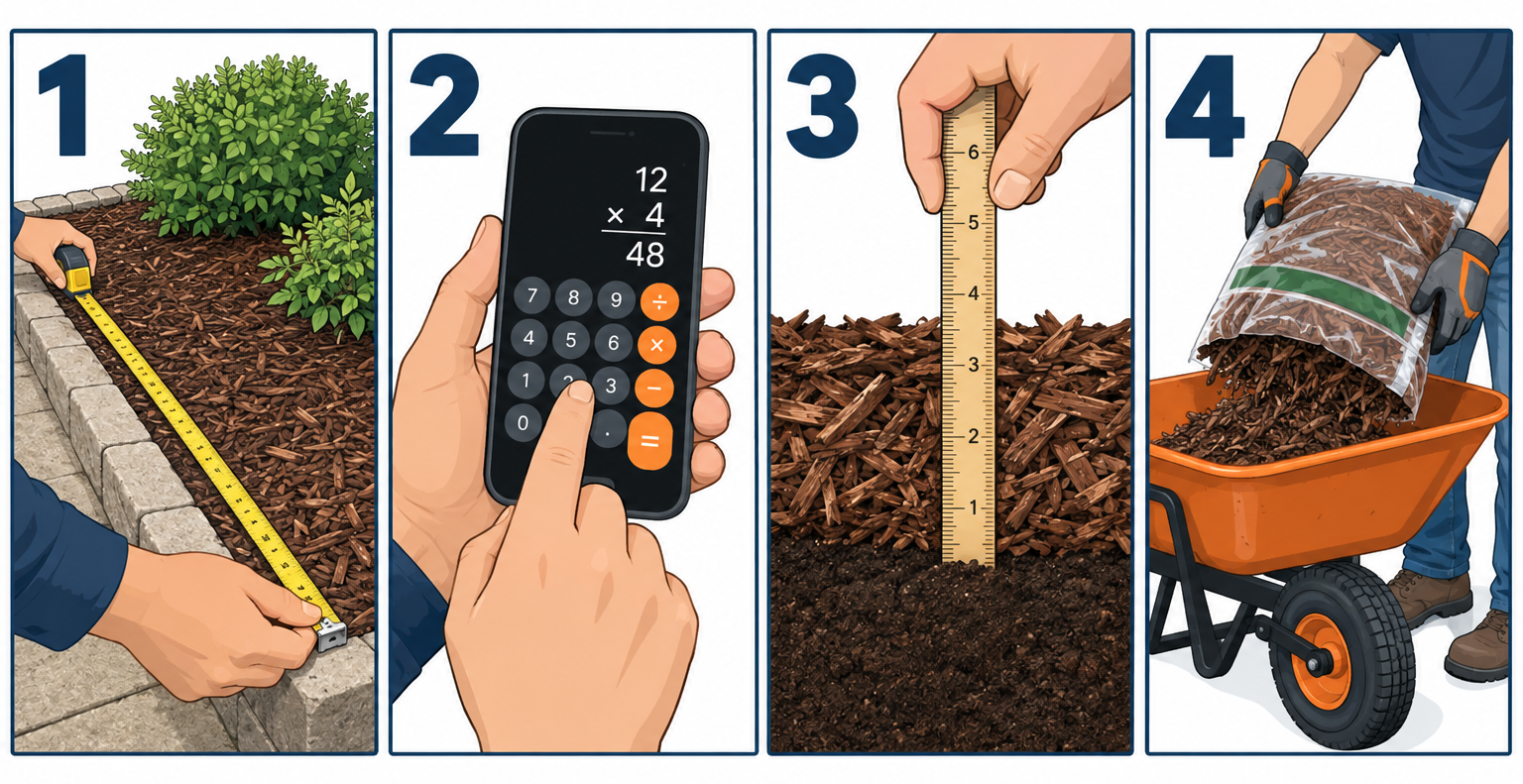
- Measure the longest side of the bed in feet and enter it as Length (ft).
- Measure across the bed at its widest point and enter it as Width (ft).
- Pick a depth in inches: 3 for a new bed, 1 to 2 for a top-up.
- Choose the Bag size you plan to buy (2, 3 or 1.5 cu ft).
- Enter the bulk Price per cubic yard if you have a quote.
- Repeat for each bed, add the cubic feet together, then round bags up.
Tools and materials
- 25 ft tape measure or 100 ft open-reel tape for long borders
- Measuring wheel for curved beds and tree rings
- Ruler or paint stir stick for checking existing mulch depth
- Notepad or phone to log each bed’s length, width and depth
- Wheelbarrow (6 cu ft) and 10-tine mulch fork for spreading
- Steel bow rake for leveling, leather gloves, N95 mask for dusty loads
How to use the mulch calculator
Each field maps directly to something you can measure in the yard. Get these right and the output is accurate to within a bag or two on any normal bed.
Length (ft) and Width (ft)
Walk the bed and measure its longest straight dimension, then the widest point across it. Enter both in feet, using decimals rather than inches: 14 feet 6 inches is 14.5, not 14.6. Beds wider at one end than the other can be averaged. A border that is 5 ft wide near the house and 3 ft wide at the walk averages to 4 ft.
For a bed that is not a rectangle, break it into rectangles and run the calculator once per piece. An L-shaped foundation bed becomes two boxes. A kidney-shaped island bed is close enough as one rectangle around its outside edges, which errs slightly high, and a little extra mulch always finds a home.
Circles need one extra step. Multiply the diameter by itself, then by 0.785, to get the square footage. A 6 ft tree ring is 6 × 6 × 0.785 = 28.3 sq ft. Enter 28.3 as Length (ft) and 1 as Width (ft), and the calculator does the rest.
Pro tip
Any odd shape works in this calculator if you already know the square footage. Enter the total square feet as Length (ft) and 1 as Width (ft). A “square footage calculator” is the quickest way to get that number for curved beds, triangles and beds that wrap a corner.
Depth (in)
The default is 3 inches, which is the standard depth for a new application of shredded hardwood, bark or wood chips. Depth drives the volume more than people expect: going from 2 inches to 3 inches adds 50 percent to your order.
Match the depth to the job:
- New bed on bare soil: 3 inches for shredded mulch, 3 to 4 inches for coarse bark nuggets.
- Annual top-up over existing mulch that still looks decent: 1 inch.
- Refresh where old mulch has thinned to a half inch: 2 inches.
- Around perennials and annuals: 2 inches, and keep it off the crowns.
- Playground wood chips under play equipment: 9 inches, which the U.S. Consumer Product Safety Commission playground handbook lists for a 10 ft fall height.
To check existing depth, push a ruler or paint stick straight down until it hits soil. Do this in four or five spots per bed and average them. Then subtract what is there from the target depth and enter the difference.
Bag size
Bagged mulch in the US comes in three common sizes. Two cubic feet is the most common size, and it is what Lowe’s and most garden centers stack on pallets in spring, while Home Depot’s main spring sale brand comes in 1.5 cu ft bags. Three cubic foot bags show up for pine bark nuggets, cedar and some premium brands. A 1.5 cu ft bag is typical for cypress blends, soil conditioner sold as mulch, and some dyed products in smaller markets.
Read the bag before you set this field. The size is printed on the front in cubic feet, and two bags that look the same height on the pallet can hold different volumes.
Price per cubic yard (optional)
Leave this at 0 if you are buying bags. If you have a bulk quote, enter the per-yard price and the calculator multiplies it by the cubic yards you need. Bulk suppliers quote mulch by the cubic yard, often shortened to “yard” or “yd” on the invoice, so a quote of “$38 a yard delivered” goes in as 38.
To compare bags against bulk, convert the bag price to a per-yard figure first. There are 13.5 two-cubic-foot bags in a cubic yard, so a $4.50 bag equals $60.75 per cubic yard. A $3.00 spring sale price equals $40.50 per yard.
Measuring mistakes that throw off the result
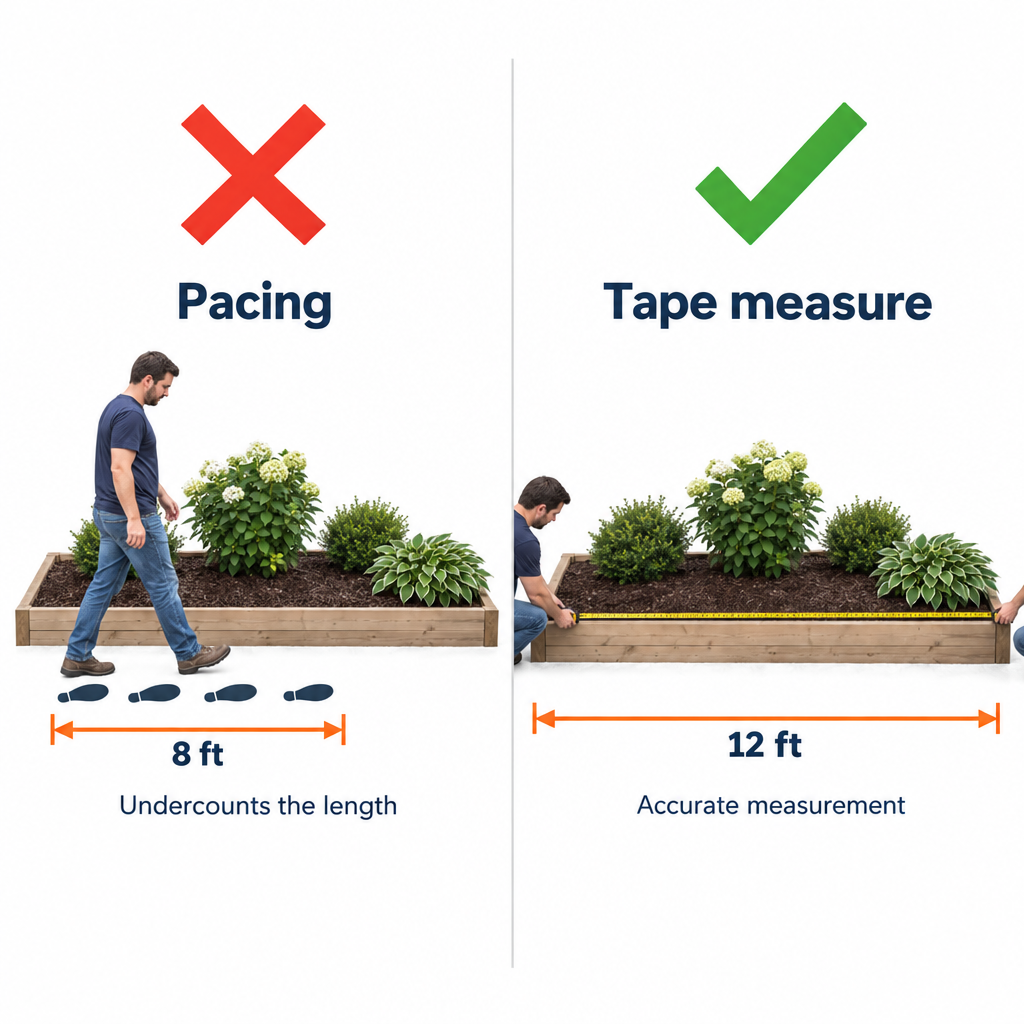
The most common error is measuring the bed in inches on one side and feet on the other. Keep everything in feet for length and width and only switch to inches for depth. Second most common is pacing the bed instead of taping it. A stride feels like 3 feet and is usually closer to 2.5, which undercounts a 30 ft border by 5 ft.
People also forget beds. Walk the whole property with the notepad: foundation beds on all four sides, tree rings, mailbox bed, the strip along the driveway, the island in the back. Log each one before you total anything.
The mulch calculator formula, written out
The calculator uses one formula, the same length × width × depth math you would use in a “concrete calculator” for a slab, just with mulch depths instead of slab thickness:
Length (ft) × Width (ft) × Depth (in) ÷ 12 = cubic feet
Cubic feet ÷ 27 = cubic yards
Cubic feet ÷ bag size = bags
Cubic yards × price per cubic yard = cost
Here is what each piece does. Length times width gives square feet of bed surface. Dividing depth in inches by 12 converts it to feet, so you are multiplying feet by feet by feet and getting cubic feet. There are 27 cubic feet in a cubic yard (3 ft × 3 ft × 3 ft), so dividing by 27 gives the unit bulk yards sell in. Bags are just the cubic feet split into bag-sized pieces.
Worked example with the default inputs
The calculator defaults to a 20 ft by 10 ft bed at 3 inches deep with 2 cu ft bags. Step by step:
- Area: 20 ft × 10 ft = 200 sq ft
- Depth in feet: 3 in ÷ 12 = 0.25 ft
- Cubic feet: 200 × 0.25 = 50 cu ft
- Cubic yards: 50 ÷ 27 = 1.85 cu yd
- Cubic meters: 50 × 0.0283 = 1.42 m³
- Bags: 50 ÷ 2 = 25 bags
So the calculator shows mulch needed of 1.85 cubic yards, 50 cubic feet, 1.42 cubic meters and 25 bags of 2 cu ft each. Order 2 cubic yards from a bulk supplier, or buy 25 bags.
Second worked example: a long border at 2 inches in 3 cu ft bags
Say you have a 35 ft border along a fence that is 6 ft deep, with an inch of old mulch still on it. You want to bring it to 3 inches, so you need 2 inches of new material, and the pine bark nuggets you like come in 3 cu ft bags at a quoted bulk price of $40 per yard.
- Area: 35 ft × 6 ft = 210 sq ft
- Depth in feet: 2 in ÷ 12 = 0.1667 ft
- Cubic feet: 210 × 0.1667 = 35 cu ft
- Cubic yards: 35 ÷ 27 = 1.30 cu yd
- Bags: 35 ÷ 3 = 11.67, round up to 12 bags
- Bulk cost: 1.30 × $40 = $52.00
Twelve 3 cu ft bags at $6 each would run $72, so bulk wins on price here, but most yards will not deliver 1.3 yards for less than a $50 to $75 delivery fee. For a job this size, bags in the back of an SUV usually make more sense. That trade-off is covered below.
Mulch coverage quick reference
Both tables below use the same formula as the calculator. The first shows how far one cubic yard, and one 2 cu ft bag, stretches at each depth.
| Depth | Sq ft per cubic yard | Sq ft per 2 cu ft bag | Sq ft per 3 cu ft bag | Bags (2 cu ft) per cubic yard |
|---|---|---|---|---|
| 1 in | 324 | 24 | 36 | 13.5 |
| 2 in | 162 | 12 | 18 | 13.5 |
| 3 in | 108 | 8 | 12 | 13.5 |
| 4 in | 81 | 6 | 9 | 13.5 |
| 6 in | 54 | 4 | 6 | 13.5 |
| 9 in | 36 | 2.7 | 4 | 13.5 |
The bag count per cubic yard never changes because it is a straight volume conversion: 27 ÷ 2 = 13.5 bags, 27 ÷ 3 = 9 bags, 27 ÷ 1.5 = 18 bags.
This second table covers common bed sizes at the two depths most people use.
| Bed size | Area | Cu yd at 2 in | Bags (2 cu ft) at 2 in | Cu yd at 3 in | Bags (2 cu ft) at 3 in |
|---|---|---|---|---|---|
| 10 × 4 ft | 40 sq ft | 0.25 | 4 | 0.37 | 5 |
| 10 × 10 ft | 100 sq ft | 0.62 | 9 | 0.93 | 13 |
| 20 × 10 ft | 200 sq ft | 1.23 | 17 | 1.85 | 25 |
| 30 × 10 ft | 300 sq ft | 1.85 | 25 | 2.78 | 38 |
| 40 × 15 ft | 600 sq ft | 3.70 | 50 | 5.56 | 75 |
| 50 × 20 ft | 1,000 sq ft | 6.17 | 84 | 9.26 | 125 |
Bag counts are rounded up, since no store sells two-thirds of a bag.
How deep to spread each type of mulch
The right depth depends on particle size. Fine, shredded material packs tight and blocks air and water if it goes on too thick. Coarse nuggets and chips leave gaps, so they need more depth to do the same job of shading out weeds and holding soil moisture.
| Mulch type | New bed depth | Top-up depth | Notes |
|---|---|---|---|
| Shredded hardwood or dyed shredded | 2-3 in | 1 in | Knits together on slopes, most common bulk product |
| Pine bark nuggets (mini or large) | 3-4 in | 1-2 in | Floats in heavy rain, keep off slopes |
| Arborist wood chips | 3-4 in | 1-2 in | Often free from tree services, settles about 25% |
| Cedar or cypress | 2-3 in | 1 in | Slow to break down, lighter per yard |
| Pine straw | 3-4 in | 2 in | Sold by the bale, not the yard |
| Compost used as mulch | 1-2 in | 1 in | Doubles as a soil amendment |
| Decorative stone or gravel | 2-3 in | none | Sold by the ton, see note below |
| Rubber mulch, landscape beds | 1.5-3 in | 1 in | Does not decompose |
| Rubber mulch, playground | 6 in | as compacted | CPSC lists 6 in for 10 ft fall height |
The 3-3-3 rule is a decent memory aid for trees: 3 inches deep, pulled back 3 inches from the trunk, out to a 3 ft radius or more. Mulch piled against bark holds moisture against the trunk, invites borers and rot, and is the single most common mistake landscapers see. The same goes for shrubs. Leave a bare ring the width of your hand around every stem.
For stone, the calculator still gives you the right cubic yards, but gravel yards sell by weight. Most 3/4 inch decorative stone runs about 1.4 tons per cubic yard, so multiply the cubic yard result by 1.4 to get tons. River rock is a touch lighter, lava rock much lighter.
Buying and ordering mulch: bulk, bags and delivery
Mulch is sold two ways in the US. Bulk suppliers, landscape yards and some big-box stores sell by the cubic yard, loaded into your truck or delivered in a dump truck. Retail stores sell bags by the piece or by the pallet. The break-even point is usually around 2 to 3 cubic yards.
| Product | Typical bulk price per cubic yard | Typical bag price | Bag price per cubic yard |
|---|---|---|---|
| Shredded hardwood, natural | $25-45 | $3-5 per 2 cu ft | $40-68 |
| Dyed shredded (black, brown, red) | $35-60 | $3.50-6 per 2 cu ft | $47-81 |
| Pine bark nuggets | $35-60 | $5-7 per 3 cu ft | $45-63 |
| Cedar | $40-75 | $5-8 per 2 cu ft | $68-108 |
| Cypress blend | $35-65 | $4-6 per 2 cu ft | $54-81 |
| Rubber mulch | sold per ton, several times wood prices | $8-15 per 0.8 cu ft | well over $200 |
| Delivery fee, bulk | $50-150 flat, often waived above 5-10 yards | n/a | n/a |
Prices move by region and season. The Northeast and West Coast run high, the Southeast low, and bagged mulch drops sharply during spring promotions when the big boxes run four or five bags for $10. Treat the table as a sanity check against a quote, not a price list.
When bulk makes sense
Bulk mulch is cheaper per yard once you are past the delivery fee. Most landscape yards set a 1 to 3 cubic yard minimum for delivery, and a single-axle dump truck carries 8 to 12 yards per trip. If you need 4 yards at $35 plus $75 delivery, that is $215, or $53.75 per yard delivered. The same 4 yards in 54 bags at $4 each is $216 and three trips with a loaded SUV. Bulk also tends to be fresher and less likely to arrive sour, that sharp vinegar smell from bags that sat wet on a pallet.
You can skip the delivery fee by picking up. A half-ton pickup with an 8 ft bed holds 2 to 2.5 cubic yards heaped and tarped. A cubic yard of shredded hardwood weighs roughly 400 to 800 pounds depending on moisture, so 2 yards of wet mulch pushes a half-ton truck to its limit. A 6 ft bed takes about 1.5 yards.
When bags make sense
Bags win below about 2 yards, for beds that are far from any spot a dump truck can reach, and for anyone without a wheelbarrow route. A 2 cu ft bag weighs 20 to 40 pounds, carries to the back corner of the yard in one hand, and splits open right where it is needed. Bags also let you buy exactly the color you want, since bulk dyed mulch varies from load to load.
How much extra to order
Add 10 percent to the calculator result for bulk orders, and round bags up to the next whole bag per bed rather than per total. Three things eat the margin. Shredded mulch settles 15 to 25 percent in the first month as it dries and compacts. Beds are almost never true rectangles, and the curves add up. And you will spread it thicker than 3 inches in the first bed because a fresh pile makes everyone generous.
Leftover bulk mulch keeps fine on a tarp for a season. Leftover bags are easier to return.
Pro tip
Ask the bulk yard how they load. Many scoop with a front-end loader bucket rated at 1 cubic yard, but a heaped bucket of light shredded mulch is often 1.2 yards and a struck-off bucket of wet mulch under 0.9. If you get home with two yards and your 1.85 yard calculation leaves you short, the bucket was light, not your math.
Rubber mulch calculator notes
The volume math is identical for rubber mulch. Enter the same length, width and depth and read cubic feet. The difference is packaging. Rubber mulch is usually sold in 0.8 cu ft bags, not 2 cu ft, so take the cubic feet from the calculator and divide by 0.8 yourself. The default bed at a 2 inch landscape depth is 200 × 2 ÷ 12 = 33.3 cu ft, which is 42 bags of 0.8 cu ft. Some suppliers also sell by the ton, at roughly 2,000 pounds covering 1.5 to 1.7 cubic yards.
Use 6 inches for playground surfacing. Because rubber does not settle or decompose, you only buy it once, which is where its premium price gets justified.
Home Depot and Lowe’s mulch calculators versus this one
Both retailers run a mulch calculator on their product pages. They work the same way, square feet and depth in, bag count out, but they assume the bag size of the product you are looking at, and they only quote bags. That is fine if you are buying their bags.
This calculator lets you switch between 2, 3 and 1.5 cu ft bags, shows cubic yards for bulk quotes, and takes a price per cubic yard so you can compare a landscape yard’s number against the store shelf in one view. Run both if you like. The bag count should match once you set the same depth and bag size.
Mistakes that leave you short or buried in extra bags
| Mistake | What happens | Fix |
|---|---|---|
| Entering 2 inches for a new bed on bare soil | Weeds push through by July, soil dries out | Use 3 in for new beds, 1-2 in only for top-ups |
| Measuring in paces instead of a tape | Undercount of 15-20% on long borders | Tape every bed, log length and width in feet |
| Mixing feet and inches in the same field | Results off by a factor of 12 | Feet for Length and Width, inches only for Depth |
| Forgetting settling | Bed looks thin after the first few rains | Add 10% to bulk orders |
| Assuming all bags are 2 cu ft | 1.5 cu ft bags leave you 25% short | Read the bag, set Bag size to match |
| Ordering a bulk yard for a 40 sq ft bed | Pay delivery on 0.4 yards, pile sits in the driveway for weeks | Buy 5 bags instead |
| Piling against trunks and siding | Trunk rot, termite bridge to the house | Keep mulch 3 in off trunks, 6 in below siding |
| Rounding bags down | One bag short with the car already unloaded | Always round up, per bed |
Safety first
Keep mulch at least 6 inches below siding and away from wood framing to avoid giving termites a covered path to the house, and never pile it against a foundation vent. Wear an N95 mask when unloading a dusty or steaming bulk pile; dry mulch dust carries mold spores that trigger coughs and headaches. Never exceed your truck’s payload rating with wet mulch.
When to call a pro
Call a landscape contractor when the job tops about 10 cubic yards, when beds sit above retaining walls or on slopes steeper than 3:1 where erosion control matters, or when a dump truck cannot get within wheelbarrow range of the beds. Installed mulch typically runs $60 to $120 per cubic yard spread, and a two-person crew moves 10 yards in a morning. Playground surfacing under public or daycare equipment should be installed and depth-certified by a playground contractor to meet CPSC and ASTM F1292 requirements.
FAQ
What is the 3-3-3 rule for mulch?
Spread mulch 3 inches deep, keep it 3 inches away from the trunk or stem, and extend it at least 3 feet out from a tree in every direction. The depth controls weeds and holds moisture, the gap at the trunk prevents rot and pests, and the 3 ft ring protects roots from mower damage. For a 3 ft radius ring, that is a 6 ft diameter circle of about 28 sq ft, which needs 7 cu ft or four 2 cu ft bags at 3 inches.
How much will a 2 cu ft bag of mulch cover?
A 2 cu ft bag covers 8 sq ft at 3 inches deep, 12 sq ft at 2 inches, and 24 sq ft at 1 inch. Divide 2 by the depth in feet to get the number for any other depth: 2 ÷ (4 ÷ 12) = 6 sq ft at 4 inches.
How much will 25 bags of mulch cover?
Twenty-five 2 cu ft bags hold 50 cu ft, or 1.85 cubic yards. That covers 200 sq ft at 3 inches deep, 300 sq ft at 2 inches, or 600 sq ft at 1 inch. Twenty-five 3 cu ft bags hold 75 cu ft and cover 300 sq ft at 3 inches.
Is it cheaper to buy bags of mulch or bulk?
Bulk is cheaper per cubic yard, usually $25 to $60 against $40 to $80 for the same material in bags, but delivery fees of $50 to $150 wipe out the savings on small orders. Below about 2 cubic yards buy bags, above 3 yards buy bulk, and in between it depends on whether you can pick up with your own truck. Spring bag promotions at the big boxes can flip the math, so check the shelf price before you order a truck.
How many bags of mulch are in a cubic yard?
A cubic yard is 27 cubic feet, so it equals 13.5 bags of 2 cu ft, 9 bags of 3 cu ft, or 18 bags of 1.5 cu ft. Rubber mulch in 0.8 cu ft bags takes about 34 bags to make a yard.
How many yards of mulch do I need for 1,000 square feet?
At 3 inches deep, 1,000 sq ft needs 1,000 × 3 ÷ 12 = 250 cu ft, which is 9.26 cubic yards, so order 10. At 2 inches it is 166.7 cu ft or 6.17 yards, so order 7. In 2 cu ft bags that is 125 bags at 3 inches or 84 at 2 inches.
Can I use this mulch calculator for compost, topsoil or stone?
Yes, the volume math is the same for anything spread in a layer. Compost usually goes on 1 to 2 inches, topsoil 2 to 4 inches, decorative stone 2 to 3 inches. Stone and topsoil are sold by the ton as often as by the yard, so multiply the cubic yard result by about 1.4 for gravel or 1.1 to 1.3 for screened topsoil depending on moisture.
How deep should mulch be around a house foundation?
Use 2 to 3 inches in foundation beds and keep the top of the mulch at least 6 inches below the bottom edge of siding, stucco or brick weeps. If the grade is already high, remove old mulch before adding new rather than stacking layers year after year. Pull mulch back from the foundation itself and from any crawl space vents.
Does mulch settle, and should I account for it?
Shredded and chipped wood mulch loses 15 to 25 percent of its depth in the first month as it dries, compacts and the fines sift down. A fresh 3 inch layer ends up around 2.5 inches. Bark nuggets and rubber settle very little. Add 10 percent to bulk orders of shredded mulch and plan on a 1 inch top-up each year to hold 3 inches.