
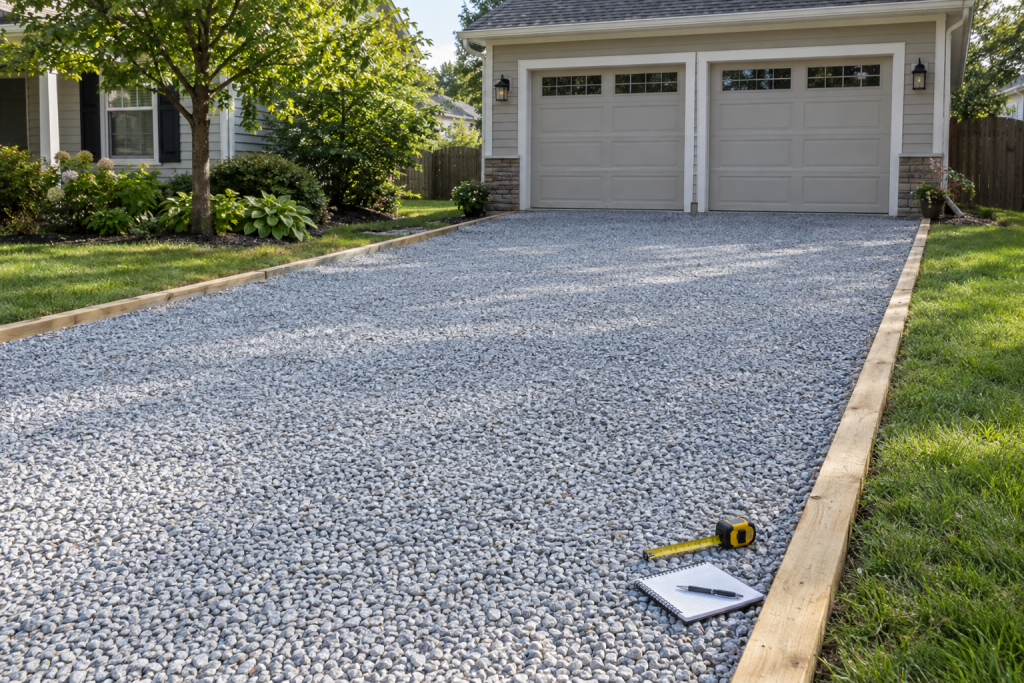
The gravel calculator above turns three tape-measure numbers (length, width and depth) into cubic yards, tons and bag counts for crushed stone, pea gravel, river rock or decomposed granite. Measure the area in feet, decide how deep the layer should be in inches, pick your material, and the result tells you exactly what to order from the quarry or load at the garden center.
Quick steps: use the gravel calculator
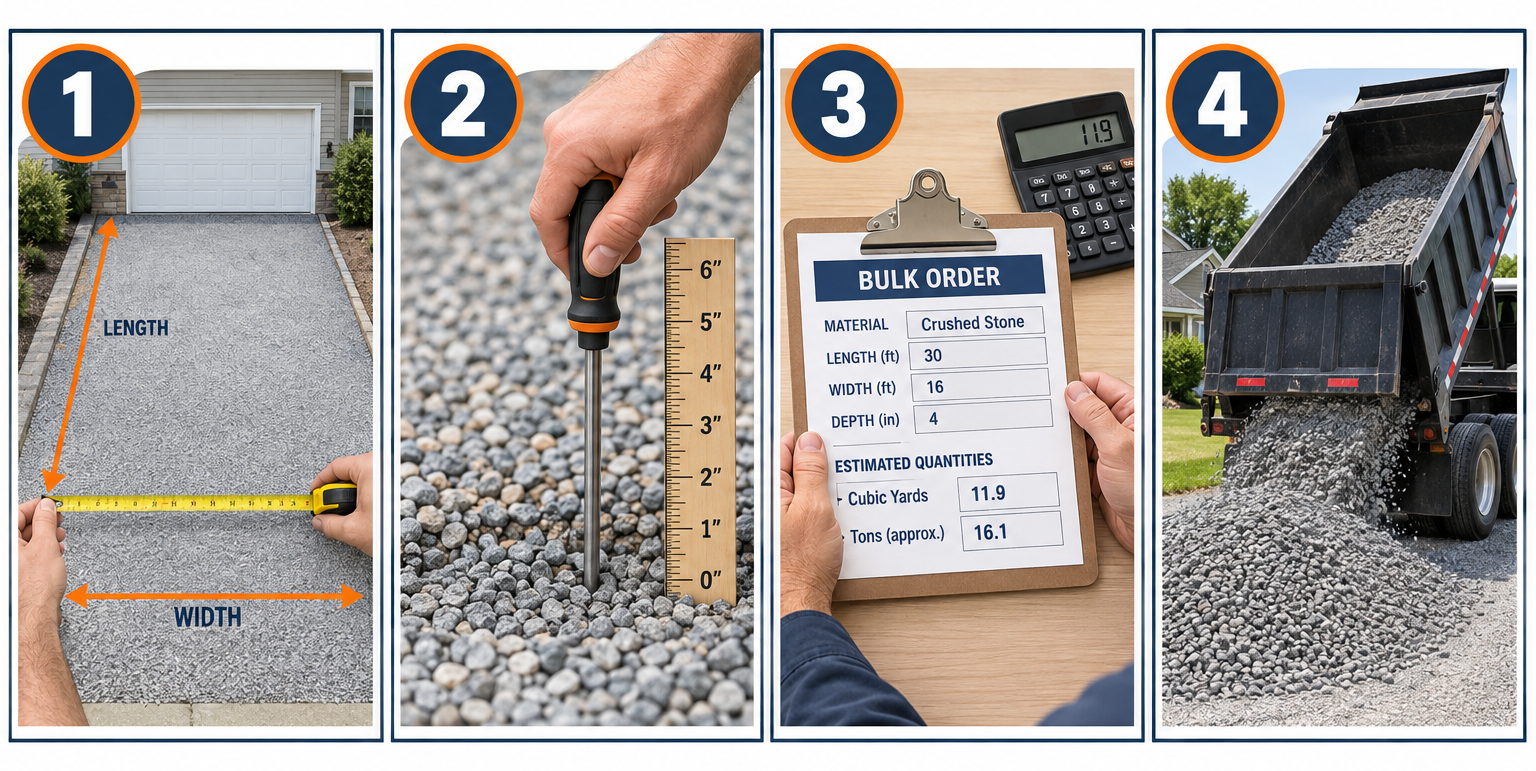
- Measure the length and width of the area in feet with a 25 ft tape or measuring wheel.
- Decide the finished depth in inches (2 in for paths, 3 in for beds, 4 in or more per driveway layer).
- Choose the Material and let the Weight per cubic yard fill in, or type your supplier’s figure.
- Pick a Bag size only if you plan to buy bagged gravel instead of bulk.
- Enter the quarry’s Price per ton if you have a quote, or leave it at 0.
- Read the cubic yards and tons, then add 5 to 10 percent before you order.
How to use the gravel calculator
Every field is in the units suppliers actually use in the US. Get these right and the result is accurate to within a wheelbarrow load.
Length (ft) and Width (ft)
Measure the longest and widest points of the area in feet, not inches or paces. For a rectangle, two measurements are enough. For a driveway with a curve, break it into straight sections and run the calculator once per section. For a circle, use the diameter times 0.785 as a stand-in: a 10 ft diameter fire pit ring becomes a 10 ft by 7.85 ft rectangle and the math works out to the same square footage.
If the shape is an L or has notches, split it into rectangles. Our square footage calculator handles odd shapes if you would rather get a single area number first, then enter it here as length with a width of 1.
Enter decimals, not fractions. A 12 ft 6 in wide drive is 12.5, not 12.6.
Depth (in)
This is the finished, compacted thickness of the gravel layer in inches. It is the single number people get wrong most often. Use these starting points:
- Decorative ground cover over landscape fabric: 2 in
- Walkways and patios in pea gravel or decomposed granite: 2 to 3 in
- Planting beds and drainage strips: 3 in
- Driveway top course: 3 to 4 in
- Driveway base course: 4 to 6 in
- French drain or footing drain backfill: whatever the trench depth minus 4 in of soil cover
Measure depth from the top of the compacted subgrade, not from the top of the loose dirt you still need to dig out. If you are topping up an old driveway, probe in six places with a screwdriver and average the gap between the current surface and where you want it.
Material
Pick the closest match. The choice sets the default Weight per cubic yard the tons figure depends on:
- Crushed stone or gravel: 1.4 tons per cubic yard
- Pea gravel: 1.4 tons per cubic yard
- River rock: 1.35 tons per cubic yard
- Decomposed granite: 1.25 tons per cubic yard
Angular crushed limestone, granite and trap rock all fall close to the 1.4 figure when dry. Rounded river rock packs with more air between the stones, so it weighs a touch less. Decomposed granite is a fine, sandy product that fluffs up more than it compacts in the truck.
Weight per cubic yard (tons)
Leave the default unless your supplier gives you a different number. Many quarries print the density on the ticket, and it swings with moisture. Wet crushed stone can run 1.5 tons per yard or more. If you are ordering by the ton and the pile has been rained on, round up.
Bag size
The two options match the bags sold at home centers: 0.5 cu ft is the common 50 lb bag of pea gravel, river rock or marble chips; 0.25 cu ft is the small decorative bag that often weighs around 20 to 25 lb. Ignore this field if you are ordering bulk.
Price per ton (optional)
Type the delivered or picked-up price per ton from your quote and the calculator multiplies it by the tons. Leave it at 0 if you have no number yet. Note that bagged gravel is priced per bag, not per ton, so this field is only useful for bulk orders.
Measuring mistakes that throw the result off
- Measuring in paces or guessing the driveway length from the car’s odometer. A 20 percent error in length is a 20 percent error in tons.
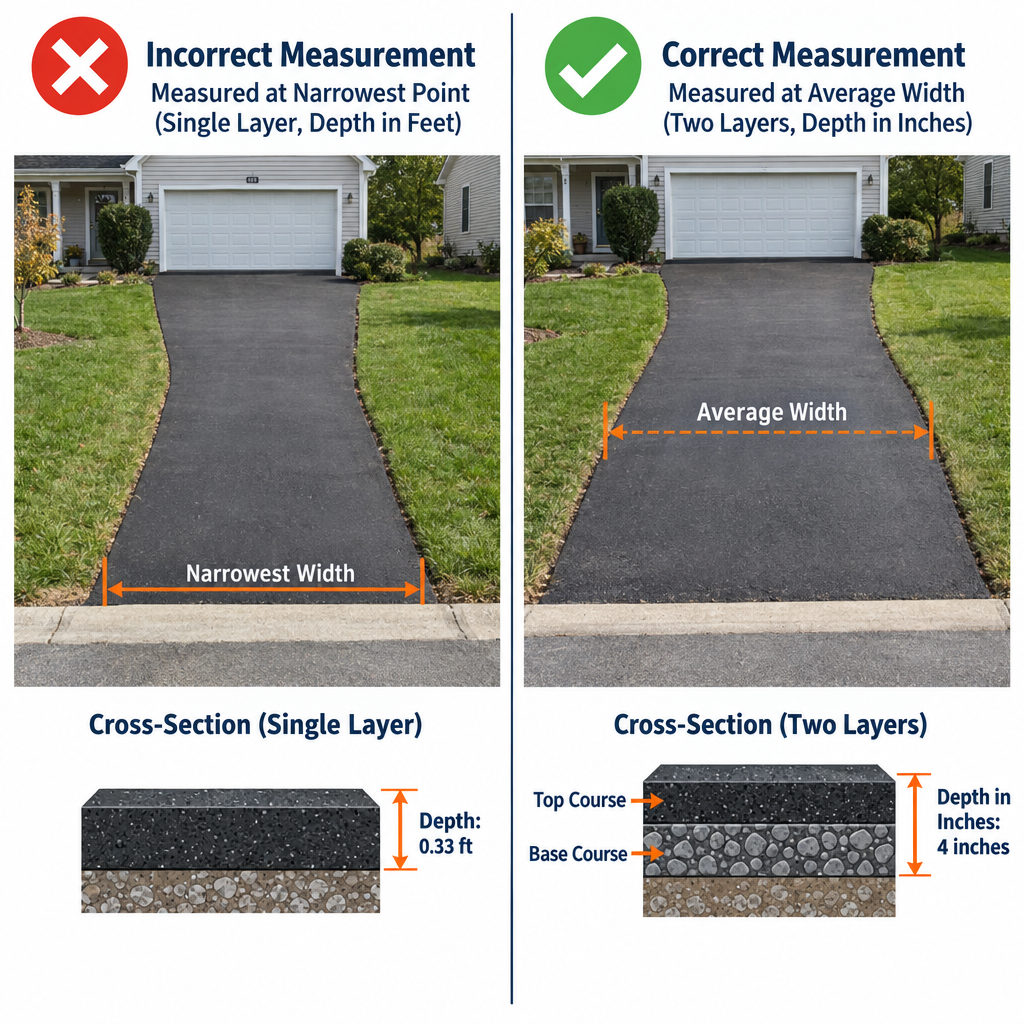
- Entering depth in feet. Four inches is 4, not 0.33.
- Forgetting that a driveway is two layers. Run the calculator twice, once for base and once for top course.
- Measuring the narrowest point of a tapered drive instead of the average width.
- Skipping the apron and turnaround, which can add 200 square feet to a modest driveway.
The gravel calculator formula, step by step
Every result on this page comes from the same arithmetic. You can check it on a phone calculator in under a minute.
Cubic feet = Length (ft) × Width (ft) × Depth (in) ÷ 12
Dividing the inches by 12 converts depth to feet so all three dimensions match.
Cubic yards = Cubic feet ÷ 27
A cubic yard is 3 ft × 3 ft × 3 ft, which is 27 cubic feet. Quarries sell bulk gravel by the cubic yard or by the ton, never by the cubic foot.
Tons = Cubic yards × Weight per cubic yard
Bags = Cubic feet ÷ Bag size (0.5 or 0.25)
Cost = Tons × Price per ton
Cubic meters, which some landscape supply yards and most of the world use, come from multiplying cubic feet by 0.0283.
Worked example: the default inputs
The calculator loads with Length 20, Width 10, Depth 3, Material crushed stone, Weight per cubic yard 1.4, Bag size 0.5. That is a one-car parking pad or a large patio base.
- Cubic feet: 20 × 10 × 3 ÷ 12 = 600 ÷ 12 = 50 cu ft
- Cubic yards: 50 ÷ 27 = 1.85 cu yd
- Cubic meters: 50 × 0.0283 = 1.42 m³
- Weight: 1.85 × 1.4 = 2.59 tons, which is 2.59 × 2,000 = 5,180 lb
- Bags: 50 ÷ 0.5 = 100 bags of 0.5 cu ft
So the result reads: Gravel needed 1.85 cu yd, Cubic feet 50, Cubic meters 1.42, Weight 2.59 tons (5,180 lb), Bags 100. A pile of 2 cubic yards delivered covers it with a little left over to top low spots after the first rain.
Second worked example: a 60 ft driveway
Say you have a straight 60 ft long, 12 ft wide driveway and you want a 4 in top course of crushed stone over an existing base.
- Cubic feet: 60 × 12 × 4 ÷ 12 = 2,880 ÷ 12 = 240 cu ft
- Cubic yards: 240 ÷ 27 = 8.89 cu yd
- Cubic meters: 240 × 0.0283 = 6.80 m³
- Weight: 8.89 × 1.4 = 12.44 tons (24,889 lb)
- Bags: 240 ÷ 0.5 = 480 bags, which is why nobody bags a driveway
With a Price per ton of $35, the cost line shows 12.44 × 35 = $435.40 for material before delivery. Order 13 to 14 tons to allow for compaction and spillage. That is one full tandem dump truck load at most quarries.
Third example: river rock in a planting bed
A 30 ft by 3 ft bed along the house, 3 in deep in river rock (Weight per cubic yard 1.35):
- 30 × 3 × 3 ÷ 12 = 22.5 cu ft
- 22.5 ÷ 27 = 0.83 cu yd
- 0.83 × 1.35 = 1.13 tons
- 22.5 ÷ 0.5 = 45 bags
Forty-five bags at $5 to $8 each is $225 to $360. One cubic yard of bulk river rock delivered usually lands between $100 and $250 depending on the stone and your distance from the yard. At this size, bulk is the better buy if you have a spot for the pile.
Quick reference: gravel per 100 square feet
This table uses the formula above with the default 1.4 tons per cubic yard. Multiply by your square footage divided by 100.
| Depth | Cubic feet | Cubic yards | Tons (crushed/pea) | Tons (river rock) | Tons (DG) | 0.5 cu ft bags |
|---|---|---|---|---|---|---|
| 1 in | 8.3 | 0.31 | 0.43 | 0.42 | 0.39 | 17 |
| 2 in | 16.7 | 0.62 | 0.86 | 0.83 | 0.77 | 34 |
| 3 in | 25.0 | 0.93 | 1.30 | 1.25 | 1.16 | 50 |
| 4 in | 33.3 | 1.23 | 1.73 | 1.67 | 1.54 | 67 |
| 6 in | 50.0 | 1.85 | 2.59 | 2.50 | 2.31 | 100 |
A useful shortcut falls out of the 3 in row: one cubic yard covers just over 100 square feet at 3 in, about 160 square feet at 2 in, and about 80 square feet at 4 in.
Gravel driveway calculator: common sizes at 4 inches
Driveways are the biggest gravel job most homeowners tackle. These figures are for a single 4 in lift of crushed stone at 1.4 tons per yard. Double them for a new driveway that needs a 4 in base plus a 4 in top course.
| Driveway size | Square feet | Cubic feet | Cubic yards | Tons |
|---|---|---|---|---|
| 10 × 20 ft (single parking pad) | 200 | 66.7 | 2.47 | 3.46 |
| 12 × 50 ft | 600 | 200 | 7.41 | 10.37 |
| 20 × 50 ft (two-car) | 1,000 | 333 | 12.35 | 17.28 |
| 12 × 100 ft | 1,200 | 400 | 14.81 | 20.74 |
| 24 × 100 ft | 2,400 | 800 | 29.63 | 41.48 |
| 12 × 200 ft (rural lane) | 2,400 | 800 | 29.63 | 41.48 |
How to run the calculator for a new gravel drive
A driveway that lasts is not one layer. Build it as two or three and calculate each separately:
- Base course: 4 to 6 in of large crushed stone, sold as #3, #2 or 2 to 3 in clean, or as crusher run if you want fines mixed in. Enter the depth, Material crushed stone, Weight 1.4.
- Top course: 3 to 4 in of #57 stone (roughly ¾ in) or ¾ in minus crusher run, which locks together under tires. Run the calculator again with the new depth.
- Optional surface dressing: 1 to 2 in of 3/8 in pea gravel or chip over the top course if you want a finer look. It will migrate, so budget for annual top-ups.
Lay 6 oz or heavier woven geotextile under the base on clay or wet ground. It stops the stone from sinking into the mud and is the difference between a drive that needs 2 tons a year and one that needs 10.
Pro tip
Order crusher run (also sold as road base, dense grade or ¾ minus) for the top course instead of clean #57 stone. The mix of fines and angular rock compacts into a surface that stays put under tires and sheds water. Clean round stone rolls, ruts and ends up in the lawn. Crusher run also costs a few dollars less per ton at most quarries.
Cost of gravel driveway installation
Material is usually the smaller half of the bill. For a basic 12 × 50 ft driveway with 4 in of base and 3 in of top course:
- Base: 10.37 tons × roughly $25 to $40 per ton = $260 to $415
- Top course: 7.78 tons × roughly $30 to $45 per ton = $235 to $350
- Delivery: $75 to $150 per truckload in most metro areas, more past 20 miles
- Geotextile: about $0.20 to $0.40 per square foot
Spread and compacted by a contractor with a skid steer and a plate compactor or roller, expect a finished price somewhere between $1 and $3 per square foot for a straightforward drive on level, firm ground. Excavation, culverts, grading for drainage or a long haul from the quarry push it higher. Doing the spreading yourself with a rented skid steer ($250 to $400 a day) and a 1,000 lb plate compactor ($220 to $300 a day) cuts the labor portion sharply but takes a long weekend.
Pea gravel calculator and river rock calculator notes
The formula is identical. What changes is the depth you should enter and the density.
Pea gravel is 3/8 in rounded stone. At 2 in it is comfortable to walk on; at 3 in or more it feels like walking on a beach. Patios and paths rarely need more than 2 in over a compacted base. The one place you go deeper is a children’s play area, where 9 to 12 in of pea gravel is the common safety-surface depth. For a 20 × 20 ft play area at 9 in: 20 × 20 × 9 ÷ 12 = 300 cu ft, ÷ 27 = 11.11 cu yd, × 1.4 = 15.56 tons.
River rock ranges from ¾ in up to 5 in cobbles. Larger stone needs more depth to hide the fabric, usually 1½ times the biggest stone diameter. A bed of 2 to 3 in river rock needs 3 to 4 in of depth. Set Material to River rock and the calculator uses 1.35 tons per yard.
Decomposed granite is spread about 25 percent thicker than its finished depth because it compacts hard under a plate compactor. If you want a 3 in finished path, enter 4 in. The 1.25 tons per yard default reflects loose material as delivered.
Buying and ordering gravel
Units suppliers use
Quarries and sand-and-gravel pits sell by the ton. Landscape supply yards and garden centers usually sell bulk by the cubic yard, scooped with a loader bucket. Home centers sell by the bag. The calculator shows all three so you can compare quotes across suppliers without converting anything yourself.
When a yard quotes per cubic yard, ask whether it is a “struck” scoop or a heaped one. A heaped loader bucket often delivers 10 to 15 percent more than its rated volume.
Bulk vs bags
| Bulk (per ton or yard) | Bagged (0.5 cu ft) | |
|---|---|---|
| Typical cost for 1 cubic yard | $30 to $60 crushed stone picked up; $100 to $250 river rock delivered | 54 bags × $4 to $8 = $216 to $432 |
| Minimum order | Often 1 yard or 1 ton picked up; 3 to 5 tons for delivery at many quarries | One bag |
| Where it ends up | A pile on your driveway or lawn | Stacked on a pallet or in the trunk |
| Best for | Anything over about ½ cubic yard | Small beds, top-ups, tight access, condos |
The crossover point is roughly 25 to 30 bags. Below that, bags are cheaper once you count the delivery fee, and you can carry them through a gate. Above that, bulk wins even with delivery, and you avoid hauling 1,500 lb of bags up the steps. A 50 lb bag is heavy; 100 of them is a real injury risk.
Delivery minimums and truck sizes
- Single-axle dump truck: about 5 to 7 tons
- Tandem-axle dump truck: about 10 to 14 tons
- Tri-axle: about 18 to 22 tons
- Landscape dump trailer: 3 to 5 cubic yards
Most quarries charge a flat delivery fee per load, so 6 tons costs the same to deliver as 12. If the calculator says 9 tons, ask the price for a full truck; the extra stone is often nearly free compared with a second trip later.
Pickup trucks are limited by payload, not bed volume. A half-ton pickup is rated for roughly 1,000 to 1,500 lb depending on trim, which is a third to half a cubic yard of crushed stone. Loader operators at the yard will happily put a full yard (2,800 lb) in your bed if you let them, and your rear springs will tell you about it.
Safety first
Call 811 at least two to three business days before digging a new driveway or trench so gas, electric and water lines get marked. Keep loaded dump trucks off septic tanks, leach fields and shallow buried utilities; a loaded tandem weighs well over 50,000 lb. Wear gloves and steel-toe boots when raking stone, and lift bags with your legs or use a hand truck.
How much extra to order
Add 5 percent for bagged decorative stone and 10 percent for anything that gets compacted or driven on. The reasons:
- Compaction: loose crushed stone settles 10 to 15 percent under a plate compactor. Four inches loose becomes about 3½ in packed.
- Subgrade loss: on soft soil, the first lift partially disappears into the ground.
- Spillage and spread: stone migrates past the edges and into the grass.
- Uneven subgrade: your “3 in” is really 2 in in some spots and 4 in in others.
For the default 1.85 cu yd example, order 2 yards. For the 12.44 ton driveway, order 13 to 14 tons.
Pro tip
Have the driver “tailgate spread” the load instead of dumping it in one pile. Most dump truck drivers will crack the gate and drive forward slowly so the stone comes out in a long windrow down the driveway. You then rake it level instead of shoveling a 12 ton heap. It costs nothing extra and saves hours.
Mistakes that leave you short or over-buying
Confusing tons and cubic yards. A ton of crushed stone is about 0.71 cubic yards, not one. If a quarry quotes 5 tons and you expected 5 yards, you are 30 percent short. Read both numbers off the calculator before you call.
Using one depth for a layered driveway. Base and top course have different depths and often different prices. Calculate each.
Entering loose depth as finished depth. Decomposed granite and crusher run compact hard. Enter the loose depth you will spread, which is roughly 20 to 25 percent more than the finished thickness.
Forgetting the existing surface. When refreshing a driveway, measure the actual gap, not the original build depth. Most top-ups need 1 to 2 in, which is 0.3 to 0.6 cubic yards per 100 square feet.
Over-buying river rock for ground cover. Decorative rock over landscape fabric only needs enough to hide the fabric. Two inches of ¾ in stone does it. Three or four inches wastes money on the most expensive gravel you will buy.
Not accounting for density changes. Wet stone weighs more per yard. If you are charged by the ton and the pile is soaked, you get less volume per dollar. Order on a dry day or buy by the yard.
Choosing the wrong product for the job. Round pea gravel under a shed or in a driveway never locks up. Angular crushed stone in a walkway is hard on bare feet and dog paws. Match the stone to the use before you match the quantity.
Skipping the gravel entirely under slabs. If you decide to pour concrete over the pad instead, you still need 4 in of compacted crushed stone first. Use this page for the base and the concrete calculator for the slab on top.
When to call a pro
Call an excavation or paving contractor when the driveway needs more than about 6 in of cut, crosses a drainage ditch or needs a culvert, has a grade over 10 percent, or sits on soft clay that pumps under foot traffic. Those jobs need a laser level, a vibratory roller and proper subgrade prep, and a culvert in a public right-of-way usually needs a permit from the town or county highway department. For anything over 25 tons, a contractor’s wholesale quarry account often beats retail pricing by enough to cover part of the labor.
FAQ
How much gravel do I need for a driveway?
Multiply length by width in feet, multiply by depth in inches, divide by 12, then divide by 27 for cubic yards and multiply by 1.4 for tons. A 12 × 50 ft driveway at 4 in needs 7.41 cubic yards or 10.37 tons per layer. A new drive with a 4 in base plus a 3 in top course needs about 18 tons total.
How many tons is a cubic yard of gravel?
Crushed stone and pea gravel run about 1.4 tons (2,800 lb) per cubic yard dry. River rock is close to 1.35 tons and decomposed granite about 1.25 tons. Wet material weighs more, sometimes over 1.5 tons per yard.
How much area does a ton of gravel cover?
At 2 in deep, one ton of crushed stone covers about 115 square feet. At 3 in it covers about 77 square feet, and at 4 in about 58 square feet. Those come from 1 ton ÷ 1.4 = 0.714 cubic yards = 19.3 cubic feet, divided by the depth in feet.
How do I use the pea gravel calculator for a patio?
Enter the patio length and width, set Depth to 2 (or 3 if the base is not compacted), set Material to Pea gravel and read the cubic yards and bag count. A 12 × 15 ft patio at 2 in needs 30 cu ft, 1.11 cubic yards, 1.56 tons or 60 bags of 0.5 cu ft.
Does the river rock calculator use a different formula?
No. The volume math is identical; only the weight per cubic yard changes to 1.35 tons. Enter a depth of about 1½ times the largest stone diameter so the landscape fabric stays hidden.
How many bags of gravel equal a cubic yard?
Fifty-four bags of 0.5 cu ft, or 108 bags of 0.25 cu ft. That is why bulk is the better buy for anything over roughly half a cubic yard.
How deep should gravel be on a driveway?
Plan on 8 to 12 in total for a new driveway on average soil: 4 to 6 in of large crushed stone base and 3 to 4 in of ¾ in crusher run or #57 top course, each compacted. Existing driveways usually only need a 1 to 2 in top-up every couple of years.
What does a gravel driveway cost to install?
Material alone for a basic 600 square foot drive is roughly $500 to $800 including delivery. Installed by a contractor with proper grading and compaction, most straightforward driveways land between $1 and $3 per square foot. Excavation, culverts, long hauls and steep grades add to that.
Should I order gravel by the ton or the cubic yard?
Order by whichever unit the supplier prices in, and use the calculator to convert so you can compare. Buying by the yard protects you from paying for water weight in wet stone; buying by the ton protects you from a short loader scoop. Either way, add 10 percent for a driveway and 5 percent for decorative beds.