
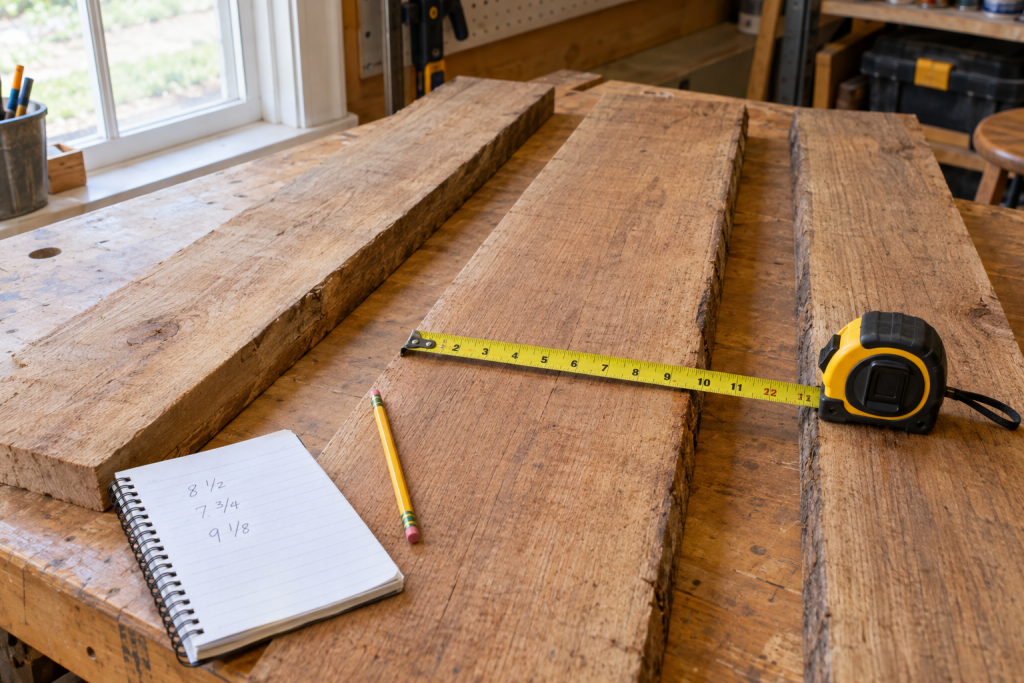
This board foot calculator turns a board’s thickness, width and length into board feet, cubic feet and cubic meters, then multiplies by a price if you enter one. You need three measurements per board: Thickness (in), Width (in) and Length (ft), plus a count of how many boards you have. That’s enough to check a hardwood invoice, size a mill order or figure out what a pile of rough-sawn oak is worth.
Quick steps: use the board foot calculator
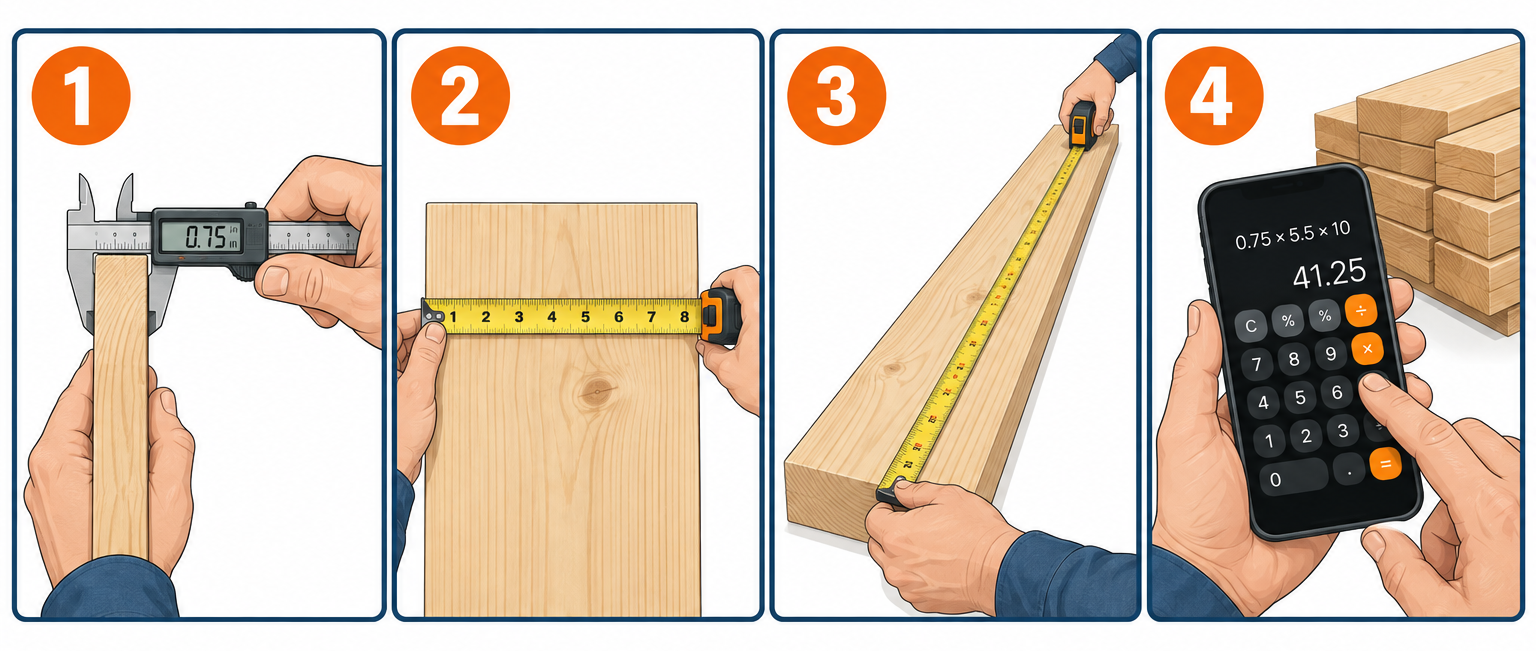
- Measure thickness in inches with a tape or calipers; use the nominal size (4/4 = 1 in, 2×6 = 2 in) if you’re matching a supplier’s price.
- Measure width in inches at the narrowest point of the board.
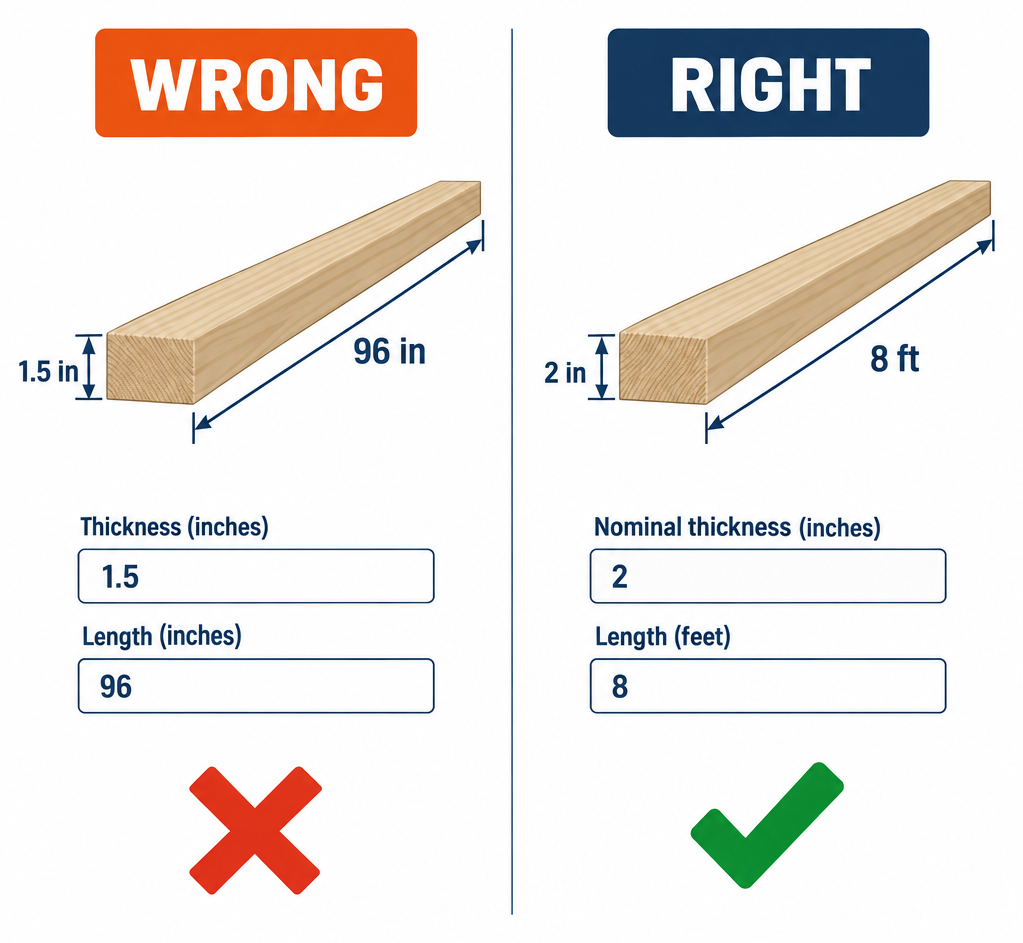
- Measure length in feet, not inches; convert 96 in to 8 ft before entering.
- Enter Number of boards for identical pieces; run separate calculations for mixed sizes.
- Add Price per board foot (optional) if your supplier quoted one, and read the total cost.
- Add 15-20% waste before you order, more for furniture parts that need defect-free stock.
Tools and materials
- 25 ft tape measure with 1/16 in graduations
- Dial or digital calipers (for surfaced hardwood thickness)
- Lumber crayon or pencil to mark measured boards
- Log scale stick (if measuring logs by the Doyle rule)
- Notepad or phone for tallying mixed-size lots
How to use the board foot calculator
The calculator has five fields. Every one of them has a trap that produces a wrong total, so here is exactly what to put in each.
Thickness (in)
Enter thickness in inches. The default is 2, which represents a 2×6 at nominal size.
There are two ways to measure thickness, and you need to pick the right one for your purpose. If you want to match what a lumberyard or hardwood dealer will charge, use the nominal thickness. A 2×6 counts as 2 in even though the planed board measures 1-1/2 in. A hardwood board sold as 4/4 counts as 1 in even if it was surfaced to 13/16 in.
If you want the actual volume of wood you’re holding, measure it with calipers and enter that. A surfaced 2×6 at 1.5 in thick gives you 5.5 board feet, not 8. Both answers are correct; they just answer different questions.
Width (in)
Enter width in inches. The default is 6. Measure across the face, not the edge.
Rough-sawn hardwood rarely has parallel edges. Measure at the narrowest usable point, or at roughly one-third of the way from the narrow end if the taper is gradual. Dealers typically measure width to the nearest full inch on rough stock, so a board that reads 7-5/8 in on your tape will often be tallied as 8 in. Ask how your supplier rounds before you argue about an invoice.
For dimensional softwood, nominal width works the same way as thickness. A 2×6 is 5-1/2 in wide, but enter 6 if you’re pricing it.
Length (ft)
Enter length in feet. The default is 8. This is the field people get wrong most often, because every other dimension is in inches.
If you measured 120 in, enter 10. If you measured 9 ft 6 in, enter 9.5. The calculator divides by 12 to convert the inch-based thickness and width back to feet, and that division only works if length is already in feet.
Hardwood dealers often round length down to the nearest foot on random-length stock. A board at 9 ft 10 in gets sold as 9 ft. That rounding works in your favor, so don’t correct it.
Number of boards
Enter how many identical pieces you have. The default is 1.
This field only works for boards that share all three dimensions. A stack of twelve 2x6x8 framing studs is one calculation with 12 boards. A pile of random-width rough walnut is twelve separate calculations, or you measure each board, add up the individual totals and skip this field.
Price per board foot (optional)
Enter the price your supplier quoted per board foot. The default is 0, which hides the cost line.
Make sure the quote is actually per board foot. Hardwood is sold that way. Framing lumber is sold per piece. Flooring is sold per square foot, which is a different unit entirely, and a “square footage calculator” is the right tool for that job. Plywood is sold per sheet. Entering a per-piece price in this field will produce nonsense.
Pro tip
When comparing two hardwood dealers, run the calculator with nominal thickness for both. One dealer might quote 4/4 red oak at $3.80 and surface it to 13/16 in, while another quotes $3.60 and surfaces to 3/4 in. You are paying for the same nominal board feet, but you get 8% more actual wood from the first one.
How to calculate board feet: the formula
A board foot is a volume. One board foot equals a piece of wood 1 in thick, 12 in wide and 12 in long, or 144 cubic inches. Everything the calculator does comes from that single definition.
The formula the calculator uses is:
Board feet = Thickness (in) × Width (in) × Length (ft) ÷ 12 × Number of boards
Each part does one job:
- Thickness × Width gives you the cross-section area in square inches.
- Multiplying by Length in feet gives you “square inches times feet,” a mixed unit.
- Dividing by 12 converts that to board feet, because 12 square inches of cross-section running 1 ft equals exactly one board foot (12 × 12 = 144 cubic inches).
- Multiplying by Number of boards scales the single-board result to the whole lot.
From there the calculator adds two conversions and an optional cost:
- Cubic feet = Board feet ÷ 12, because a board foot is 1/12 of a cubic foot.
- Cubic meters = Cubic feet × 0.0283168.
- Cost = Board feet × Price per board foot.
Worked example with the default inputs
The calculator loads with a 2×6, 8 ft long, 1 board, no price. Here’s the math it runs:
- Thickness × Width: 2 × 6 = 12 square inches
- Times Length: 12 × 8 = 96
- Divide by 12: 96 ÷ 12 = 8 board feet
- Times Number of boards: 8 × 1 = 8 board feet
- Cubic feet: 8 ÷ 12 = 0.667 cubic feet
- Cubic meters: 0.667 × 0.0283168 = 0.0189 cubic meters
So the display shows Total: 8 board feet, Cubic feet: 0.667, Cubic meters: 0.0189. A nominal 2x6x8 is 8 board feet, which is a handy number to remember.
Second worked example: a rough cherry order
Say you’re building a dresser and the dealer has 4/4 rough cherry at $6.25 per board foot. You pick out six boards that each measure 7-1/2 in wide and 10 ft long. You enter Thickness 1, Width 7.5, Length 10, Number of boards 6, Price 6.25.
- 1 × 7.5 = 7.5 square inches
- 7.5 × 10 = 75
- 75 ÷ 12 = 6.25 board feet per board
- 6.25 × 6 = 37.5 board feet
- Cubic feet: 37.5 ÷ 12 = 3.125
- Cubic meters: 3.125 × 0.0283168 = 0.0885
- Cost: 37.5 × $6.25 = $234.38
If the dealer rounds width up to 8 in, which many do on rough stock, the same six boards become 1 × 8 × 10 ÷ 12 × 6 = 40 board feet and $250.00. That $15.62 difference is why you should know your supplier’s tally rules before you check out.
Board feet for common lumber sizes
These totals use nominal dimensions and the same formula as the calculator. They are what a yard charges for; actual wood volume is less because of planing.
| Nominal size | 8 ft | 10 ft | 12 ft | 16 ft |
|---|---|---|---|---|
| 1×4 | 2.67 | 3.33 | 4 | 5.33 |
| 1×6 | 4 | 5 | 6 | 8 |
| 1×8 | 5.33 | 6.67 | 8 | 10.67 |
| 1×12 | 8 | 10 | 12 | 16 |
| 2×4 | 5.33 | 6.67 | 8 | 10.67 |
| 2×6 | 8 | 10 | 12 | 16 |
| 2×8 | 10.67 | 13.33 | 16 | 21.33 |
| 2×10 | 13.33 | 16.67 | 20 | 26.67 |
| 2×12 | 16 | 20 | 24 | 32 |
| 4×4 | 10.67 | 13.33 | 16 | 21.33 |
| 6×6 | 24 | 30 | 36 | 48 |
A few patterns fall out of the table. A 2×6 gives you one board foot per lineal foot. A 1×12 does the same. A 2×12 and a 4×6 both give two board feet per lineal foot. If you memorize those three, you can tally a framing package in your head.
Hardwood thickness: reading the quarter system
Hardwood dealers describe thickness in quarters of an inch. The number before the slash is how many quarter-inches thick the board was when it left the sawmill. Enter the nominal inch value in the Thickness (in) field when you’re pricing.
| Quarter name | Nominal thickness (enter this) | Typical S2S surfaced thickness | Board feet per 12 in wide × 1 ft |
|---|---|---|---|
| 4/4 (“four quarter”) | 1 in | 13/16 in | 1 |
| 5/4 | 1.25 in | 1-1/16 in | 1.25 |
| 6/4 | 1.5 in | 1-5/16 in | 1.5 |
| 8/4 | 2 in | 1-3/4 in | 2 |
| 10/4 | 2.5 in | 2-1/4 in | 2.5 |
| 12/4 | 3 in | 2-3/4 in | 3 |
The surfaced thicknesses follow the standard the hardwood industry uses for lumber planed on two sides (S2S). Some retailers plane 4/4 all the way to 3/4 in, which is fine for furniture but means you’re paying for a quarter inch of shavings.
The practical rule: your project needs finished stock thicker than what S2S leaves you, so buy the next size up. A 1 in thick tabletop needs 5/4 or 6/4 rough stock, not 4/4.
Pro tip
Buy rough 4/4 instead of S2S when you own a planer. Rough stock is usually 1 in to 1-1/8 in thick, so you can flatten it, plane it to 7/8 in and still have a heavier board than the dealer’s 13/16 in S2S, at the same nominal price per board foot.
Board foot calculator for logs: the Doyle rule
A log board foot calculator answers a different question: how many board feet of lumber can a sawmill cut from a round log? You can’t use the flat-board formula for that, because a log is tapered, round and loses wood to bark, slabs and saw kerf.
Most sawmills and timber buyers in the eastern and southern US use the Doyle log rule. The formula is:
Board feet = ((D − 4) ÷ 4)² × L
D is the diameter in inches at the small end of the log, measured inside the bark. L is the log length in feet. The “minus 4” is the Doyle allowance for slab and edging waste, and dividing by 4 approximates the kerf loss.
A worked Doyle example: a red oak log with a 16 in small-end diameter and a 12 ft length.
- 16 − 4 = 12
- 12 ÷ 4 = 3
- 3² = 9
- 9 × 12 = 108 board feet
Here is a Doyle quick-reference table, computed with that formula:
| Small-end diameter | 8 ft | 10 ft | 12 ft | 16 ft |
|---|---|---|---|---|
| 12 in | 32 | 40 | 48 | 64 |
| 14 in | 50 | 62.5 | 75 | 100 |
| 16 in | 72 | 90 | 108 | 144 |
| 18 in | 98 | 122.5 | 147 | 196 |
| 20 in | 128 | 160 | 192 | 256 |
| 24 in | 200 | 250 | 300 | 400 |
| 30 in | 338 | 422.5 | 507 | 676 |
Two things to know before you use these numbers to negotiate:
Doyle undercounts small logs. On a 12 in log, a modern thin-kerf band mill will often cut noticeably more than 48 board feet from 12 ft. The Doyle rule was written for wide circular saw blades and generous slab waste. The International 1/4-inch rule gives a higher, more realistic yield on small logs, and the Scribner rule falls in between. Timber buyers like Doyle because it favors them on small logs; if you are selling logs, ask which rule the buyer uses.
Measure the small end, inside the bark. If the small end is oval, measure the long and short axis and average them. Measure length to the nearest foot and subtract 4 to 6 in for trim allowance if the mill requires it.
If you’re having logs custom sawn, the sawyer will typically charge per board foot of lumber actually produced, or by the hour. Either way, a Doyle tally gives you a floor estimate for how much lumber to expect and how much it will cost to have milled.
Buying and ordering lumber by the board foot
Knowing the number is half the job. The other half is ordering in a way that matches how suppliers sell.
Units suppliers use
- Hardwood dealers sell by the board foot, almost always on nominal thickness and rough width. Stock comes in random widths and random lengths, usually 6 to 12 ft. You cannot order “ten 6 in wide boards,” you order 50 board feet and pick what’s on the rack.
- Lumberyards and big-box stores sell dimensional softwood per piece. A 2x6x8 has a sticker price, and the board feet are irrelevant at checkout. You only need board feet to compare prices or figure volume.
- Wholesale and commodity markets price softwood per thousand board feet, written MBF. A quote of “$450/MBF” means $0.45 per board foot.
- Sawmills selling green rough-sawn lumber usually price per board foot, often with a minimum order. Some will scale the pile by the Doyle rule on the log side instead.
- Flooring, siding and decking are sold by the square foot or per lineal foot, not board feet. Use a “square footage calculator” for floor area, and remember that T&G flooring needs a coverage factor because the tongue is hidden.
Typical hardwood prices
These are ballpark ranges for rough or S2S 4/4 lumber in the better grades (FAS or Select) at a US hardwood dealer. Prices swing by region, grade, width and whether the stock is kiln-dried, so treat them as a sanity check for a quote rather than a price list.
| Species | Ballpark price per board foot (4/4) |
|---|---|
| Poplar | $2.50-4.50 |
| Red oak | $3.50-5.50 |
| Ash | $3.50-5.50 |
| Hard maple | $4.50-7.50 |
| White oak | $5.50-9.00 |
| Cherry | $5.00-8.00 |
| Walnut | $9.00-15.00 |
Thicker stock costs more per board foot, not just more in total. Expect 8/4 to run 20-40% higher per board foot than 4/4 in the same species, because thick stock is harder to dry without defects. Wide boards (10 in and up) often carry a surcharge too.
Framing lumber for comparison usually works out somewhere between $0.50 and $1.20 per board foot at retail, depending on the year and the size. That’s why nobody tallies studs in board feet at the store.
Delivery minimums and lot sizes
Hardwood dealers commonly set a minimum for delivery, often 100 to 300 board feet, or charge a flat delivery fee below that. Many sell by the “bundle” or “pack” at a discount, where a pack of 4/4 red oak might be 250 to 500 board feet. If your project needs 80 board feet, you’ll usually pick it up yourself.
Mills selling green lumber will often quote a lower per-board-foot price for a full log’s worth or a 1,000 board foot minimum. Below that, expect the retail rate.
How much extra to order
Add waste before you order, not after you run out. The right factor depends on the job:
- Framing with dimensional lumber: 5-10%, mostly for cutoffs and the occasional crowned or split stud.
- Furniture and cabinetry from hardwood: 15-25%. You lose wood to jointing, planing, squaring ends, sapwood and defects. Rough 4/4 at 7 in wide becomes a 6-1/4 in finished panel more often than not.
- Figured or highly selected stock (curly maple, quartersawn white oak): 30% or more, because you’ll reject boards that don’t match.
- Custom milling from logs: Doyle already builds in waste on the log side, but add 10-15% on the lumber side for drying degrade, end checks and warp.
Running short on hardwood is worse than over-buying. The next batch at the dealer will come from a different tree, with different color and grain, and the mismatch will show in a tabletop or a run of face frames. Leftover hardwood keeps indefinitely if it stays dry.
Common mistakes that throw off the total
| Mistake | What you see | Fix |
|---|---|---|
| Entering length in inches | Totals 12 times too high (96 instead of 8) | Convert to feet before entering; 96 in = 8 ft |
| Using actual thickness to check a nominal invoice | Your number is 20-30% lower than the dealer’s | Enter 1 for 4/4, 2 for a 2×6, when pricing |
| Measuring width at the widest point of a tapered board | You pay for wood you can’t use | Measure the narrowest usable width |
| Confusing lineal feet with board feet | A 10 ft 2×4 tallied as 10 board feet instead of 6.67 | Run the full formula every time |
| Confusing square feet with board feet | Flooring or paneling order is wildly wrong | Floor area is square feet; use a square footage calculator for that |
| Forgetting Number of boards | Total is for one stud, not the bundle | Multiply, or enter the count |
| Multiplying price by cubic feet | Cost comes out 12 times too low | Price per board foot applies to board feet |
| Skipping the waste factor | Short by one or two boards at the end | Add 15-20% for hardwood projects |
| Ignoring the dealer’s rounding rules | Invoice is 5-10% higher than your tally | Ask whether width rounds to the full inch and length rounds down |
| Using the flat formula on logs | Massive overestimate of lumber yield | Use the Doyle rule for logs |
One more that bites DIY deck builders: tallying the framing in board feet and forgetting that the footings are a separate volume problem. Run a “concrete calculator” for the piers so you’re not mixing bags at 7 pm.
Pro tip
Carry a lumber crayon and write the board feet on the end grain of each board as you tally rough stock. When the dealer totals the pile, you can compare board by board instead of arguing over a single lump sum, and the marks plane off when you mill the wood.
When to call a pro
If you’re selling standing timber or a load of logs, hire a consulting forester or a licensed log scaler to tally the volume and tell you which log rule the buyer should be using; the difference between Doyle and International 1/4 on a truckload of 12 in logs can be 20% of your check. If the board feet are for a beam, header or floor joist that carries load, the volume doesn’t tell you if it’s strong enough; a structural engineer or your building department has to size it, and that beam usually needs a permit.
FAQ
What is a board foot?
A board foot is a volume of wood equal to 1 in thick by 12 in wide by 12 in long, or 144 cubic inches. Twelve board feet make one cubic foot. It’s the standard unit for pricing hardwood in the US because it lets a dealer charge the same rate for boards of any width and length.
How do you calculate a board foot by hand?
Multiply thickness in inches by width in inches by length in feet, then divide by 12. A 1 in by 6 in by 8 ft board is 1 × 6 × 8 ÷ 12 = 4 board feet. If your length is in inches, divide by 144 instead of 12.
How many board feet are in a 2x4x8?
A nominal 2x4x8 is 2 × 4 × 8 ÷ 12 = 5.33 board feet. Measured at its actual 1.5 in by 3.5 in size it’s 3.5 board feet, but suppliers and lumber tables use the nominal figure.
How do I use a board foot calculator for logs?
Don’t use the flat-board formula on a log. Measure the small-end diameter inside the bark and the length in feet, then apply the Doyle rule: ((diameter − 4) ÷ 4)² × length. A 20 in log that’s 10 ft long scales to ((20 − 4) ÷ 4)² × 10 = 16 × 10 = 160 board feet. Mills with thin-kerf blades will often cut more than Doyle predicts from logs under 16 in.
Is this the same as the Omni board foot calculator?
The math is identical, because there’s only one correct formula for board feet. The difference is in what you do with the result. This page adds cubic feet and cubic meters, an optional cost line, the quarter-system thickness table, the Doyle log table and ordering guidance so you can go from a tally to a purchase order.
Should I enter nominal or actual thickness?
Enter nominal thickness (4/4 = 1, 2×6 = 2) when you’re pricing or checking an invoice, because that’s how suppliers charge. Enter the measured actual thickness when you want the true volume of wood, for example to estimate weight or kiln capacity. The two answers differ by 20-30% on surfaced stock.
How many board feet do I need for a tabletop?
Figure the finished area, then convert and add waste. A 36 in by 72 in top at 1 in thick is 1 × 36 × 6 ÷ 12 = 18 board feet of finished wood. Buy 6/4 rough stock to end up at 1 in, and add 20% for jointing and defect cuts, so order about 22 board feet of 6/4.
What’s the difference between a board foot and a lineal foot?
A lineal foot measures only length. A board foot measures volume. Ten lineal feet of 2×4 is 6.67 board feet, while ten lineal feet of 2×12 is 20 board feet. Trim, molding and decking are sold by the lineal foot; hardwood is sold by the board foot.
How many board feet are in a cubic meter?
One cubic meter is about 423.8 board feet (35.3147 cubic feet × 12). The calculator shows cubic meters so you can compare quotes from exporters and overseas mills, which price lumber per cubic meter rather than per board foot.