
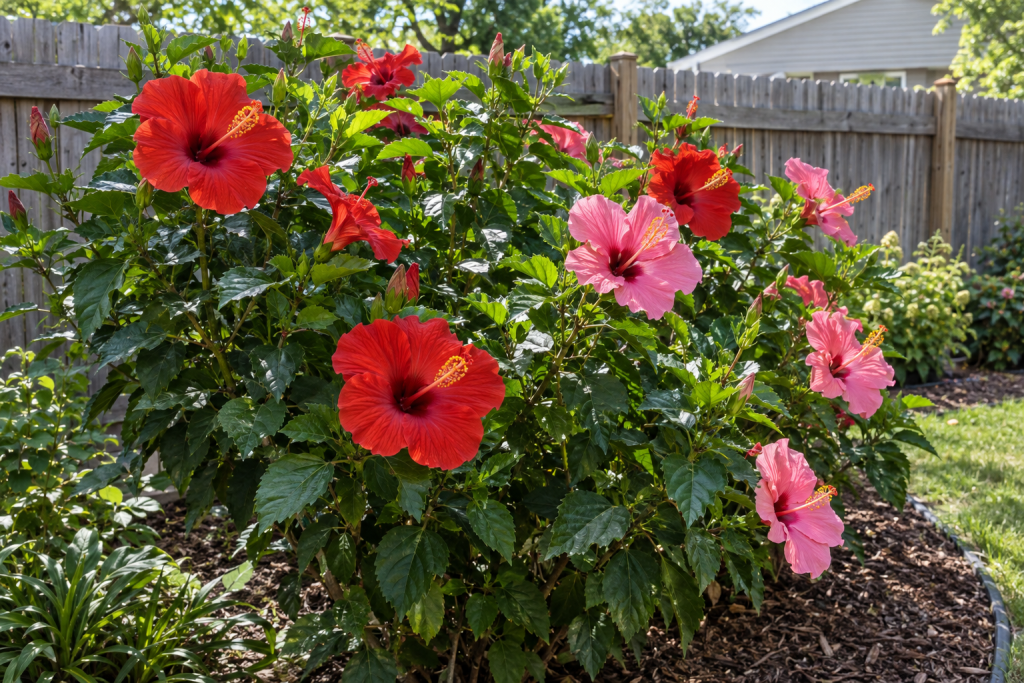
Hibiscus flowers need full sun, consistently moist but well-drained soil, and regular potassium-rich feeding to keep producing their 4 to 12 inch blooms from June until frost. Pick the right type for your zone first: tropical hibiscus for pots and warm climates, hardy hibiscus or rose of Sharon for a perennial that survives northern winters. Get those three things right and the rest is light pruning and a watchful eye for aphids.
Quick steps: planting and caring for hibiscus
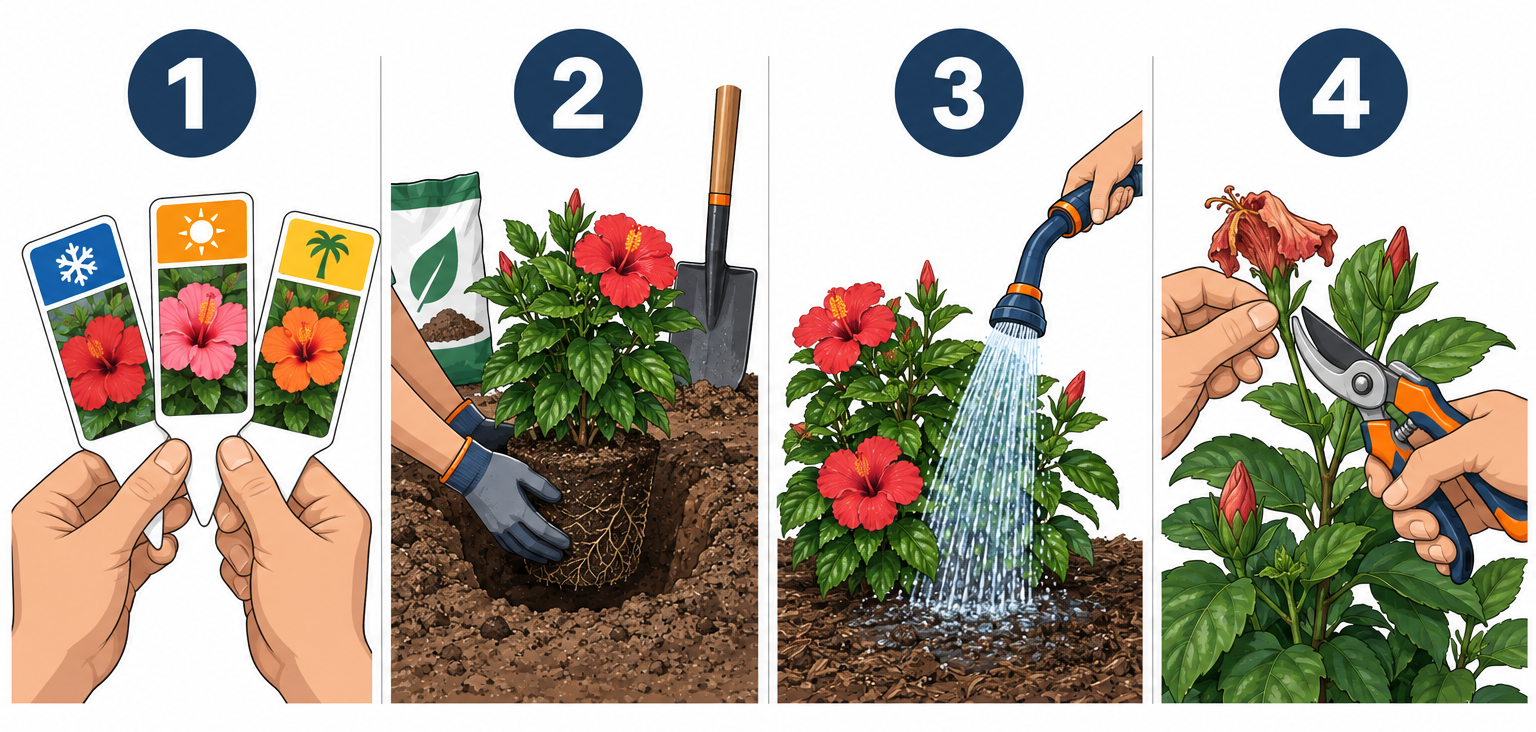
- Choose tropical, hardy, or rose of Sharon based on your USDA zone.
- Pick a full-sun spot with soil that drains within a few hours of rain.
- Plant at nursery depth in amended soil or a 12-18 inch container.
- Water deeply after planting, then keep soil evenly moist all season.
- Feed every 2-4 weeks with a low-phosphorus, high-potassium fertilizer.
- Deadhead spent blooms and prune for shape in early spring.
- Check leaves weekly for aphids, whiteflies, and sawfly damage.
- Bring tropicals indoors before nights drop below 50°F; cut hardy types to 4-6 inches after frost.
Tools and materials
- Hibiscus plant (1-3 gallon nursery pot)
- Round-point shovel and hand trowel
- Compost or aged manure (2-3 cubic feet per plant)
- Container, 12-18 inch diameter with drainage holes (for tropicals)
- Quality potting mix with perlite (for containers)
- Hibiscus fertilizer, roughly 9-3-13 or 17-5-24 ratio
- Bypass pruners, sharpened
- Shredded bark mulch, 2-3 inches deep
- Insecticidal soap or neem oil concentrate
- Watering wand or soaker hose
Calculators for this job
Safety first
Do not spray neem oil or insecticidal soap when temperatures are above 85°F or in direct midday sun, or the leaves will burn. Wear gloves and eye protection when mixing concentrates, and keep granular fertilizer off foliage.
Step 1: Pick the right type of hibiscus
Most planting failures start here. People buy a glossy tropical hibiscus at a big-box store in Ohio, plant it in the ground, and lose it in October. The three groups behave completely differently.
| Type | Botanical name | USDA zones | Bloom size | Mature size | Winter behavior |
|---|---|---|---|---|---|
| Tropical hibiscus | Hibiscus rosa-sinensis | 9-11 | 4-8 in | 4-10 ft shrub | Evergreen; dies below 32°F |
| Hardy hibiscus (rose mallow) | Hibiscus moscheutos and hybrids | 4-9 | 8-12 in | 3-6 ft perennial | Dies to ground, returns late spring |
| Rose of Sharon | Hibiscus syriacus | 5-9 | 2-4 in | 8-12 ft shrub | Deciduous woody shrub |
| Roselle (tea hibiscus) | Hibiscus sabdariffa | 8-11 (annual elsewhere) | 2-3 in | 4-7 ft | Grown as an annual; needs 5-6 months |
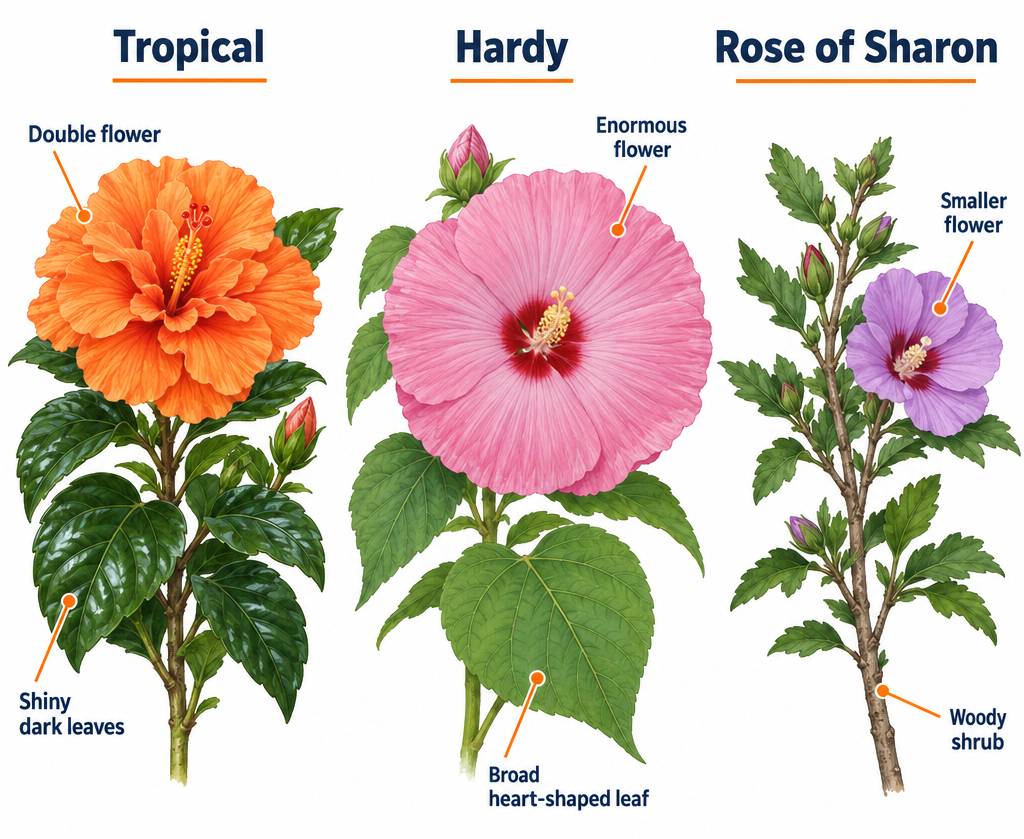
Tropical hibiscus has shiny, dark green leaves and the widest color range: orange, salmon, yellow, and the doubles you see throughout the world in resort landscaping. Each flower lasts one day on most cultivars, but a healthy plant opens new ones daily.
Hardy hibiscus has dull, lighter green leaves, often heart-shaped. The blooms are enormous, the size of a dinner plate, in white, pink, and deep red. Series like ‘Luna’ and ‘Summerific’ stay compact at 3-4 feet. It is a true perennial from Minnesota to Florida.
Rose of Sharon is the woody shrub with smaller flowers that blooms July into September. It is tough, tolerant of poor soil, and sometimes too eager, since older varieties self-seed heavily. Look for sterile or near-sterile cultivars such as ‘Azurri Blue Satin’ or ‘Sugar Tip’ if volunteers bother you.
Roselle is the one used for tea. The dried calyces behind the flower, not the petals, create the tart red hibiscus tea sold in bulk and in organic herb shops. It needs a long, hot season, so northern growers start seed indoors in March.
Typical nursery pricing in the US runs $12-25 for a quart or 1-gallon tropical, $25-45 for a 3-gallon, and $40-80 for a braided tree form. Hardy hibiscus in 1-2 gallon pots sells for $20-35. Rose of Sharon shrubs run $20-50 at 3 gallons.
Step 2: Choose the spot and fix the soil
All hibiscus want at least 6 hours of direct sun. In zones 9-11, tropicals bloom better with light afternoon shade because flower buds abort when the plant overheats. Everywhere else, give full sun.
Drainage matters more than fertility. Dig a test hole 12 inches deep, fill it with water, and time it. If the water is still standing after four hours, the spot is too wet for tropicals and rose of Sharon. Hardy hibiscus is the exception; it grows wild in marshes and tolerates damp ground. A bed that stays swampy for days after every storm usually needs a french drain or a raised bed before anything goes in.
Target soil pH is 6.0 to 7.0. Spread 2-3 inches of compost over the planting area and turn it into the top 10-12 inches. Skip peat moss in heavy clay; it holds water and makes the problem worse. Use compost or pine bark fines instead.
Space hardy hibiscus 3-4 feet apart. Rose of Sharon needs 6-10 feet between shrubs. Tropicals planted in the ground in zone 9-11 go 4-6 feet apart.
Step 3: Plant in the ground or in a container
Plant after the last frost date once soil temperature holds above 60°F. Hibiscus roots stall in cold soil and the plant sulks for weeks.
For in-ground planting, dig a hole twice the width of the root ball and exactly as deep. Set the plant so the top of the root ball sits level with or a half-inch above the surrounding grade. Planting deep is the fastest way to rot a tropical hibiscus. Backfill, firm gently with your hands, and water until the soil settles. Mulch 2-3 inches deep, keeping the mulch 2 inches away from the stem.
For containers, size up only one or two inches from the nursery pot. A 3-gallon tropical goes into a 12-14 inch pot, not a 20-inch tub. Oversized pots hold cold, wet soil around a small root system. Use a quality bagged potting mix with perlite, never garden soil, and make sure the pot has real drainage holes. Place the container where it gets morning sun and can be reached with a hose daily.
Pro tip
Before you put a new tropical hibiscus in a pot, gently tease the outer inch of roots loose and cut any that circle the root ball. Circling roots from the nursery never straighten on their own, and the plant stays stunted no matter how much you feed it.
Hardy hibiscus emerges very late, often not until late May in zone 5. If you plant one in spring and it looks like a bare stick, be patient. Mark the spot so you do not dig it up or plant over it.
Step 4: Water deeply and consistently
Inconsistent water is the number one cause of yellow leaves and dropped buds. Hibiscus want evenly moist soil, never bone dry and never saturated.
| Situation | How often | How much |
|---|---|---|
| New in-ground plant, first month | Every 2-3 days | Slow soak, 2-3 gallons |
| Established in-ground, normal weather | 1-2 times per week | 1-2 inches total |
| Established in-ground, above 90°F | Every 2-3 days | Deep soak to 8 inches |
| Container, spring and fall | Every 2-3 days | Until water runs from the drainage holes |
| Container, summer heat | Daily, sometimes twice | Until water runs through |
| Tropical overwintering indoors | Every 7-10 days | When top 2 inches are dry |
Check containers by pushing a finger into the mix. Water when the top inch feels dry. A drip tray left full of water for more than an hour will rot roots, so empty it.
Water at the base with a wand or soaker hose. Overhead sprinklers wet the foliage, which invites fungal leaf spot and knocks petals off open flowers.
Step 5: Feed for flowers, not foliage
Hibiscus are heavy feeders, but the wrong fertilizer gives you a big green bush with no blooms. Tropical hibiscus in particular dislike high phosphorus. The “bloom booster” formulas with a middle number of 30 or 50 build up phosphorus in the soil and actually reduce flowering over time.
Look for a ratio heavy in potassium and light in phosphorus. Products labeled for hibiscus or palms, such as 9-3-13 or 17-5-24, work well. A balanced organic 5-5-5 with added kelp or sulfate of potash is a reasonable substitute.
Feeding schedule we follow:
- In-ground tropical and rose of Sharon: slow-release granular in April and again in July, following label rates.
- Container tropical: water-soluble feed at half strength every 2 weeks from April through September.
- Hardy hibiscus: one application of 10-10-10 or compost when new growth appears, then a second feeding in early July.
- All types: stop feeding by late September so growth hardens before cold weather.
Yellow leaves with green veins mean iron or magnesium deficiency, common in alkaline soil and in pots watered with hard water. A tablespoon of Epsom salt dissolved in a gallon of water, applied monthly, fixes magnesium. Chelated iron fixes the other.
Step 6: Prune and deadhead
Deadheading is optional for tropical hibiscus since spent flowers drop cleanly on their own. Snapping off faded blooms on hardy hibiscus and rose of Sharon tidies the plant and, for rose of Sharon, prevents seed pods.
Prune for shape in early spring, before new growth starts. All three types bloom on new wood, so spring pruning costs you nothing.
- Tropical hibiscus: cut back up to one-third, making each cut a quarter inch above an outward-facing node. Remove crossing branches and anything thinner than a pencil.
- Hardy hibiscus: cut old stems to 4-6 inches after a hard frost or in early spring. New shoots rise from the crown.
- Rose of Sharon: remove dead wood and thin crowded interior branches in late winter. Hard pruning to 2-3 feet produces fewer but larger flowers.
Pro tip
Pinch the growing tips of young tropical hibiscus every 4-6 weeks through June. Every pinch forces two side shoots, and every side shoot is another place for flower buds. One season of pinching roughly doubles the bloom count on a plant bought in a 1-gallon pot.
Step 7: Get hibiscus through winter
Hardy hibiscus and rose of Sharon handle winter outdoors in their zones with no help beyond a 3-inch mulch layer over the crown.
Tropical hibiscus in zone 8 and colder must come inside. Move pots in before night temperatures hit 50°F, usually late September in the Midwest. Hose the plant off thoroughly first, including the undersides of leaves, to knock off whiteflies and aphids that otherwise explode indoors. Prune back by a third to make it manageable.
Indoors, give it the brightest window you have, ideally south-facing, and keep the room at 60-70°F. Expect it to drop a third to half of its leaves within two weeks. That is normal. Water only when the top 2 inches of mix dry out and skip fertilizer until March. A plant in a dim room survives as a near-leafless stick and leafs back out in May when it goes outside again.
If you also overwinter a potted herb rosemary indoors, give the hibiscus the sunnier spot. Rosemary tolerates a cool, bright garage window; a hibiscus does not.
Step 8: Control pests before they spread
Inspect the undersides of leaves and the newest growth once a week. Most hibiscus pests are soft-bodied and easy to control if caught early.
| Pest | What you see | Fix |
|---|---|---|
| Aphids | Clusters of green or black insects on new tips, sticky residue | Blast with hose, then insecticidal soap every 5 days for 3 applications |
| Whiteflies | Tiny white insects fly up when leaves are disturbed | Yellow sticky traps plus insecticidal soap on leaf undersides |
| Spider mites | Fine webbing, stippled yellow leaves, worst indoors | Increase humidity, spray undersides with water, then neem oil weekly |
| Hibiscus sawfly | Hardy hibiscus leaves skeletonized to the veins | Hand-pick larvae; spinosad spray at first sign in late May |
| Japanese beetles | Chewed petals and lacy leaves in July | Hand-pick into soapy water in early morning |
| Mealybugs | White cottony masses in leaf axils | Dab with rubbing alcohol on a cotton swab, repeat weekly |
Spray in the early morning or evening when temperatures are under 85°F. Always test a single leaf 24 hours before treating the whole plant.
Troubleshooting
| Symptom | Likely cause | Fix |
|---|---|---|
| Buds form then drop before opening | Inconsistent water, heat above 95°F, or thrips | Water on a schedule, add afternoon shade, inspect buds for thrips |
| Lower leaves yellow and drop | Overwatering or sudden temperature change | Let soil dry to 1 inch, check drainage, move out of drafts |
| Lots of leaves, no flowers | Too much nitrogen or phosphorus, or too little sun | Switch to low-phosphorus hibiscus feed, confirm 6+ hours of sun |
| Leaves yellow between green veins | Iron or magnesium deficiency, high pH | Chelated iron, Epsom salt, acidify with elemental sulfur |
| Hardy hibiscus shows nothing by mid-May | Normal late emergence | Wait until mid-June before giving up |
| Wilting despite wet soil | Root rot from poor drainage | Repot into fresh mix, cut away brown mushy roots, water less |
| Petals shredded, leaves lacy | Japanese beetles | Hand-pick daily for 2-3 weeks |
| Small knobby growths on buds, buds blacken and drop | Hibiscus gall midge | Remove and bag all affected buds, clean up fallen debris |
When to call a pro
Call a certified arborist or a licensed landscape contractor if a mature rose of Sharon or in-ground tropical dies back suddenly from the top down, which can signal root disease or a buried irrigation leak. Persistent standing water across a bed is a grading or drainage job, and your county extension office will test soil for a few dollars if pH corrections are not working.
FAQ
Can hibiscus flowers be eaten or used for tea?
Tropical hibiscus petals are edible and sometimes used as a garnish, but the familiar tart red tea comes from the calyces of Hibiscus sabdariffa, or roselle. Grow roselle from seed if you want to make your own; the plants sold as patio hibiscus are not the tea variety.
How long does a hibiscus flower last?
A single tropical hibiscus bloom opens for one day on most cultivars, two or three on some hybrids. Hardy hibiscus flowers last one to two days. A healthy plant produces new buds continuously, so the show runs for months even though individual flowers are brief.
Should we grow hibiscus in a container or in the ground?
In zones 9-11, tropical hibiscus does best in the ground. Everywhere colder, keep it in a 12-18 inch container so it can come indoors. Hardy hibiscus and rose of Sharon belong in the ground as permanent perennials.
Why does our hibiscus bloom at the nursery but not at home?
Nurseries grow in full greenhouse sun and feed constantly. At home the most common causes are irregular watering that makes the plant abort buds, fewer than 6 hours of direct sun, or temperature stress from heat waves and cold snaps. Fix those three and blooms usually return within 4-6 weeks.
How big of a pot does a tropical hibiscus need?
Move up gradually. A plant from a 1-gallon nursery pot goes into a 10-inch container, a 3-gallon into 12-14 inches. Repot every two years into something 2 inches wider until you reach about 18-20 inches, then just refresh the top third of the mix each spring.