
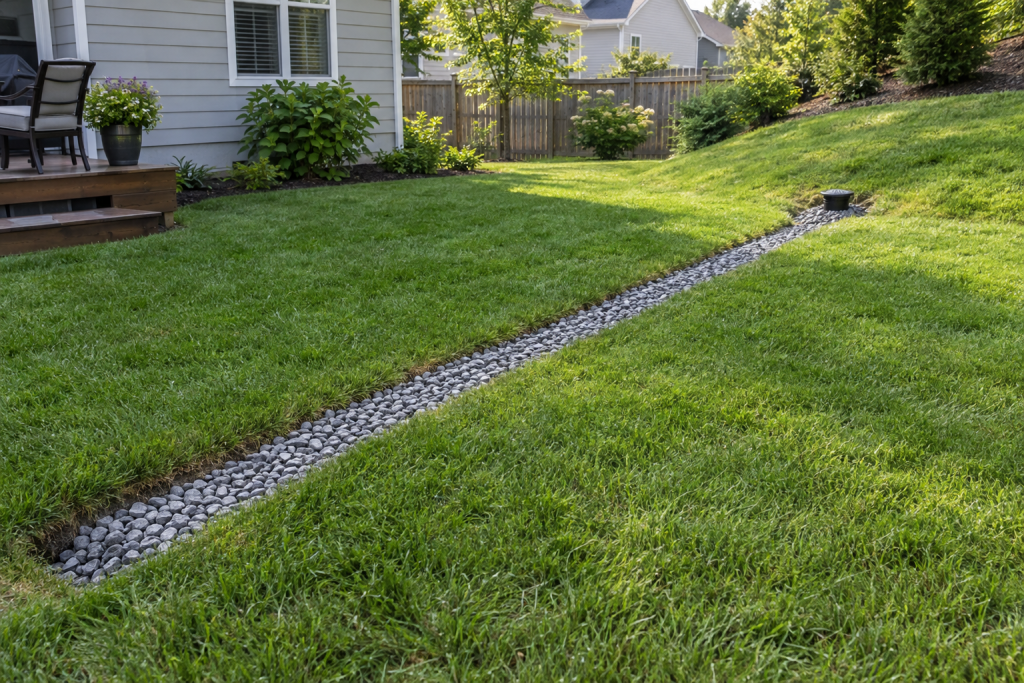
A French drain is a gravel-filled trench with a perforated pipe at the bottom that collects groundwater and carries it downhill to a safe discharge point. You can install one yourself with a shovel or rented trencher, 4-inch perforated pipe, washed gravel and filter fabric, and most residential runs of 30 to 60 feet take a weekend and cost $300 to $800 in materials.
Quick steps: install a French drain
- Call 811 and wait for utility marking, then plan a route with a downhill exit.
- Set a string line at 1 inch of fall per 8 to 10 feet of run.
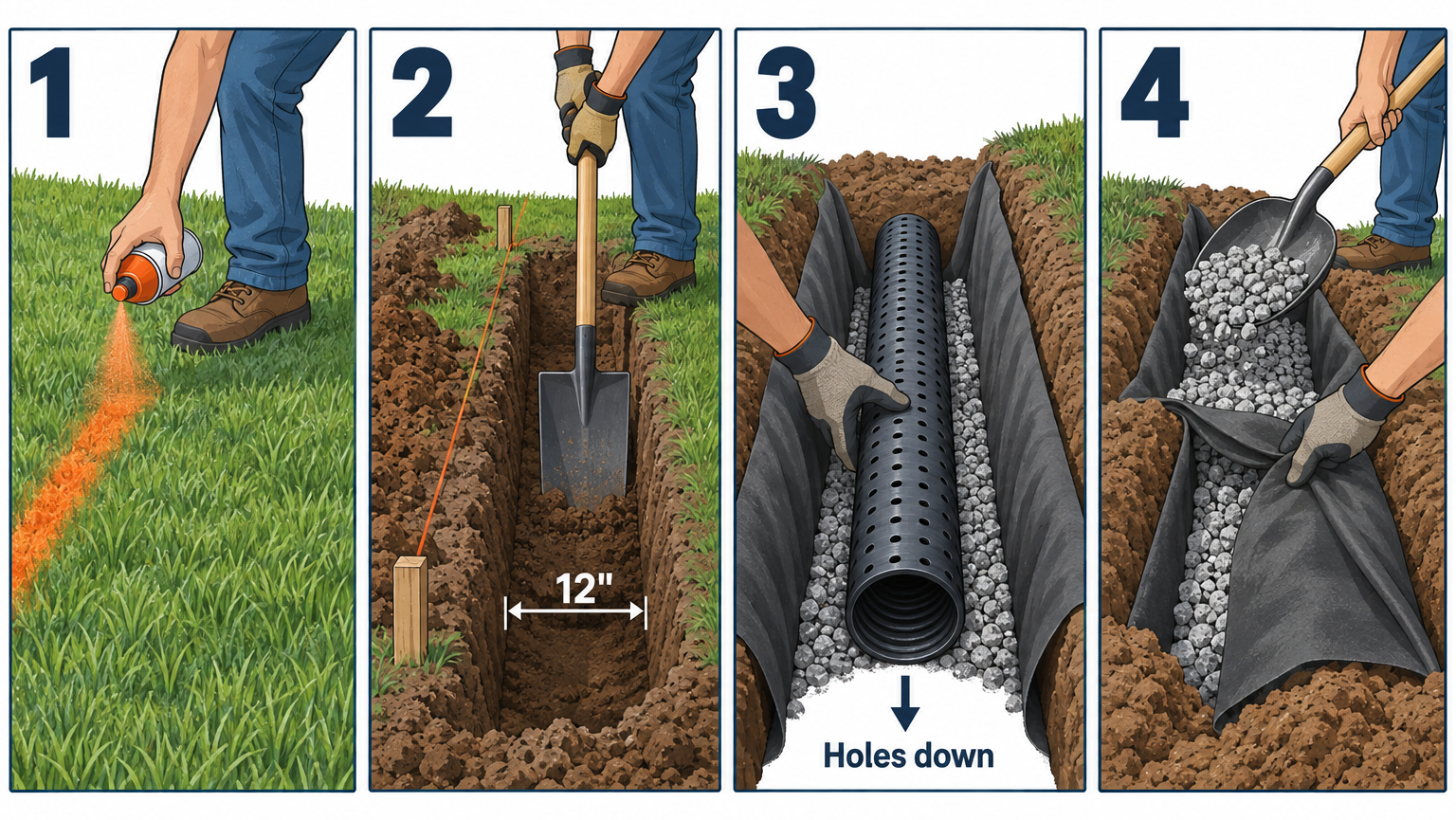
- Dig a trench 12 inches wide and 18 to 24 inches deep, grading the bottom to the string.
- Line the trench with non-woven filter fabric, leaving 12 inches of overlap on each side.
- Spread 2 to 3 inches of washed 3/4-inch gravel and set the perforated pipe, holes down.
- Connect solid pipe at the outlet and run it to daylight, a dry well or a pop-up emitter.
- Backfill with gravel to 4 inches below grade and fold the fabric over the top.
- Cover with topsoil and sod, or leave the gravel exposed for a surface drain.
Tools and materials
- 4-inch perforated corrugated or PVC pipe (10-foot or 100-foot coil)
- 4-inch solid pipe for the outlet run
- Non-woven geotextile filter fabric, 4-ounce, 6-foot wide roll
- Washed drainage gravel, 3/4-inch clean (about 1 ton per 25 feet of trench)
- 4-inch pipe couplings, 45-degree elbows, end cap, outlet grate or pop-up emitter
- Trenching shovel, drain spade and mattock, or a rented walk-behind trencher
- Wooden stakes, mason’s string, line level, 4-foot level, tape measure
- Wheelbarrow, hand tamper, utility knife, landscape staples
- Marking paint, gloves, safety glasses
Calculators for this job
Safety first
Call 811 at least two to three business days before you dig so gas, electric and communication lines get marked for free. Hand-dig within 18 inches of any marked line. A trench over 20 inches deep in loose soil can cave in, so keep spoil piles at least 2 feet from the edge.
Step 1: Plan the route and the discharge point
Walk the yard after a hard rain and note where water pools and where it flows. A French drain only works when it has somewhere to send the water, so find the exit first and then work backward to the problem area. The outlet needs to be lower than the lowest point of the trench, and it should land at least 10 feet from your foundation and never on a neighbor’s lot.
You have three realistic discharge options. Daylight is best: the pipe pokes out of a slope or a retaining wall and water simply runs out through a grate. A pop-up emitter works on flatter lots, sitting flush with the lawn and lifting its lid when water pressure builds. A dry well, which is a buried perforated barrel or a 3-foot gravel pit, handles yards with no low spot at all, though it fails in heavy clay that cannot absorb the water.
Most French drains that protect a basement follow one of two layouts. A curtain drain runs across the slope uphill of the house, intercepting groundwater before it reaches the foundation. A footing drain runs right alongside the foundation at the base of the footing, which is a far bigger excavation and usually a job for a contractor with a mini excavator.
Mark the whole route with marking paint and measure it. Add 10 percent to your pipe length for fittings and mistakes.
Step 2: Set the slope with a string line
Grade is the single thing that makes or breaks french drain installation. Water in a perforated pipe does not get pushed; it rolls, so the pipe needs consistent fall from the first foot to the last. The minimum is 1 inch of drop per 10 feet of run, and 1 inch per 8 feet gives you some margin for settling.
Drive a stake at each end of the route and tie mason’s string tight between them. Hang a line level in the middle and adjust until the string reads dead level, then measure the full run. For a 40-foot trench you need at least 4 inches of fall, so slide the string down the downhill stake 5 inches and retie it. Every point on the trench bottom will now be measured from that string.
Long runs over 50 feet need an intermediate stake so the string does not sag. If the yard rises in the direction you want water to flow, you cannot fix that with slope. Choose a different exit or plan on a sump basin and pump at the low end.
Pro tip
Wrap a 4-foot level with a 1/4-inch shim taped under one end. When the bubble reads level, the level itself is sitting at roughly 1 inch per 8 feet of fall. Lay it on the trench bottom every few feet and you can check grade without pulling a tape to the string every time.
Step 3: Dig the trench
Dig the trench 12 inches wide and 18 to 24 inches deep for a yard drain. Go deeper if you are intercepting water that reaches a basement wall; the pipe needs to sit below the level of the problem, which for a slab or footing means 6 inches below the bottom of the footing. Sod comes off first in strips with a flat spade so you can lay it back at the end.
For anything over 30 feet, rent a walk-behind trencher for $120 to $200 a day. It cuts a 6-inch-wide slot, so you will still widen the trench by hand to fit pipe and gravel with room to work. Hand digging runs about 10 feet per hour in average loam and half that in clay or rocky soil, which is why a 60-foot drain is a two-person weekend.
As you dig, hang a tape from the string line every 4 feet and check the depth. The bottom of the trench should stay the same distance below the string along its entire length. Scrape out high spots and never fill low spots with loose dirt, since it settles and creates a belly where water sits and silt collects. Compact any spot you do have to fill with a hand tamper.
Pile the spoil on one side only, on a tarp, so the other side stays clear for your gravel wheelbarrow. Expect two to three times more soil than you think; a 40-foot trench at 12 by 20 inches produces about 2.5 cubic yards.
Step 4: Line the trench with filter fabric
Filter fabric is what keeps a French drain working past its fifth year. Without it, fine soil particles migrate into the gravel and eventually into the pipe perforations until the whole thing turns into a clay-choked trench. Use non-woven geotextile, often sold as drainage fabric, at 4 ounces per square yard. Skip woven landscape fabric meant for weed control, which blocks water nearly as well as it blocks weeds.
Roll the fabric down the trench, pressing it flat against the bottom and both walls. Leave a minimum of 12 inches draped over the ground on each side so you can fold it over the gravel later. Where two sections meet, overlap them by 12 inches in the direction of flow, uphill piece on top. Pin everything with landscape staples every 3 feet so the wind and your wheelbarrow do not drag it into the trench.
Step 5: Add bedding gravel and lay the pipe
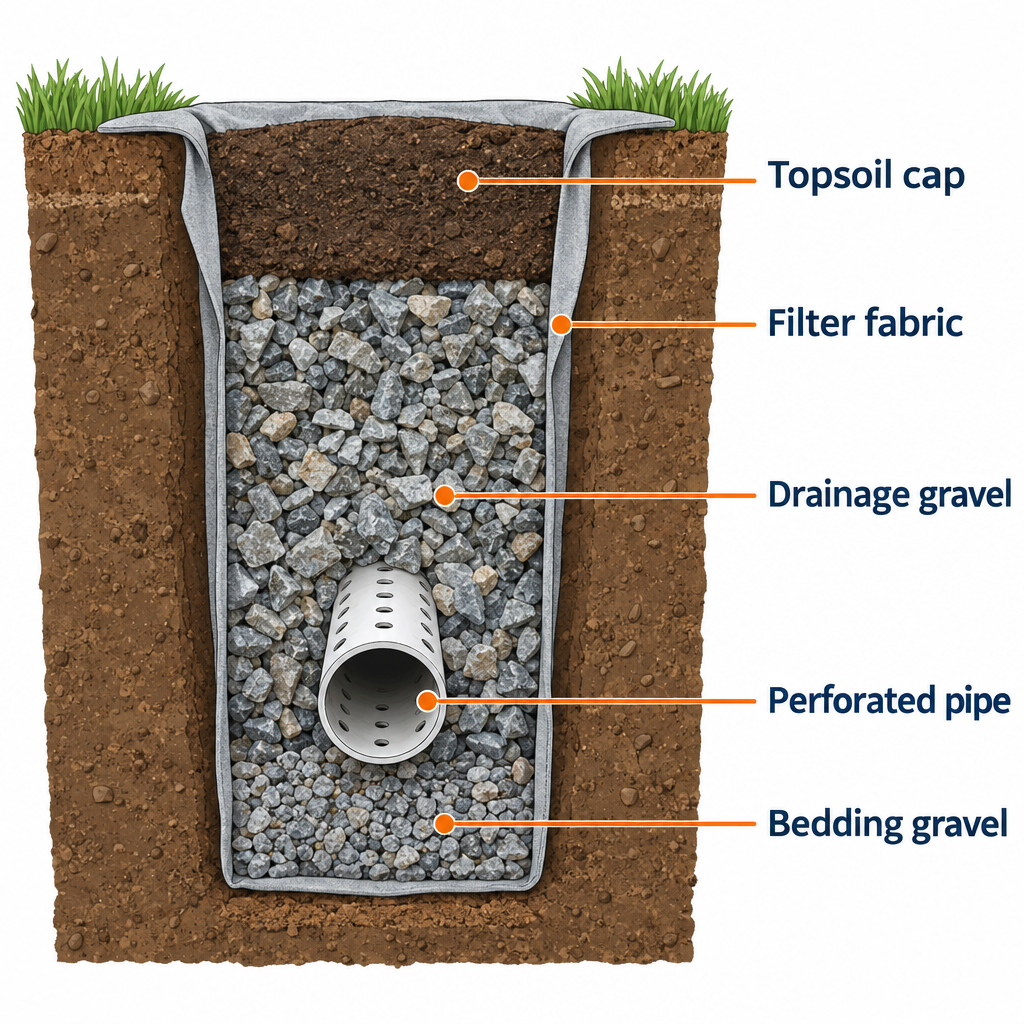
Spread 2 to 3 inches of washed 3/4-inch gravel across the trench bottom. Washed matters. Crusher run and pea gravel both contain fines that clog fabric and settle solid, while clean crushed stone or river rock leaves open voids that move water fast. Rake the bedding smooth and check grade again with the level.
Set the perforated pipe on the gravel bed. Corrugated pipe with pre-cut slots costs about $1 a foot and bends around gentle curves, but it crushes under vehicle loads and cannot be snaked out if it clogs. Rigid PVC SDR-35 perforated pipe runs closer to $2.50 a foot, needs elbows at every turn, and stays round under a driveway and clean under a sewer jetter. For a yard drain either works. Under a driveway or next to a foundation, use PVC.
Lay the pipe with the holes facing down. This surprises most first-timers, but water rises up from the saturated gravel into the pipe through the bottom holes, and the pipe then carries it downhill below the gravel’s water level. Holes up means water has to fill the pipe to the top before it drains, which leaves the bottom 4 inches of your trench permanently soaked.
Cap the uphill end so soil cannot creep in. Join corrugated sections with snap couplings and PVC with solvent-welded couplings. Keep each joint sitting on gravel, not sagging in air.
Pro tip
Buy sock pipe, which is perforated pipe with a knit fabric sleeve already on it, if your soil is sandy or silty. It costs 30 to 50 cents more per foot and adds a second filter right at the perforations. In heavy clay, skip the sock; clay fines will plaster it shut, and the trench fabric alone does the job.
Step 6: Build the outlet
Switch from perforated to solid 4-inch pipe at the point where the trench leaves the wet area and heads for the exit. Perforated pipe in the outlet run just leaks water back into the ground before it reaches daylight. Use a 45-degree elbow for any direction change rather than a 90, which slows flow and snags debris.
For a daylight exit, run the solid pipe out through the slope so the end sits at least 2 inches above the ground surface and fit a plastic grate or a flap cap to keep rodents out. Set a few flat stones or a small splash pad under the opening so the discharge does not wash a hole in the hillside.
For a pop-up emitter, dig a 12-inch-square pit at the end of the run, fill it with 4 inches of gravel, and set the emitter so its lid sits 1/4 inch above finished lawn height. The emitter needs about 1 inch of fall per 10 feet in the pipe behind it, same as the drain, or the lid will not lift under flow.
If you are connecting to a dry well, the pit should hold at least 50 gallons for a typical 40-foot drain, and the bottom must sit above the seasonal water table. A 50-gallon perforated plastic well costs $100 to $180. Wrap it in fabric and surround it with 12 inches of gravel on all sides.
Step 7: Backfill with gravel
Shovel washed gravel over the pipe carefully for the first 6 inches, working from the sides so you do not knock the pipe off grade or shift it sideways. Then fill in bulk, 6 inches at a time, and settle each lift by walking it down. Stop 4 inches below finished grade for a lawn or 2 inches below if you plan to leave the gravel exposed.
Budget about 1 ton of gravel per 25 feet of 12-by-20-inch trench, which is roughly 0.7 cubic yards. Bulk delivery from a landscape yard costs $40 to $70 a ton plus a delivery fee, far cheaper than 50-pound bags at $5 each. Have it dumped on a tarp as close to the trench as the truck can get.
Fold the extra fabric over the top of the gravel so the two sides overlap in the middle. This fabric cap is what stops topsoil from sifting into the stone over the years.
Step 8: Finish the surface
For a hidden drain, spread 3 to 4 inches of topsoil over the fabric, rake it level with the surrounding lawn, and lay the sod you saved or seed it. Water the sod daily for two weeks. The strip will settle an inch or so in the first year, so mound the soil slightly above grade.
For a surface drain that also catches runoff, which is the better choice at the base of a slope or along a driveway, leave decorative stone exposed and skip the fabric cap. Use 1-1/2-inch river rock on top so it does not scatter under a mower.
Test the system before you put the tools away. Run a hose at the uphill end for 20 minutes and check that water appears at the outlet. If it takes more than a few minutes to show up, or the yard above the trench stays wet, something is off on grade and you want to know now rather than after the sod roots.
Maintaining a French drain
A properly built French drain needs very little attention. Twice a year, pull leaves and grass clippings off the outlet grate and make sure the pop-up emitter lid moves freely. Every spring, run a hose into the uphill end for 10 minutes and confirm clear flow at the outlet. If flow slows, a sewer jetter attachment on a pressure washer, fed in from the outlet end, will scour silt from a PVC pipe. Corrugated pipe tolerates a plumber’s snake but not a jetter.
Keep trees with aggressive roots, like willow, poplar and silver maple, at least 20 feet from the trench. Roots find perforated pipe faster than anything else in the yard.
Troubleshooting
| Symptom | Likely cause | Fix |
|---|---|---|
| Water never reaches the outlet | Belly or reverse grade in the trench | Dig up the low section, regrade bottom, relay pipe on fresh gravel |
| Soggy strip right above the drain | Fabric cap missing or trench too shallow | Excavate top 6 inches, add fabric and gravel, or deepen the trench |
| Outlet drips for days after rain | Normal if soil is saturated; a problem if pipe holes face up | Confirm pipe orientation at the outlet end with a flashlight |
| Pop-up emitter never opens | Insufficient fall in the outlet run or debris under lid | Regrade last 10 feet of pipe; clean emitter seat |
| Flow drops off after two or three years | Silt in gravel from missing or woven fabric | Jet the pipe; if that fails, rebuild with non-woven fabric |
| Basement still wet after install | Drain is above the water level that reaches the wall | Deepen to below the footing or add an interior perimeter drain and sump |
| Standing water on the lawn far from the drain | Surface runoff, not groundwater | Add a channel drain or regrade; a French drain only collects subsurface water |
When to call a pro
Call a drainage or waterproofing contractor if the trench has to run along the foundation below the footing, if the only outlet is a sump pump tied into the basement, if you hit the water table while digging, or if the route crosses a septic field, a gas line or a utility easement. Any exterior footing drain or interior perimeter drain that involves cutting a basement slab is pro work, and many towns require a permit for discharge to a storm sewer or the street.
FAQ
How deep does a French drain need to be?
A yard drain works at 18 to 24 inches. A drain meant to keep water out of a basement must sit below the level water reaches at the wall, which usually means the pipe bottom is at or below the base of the footing, often 6 to 8 feet down. That depth is why foundation drains are typically a contractor job.
Do the holes go up or down on French drain pipe?
Down. Water rises through the gravel into the bottom holes and the pipe carries it off below the saturated zone. With holes up, the gravel has to fill with water past the top of the pipe before anything drains.
What slope does a French drain need?
A minimum of 1 inch of fall per 10 feet of pipe, and 1 inch per 8 feet is safer. Set it with a string line and line level before you dig, and check the trench bottom against the string every 4 feet.
How much does french drain installation cost?
DIY materials run $8 to $20 per linear foot depending on pipe type and whether you rent a trencher. Professional exterior installation runs $10 to $50 per foot for a shallow yard drain and $80 to $100 per foot for a deep footing drain. Interior perimeter drains with a sump typically cost $4,000 to $12,000 for an average basement.
Can I install a French drain without fabric?
You can, but it will silt up within a few years in most soils and you will dig it out and do it again. A 100-foot roll of non-woven fabric costs about $50 to $80 and is the cheapest insurance on the job.
Will a French drain stop water in my basement?
It stops water that is traveling through the soil toward the foundation, which is the most common cause of wet basement walls. It does nothing for water that comes over the top from clogged gutters, poorly graded soil at the foundation, or a high water table pushing up through the slab. Fix the gutters and grading first, since they are cheaper and solve a surprising share of basement leaks on their own.