
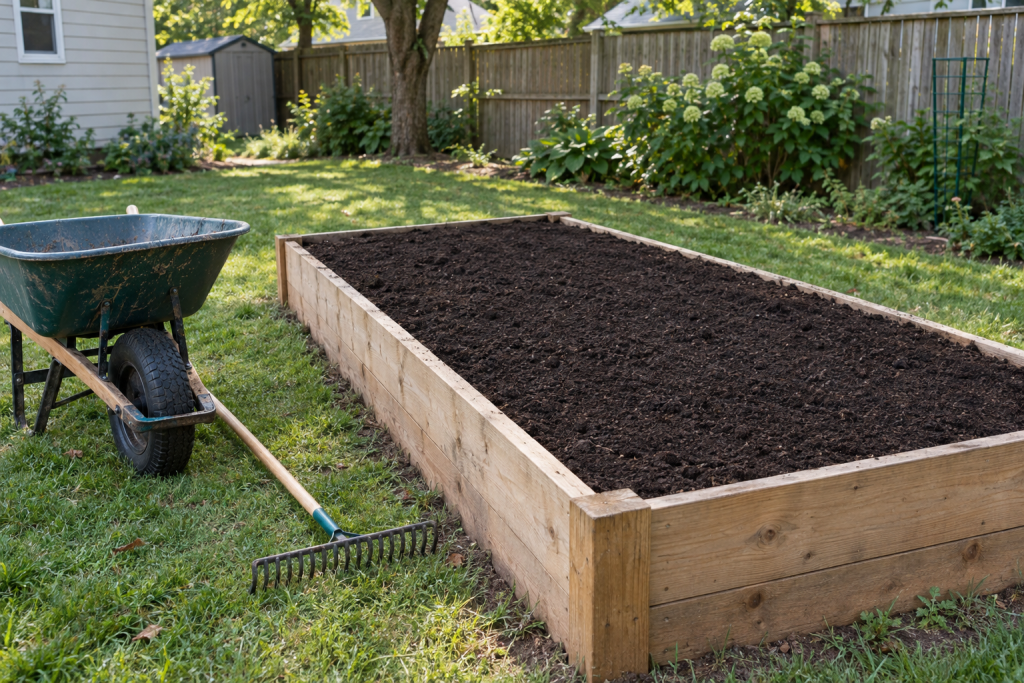
This topsoil calculator turns the length, width and depth of your area into cubic yards, cubic feet, tons and the number of bags to buy. Measure the space in feet, decide how deep the soil needs to be in inches, and the calculator above does the rest, including a cost estimate if you add your supplier’s price per cubic yard.
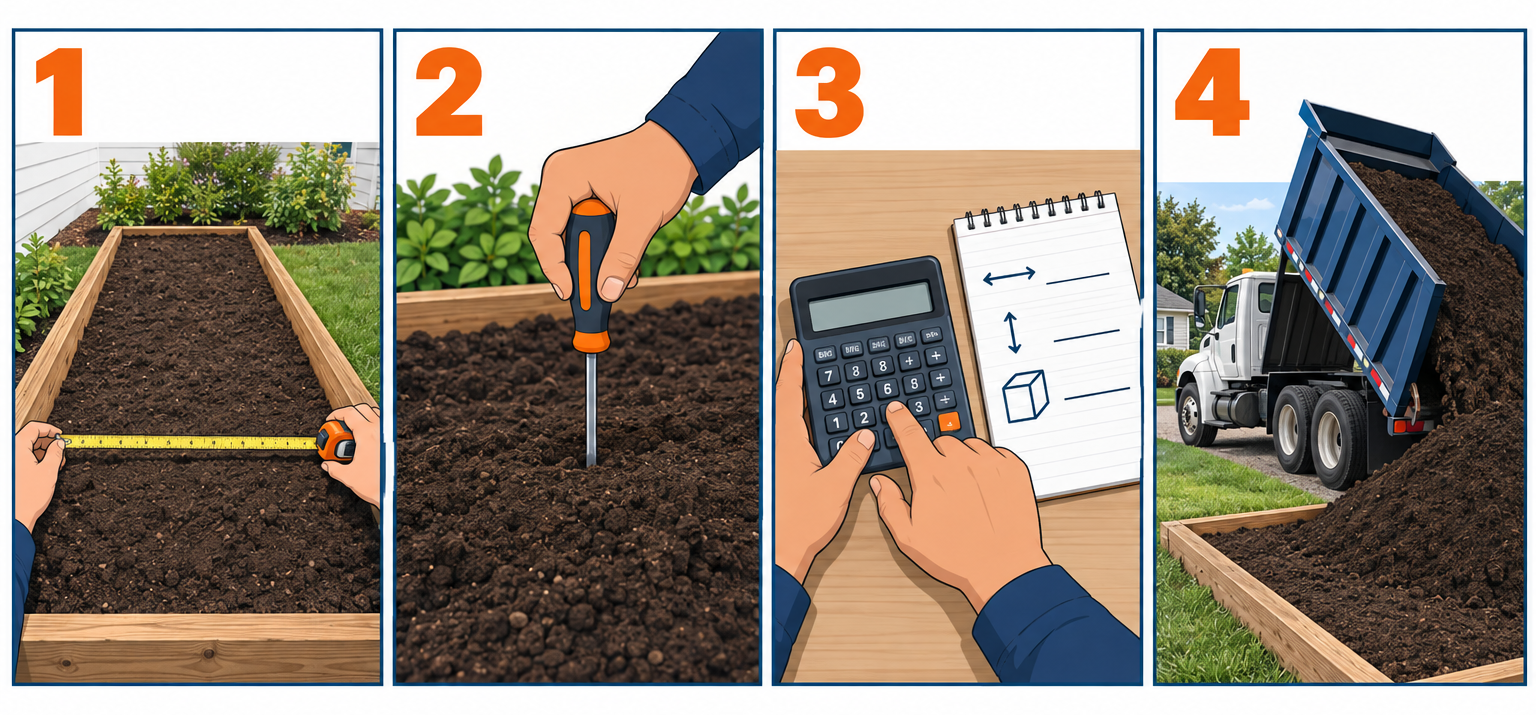
Quick steps: use the topsoil calculator
- Measure the Length (ft) and Width (ft) of the area with a tape, rounding up to the nearest half foot.
- Decide the Depth (in): 2 to 3 in to top-dress a lawn, 4 to 6 in for a new lawn or garden bed, 10 to 18 in for a raised bed.
- Leave Weight per cubic yard (tons) at 1.1 unless your supplier quotes a different figure.
- Pick the Bag size that matches what your store sells (0.75, 1 or 1.5 cu ft).
- Enter Price per cubic yard if you have a bulk quote, then read cubic yards, tons and bag count.
- Add about 10 percent to the result before you order to cover settling and uneven ground.
How to use the topsoil calculator
Each field in the calculator above maps to one physical measurement or one supplier spec. Here is what to put in every box and how to get the number right.
Length (ft) and Width (ft)
Measure the longest dimension of the area and the dimension at right angles to it. Use feet with decimals, so 12 ft 6 in becomes 12.5. The default values of 20 and 10 represent a 200 sq ft bed.
Irregular shapes are the most common source of error. Break an L-shaped bed into two rectangles and run the calculator twice. For a circle, measure the diameter, multiply half of it by itself, then multiply by 3.14 and enter that as Length with Width set to 1. A 10 ft diameter circle is 5 x 5 x 3.14, or 78.5 sq ft, so Length 78.5 and Width 1. If you already have the area from a square footage calculator, the same trick works: enter the square footage as Length and 1 as Width.
Depth (in)
Depth goes in inches, not feet. This is the field people get wrong most often, and a 4 vs 0.33 mistake throws the result off by a factor of 12.
Match the depth to the job:
- Patching bare spots or leveling low areas in an existing lawn: 0.5 to 1 in per application
- Top-dressing a lawn before overseeding: 0.25 to 0.5 in, so grass blades still show through
- New lawn from seed or sod: 4 to 6 in of good topsoil over the subgrade
- Vegetable or flower bed in the ground: 6 to 8 in after turning in the existing soil
- Raised bed: the full interior height, usually 10 to 18 in
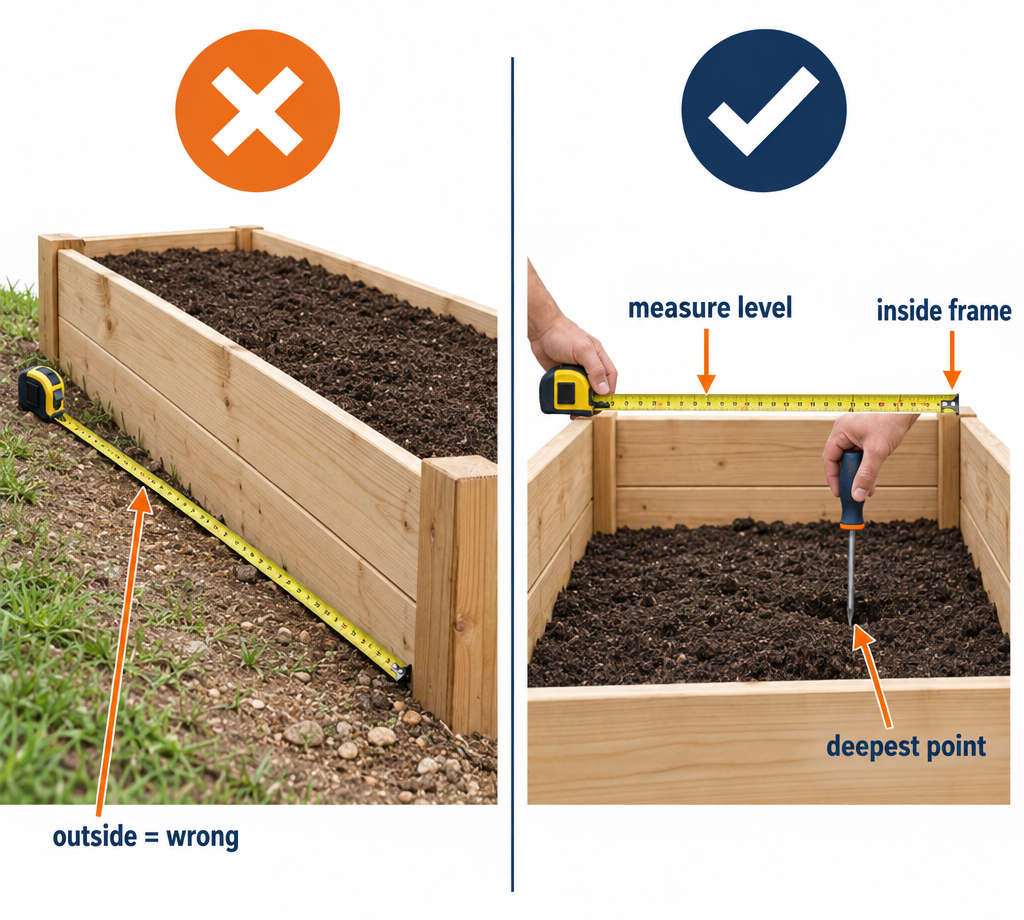
Measure depth where the soil will actually sit. Push a screwdriver into the existing ground at several spots, or hold a straightedge across a low area and measure down to the dirt at the deepest point. Use the average, not the shallowest reading, or you will run short.
Weight per cubic yard (tons)
Suppliers often sell bulk topsoil by the ton rather than the yard, and dump trucks are limited by weight. The default of 1.1 tons per cubic yard (2,200 lb) is a working average for screened topsoil with normal moisture. Dry, sandy soil can weigh closer to 0.9 to 1.0 tons per yard. Wet clay-heavy topsoil can hit 1.3 to 1.5 tons. If your supplier quotes a weight, enter their number so your tons match their invoice.
Bag size
Bagged topsoil in the US comes in three common sizes:
| Bag size | Approximate weight | Bags per cubic yard |
|---|---|---|
| 0.75 cu ft | about 40 lb | 36 |
| 1 cu ft | 50 to 55 lb | 27 |
| 1.5 cu ft | 60 to 75 lb | 18 |
The calculator divides your cubic feet by the bag size you choose and rounds up. Check the bag label at the store, because the same brand often sells two sizes side by side.
Price per cubic yard (optional)
Enter your bulk price per cubic yard, before delivery, and the calculator multiplies it by the cubic yard result. Leave it at 0 if you only want quantities. Add the delivery fee separately when you compare bulk against bags.
Common measuring mistakes
- Entering the depth in feet instead of inches
- Measuring the outside of a raised bed frame instead of the inside (2x lumber takes 1.5 in off each side)
- Measuring a sloped area with the tape lying on the ground instead of held level
- Forgetting that a tilled bed needs less fill because the existing soil has been loosened and mixed in
- Measuring a lawn repair at its shallowest point rather than its deepest
Topsoil calculator formula: cubic feet, cubic yards, tons and bags
The math behind the calculator is three short steps. You can do it on paper to check an order or a delivery.
Cubic feet = Length (ft) x Width (ft) x Depth (in) / 12
Dividing the depth by 12 converts inches to feet so all three dimensions match.
Cubic yards = Cubic feet / 27
A cubic yard is 3 ft x 3 ft x 3 ft, which is 27 cubic feet. This answers the question people ask most: how many cubic feet in a cubic yard of dirt? Always 27, no matter what the material is.
Tons = Cubic yards x Weight per cubic yard
Bags = Cubic feet / Bag size, rounded up
Worked example 1: the default inputs
With Length 20 ft, Width 10 ft and Depth 4 in:
- 20 x 10 = 200 sq ft of area
- 4 / 12 = 0.333 ft of depth
- 200 x 0.333 = 66.7 cubic feet
- 66.7 / 27 = 2.47 cubic yards
- 2.47 x 1.1 = 2.72 tons, which is 2.72 x 2,000 = 5,432 lb
- 66.7 / 0.75 = 88.9, rounded up to 89 bags of 0.75 cu ft
- 2.47 x 0.7646 = 1.89 cubic meters, for anyone converting to metric
So the calculator shows 2.47 cu yd of topsoil, 66.7 cu ft, 1.89 cubic meters, 2.72 tons (5,432 lb) and 89 bags. In practice you would order 3 cubic yards bulk, since most yards sell in half or whole yard increments.
Worked example 2: a 30 x 15 ft lawn area at 3 in
Say you are stripping a dead patch of lawn 30 ft long and 15 ft wide and want 3 in of fresh topsoil before you seed.
- 30 x 15 = 450 sq ft
- 3 / 12 = 0.25 ft
- 450 x 0.25 = 112.5 cubic feet
- 112.5 / 27 = 4.17 cubic yards
- 4.17 x 1.1 = 4.58 tons, or about 9,167 lb
- 112.5 / 0.75 = 150 bags at 0.75 cu ft, or 112.5 / 1 = 113 bags at 1 cu ft, or 112.5 / 1.5 = 75 bags at 1.5 cu ft
At 4.17 cubic yards plus 10 percent for settling, order 4.5 to 5 cubic yards. That is roughly one single-axle dump truck load and well past what any pickup can carry in one trip.
Pro tip
Do the arithmetic once by hand for every delivery. A full-size dump truck holding 10 to 14 yards looks much the same whether it has 8 or 10 yards in it. Knowing your cubic feet lets you spot a short load: spread it at the planned depth, measure what it covered, and compare.
Quick-reference chart: cubic yards of topsoil by area and depth
Every figure here uses the same formula as the calculator (area x depth / 12 / 27). Find your square footage, read across to your depth, then round up to the next half yard when you order bulk.
| Area (sq ft) | 2 in deep | 4 in deep | 6 in deep | 12 in deep |
|---|---|---|---|---|
| 100 | 0.62 cu yd | 1.23 cu yd | 1.85 cu yd | 3.70 cu yd |
| 200 | 1.23 cu yd | 2.47 cu yd | 3.70 cu yd | 7.41 cu yd |
| 500 | 3.09 cu yd | 6.17 cu yd | 9.26 cu yd | 18.52 cu yd |
| 1,000 | 6.17 cu yd | 12.35 cu yd | 18.52 cu yd | 37.04 cu yd |
A handy rule from this table: one cubic yard covers about 81 sq ft at 4 in, 162 sq ft at 2 in, or 324 sq ft at 1 in.
Raised bed sizes and bags needed
Raised beds are the most common reason people search for a yards of topsoil calculator, so here are the standard kit sizes worked through. Dimensions are interior.
| Bed size (interior) | Cubic feet | Cubic yards | 0.75 cu ft bags | 1 cu ft bags | 1.5 cu ft bags |
|---|---|---|---|---|---|
| 4 x 4 ft, 12 in deep | 16 | 0.59 | 22 | 16 | 11 |
| 3 x 6 ft, 10 in deep | 15 | 0.56 | 20 | 15 | 10 |
| 4 x 8 ft, 12 in deep | 32 | 1.19 | 43 | 32 | 22 |
| 4 x 8 ft, 18 in deep | 48 | 1.78 | 64 | 48 | 32 |
| 4 x 12 ft, 12 in deep | 48 | 1.78 | 64 | 48 | 32 |
Most gardeners fill raised beds with a blend rather than straight topsoil, often 50 to 60 percent topsoil with the rest compost. Run the calculator for the total volume, then split the order by percentage.
Buying and ordering topsoil
Units suppliers use
Bulk topsoil is sold by the cubic yard at most landscape supply yards and by the ton at quarries and some larger operations. Bags are sold by volume in cubic feet, though the label may lead with the weight (40 lb) instead. The calculator gives you all three so you can compare any quote directly.
When a supplier quotes by the ton, divide their price by the weight per cubic yard to compare with a per-yard quote. At 1.1 tons per yard, a price of $30 per ton works out to $33 per cubic yard.
Bulk vs bags
Bags make sense up to roughly 1 cubic yard (36 bags of 0.75 cu ft). Beyond that, bulk delivery is almost always cheaper and far less work.
Take the default example of 2.47 cubic yards. Buying 89 bags at $3 to $5 each runs $267 to $445, plus a lot of lifting and a pile of empty plastic. Ordering 3 cubic yards of screened topsoil in bulk typically runs $20 to $40 per yard for basic screened soil, so $60 to $120 for the material, plus a delivery charge that commonly falls between $50 and $150 depending on distance. Even at the high end, bulk wins once you pass a yard or so.
Prices vary a lot by region and by product. Plain screened fill-grade topsoil sits at the low end. Premium blends with compost, sand or amendments can run $40 to $80 per yard or more. Call two local yards for quotes before you enter a price in the calculator.
Delivery minimums and truck capacity
Most suppliers set a minimum delivery of 1 to 3 cubic yards and charge a flat fee under a certain distance. Single-axle dump trucks usually carry 5 to 10 yards, tandem axle trucks 10 to 16 yards.
If you plan to haul it yourself, think in weight, not volume. One cubic yard at the calculator’s default weighs 2,200 lb. Modern half-ton pickups are typically rated for 2,000 lb or more of payload, but that rating includes passengers and anything else in the truck, and a yard of wet soil can push past it. Plan on half a yard per trip in a half-ton truck, or borrow a trailer. A 5 x 8 ft utility trailer holds about one yard level with the sides but check its weight rating too.
How much extra to order
Add 10 percent to the calculator’s result for a lawn or garden bed, and 15 to 20 percent for a raised bed you will water heavily. Topsoil arrives loose and fluffed from the loader. It settles as it gets rained on, walked on and watered, often losing 10 to 20 percent of its loose height in the first month. Ordering a little extra costs far less than a second delivery fee.
Round up to the supplier’s increment as well. If the calculator says 4.17 yards and your yard sells in half yards, 4.5 yards with 10 percent added becomes 5 yards.
Pro tip
Ask for “screened” topsoil and ask what screen size they use. Half-inch screened soil spreads with a rake and is fine for lawns. Unscreened topsoil is cheaper but comes with rocks, roots and clods that you will spend hours picking out of a seedbed.
Safety first
A cubic yard of topsoil weighs over a ton and a 40 lb bag is heavy enough to strain your back on the fortieth lift. Keep loads close to your body, use a wheelbarrow for anything over a few feet, and call 811 before digging more than a few inches to raise or regrade an area.
Common mistakes that leave you short or over-buying
| Mistake | What happens | How to avoid it |
|---|---|---|
| Depth entered in feet | Result is 12 times too small | The field is inches; 4 in, not 0.33 |
| Measuring outside of raised bed frame | Buy 10 to 15 percent too much | Measure inside the boards |
| Measuring the shallow edge of a low spot | Run short in the middle | Measure the deepest point and average several spots |
| No allowance for settling | Bed sits 1 to 2 in low after a month | Add 10 to 20 percent |
| Forgetting existing soil in a tilled bed | Buy more than you can fit | Measure depth above the tilled surface only |
| Ignoring bag volume vs weight | 40 lb bag assumed to be 1 cu ft | Read the cubic feet on the label; most 40 lb bags are 0.75 cu ft |
| Comparing a per-ton quote to a per-yard quote | Pick the wrong supplier | Convert with weight per cubic yard |
| Using topsoil math for mulch or gravel | Wrong weight and coverage | Use a mulch calculator or gravel calculator for those materials |
One more that catches people on bigger projects: delivery trucks dump where the driver can reach, not where you want the soil. If the pile lands 60 ft from the bed, you move the whole 5,000 lb by wheelbarrow. Clear the drop zone and mark it before the truck arrives.
When to call a pro
Call a landscape contractor or grading contractor if the job involves raising grade more than 6 in against a foundation, changing drainage direction, filling against a retaining wall, or moving more than about 10 cubic yards. A skid steer with an operator spreads a truckload in an hour that would take a weekend by hand, and improper grading next to a house causes water intrusion that costs far more to fix than the labor.
FAQ
How many cubic feet are in a cubic yard of dirt?
There are 27 cubic feet in one cubic yard of dirt, topsoil or any other material. A cubic yard is a 3 ft cube, and 3 x 3 x 3 equals 27. The calculator divides your cubic feet by 27 to give cubic yards.
How many bags of topsoil make a cubic yard?
Thirty-six bags of 0.75 cu ft (the typical 40 lb bag), 27 bags of 1 cu ft, or 18 bags of 1.5 cu ft equal one cubic yard. Buying by the bag at a yard or more costs two to three times the bulk price.
How much does a cubic yard of topsoil weigh?
The calculator defaults to 1.1 tons, which is 2,200 lb per cubic yard. Dry topsoil can be closer to 2,000 lb and wet or clay-heavy soil can approach 2,600 to 3,000 lb. Change the Weight per cubic yard field if your supplier quotes a different figure.
How many cubic yards of topsoil do I need for 1,000 square feet?
At 2 in deep you need 6.17 cubic yards, at 4 in deep 12.35 cubic yards, and at 6 in deep 18.52 cubic yards. Enter Length 1000 and Width 1 in the calculator with your depth to see the exact figure, then add 10 percent.
How deep should topsoil be for a new lawn?
Four to six inches of screened topsoil over the subgrade gives grass roots enough depth. For top-dressing an existing lawn before overseeding, keep it to a quarter or half inch so you do not smother the grass. Two 200 sq ft applications at 0.5 in use 0.62 cubic yards total.
How do I calculate topsoil in tons instead of yards?
Multiply cubic yards by the weight per cubic yard. The default 2.47 cubic yards x 1.1 tons equals 2.72 tons. If you have a price per ton, multiply the tons by that price to compare with a per-yard quote.
Can I use this topsoil calculator for mulch, compost or gravel?
The volume math is identical for any loose material: length x width x depth / 12 / 27 gives cubic yards. The weight and bag sizes differ, though. Mulch weighs roughly 0.4 to 0.5 tons per yard and often comes in 2 cu ft bags, while gravel runs 1.3 to 1.5 tons per yard. For those materials use a mulch calculator or gravel calculator, or adjust the Weight per cubic yard field here. For slabs and footings, a concrete calculator uses the same volume formula but works in bags of mix.
Why did my raised bed drop an inch after filling it?
Loose topsoil and compost settle 10 to 20 percent after watering. Fill the bed to the top of the boards, water it in, and top it off a week later. Ordering 15 percent extra on a bed covers this without a second trip.