
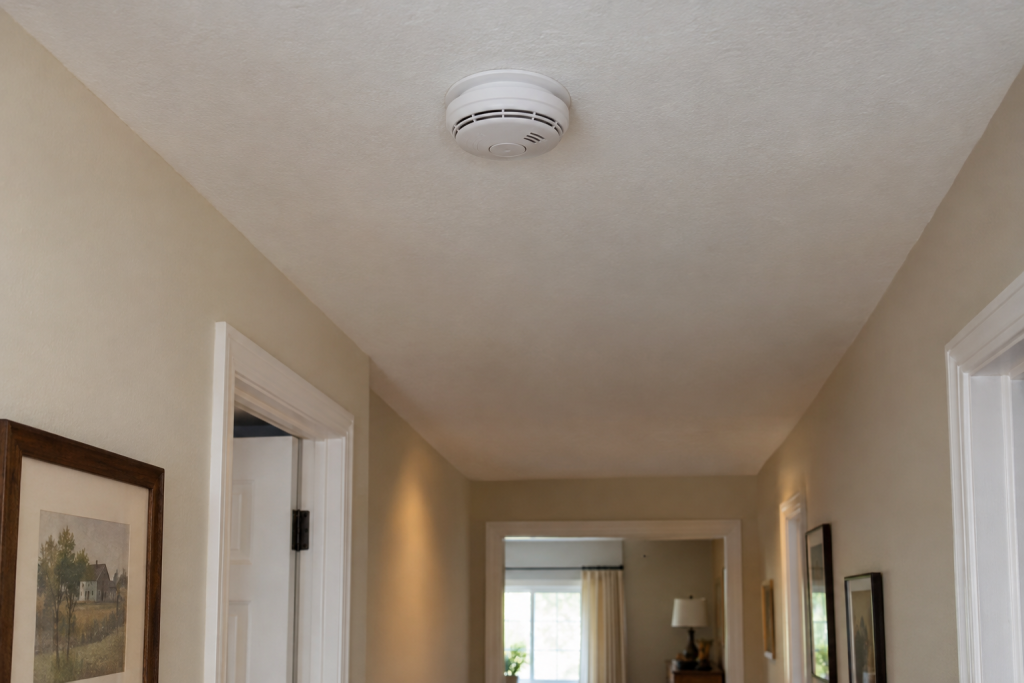
To turn off a smoke detector, press and hold the test/hush button for 3 to 5 seconds, which silences it for roughly 8 to 10 minutes. If it keeps going or you need it fully off, pull the battery, and for hardwired units also flip the breaker and unplug the wiring harness. Below is the whole job, from a quick silence to a complete shutdown and a safe way to put it back in service.
Quick steps: turn off a smoke detector
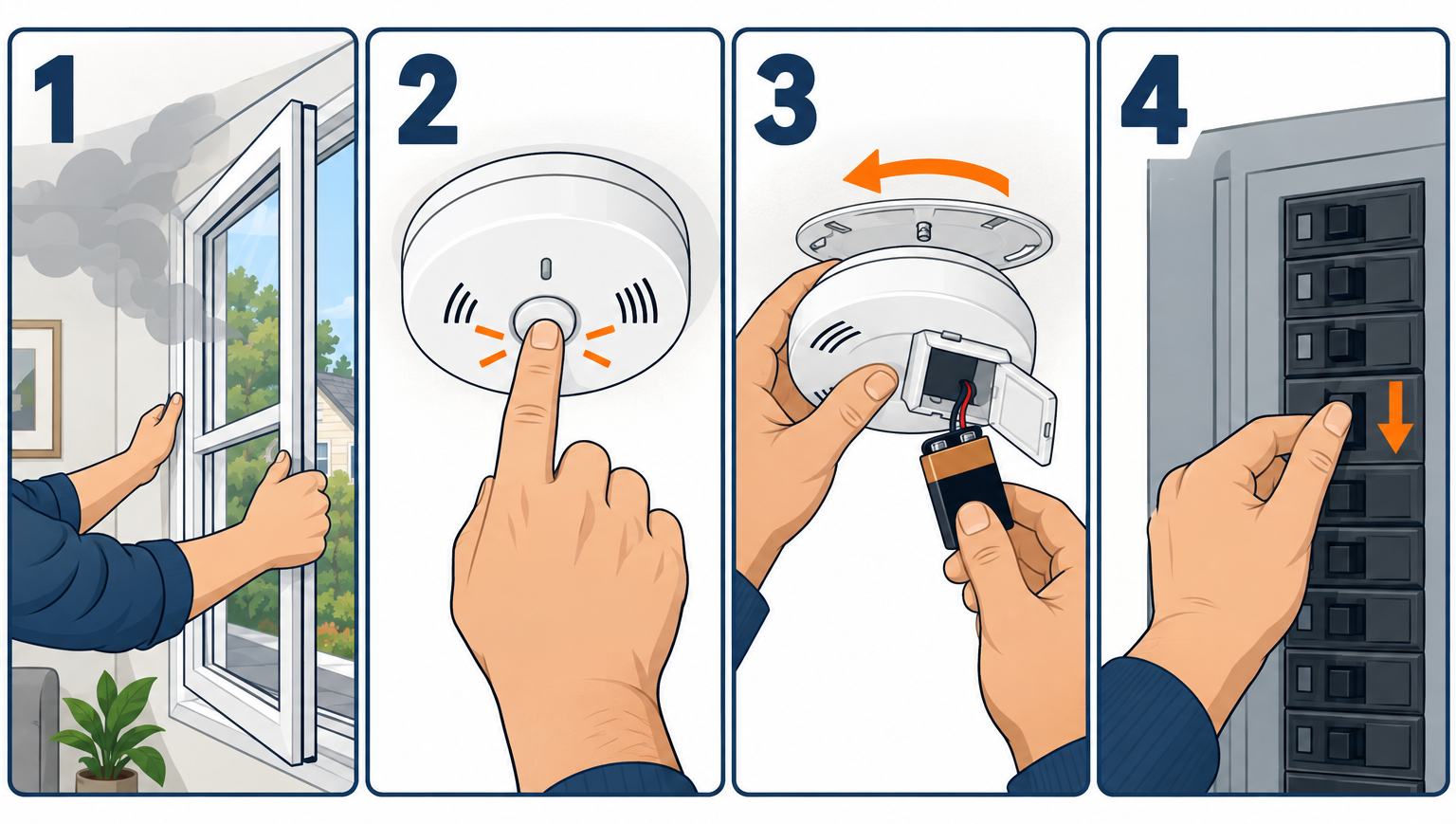
- Confirm there is no fire, then open windows and clear smoke or steam.
- Press the test/hush button once and hold for 3 to 5 seconds.
- If it will not stop, twist the alarm counterclockwise to remove it from its bracket.
- Open the battery door and pull the 9V or AA batteries.
- On hardwired alarms, unplug the wiring harness connector on the back.
- Hold the test button 15 to 20 seconds to drain residual charge.
- Flip the breaker if other alarms keep sounding or you are leaving it off for a while.
- Reinstall or replace the alarm the same day and test it.
Tools and materials
- Step ladder (4 ft to 6 ft, depending on ceiling height)
- Fresh 9V alkaline battery or 2-3 AA batteries (check the alarm label)
- Phillips #2 screwdriver (for brackets and some battery doors)
- Non-contact voltage tester (hardwired alarms only)
- Vacuum with soft brush attachment or can of compressed air
- Flashlight or phone light
- Replacement smoke alarm if the unit is 10 or more years old
Safety first
Never shut off a smoke alarm while smoke is still in the house until you have confirmed the source. For hardwired alarms, switch off the breaker and verify with a non-contact voltage tester before touching any wires. Only disconnect an alarm for the minutes it takes to fix the problem, and never leave a bedroom without working coverage overnight.
Know which kind of alarm you have before you touch it
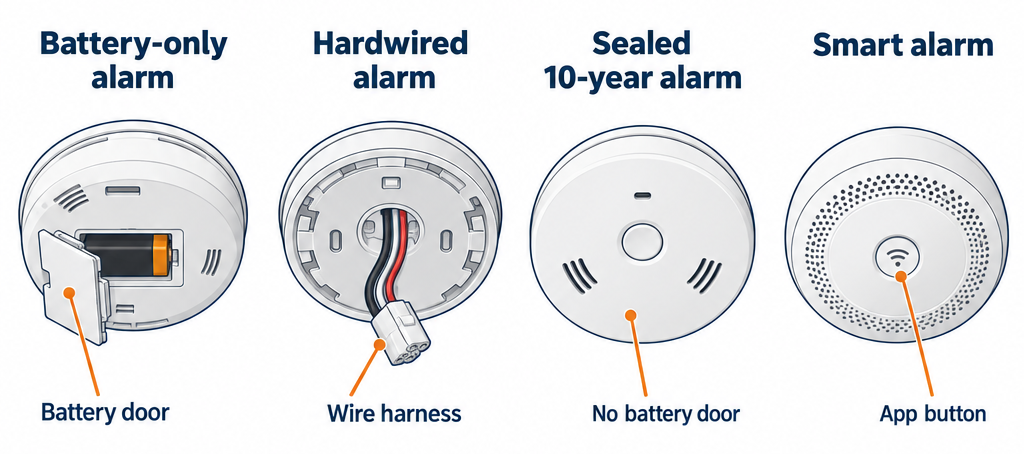
The way you turn it off depends on the type. Pull the alarm down and look at the back, or read the front label. You will see one of four designs.
| Alarm type | How to identify it | How to silence | How to fully disable |
|---|---|---|---|
| Battery-only (replaceable) | Battery door on the back or side, no wires | Hold hush/test button | Remove the 9V or AA batteries |
| Hardwired with battery backup | Three-wire plug (black, white, red) on the back plus a 9V battery | Hold hush/test button | Unplug harness, remove battery, hold test 15-20 seconds |
| 10-year sealed battery | No battery door, “sealed” or “10-year” on the label | Hold hush/test button | Slide the deactivation switch (permanent) |
| Smart alarm (Nest Protect, First Alert Onelink) | Branded, pairs to an app, usually a round body | App or button | Remove from mount, pull battery or unplug |
Interconnected alarms are a special case. If one goes off, every unit in the house sounds. Only the one that detected smoke blinks a red or green LED rapidly. Find that unit first, because silencing the others will not stop the chain.
Step 1: Rule out a real fire
Before you reach for the button, walk the house. Check the kitchen, the laundry room, the furnace closet and anywhere a candle, space heater or charger is running. Smell for burning plastic or electrical insulation, which has a sharp, sweet odor that a toaster does not produce.
Common harmless triggers that sound exactly like the real thing:
- Toast, bacon or a smoking oven
- Steam from a shower with the bathroom door open
- A dryer with a clogged “clothes dryer vent” pushing hot, lint-heavy air into the laundry room
- Dust kicked loose while sanding, sweeping an attic or running a “ceiling fan” for the first time in months
- Aerosol spray, hair spray or a fresh coat of paint near the alarm
- Steam from a carpet cleaner, since many people learn this the hard way when they “steam carpets” in a hallway under an alarm
If you cannot find a source and the alarm keeps sounding, treat it as real. Get out and call 911 from outside.
Step 2: Press the hush button to silence it
Every alarm sold in the last 20 years has a single large button on the face, labeled Test, Hush, Silence or Test/Silence. On Kidde it is usually Hush. On First Alert and BRK it is usually Test/Silence.
Press it once, firmly, for 3 to 5 seconds. You will hear a short chirp, and the alarm goes quiet. The hush mode lasts about 8 to 10 minutes depending on the brand. During that window the alarm is less sensitive, not off. If smoke gets thick enough, it will override hush and sound anyway. That is by design.
While it is quiet, clear the air. Open a window, turn on the range hood or run a box fan toward the door. If the air is clean when the hush timer ends, the alarm simply resets with no further noise.
A few things that look like a failure but are not:
- The alarm chirps once when you release the button. That is confirmation, not a fault.
- The LED blinks every 30 to 60 seconds. That is a normal “I have power” heartbeat.
- The alarm goes off again after 10 minutes. Air is still dirty, or the sensor chamber is contaminated. Move to Step 4.
Pro tip
On an interconnected system, hushing the originating unit (the one with the fast-blinking LED) silences all of them. Hushing a remote unit usually does nothing. Save yourself the ladder trips and find the right one first.
Step 3: Pull the battery to shut it off completely
If hush does not work, the alarm is confused, or you need it quiet for more than 10 minutes, take the power away.
Grip the body of the alarm and twist counterclockwise about a quarter turn. It releases from the mounting plate. Some older or cheaper models have a small locking tab you push with a flathead screwdriver before it will turn. If it will not budge, do not yank it; look for the tab.
On the back or side you will find the battery compartment. Most take a single 9V. A lot of newer units use two or three AA batteries. Slide the battery out and the alarm goes dead.
On a hardwired unit, you are not done yet. The alarm is still fed by the house wiring and may keep sounding or chirping. There is also a small capacitor inside that stores enough energy to keep the horn going for a few seconds after power is gone.
- Look at the back for a plug-in connector with three wires (black, white and red or orange). Squeeze the connector’s release tab and pull it straight out.
- Press and hold the test button for 15 to 20 seconds. This drains the stored charge. A faint, dying chirp is normal.
- Set the alarm somewhere it will not get stepped on.
The red or orange wire is the interconnect. It carries a low-voltage signal between alarms. When you unplug one unit, the others stay powered and keep working, so the rest of the house still has coverage.
Step 4: Shut off the breaker for hardwired alarms
You rarely need the breaker to silence a single alarm. Pulling the harness does the job. The breaker matters in two situations: an entire chain of interconnected alarms will not stop, or you are replacing a unit and want zero chance of touching a live wire.
Smoke alarms in most US homes built after the late 1980s share a 15-amp lighting circuit, often the one that feeds the bedroom or hallway lights. Some newer homes have a dedicated breaker labeled “Smoke” or “SD.” Open the panel door and read the directory on the inside.
If the directory is blank or wrong, do it the slow way. Have someone stand under the alarm while you switch breakers off one at a time. The LED heartbeat stops blinking when you hit the right one. Flip each wrong guess back on before moving to the next so you do not lose the fridge.
Once the breaker is off, climb back up and verify. Hold a non-contact voltage tester against the black wire at the connector. No beep means it is dead. Now the alarm is truly off, and every other unit on that chain is running on its backup battery only.
Note the time. Backup batteries are meant to bridge a power outage, not run the house for a week. Flip the breaker back on as soon as the problem is fixed.
Pro tip
Before you unplug a hardwired alarm, snap a photo of the connector and the wire colors. Replacement alarms from a different brand use a different harness, and the photo tells you which pigtail adapter to buy. First Alert/BRK and Kidde both sell cross-brand adapters, typically in packs of 12 for about $29 to $40.
Step 5: Disable a 10-year sealed alarm
Sealed alarms have no battery door. You cannot pull the power. Instead, there is a deactivation switch, usually a small slide tab on the back or side marked “Deactivate” or “Off,” sometimes under a thin plastic cover you break away with a screwdriver.
Here is the catch. Sliding that switch is permanent. It physically disconnects the battery inside and the alarm will never work again. That is the whole point: it stops a dead unit from being tossed in the trash still chirping.
So for a sealed alarm the sequence is:
- Nuisance alarm: use hush and clear the air. Nothing else.
- End-of-life chirp or a unit that will not stop: slide the deactivation switch and buy a replacement, $20 to $35 at any hardware store.
If a sealed alarm goes off and hush does not help, take it outside or into the garage, hush it again and let it run down in fresh air. It will settle within a few minutes once it stops sensing particles.
Step 6: Silence a smart smoke alarm
Smart alarms give you one extra option, your phone. Nest Protect lets you silence a nuisance alarm from the Google Home app, and First Alert Onelink does the same from its app. The silence feature only works for low-level smoke; a heavy alarm cannot be dismissed remotely, which is a safety requirement, not a bug.
If the app will not cooperate, the physical button on the face still works. Press it once to hush. To fully turn off a Nest Protect, twist it off the mount and either pull the AA batteries (battery model) or unplug the connector (wired model). The app will nag you that a device is offline, which is a useful reminder to put it back.
Step 7: Clean, reset and reinstall
Most false alarms that survive the hush button come from a dirty sensing chamber. Dust, cooking grease, cobwebs and dead gnats all scatter light inside a photoelectric sensor or disrupt an ionization chamber.
With the battery out, clean the alarm:
- Run a vacuum brush attachment over every vent slot on the face and sides for 30 seconds.
- Blow short bursts of compressed air into the vents from 6 inches away. Do not hold the can upside down, which sprays liquid propellant.
- Wipe the outside with a dry cloth. No cleaners, no water.
Now reset it. Install the battery (positive end oriented as the molding shows), plug in the harness if hardwired, and hold the test button for about 10 seconds. The horn should sound loud and steady, then stop when you release. Twist the alarm clockwise onto its bracket until it clicks. Turn the breaker back on and test once more.
The expected result: a single loud test alarm, then a quiet unit with a blinking LED heartbeat and no chirps for at least five minutes. If it chirps again inside that window, the battery is wrong or weak, or the unit is at end of life.
Stop the chirping for good
A chirp every 30 to 60 seconds is not an alarm. It is a status message, and the pattern tells you which one.
| Sound | What it means | What to do |
|---|---|---|
| Three loud beeps, pause, repeat | Smoke detected | Check for fire, then hush |
| Four loud beeps, pause, repeat | Carbon monoxide detected (combo units) | Get outside, call 911 or the gas utility |
| Single chirp every 30-60 seconds | Low battery | Replace with a fresh alkaline battery |
| Single chirp with a yellow LED | Low battery (First Alert style) | Replace battery |
| Two to five chirps once per minute | End of life, varies by brand | Replace the whole alarm |
| Random chirps that stop after a few minutes | Loose battery, cold draft or power blip | Reseat battery, check harness |
Once a smoke alarm hits about 10 years old it is done, no matter how good the battery is. The manufacture date is printed on the back. Add 10 years and if that date has passed, no amount of fresh batteries will stop the end-of-life chirp.
Fresh battery still chirping? Three causes cover almost every case:
- Someone bought a “heavy duty” carbon-zinc 9V instead of alkaline. The alarm reads it as weak within days. Buy alkaline, ideally Duracell or Energizer, $3 to $6 each.
- The battery clip is not fully seated. Push until it snaps, and make sure the battery door closes completely. Many alarms will not run with the door open.
- The alarm is hardwired and the chirp is actually coming from the neighbor unit down the hall. Stand under each one for a full minute to find the culprit.
Replacement cost and what you get
If the alarm is dirty beyond saving, over 10 years old, or you are tired of the false alarms, replacing it is cheap and takes 10 minutes. Here is what the current market looks like at big-box stores.
| Alarm type | Typical price (each) | Best for |
|---|---|---|
| Basic 9V battery, ionization | $8-15 | Budget replacement, hallways |
| Battery photoelectric | $15-25 | Near kitchens and bathrooms, fewer nuisance alarms |
| Hardwired with battery backup | $15-40 | Direct swap in homes built after 1990 |
| 10-year sealed battery | $20-35 | Rentals, high ceilings, “install and forget” |
| Smoke/CO combination | $30-60 | Bedrooms, homes with gas appliances or an attached garage |
| Smart (Nest Protect, Onelink) | $80-130 | Phone alerts, voice warnings, interconnect without wires |
| Electrician install, hardwired, per unit | $100-250 | Adding new wired alarms where none exist |
Photoelectric alarms respond better to smoldering fires and are far less likely to go off over toast. If you are replacing a kitchen-adjacent alarm that cries wolf, this one swap usually solves the problem.
Where to put alarms so they stop crying wolf
A lot of “broken” alarms are simply in the wrong place. Current NFPA 72 and most state codes call for the following.
| Location | Rule | Note |
|---|---|---|
| Every bedroom | One alarm inside each | Required in all new construction since 1993 |
| Outside each sleeping area | One in the hallway | Within about 21 feet of bedroom doors |
| Every level including basement | At least one | Near the bottom of the stairs in a basement |
| Kitchen | Keep at least 10 feet from the stove | Use photoelectric if under 20 feet |
| Bathrooms | Not inside, at least 3 feet from the door | Steam is the number one nuisance trigger |
| Ceiling mount | At least 4 inches from any wall | Avoid dead-air corners |
| Wall mount | Top of alarm 4 to 12 inches below ceiling | Smoke collects high |
| Garage, attic, furnace closet | Use a heat detector instead | Exhaust and dust ruin smoke alarms |
If you move an alarm, you cannot just leave bare wires in the ceiling. Cap each wire with a wire nut and cover the box with a blank plate. Hardwired alarms also need to be on the same interconnect chain, so new runs are a job for an electrician if you are not comfortable fishing cable.
Troubleshooting
| Symptom | Likely cause | Fix |
|---|---|---|
| Hush button does nothing | Smoke too thick, or button held too briefly | Clear air for 2 minutes, press firmly for 5 seconds |
| Alarm resumes after 10 minutes | Air still contaminated or chamber dirty | Ventilate, vacuum vents, replace if over 10 years |
| All alarms sound, no smoke anywhere | One dirty unit on the interconnect | Find the fast-blinking LED, clean or replace that unit |
| Keeps sounding with battery removed | Hardwired, residual charge | Unplug harness, hold test 15-20 seconds |
| Chirps after new battery | Carbon-zinc battery, loose clip or end of life | Alkaline battery, reseat, check manufacture date |
| Goes off at the same time every night | Thermostat cycle, bathroom steam or temperature swing | Relocate 3 ft further from bathroom or vent |
| Goes off during storms or power flicker | Loose harness or failing power supply | Reseat connector, replace alarm if it repeats |
| New alarm will not fit old bracket | Brand mismatch | Buy the matching adapter plate and pigtail, $5-10 |
| Alarm sounds but LED never blinks | No power reaching unit | Check breaker, test black wire for 120V |
Putting it back on the same day
Turning off a smoke detector is fine for the time it takes to clear the air, swap a battery or clean the chamber. Leaving it off is where people get hurt. In the United States, roughly three out of five home fire deaths happen in homes with no smoke alarms or alarms that failed to operate, and missing, disconnected or dead batteries, along with disconnected hardwired units, account for most of the cases where an alarm that existed did not sound.
Set a phone reminder before you climb the ladder. If the alarm is dead and the store is closed, move a working battery unit from a less critical room into the bedroom hallway for the night.
When to call a pro
Call a licensed electrician if a hardwired alarm has no plug-in harness and the house wires go straight into the unit, if you find scorching or melted plastic on the connector, if the breaker trips when you restore power, or if the whole interconnected system keeps sounding with every unit clean and under 10 years old. Call the fire department, not an electrician, if any alarm sounds and you cannot find the source. For a monitored system wired into a security panel, call the alarm company before you disconnect anything, or you will trigger a dispatch.
FAQ
Is there any way to turn off a smoke detector?
Yes. Hold the hush button for a temporary silence of about 8 to 10 minutes, or remove the battery and unplug the wiring harness to shut it off completely. Sealed 10-year models have a permanent deactivation switch on the back. Whatever method you use, put a working alarm back in place the same day.
How can I stop my smoke detector from beeping?
A steady chirp every 30 to 60 seconds means low battery or end of life. Replace the battery with a fresh alkaline 9V or AA set, press and hold the test button for 10 seconds, and wait five minutes. If it still chirps, check the manufacture date on the back. Anything past 10 years needs a new alarm, not a new battery.
How do I shut off power to smoke detectors?
Hardwired alarms usually share a 15-amp bedroom or hallway lighting breaker, or sit on a dedicated breaker labeled “Smoke.” Turn it off, then confirm with a non-contact voltage tester at the black wire. Remember the backup battery keeps the alarm running, so you also need to pull the battery and hold the test button for 15 to 20 seconds to drain it fully.
Does the button on a smoke detector turn it off?
Not permanently. The test/hush button silences a nuisance alarm for roughly 8 to 10 minutes and reduces sensitivity during that time. Heavy smoke overrides it. To fully disable the alarm you have to remove the battery, unplug the harness on hardwired units, or slide the deactivation switch on a sealed model.
How do I disable a smoke detector in a rental?
Legally, you usually cannot. Most state landlord-tenant laws make tampering with or disabling a smoke alarm a violation, and some impose fines. Use hush, ventilate, and report chronic false alarms to the landlord in writing so they replace the unit or move it away from the kitchen or bathroom.
Why does my smoke detector go off when nothing is burning?
Steam, cooking aerosols, dust and insects in the sensor chamber are the usual causes, followed by a unit past its 10-year life. Vacuum the vents, relocate the alarm at least 10 feet from the stove and 3 feet from bathroom doors, and switch to a photoelectric model, which is far less sensitive to cooking fumes.