
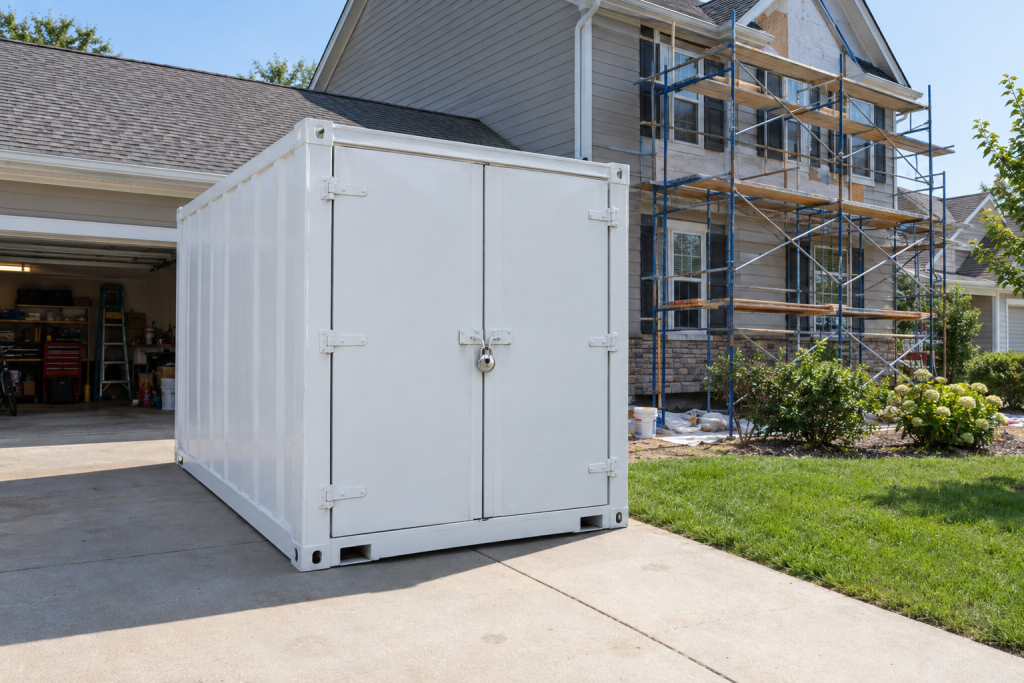
For most renovations, a moving pod wins: one container delivered to your driveway holds the contents of three or four rooms, stays on site for as long as the contractor needs, and costs less over two or three months than hiring local movers twice plus warehouse storage. Hire local movers instead when you have no legal place to park a container, when your renovation is under three weeks, or when the heavy stuff (pianos, slate pool tables, 300 lb armoires) is beyond what you and a friend can carry. The hybrid, a pod loaded by a two-person labor crew, is what most homeowners end up happiest with.
| Moving pod (PODS, 1-800-PACK-RAT, U-Box) | Local movers (Two Men and a Truck, independents) | |
|---|---|---|
| Best renovation length | 3 weeks to 6+ months | Under 3 weeks, or when you need warehouse storage anyway |
| Where your stuff sits | Your driveway, or the company’s storage center | Mover’s warehouse in wooden vaults |
| Who lifts | You (or a hired labor crew) | Their crew |
| Access during the project | Any time, if the pod stays at your house | Usually by appointment, often with a fee |
| Typical 3-bedroom cost, 2 months | Roughly $800 to $1,800 all in | Roughly $2,000 to $4,000 for two moves plus storage |
| Scheduling risk | Low; the box waits for your contractor | High; two crew bookings that must match the reno timeline |
| Needs a permit or HOA approval | Often, if it sits on the street | No |
| Weather and temperature | Steel boxes get hot; fine for furniture, bad for candles and electronics | Climate control available at many warehouses for a fee |
Verdict
Rent one 16-foot container, keep it in the driveway, and pay a local labor crew for two or three hours to load the heavy pieces. You get mover muscle on the hard day, zero scheduling pressure when the contractor runs late, and the ability to walk out and grab the box of winter coats in week six.
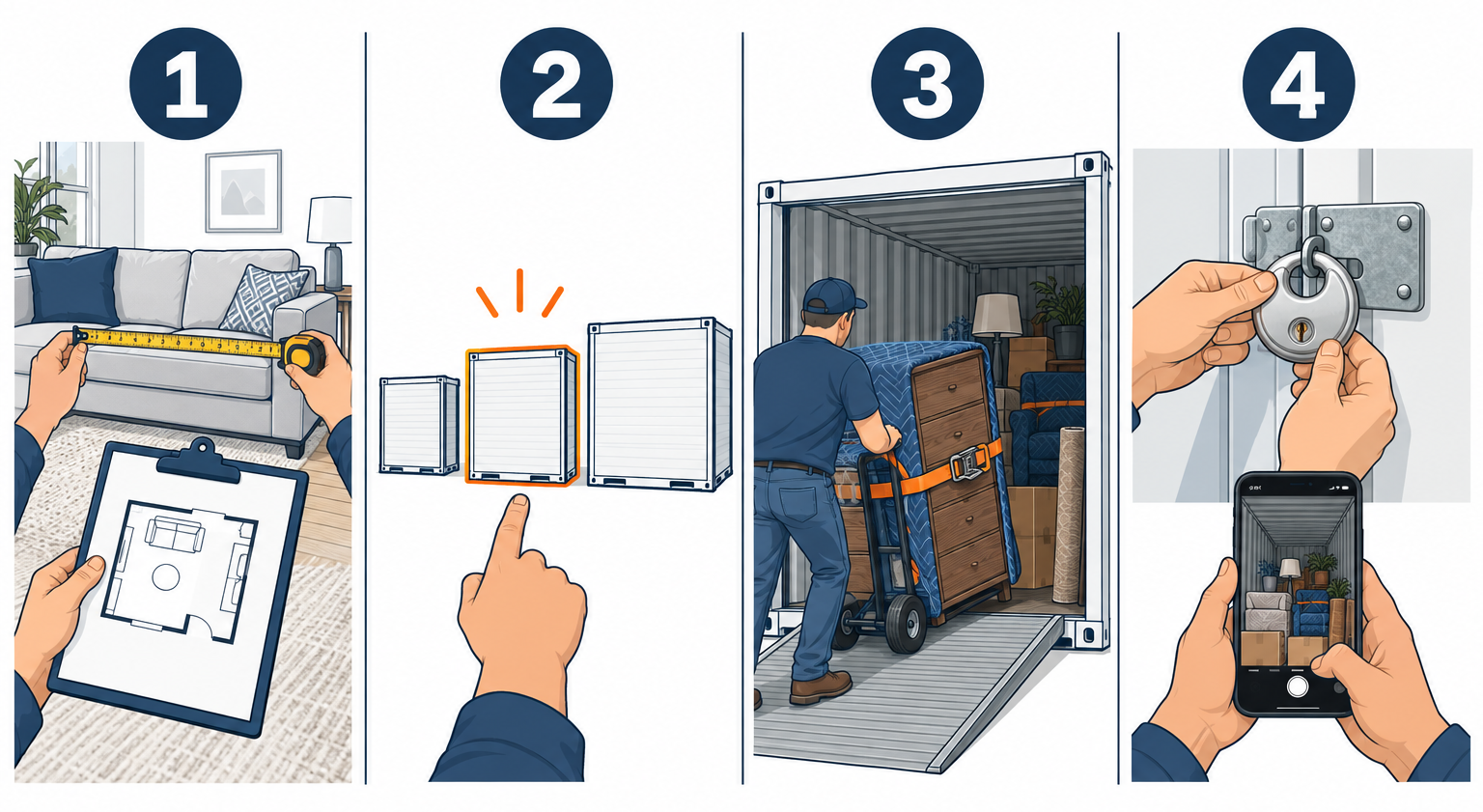
Quick steps: clear a house for renovation with a pod
- List every item leaving the work zone and estimate cubic feet.
- Pick a container size (16 ft for 3-4 rooms) and get three quotes.
- Check driveway width, overhead clearance and street permit rules.
- Book delivery for two days before demo starts.
- Pack the first third of the box with tagged “won’t need” items.
- Load heavy furniture against the walls, tie off every quarter of the way.
- Lock it, photograph the load, and keep the key on your ring.
- Unload only after floors have cured and the contractor’s final walk.
Tools and materials
- Moving blankets (12 to 24, roughly 72 x 80 in)
- Ratchet straps or rope, 4 to 6 (pods have interior tie rings)
- Furniture dolly (4-wheel, 1,000 lb rating) and hand truck
- Stretch wrap, 18 in x 1,000 ft roll
- Medium boxes (18 x 18 x 16) and dish-pack boxes with cell dividers
- Packing paper, 25 lb bundle, plus 3 in packing tape and a gun
- Mattress bags, queen and king
- Disc padlock (the shackle-free kind that fits the pod hasp)
- Plywood or 2×12 scraps if the pod sits on soft or uneven ground
- Zip ties and a paint marker for labeling furniture parts
- 3 mil plastic sheeting and painter’s tape for items staying inside the house
Calculators for this job
Safety first
A loaded 16 ft container weighs over 10,000 lb and the delivery truck can crack a thin driveway slab or crush a septic lid. Mark septic tanks, sprinkler heads and underground utilities before the driver arrives, and keep kids and pets inside while the lift system sets the box down.
How the two options actually work during a renovation
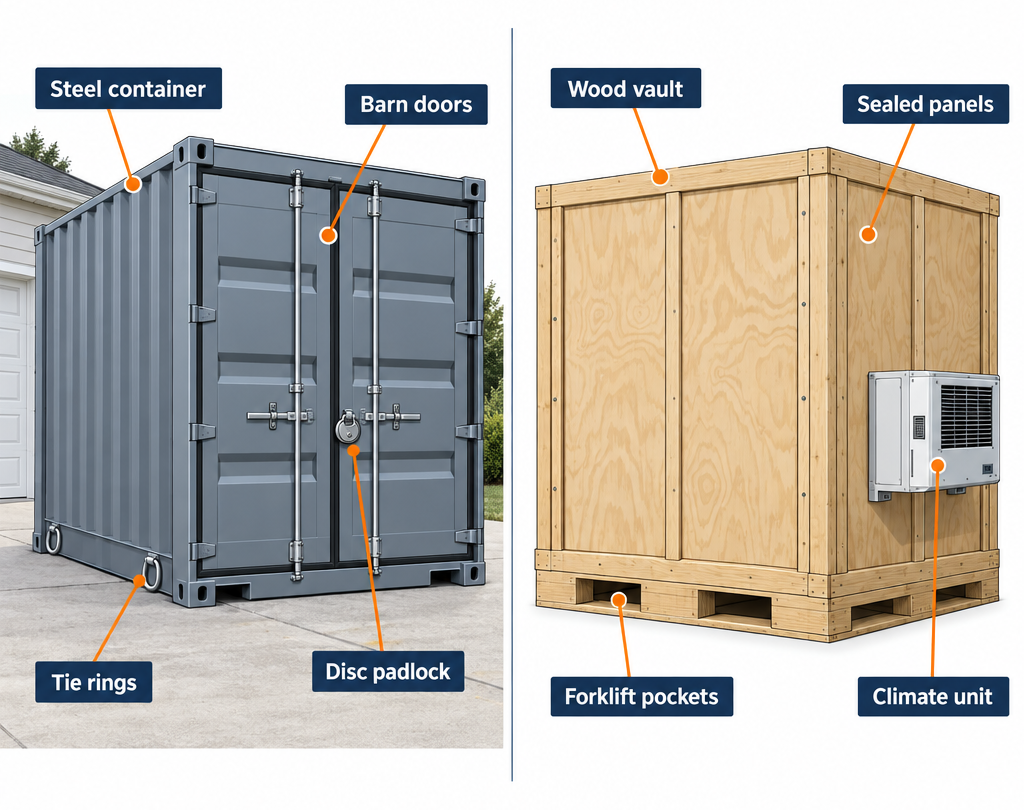
A pod company drops an empty steel or plywood container in your driveway on a flatbed with a built-in lift. You load it over days or weeks, lock it, and either leave it there or have it hauled to the company’s storage center. When the contractor finishes, the box comes back and you unload.
Local moving companies run the opposite model. A crew of two to four shows up with a 26 ft box truck, wraps and carries everything in three to six hours, and drives it to a warehouse. Your furniture is stacked into wooden vaults, about 7 x 5 x 7 ft each, and stays sealed until you book the return trip.
The difference that matters mid-renovation is control of the calendar. Drywall takes longer than planned. The tile is backordered. The floor finisher needs three more cure days. A pod sitting in the driveway doesn’t care. A mover’s return booking does, and rescheduling in peak season can push you a week or more.
The second difference is access. If you need the air mattress, the Christmas decorations or the kids’ bikes in week five, you open the pod with your own key. With warehouse storage you call the office, wait for a slot, and in many cases pay an access fee for the crew to pull your vault.
Which moving pod companies to compare
Three names dominate searches for moving pod companies, and they are not interchangeable. PODS is the largest network, with the most delivery coverage and the smoothest online booking. 1-800-PACK-RAT runs all-steel containers with a barn-door design and tends to come in cheaper on long storage. U-Haul’s U-Box is the small, cheap option that works well for a one or two room project.
| Company | Container sizes | Construction | What a 16 ft (or largest) box holds | Standout feature |
|---|---|---|---|---|
| PODS | 7 ft, 12 ft, 16 ft | Steel frame, aluminum skin, translucent roof panel | 3-4 rooms, roughly a 1,200 to 1,500 sq ft home | Biggest service area, “PODZILLA” lift sets the box level on sloped drives |
| 1-800-PACK-RAT | 8 ft, 12 ft, 16 ft | All steel, weatherproof, barn doors | 3-4 rooms, higher weight rating than PODS | Steel floor and walls, price-match on quotes |
| U-Haul U-Box | One size, about 8 ft x 5 ft x 7.5 ft | Plywood with weatherproof cover | About 1 to 1.5 rooms, roughly 257 cu ft, 2,000 lb | Cheapest monthly storage, can tow it yourself on a U-Haul trailer |
| Zippy Shell | 10 ft, 15 ft | Steel cage, trailer-mounted | 2-3 rooms | Sits on a trailer, so no lift truck needed in tight driveways |
| SMARTBOX | One size, 8 ft x 5 ft x 7 ft | Wood frame with fabric cover | About 1 room | Small footprint for condos and townhouses |
Container weight limits matter more than people think once you start loading tile boxes, a full bookcase and a cast-iron tub for reinstall. PODS publishes limits in the 4,200 to 5,200 lb range depending on size (the 16 ft box is rated at 4,200 lb), PACK-RAT’s 16 ft container is rated at 6,000 lb, and a U-Box tops out at 2,000 lb. Books alone run about 40 lb per medium box.
For a typical kitchen and family room renovation, a single 16 ft container from PODS or PACK-RAT covers the furniture, the dishes and the pantry with room to spare. A whole-house remodel of a 2,500 sq ft home usually needs two 16 ft boxes, which is where local movers with warehouse storage start to compete on price.
Which local moving companies to compare
Two Men and a Truck is the brand most people recognize, and it is a franchise, so the crew quality and hourly rate depend on your local owner. Typical local rates for a two-person crew and truck fall between about $120 and $220 per hour, with a two to four hour minimum and a travel charge. Three movers run roughly $175 to $300 per hour and are the better buy once you have more than a couple of heavy pieces, because a third set of hands keeps the truck filling instead of waiting.
Independent local moving companies near you often undercut the franchises by 15 to 30 percent and can be just as good. The tell is whether they carry a state household goods license (most states require one for intrastate moves) and whether they’ll give you a written Not-to-Exceed estimate after a video walkthrough.
Here is what to ask every local moving service you call:
- Is the quote hourly or flat, and what’s the minimum?
- Does the clock start at your warehouse or at my door?
- What is your valuation coverage, and what does full replacement cost per $1,000 declared?
- Do you store in sealed vaults, and is the warehouse climate controlled?
- What’s the access fee and notice period to get into my vault?
- Can you guarantee a return date, and what happens if my contractor runs late?
That last question is where most quotes fall apart. A good company will tell you honestly that peak-season return dates book two to three weeks out.
Step 1: Measure what’s leaving the work zone
Walk the rooms the contractor will touch and list every item, then add the rooms that will become dust tunnels because the crew walks through them. Hallways, the stairwell and the room next to the kitchen all count.
Use a rough cubic-foot estimate for sizing. A queen bed with frame and mattress is about 65 cu ft. A three-seat sofa is 50 to 60. A dining table with six chairs is around 70. A dresser is 30 to 40, a refrigerator about 45, and a medium moving box is 3 cu ft. Add it up, then add 20 percent for air gaps.
A 16 ft container holds about 825 to 835 cu ft of actual usable space once you account for the door swing and wall thickness. A 12 ft box holds roughly 600, and a U-Box about 257. If your list lands at 900 cu ft, you have a packing problem to solve, not a second container to rent, so look at what can go to a spare bedroom instead.
Split your list into three tags with a paint marker on blue tape:
- Won’t need: seasonal clothing, books, decor, spare bedding. These load first, deepest in the box.
- Might need: tools, kitchen basics for the temporary setup, kids’ gear. Load last, near the doors.
- Stays inside: anything heat-sensitive, valuable or needed daily. Wrap in 3 mil plastic in a closed room.
Heat is the item people forget. A dark steel container in a July driveway can run 30 degrees above the outside temperature, so interior readings above 120°F are normal in much of the country. Candles, vinyl records, wine, photographs, cosmetics, lithium batteries and most electronics should stay in the house or go to climate-controlled storage.
Pro tip
Photograph each room before you empty it, including the backs of TVs and the cable layout behind the AV cabinet. Three months later you will not remember which HDMI port fed the soundbar, and the photo saves an hour of trial and error on move-back day.
Step 2: Pick the container size and the right company
Sizing rule: one 16 ft container per roughly 1,200 sq ft of furnished living space you’re clearing. A kitchen plus adjacent dining room is a 12 ft box. A single bedroom or home office is a U-Box or a 7 ft PODS container.
Renting a container that’s too big costs maybe $50 to $100 more per month. Renting one that’s too small costs you a second delivery fee, a second monthly rate and a scramble on loading day. When the estimate lands between sizes, go up.
| Container | Approximate interior | Usable cu ft | Rooms | Fits in |
|---|---|---|---|---|
| U-Haul U-Box | 95 x 56 x 83 in | 257 | 1 to 1.5 | One parking space |
| PODS 7 ft | 7 x 7 x 8 ft | ~385 | 1 | One parking space |
| 1-800-PACK-RAT 8 ft | 8 x 7 x 8 ft | ~400 | 1 to 2 | One parking space |
| PODS or PACK-RAT 12 ft | 12 x 8 x 8 ft | ~600 to 690 | 2 to 3 | Single-car driveway |
| PODS or PACK-RAT 16 ft | 16 x 8 x 8 ft | ~800 to 860 | 3 to 4 | Single-car driveway, 20 ft long |
Now match the company to the job:
- Renovation of 2 to 4 months in a suburban driveway: PODS or PACK-RAT 16 ft, kept on site. Compare both; PACK-RAT often beats PODS on the monthly rate while PODS has more delivery slots.
- Condo or townhouse with no driveway: U-Box or SMARTBOX delivered to a permitted street spot, then hauled to the company’s facility within a few days to avoid the daily street fee.
- One room, tight budget: U-Box. It’s the cheapest monthly storage of the group, and if you own a hitch you can tow it to the U-Haul center yourself and skip the delivery charge.
- Steep or gravel driveway: Ask about the lift. PODS’ lift system handles moderate slopes; trailer-based containers (Zippy Shell, U-Box) need a flat spot to unhitch.
Check the delivery footprint before you book. The truck typically needs a lane about 12 ft wide, 15 ft of overhead clearance (watch for low branches and service drops), and the length of the container plus the truck, so roughly 40 ft of straight approach for a 16 ft box. If your driveway curves hard or has a basketball hoop over it, send the company a photo before paying a deposit.
Step 3: Get quotes from both sides and compare total cost
Price a pod and price full-service movers for the same job, because the gap is not always as wide as the first table suggests. Pod pricing has four parts: delivery, monthly rent, pickup, and any transport to the storage center and back. Mover pricing has three: load day, storage months, and unload day.
Rough numbers for a 3-bedroom home, two months of storage, in a mid-cost US metro:
| Line item | Pod kept in driveway | Pod stored at facility | Local movers + warehouse |
|---|---|---|---|
| Delivery / load day | $100-200 delivery | $100-200 delivery | $700-1,400 (4-6 hrs, 3 movers) |
| Monthly rent / storage | $180-350 x 2 | $180-350 x 2 plus transport $100-200 each way | $200-450 x 2 (1-2 vaults) |
| Pickup / unload day | $100-200 | $100-200 | $700-1,400 |
| Labor to load pod (optional) | $250-500 (2 movers, 2-3 hrs) | $250-500 | Included |
| Permit (street only) | $25-200 | $25-200 | $0 |
| Typical total | $800-1,800 | $1,200-2,400 | $2,000-4,000 |
Quotes vary a lot by zip code and month. Expect summer and end-of-month pricing to run 20 to 40 percent higher on both sides, and some pod companies charge a premium for Saturday delivery.
What to ask the moving pod companies specifically:
- Is the monthly rate prorated, or do I pay a full month if I return it on day 32?
- What is the fee if I need the box moved from the driveway to the street or back?
- Is contents coverage included, and what’s the deductible? Most offer tiers from a few thousand to $20,000+ of coverage for a monthly fee.
- Can I keep the container past the quoted end date without re-delivery?
- What’s your weight limit, and what happens at pickup if I’m over?
Pro tip
Ask the pod company for a quote with and without the storage center transport, and ask local movers for a “load only” rate. Many Two Men and a Truck franchises and most independents will send two movers to load your container for two or three hours. That hybrid typically lands around $1,100 to $2,000 total and buys you professional packing on the pieces that actually get damaged.
Valuation coverage is where local movers can be worth more than they look. Basic released-value protection pays about 60 cents per pound, so a 90 lb TV that gets cracked is worth $54. Full-value protection costs extra but replaces the TV. With a pod you’re loading it yourself, so the only coverage that matters is the container contents plan, and it won’t pay for damage you caused by stacking badly.
Step 4: Clear and permit the drop site
Pick the spot a week before delivery. The container needs a surface that holds weight: concrete, asphalt or packed gravel. Fresh asphalt under a year old can dent under the lift’s feet in summer heat, and pavers will shift. If you must set it on lawn or soft gravel, lay two 2×12 runners or sheets of 3/4 in plywood where the feet land, and expect the grass underneath to die.
Measure the clearance path, not just the parking spot. Low branches, the garage roof overhang and the drop line from the utility pole are the usual snags. The driver can’t trim your tree, and a delivery that fails on site still gets billed.
Street placement needs a permit in most cities and towns. Call the public works or right-of-way office and ask about “temporary storage container” or “dumpster” permits; they are usually the same form. Fees range from about $25 for a week in a small town to $200 or more per week in dense cities, and many limit street placement to 14 or 30 days. Some require reflective tape or cones on the traffic side at night.
HOAs often ban containers entirely or cap them at 7 to 14 days in a driveway. Read the covenants before you pay a deposit. Fines of $50 to $100 per day are common, and the pod company won’t refund you because your board said no.
The renovation adds one more conflict: the dumpster. A 20-yard roll-off is about 22 ft long and 8 ft wide, and the contractor wants it near the door. If your driveway fits one or the other, put the pod on the driveway and the dumpster at the curb with a permit, because the pod stays longer and you need to get into it.
Mark hazards for the driver: sprinkler heads, septic tank lids, drainage grates, the water meter box. A delivery truck crushing a septic lid is a $500 to $1,500 repair you’ll be paying for, not the pod company.
Step 5: Pack and load for a months-long sit
Loading a pod for three months is different from loading a truck for an afternoon. The box will vibrate on a flatbed if it goes to the storage center, bake in the sun, and possibly sit through a few thunderstorms. Pack for all three.
Start with the floor. Lay a tarp or moving blankets across the pod floor, especially on a U-Box or any plywood-floored unit, so condensation doesn’t wick into box bottoms.
Load heavy and square first. Dressers, bookcases, the washer and dryer go against the back wall and the two side walls, blanket-wrapped and stretch-wrapped over the blanket so the pad can’t slide off. Keep drawers in dressers but tape them shut and put nothing breakable inside. A loaded dresser is fine for the pod; it’s the mover’s hand truck that hates it, so if a crew is loading, empty the drawers.
Build walls, not piles. Every three to four feet of depth, run a ratchet strap wall-to-wall through the tie rings and cinch it. The front face of each section should be flat so the next section leans against it. Mattresses in bags make excellent dividers between sections and protect the sofa face.
Stack boxes by weight, heaviest at the bottom, and keep stacks to four boxes high. Dish-pack boxes with cell dividers go on top of the stack or inside a wardrobe box, never under anything. Fill gaps with pillows, bedding and couch cushions in trash bags so nothing can shift.
The sofa goes on end only if the arms are solid wood or metal. Upholstered arms will deform over three months on end. Lay it on its back on blankets instead and use the space under it for lamp shades in boxes.
Appliances need prep. Drain the washer, tape the lid, and secure the drum with the shipping bolts if you still have them. Defrost the fridge for 24 hours and prop the doors open an inch with a taped block so it doesn’t mildew. Disconnect the dryer and check the “clothes dryer vent” while you’re back there, because a lint-packed duct is the easiest fix to do with the machine already pulled out.
Fixtures you’re reusing need the same care. Bag the screws and the canopy with each “ceiling fan” you take down, and zip-tie the blades together. Label the bag with the room name. If you’ve ordered new kitchen boxes, store them inside the house rather than the pod; flat-packs like “custom cabinets ikea” hacks start with particleboard that swells at the first humid week in a steel box.
Leave the last two feet by the door for the “might need” tier, with a walkway down one side if the box is big enough. Tag that section clearly. Lock the hasp with a disc padlock; a standard shackle lock gives bolt cutters something to grab.
Photograph the loaded box from the door before you close it, and write the strap count on the inside of the door with the paint marker so you know what to expect on unload.
Pro tip
Put a cheap wireless temperature and humidity sensor inside the pod and the base station on your kitchen counter. If you see 95 percent humidity after a storm, you’ve got a roof leak and a week to deal with it instead of three months of mold.
Step 6: Manage the container through the construction
The pod is on site. Now the renovation runs over it, around it and occasionally into it.
Talk to the contractor on day one about the box. Tell the crew it’s off limits as a tool store, that nobody leans sheet goods against it, and that the dumpster truck needs to swing wide of it. A loaded pod scraped by a roll-off hook is your problem because you own the contents.
Check the seals after the first hard rain. Walk the perimeter, open the door, and look at the floor near the threshold and the back corners. PODS’ translucent roof panels make the inside bright enough to spot wet cardboard; PACK-RAT’s steel roof needs a flashlight. If you find water, call the company the same day, because the contents coverage usually requires prompt notice.
Pods that sit on the ground for months attract mice looking for a nest, especially when demolition stirs up the ones already living in your walls. Keep the floor around the box swept of food wrappers, don’t store pet food or bird seed inside, and if you see droppings on the threshold, “snap traps for mice” set along the inside wall by the door work better in a container than bait, since a poisoned mouse dying under your sofa is not a smell you want to chase.
Dust is the other intruder. If the pod is near the demolition entry, keep it closed and ask the crew to point the exhaust fan the other way. Interior finish dust is fine and abrasive; it gets into upholstery and never fully vacuums out.
If the renovation runs long, call the pod company before the paid month ends. Most will extend month-to-month with no re-delivery charge if the box hasn’t moved. Let the date lapse and some providers bill a late fee plus a full month.
With local movers and warehouse storage, the equivalent chore is calling to push the return date as soon as the contractor’s schedule slips. Peak-season crews book out fast, and the storage month will just keep rolling until you do.
Step 7: Move back in without wrecking the new finishes
The biggest risk of the whole job is the last day. New floors are soft, new paint is fresh, and everyone’s tired.
Wait for the cure. Oil-based polyurethane on hardwood needs at least 72 hours before furniture goes back and 7 days before rugs. Water-based finishes need about 48 hours for light furniture and a week for rugs. Fresh latex paint on walls scuffs easily for two to four weeks, so leave an inch of air behind the headboard and bookcases.
Do a walkthrough with the contractor before the first piece comes in. Note any touch-ups, then let the crew finish them before the room fills. Once the sofa is in, nobody repaints that wall.
Protect the path. Lay rosin paper or a runner from the pod to the far rooms and tape the edges with painter’s tape, not duct tape. Put felt pads on every chair and table leg before it crosses the threshold, and use furniture sliders for anything you’ll drag.
Unload in reverse: “might need” tier first, then section by section as you release each strap. Stage everything in the garage or a finished room rather than pulling it straight to its final spot, because you’ll want to vacuum the pod dust off the blankets before anything touches new carpet.
Reconnect appliances last. Check the washer hoses for cracks after three months dry, and run a cycle before you push it back. Change the furnace and “air conditioning” filter as the first thing you do, since construction dust will have loaded it and the blower will spread the rest into the furniture you just carried in.
Call for pickup the morning you finish unloading. Most moving pod companies need 24 to 72 hours’ notice and bill until the box leaves.
Loading a pod vs letting movers do it: what breaks
Damage in self-loaded containers almost always comes from one of four mistakes: nothing strapped, boxes stacked on soft items, glass or stone unwrapped, and drawers or cabinet doors swinging open on the truck. Professional crews make the same mistakes rarely because they do it daily, and because their valuation policy pays when they do.
If you hire a labor crew for the pod, give them the heavy and awkward pieces: sleeper sofas, armoires, the dining table top, anything with marble or glass, the treadmill. Save the boxes for yourself. Two experienced movers will load a 16 ft box with a 3-bedroom house in three to four hours if the boxes are packed and staged in the garage before they arrive.
Full-service local movers are the right call for items a pod can’t take at all. Pod weight limits rule out a full slate pool table, a gun safe over 1,000 lb, or a large cast-iron radiator stash, and the lift truck can’t handle an upright piano loaded last against the door. A piano mover is a separate trade and runs roughly $300 to $800 per local move.
Troubleshooting
| Symptom | Likely cause | Fix |
|---|---|---|
| Delivery truck can’t get in | Low branches, tight turn or less than 12 ft of width | Send photos before booking; trim branches; switch to a trailer-based container or street drop with permit |
| Driveway cracked where the feet landed | Thin or new slab, hot asphalt | Set the box on 2×12 runners or 3/4 in plywood; document existing cracks with photos before delivery |
| Wet cardboard at the back corners | Roof seam leak or door seal gap | Report to the company immediately; move boxes forward; add a tarp over the top; file on contents coverage |
| Boxes crushed on the bottom of a stack | Stacks over four high, or heavy on top of light | Reload with heaviest boxes down; max four high; use mattresses as dividers |
| Furniture scratched after pickup and return | No straps, blankets slipped off | Strap every 3-4 ft; stretch-wrap over every blanket; stuff gaps with bedding |
| Mice droppings inside | Open food or bird seed stored, box on grass | Remove all food; set snap traps inside the door; sweep the perimeter; ask to move it onto pavement |
| Mold smell on upholstery | Humidity trapped after a storm or wet blankets | Pull soft goods, dry in sun, wipe with diluted vinegar; use a cheap humidity sensor going forward |
| HOA fine arrives | Container exceeded the allowed days | Request an extension in writing; move the box to the company’s storage center for the remaining weeks |
| Movers can’t return on the date you need | Peak-season booking lag | Call to rebook the moment the contractor slips; ask for a mid-week, mid-month slot |
| Container over weight at pickup | Books, tile and tools all loaded | Pull the heaviest boxes to the garage; ask the driver to re-weigh; some companies allow a fee instead |
| Charged a full extra month | Returned the box after the billing date | Schedule pickup two days before the paid month ends; confirm proration in writing at booking |
When to call a pro
Call a licensed local mover rather than loading a pod yourself when any single item is over 300 lb, when there’s a piano, safe or slate table, when the house has more than one flight of stairs between rooms and the driveway, or when you physically can’t lift a dresser with a helper. Call a piano mover specifically for uprights and grands. And if you’re clearing more than two 16 ft containers’ worth, get a full-service quote with warehouse storage; at that volume the labor and vault pricing often beats three pod rentals.
Deciding fast: five renovation scenarios
Kitchen remodel, 6 to 8 weeks, suburban driveway. A 12 ft or 16 ft pod in the driveway, loaded yourself with a friend over a weekend. Dishes, pantry, the table and chairs, the hutch. Budget around $600 to $1,000.
Whole-house flooring, 10 days. Two Men and a Truck or an independent local mover, two moves at roughly $700 to $1,200 each, no storage needed if they can hold the truck overnight or vault it for a few days. A pod’s delivery and pickup fees plus a full month don’t pay off for ten days.
Addition and second-floor remodel, 4 to 6 months. One or two 16 ft containers from PACK-RAT or PODS, with a labor crew for the load. Keep one box on site and send the second to the storage center to free the driveway for the dumpster.
Condo bathroom and bedroom, 3 weeks, no driveway. U-Box delivered to a permitted street spot for one day, loaded fast, hauled to the U-Haul center. Or skip the container entirely and stack everything in the living room under plastic if the contractor can seal the work zone.
Downsizing into a “small house tiny house” build while the main house sells. A pod is the natural fit, because it doubles as storage while you decide what fits the new footprint, and most companies will deliver it cross-country to the new site for a per-mile transport charge instead of forcing a second unload.
FAQ
Is a moving pod cheaper than local movers for a renovation?
For anything over about three weeks, yes, usually by 40 to 60 percent. The pod’s monthly rent is roughly the same as warehouse storage, but you skip two crew bookings. Under three weeks, local movers often come out even or cheaper because a pod still bills a full month plus two delivery fees.
Can I keep a moving pod in my driveway for six months?
With most moving pod companies, yes. You pay month to month, and the box doesn’t need to move. Check your HOA covenants and city rules first; many HOAs cap driveway containers at 7 to 30 days, and some municipalities treat a long-term container as a structure that needs a permit.
Which pod company is best for storage during a remodel?
For a box staying in the driveway, PODS and 1-800-PACK-RAT are close, and the better one is whichever quotes lower in your zip code that month. PACK-RAT’s all-steel construction gives it an edge in heavy rain regions; PODS has more delivery slots in most metros. For a single room, U-Box is the cheapest monthly rate by a wide margin.
Can local movers load my pod for me?
Many will. Ask Two Men and a Truck or independent local moving companies near you for a “load only” or “labor only” rate, typically two movers for a two or three hour minimum. Marketplace services that book hourly labor crews are another route, and the pod companies themselves often refer you to partner crews.
Will my furniture get damaged by heat in a pod?
Solid wood, metal and most upholstery handle a hot container fine. Veneered particleboard can delaminate in high humidity, and candles, vinyl, photos, electronics, wine and cosmetics should stay inside the house or go to climate-controlled storage. If the pod goes to the company’s storage center, ask whether that building is climate controlled; many are not.
How far ahead do I need to book?
Three to four weeks for a pod in the off season, six or more in summer. Local movers in May through September often book two to three weeks out for load day and another two to three for the return. Mid-week, mid-month dates are easiest to get and frequently cheaper on both sides.
What size pod do I need for a 3-bedroom house?
One 16 ft container covers the furniture and boxes from three or four typically furnished rooms, which is most of a 3-bedroom home with a modest garage. If you’re clearing every room including a large living room and the garage, plan on two 16 ft boxes or one 16 ft plus a 12 ft.
Do I need a permit for a pod on the street?
Almost always. Call your city’s public works or right-of-way office and ask about temporary container permits. Expect $25 to $200 or more per week, a 14 to 30 day cap in many cities, and a requirement for cones or reflective tape on the traffic side.