
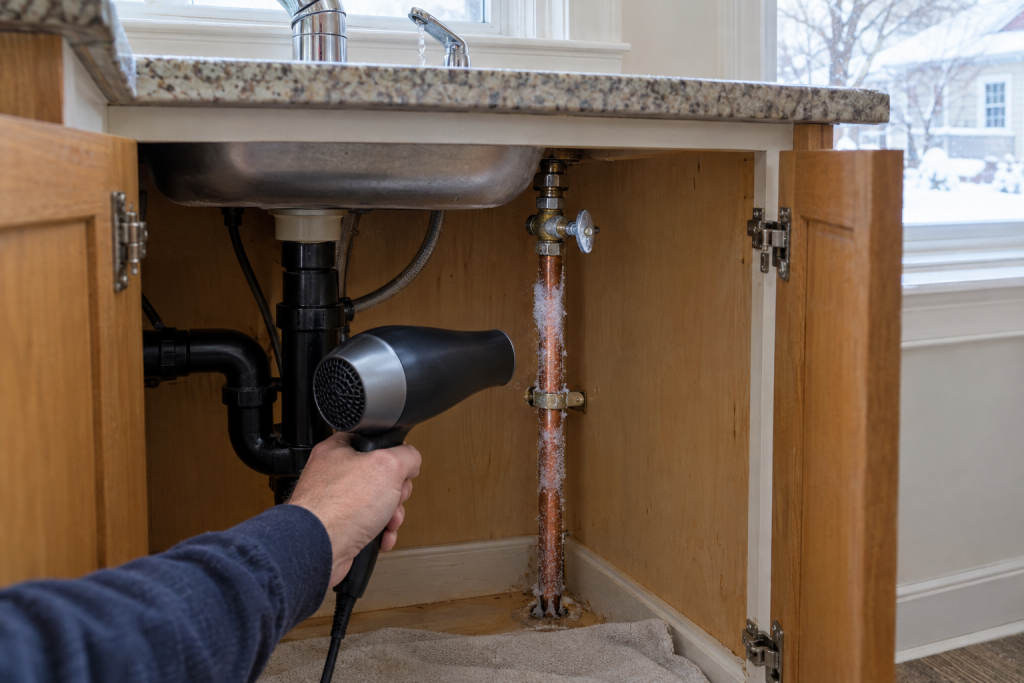
Frozen plumbing pipes thaw safely with a hair dryer, a heat gun on low, or hot towels, working from the open faucet back toward the ice. Keep the faucet open the whole time, never use an open flame, and shut off the main water valve first if you spot a split or bulge in the pipe.
Quick steps: thaw a frozen pipe
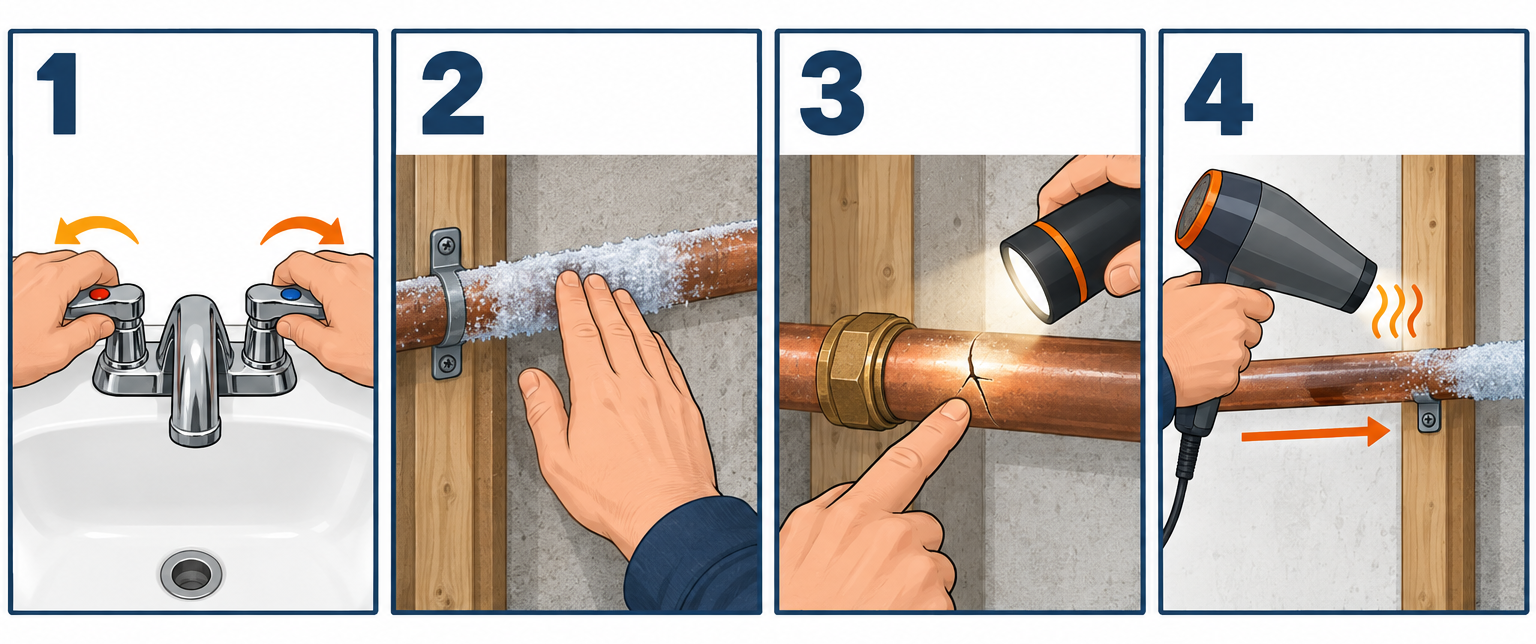
- Open the affected faucet, both hot and cold handles.
- Find the frozen section by touch and frost.
- Check that stretch for cracks or bulges; shut off the main if you see one.
- Warm the pipe starting at the faucet end and move toward the ice.
- Keep heating until full flow returns, then run water for several minutes.
- Check every exposed joint for drips once pressure is back.
Tools and materials
- Hair dryer (1,500 to 1,875 watts)
- Heat gun with a low setting (optional, 600°F max setting, keep it on low)
- Bath towels and a bucket of hot tap water
- Electric heating pad or UL-listed pipe heat cable (3 to 30 ft)
- Flashlight or headlamp
- Space heater with tip-over shutoff (for enclosed spaces)
- Foam pipe sleeves (1/2 in. or 3/4 in. to match pipe size)
- Adjustable wrench and bucket for the main shutoff
Calculators for this job
Safety first
Never thaw pipes with a propane torch, charcoal, or any open flame. Keep electrical tools out of standing water, plug them into a GFCI outlet, and locate the main water shutoff before you start so you can kill the supply in seconds if a pipe lets go.
How to know the pipes are actually frozen
Turn on a faucet. If we get a trickle or nothing at all while the rest of the house works fine, a frozen line is the first suspect once outdoor temperatures have dropped below about 20°F.
Other giveaways: visible frost on an exposed pipe, a faint bulge where the copper has stretched, or a sewer smell from a drain that cannot vent because the line is iced. If no faucet in the house runs, the problem is the main supply line or the meter, which is usually the water utility’s call rather than ours.
One more quick test. Run both hot and cold at the same tap. If only cold is dead, the freeze is on the cold line between the meter and that fixture. If both are dead, it is probably upstream of the water heater, where the lines split.
Step 1: Open the faucet and shut off power to risky appliances
Open the hot and cold handles on the fixture that stopped working. Leave them open for the whole job. Open faucets do two things: they let melting water and steam escape instead of building pressure against the ice plug, and they tell us the instant flow returns.
If the frozen section feeds the water heater, switch the heater’s breaker or gas control to off until water is moving again. Heating an empty or partly drained tank damages elements and can trip the high-limit switch, and we would rather not add a water heater repair to the day.
Step 2: Find the frozen section
Start at the dead faucet and trace the supply line backward. The usual suspects are pipes running along exterior walls, through unheated crawl spaces, garages, attics, under kitchen sinks on outside walls, and anywhere a water softener system sits in an unheated utility room.
Run a bare hand along the pipe. Frozen copper or PEX feels noticeably colder than the rest of the run, and you will often find frost or condensation right at the plug. Copper can also look slightly swollen. On long runs, the freeze is usually within a few feet of where the pipe passes closest to the outdoors or a foundation vent.
Cannot reach it? If the line is inside a finished wall, skip to the “inside a wall” section below before cutting anything.
Step 3: Inspect for damage before you add heat
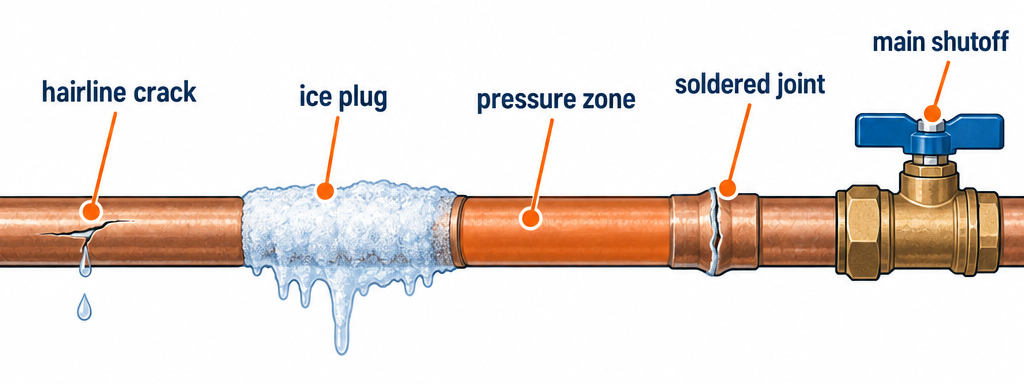
This is the step most people skip, and it is the one that floods a basement. Water expands roughly 9 percent when it freezes, and the pressure builds between the ice plug and the closed faucet, not at the ice itself. That means the split may be a few feet away from the frost.
Look for hairline cracks, a seam that has opened at a soldered joint, a bulge, or a PEX fitting that has backed off. If we find any of those, close the main shutoff valve now. Thawing a cracked pipe with the main open just turns a cold problem into a wet one.
Pro tip
Keep the main valve closed and thaw anyway, then open the valve slowly while someone watches the suspect spot. If it leaks, close it again and you have found your repair point without flooding the room.
Step 4: Warm the pipe from the faucet end toward the ice
Here is the part everyone searching “how can I unfreeze pipes” really wants. Start heating at the end nearest the open faucet and work back toward the frozen section. That way melted water has a clear path out instead of being trapped behind more ice.
Pick the method that fits the location:
- Hair dryer: The safest everyday choice. Hold it 2 to 3 inches from the pipe and sweep slowly, 6 to 12 inches at a time. A 1,500 watt dryer clears a short freeze in copper in about 15 to 30 minutes.
- Heat gun on low: Faster, but keep it moving. Over 200°F will scorch PEX and soften PVC, so never park it in one spot and keep it off plastic fittings.
- Hot towels: Soak bath towels in the hottest tap water you can get, wring them, and wrap the pipe. Swap every 5 to 10 minutes. Great for tight spots where a cord will not reach.
- Electric heating pad or heat cable: Wrap it around the pipe, set it to medium, and wait. This is the slow, hands-off option, often 1 to 3 hours.
- Space heater: For a crawl space or under-sink cabinet, open the doors and point a heater with a tip-over switch at the area. Stay in the room.
Expect dripping first, then a sputter, then full flow. Do not stop at the first trickle. Keep heating another 10 minutes so the whole run clears, or the plug can refreeze overnight.
Pro tip
Open the cabinet doors under any sink on an exterior wall and point a box fan into the cabinet. Moving room air at 68°F thaws a sink supply faster than most people expect, and it costs nothing.
Step 5: Restore full flow and check for leaks
Once water runs clear and steady, let it go for 3 to 5 minutes. Then walk the whole line with a flashlight and a dry paper towel. Wipe each joint and look for moisture. Check the ceiling below any upstairs line, and check the floor around the water heater and softener.
If the main was shut, open it a quarter turn at a time while watching the repaired area. Full pressure in a residential line runs 40 to 80 psi, so a hairline crack that looked harmless will show itself quickly.
Found a split? For copper, a push-to-connect repair coupling ($10 to $20) bridges a cut-out section without soldering. For PEX, cut out the damaged inch or two and add a coupling with crimp rings or a push fitting. Either fix takes under 30 minutes if you have the pipe exposed.
Step 6: Keep it from refreezing tonight
Thawed is not fixed. Until the cold snap passes:
- Leave the affected faucet dripping, roughly 5 drips per second, on both hot and cold.
- Keep cabinet doors open on exterior-wall sinks.
- Set the thermostat no lower than 55°F, day and night, even if you leave.
- Slide foam sleeves (roughly $3 to $7 per 6 foot length) over every exposed run you can reach.
- Wrap the worst spot with self-regulating heat cable that carries a UL or ETL safety listing ($25 to $80 for 6 to 30 feet) and plug it into a GFCI outlet.
Frozen pipe inside a wall or ceiling
If the dead fixture sits on an exterior wall with no access, we have three choices before cutting drywall. First, warm the room: crank the thermostat to 70°F or higher and aim a space heater at the wall section. Second, open any adjacent cabinet or closet so warm air reaches the cavity. Third, use an infrared thermometer ($20) to find the coldest patch of wall; that is where the pipe is.
If nothing moves after two hours, cut a 6 by 6 inch inspection hole at the cold spot and thaw the pipe directly. A drywall patch is a $15 fix. A burst pipe inside a wall is not.
How to prevent pipes from freezing next winter
The permanent fixes are all cheap compared with one burst line:
- Insulate every supply line in unheated spaces with foam or fiberglass sleeves.
- Seal gaps where pipes pass through rim joists and exterior walls with spray foam.
- Close foundation vents in winter and insulate the crawl space access door.
- Disconnect garden hoses and drain outdoor spigots, or install frost-free sillcocks.
- Shut off and drain any lines serving a detached garage or seasonal space.
- Keep garage doors closed if supply lines run through the garage.
- Leave the heat at 55°F or higher when away, and have someone check the house if you are gone more than a day.
Troubleshooting
| Symptom | Likely cause | Fix |
|---|---|---|
| No flow after 30 minutes of heat | Heating the wrong spot, or a second plug upstream | Trace the line further toward the source and check branches |
| Water trickles then stops | Partial thaw refreezing | Keep heat on longer and leave the faucet open |
| Flow returns but pressure is weak | Ice chips or debris in the aerator | Unscrew and clean the faucet aerator |
| Dripping at a joint after thaw | Solder joint or fitting cracked under pressure | Shut the main, cut out the joint, install a repair coupling |
| Every faucet in the house is dead | Frozen main line or meter | Call the water utility; thawing at the meter is their job |
| Hot water weak after thaw | Water heater supply still partly frozen or sediment stirred up | Thaw the cold inlet line and flush the tank |
When to call a pro
Call a licensed plumber if the frozen section is inside a wall and two hours of room heat has not cleared it, if you find a split you cannot isolate with a shutoff, if the freeze is in the main line between the street and the house, or if water is actively leaking into a ceiling. Expect $150 to $500 for an emergency thaw call and $400 to $1,200 for a burst pipe repair, before any drywall or flooring work.
FAQ
How long does it take to unfreeze pipes?
A short exposed freeze in copper clears in 15 to 45 minutes with a hair dryer. Long runs, PEX in a crawl space, or a pipe inside a wall can take 2 to 3 hours with heat cable or room heat.
Will frozen pipes thaw on their own?
Usually, once the air around them climbs above freezing for several hours. Waiting is risky, though, because pressure keeps building against the ice plug, and a pipe that bursts while you wait floods the house.
How do you unfreeze your pipes without electricity?
Wrap the pipe in towels soaked in hot water from a kettle or gas stove, swap them every few minutes, and open cabinet doors so warm air reaches the line. Keep the faucet open throughout.
Can I pour hot water on a frozen pipe?
Yes, on an exposed pipe over a bucket or drain, and only warm to hot tap water rather than boiling. Boiling water on frozen copper can crack a weak joint. Towels soaked in hot water are gentler and easier to control.
At what temperature do pipes freeze?
Uninsulated pipes in unheated spaces start freezing when outdoor temperatures hold at or below about 20°F. Pipes on exterior walls of a heated house can freeze at that threshold too if the wall cavity is poorly insulated.