

Pick a home remodeling contractor by verifying the license and insurance yourself, calling references for jobs finished at least a year ago, and comparing three line-item bids against one written scope. Then sign a contract that ties every payment to finished work, not calendar dates. Here is the whole process, from first phone call to final check.
Quick steps: hiring a remodeling contractor
- Write a one-page scope with a budget range before you call anyone.
- Build a list of five to seven names from neighbors, suppliers, and permit records.
- Verify each license and insurance certificate directly with the issuer.
- Walk the job with your top three and watch how they measure and ask questions.
- Call three references each, and visit one job in progress.
- Compare line-item bids against the same scope, not against each other.
- Sign a contract with milestone payments, a change-order process, and a lien waiver clause.

Tools and materials
- One-page written scope with rough measurements and a photo folder
- Budget range (target number plus a 15 percent contingency)
- State license lookup site and your county permit portal
- Certificate of insurance request (general liability and workers’ comp)
- Reference call sheet with the same eight questions for every contractor
- Bid comparison spreadsheet (line items down the side, bidders across the top)
- Sample contract from NARI or your state contractors board
Calculators for this job
Before you sign
Never pay more than 10 percent down (California caps deposits at 10 percent or $1,000, whichever is less), never pay cash, and never let a contractor pull the permit in your name. If they ask you to pull the permit yourself, they usually cannot.
Step 1: Write the scope before you call anyone
Contractors price what you describe. A vague “we want to redo the kitchen” gets you a vague number, and a vague number is impossible to compare.
Spend an evening writing one page. List every room, what stays, what goes, and what you want done to each surface. Note the square footage, ceiling height, and where the plumbing and electrical currently sit. Add ten photos.
Decide your tier. A midrange kitchen in most US markets runs roughly $27,000 to $80,000, from a minor refresh to a major remodel. A midrange bathroom lands between $15,000 and $35,000. A full gut of a 1,500-square-foot house can pass $150,000 before you touch the exterior. Put your real number on the page, then hold back 15 percent as contingency for what the walls hide.
Decide what you will do yourself, if anything. Demo with a rented jack hammer or sledge saves a few thousand dollars, and finishing stock cabinets to look like custom cabinets ikea style is a legitimate way to cut a kitchen budget. Just say so up front. A general contractor who finds out mid-job that you planned to handle the tile will either reprice or walk.
Pro tip
Rank your wish list as “must,” “want,” and “if the budget allows.” Hand that ranking to every bidder. The good ones will price the musts and show the wants as separate line items you can accept or cut.
Step 2: Build a shortlist of five to seven names
Online directories are a starting point, not a shortlist. Reviews on the big platforms skew toward companies that pay for placement, and a 4.9-star renovation company with 40 reviews tells you very little about how it handles a job that goes sideways.
Better sources, in order:
- Neighbors who finished a similar project in the last two years. Ask who they would hire again and who they would not.
- Your county or city permit portal. Search finished permits for “kitchen remodel” or “addition” in your zip code. The names that appear ten times a year are busy, local, and pulling permits.
- The lumberyard, tile shop, or plumbing supply counter. Ask who pays their bills on time. Suppliers know which house remodeling contractors are solvent.
- NARI and NAHB Remodelers chapters. Membership is not a guarantee, but members agree to a code of ethics and tend to be established.
- Your architect or designer, if you have one. They know who builds from drawings without arguing.
Aim for five to seven names. Fewer than that and you will end up settling. More and you will burn weeks on site visits.
Step 3: Verify the license and insurance yourself
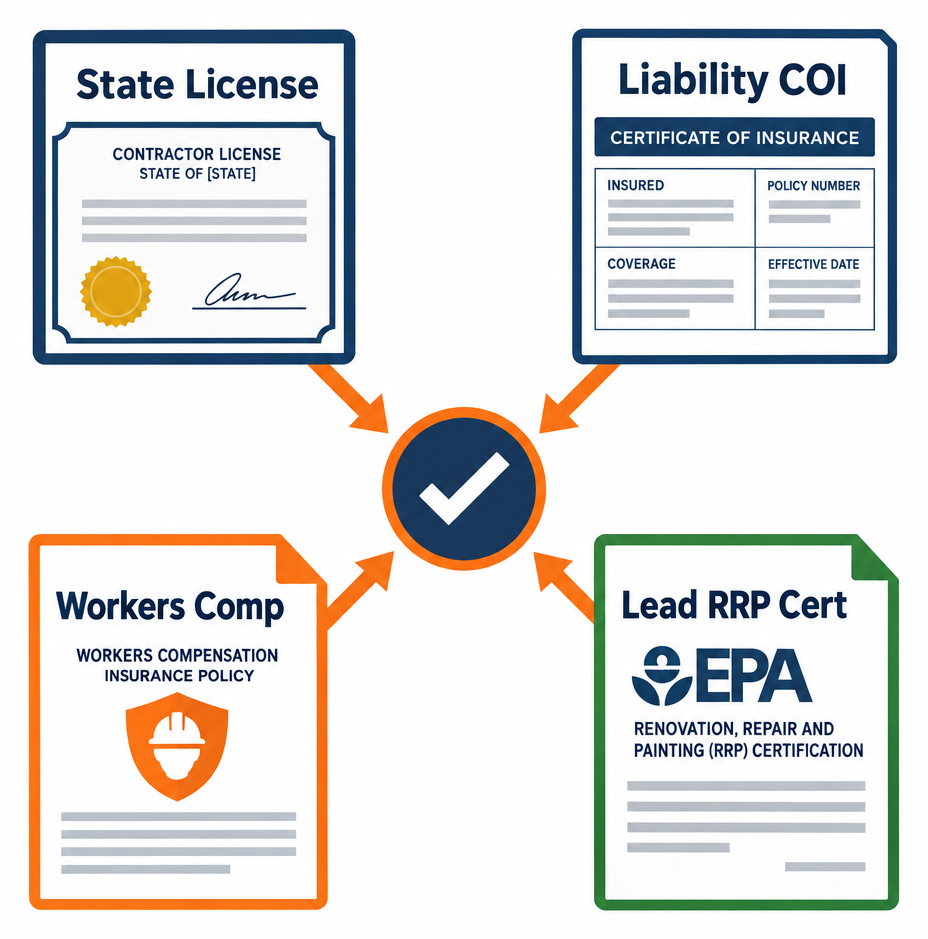
Every home remodeling company will tell you they are licensed and insured. Check anyway. It takes 20 minutes and it is the single step that removes the most risk.
License. Most states license general contractors through a state board, and most require one for any job above a low dollar threshold. Look the license up on the board’s site, not on a screenshot the contractor sends you. Confirm the name on the license matches the business name on the bid, the license is active, and the classification covers remodeling. A roofer’s license does not cover a kitchen. Check the complaint history while you are there.
General liability insurance. Ask for a certificate of insurance (COI) sent directly from the agent, with you named as certificate holder. A $1 million per-occurrence policy is the standard floor for residential work. Call the agent’s number on the certificate and confirm the policy is current.
Workers’ compensation. If anyone on the crew gets hurt in your house and the contractor has no comp policy, the claim can land on your homeowner’s insurance. A sole proprietor with no employees can be legally exempt in many states, but then every sub needs their own policy. Ask how the crew is covered.
EPA Lead RRP certification. If your house was built before 1978, federal law requires the firm doing the work to be EPA Lead-Safe Certified. Ask for the certificate number. A contractor who shrugs at this on a 1950s house will cut other corners too.
Permit history. Pull the contractor’s name in your permit portal. A remodeler who claims 15 years of kitchen work but has three permits on record is either working unpermitted or not doing as much as they say.
Step 4: Walk the job and watch how they work
Invite your top three to the house. Give each the same one-page scope and the same hour. What they do in that hour tells you most of what you need.
A good renovation contractor measures. They open the panel to count breaker spaces, look under the sink, go in the attic or crawlspace, and ask where the main shutoff is. They ask about your timeline, whether you will live in the house during the work, and how you want to handle decisions.
Warning signs during the walk:
- Quotes a price on the spot for a $40,000 job.
- Says “no permit needed” for work that moves plumbing, adds circuits, or touches structure.
- Will not name their plumber or electrician.
- Pushes you toward a bigger scope before you have discussed the one you wrote.
- Cannot explain, in plain terms, how they handle changes once walls are open.
Ask directly: “Who will be on my job every day, and who do I call when something is wrong?” A larger home renovation company may run your project through a project manager who also has four other jobs. That can work fine, but you should know it before you sign.
Ask about scheduling too. If they can start next Monday in peak season, ask why. Quality remodelers in most markets are booked six to twelve weeks out.
Pro tip
Ask every bidder the same question: “Tell me about a job where something went wrong and what you did.” The ones who have a real story, with a dollar figure and a resolution, are the ones who have been doing this long enough to have earned it.
Step 5: Call references and visit a live job
References are only useful if you ask real questions. Request three: one from the last six months, one from one to two years ago, and one from three or more years ago. The old one matters most, because that is when workmanship problems show up.
Use the same sheet for every call:
- What was the job and the final cost versus the bid?
- How many change orders were there, and who initiated them?
- Did it finish on schedule? If not, by how much?
- How was the site left at the end of each day?
- Who was on site daily, the owner or a lead carpenter?
- Did anything fail after completion, and how fast did they fix it?
- Would you hire them again for a bigger job?
- What would you tell them to do differently?
Then ask to visit a job in progress. Ten minutes on an active site shows you dust control, whether the floors are protected, how the crew treats the homeowner’s things, and whether the dumpster is overflowing into the driveway. If the contractor refuses, that is your answer.
For subs, ask the contractor who does their plumbing, electrical, and HVAC, then look those licenses up too. Your warranty is only as good as the weakest trade on the job.
Step 6: Compare bids line by line
You should have three written bids within ten days of the walkthrough. A bid that takes four weeks to arrive is a preview of the schedule.
Set up a spreadsheet with line items down the left and the three bidders across the top. Demolition, framing, plumbing rough-in, electrical rough-in, drywall, cabinets, countertops, tile, flooring, paint, fixtures, permits, dumpster, cleanup, overhead and profit. If a bidder gave you one lump sum, send it back and ask for the breakdown. A professional remodeler has it, because that is how they priced the job.
Then look for three things.
Allowances. This is where bids get gamed. A $2,000 tile allowance on a 120-square-foot bathroom floor and shower means builder-grade ceramic, not the porcelain you were looking at. Compare allowance dollars for cabinets, counters, tile, fixtures, lighting, and appliances. The low bid is often low because its allowances are.
Exclusions. Read the fine print for “excludes structural repair,” “excludes electrical panel upgrade,” or “excludes painting.” Those exclusions become change orders.
Spread. Three honest bids on the same scope usually land within 10 to 15 percent of each other. One bid 30 percent below the others is missing something or counting on change orders. One bid 30 percent above is either padded or from a company that does not want the job.
Pay attention to the overhead and profit line. Remodelers typically carry 15 to 25 percent combined, and some show it as a separate “cost plus” fee. A bid that shows 8 percent is hiding margin elsewhere.
Do not pick on price alone. Pick the contractor whose bid matched your scope most closely, whose references held up, and who you would trust to tell you bad news.
Step 7: Sign a contract that protects you
A handshake and a one-page estimate is not a contract. Before you sign anything, the document should include:
- Full scope attached as an exhibit, including drawings and the allowance schedule.
- Start date and substantial completion date, with a defined process for extending them.
- Payment schedule tied to milestones. Typical for a kitchen: 10 percent at signing, 25 percent at rough-in inspection, 25 percent at drywall, 25 percent at cabinet install, 10 percent at punch list sign-off, final 5 percent at completion. Never pay ahead of work.
- Change-order process. Every change gets a written price and your signature before the work happens. Set a markup for changes, usually the same overhead and profit as the base contract.
- Permits. The contractor pulls them in the company name and schedules inspections.
- Lien waivers. Each payment is released against signed waivers from the contractor and every sub and supplier who worked that phase. This is what stops a plumber you never met from filing a mechanic’s lien on your house.
- Insurance listed by carrier and policy number.
- Warranty. One year on workmanship is standard; some remodelers give two. Manufacturer warranties pass through on materials.
- Daily details. Work hours, bathroom use, dust barriers, where the dumpster goes, who locks up.
- Dispute resolution and a termination clause with notice periods for both sides.
If you plan to stay in the house, decide now where the furniture goes. Some homeowners compare moving pod companies for driveway storage during a kitchen gut, and it is far cheaper than paying the crew to shuffle a dining set every morning.
Read the whole thing. If the contractor’s contract is thin, ask to use the NARI or your state board’s sample agreement as the base. A good remodeling company will not object.
Pro tip
Add a line that says material selections are due two weeks before each phase starts. Most schedule slips in remodeling come from the homeowner not picking the tile, not from the crew. Putting the deadline in the contract keeps both sides honest.
Troubleshooting: when the hiring process goes wrong
| Symptom | Likely cause | Fix |
|---|---|---|
| Every bid is wildly different | Your scope was too vague | Rewrite the scope with measurements and allowances, then re-bid all three |
| Contractor wants 30 to 50 percent down | Cash-flow problems or inexperience | Counter with 10 percent; walk if they refuse |
| License name does not match the bid | Working under someone else’s license | Walk away, and consider reporting it to the board |
| No bid after three weeks | Too busy, or not interested in the job | Move to the next name on your list |
| “We’ll skip the permit to save you money” | Unlicensed or cutting corners | Walk away; unpermitted work surfaces when you sell |
| References are all from the last few months | New company or hiding older problems | Ask for a three-year-old job or pull their permit history |
| Low bidder’s allowances are half the others | Bid engineered to win, then change-order up | Normalize allowances in your spreadsheet and compare again |
| Contractor refuses lien waivers | Has not paid subs on past jobs | Non-negotiable; find another remodeler |
What good contractors do during the job
Once work starts, the signs of a good hire are boring. The crew shows up when they said. Dust walls go up before demo. You get a weekly schedule update, usually a Friday email or text. Inspections pass the first time. Change orders arrive in writing before the work, with a number on them.
Keep your own job log. Note who was on site, what got done, and every verbal decision. Confirm anything that costs money by email the same day. Most disputes trace back to a conversation nobody wrote down.
Hold the final payment until the punch list is done and you have final lien waivers, the signed-off permit, and every manufacturer warranty and manual in a folder.
When to call a pro
Hire an architect or structural engineer, not just a contractor, when the plan removes a wall, adds a second story, changes the roofline, or touches the foundation. Use a design-build firm when you want one contract covering design and construction. Call a real estate attorney before signing any remodel over $100,000, or any contract the contractor wrote that runs under two pages.
FAQ
How many bids should I get for a home remodel?
Three from pre-vetted home renovation contractors is the sweet spot. Two does not give you a sense of the market, and five burns everyone’s time. Vet licenses and references before you ask for a bid, not after.
Should I hire a general contractor or a design-build company?
A general contractor builds from plans you supply, so you hire a designer or architect separately. A design-build firm does both under one contract, which cuts finger-pointing but limits your bidding. For a kitchen or bath, either works. For an addition, design-build often saves time.
What is a fair deposit for a remodeling contractor?
Ten percent at signing is the standard, and California caps it at 10 percent or $1,000, whichever is less. Larger deposits can be justified for custom orders like cabinets or windows, but the money should go to the supplier, with a receipt, not into the contractor’s general account.
How do I know if a remodeling bid is too low?
Compare allowances and exclusions, not the total. A bid 25 to 30 percent under the others almost always has thin allowances, missing scope, or an inexperienced estimator. Any of those becomes your problem once the walls are open.
Can I do part of the work myself to save money?
Yes, if it is in the contract. Demolition, painting, and final cleanup are the usual homeowner tasks. Say so before bidding, agree on a handoff date, and understand that the contractor will not warranty work they did not do.
What should I do if the contractor stops showing up?
Send a written notice citing the contract’s termination clause and the number of days they have to resume. Stop all payments. If they do not return, document the state of the work with photos, gather your lien waivers, and file a complaint with the state licensing board before hiring a replacement.