
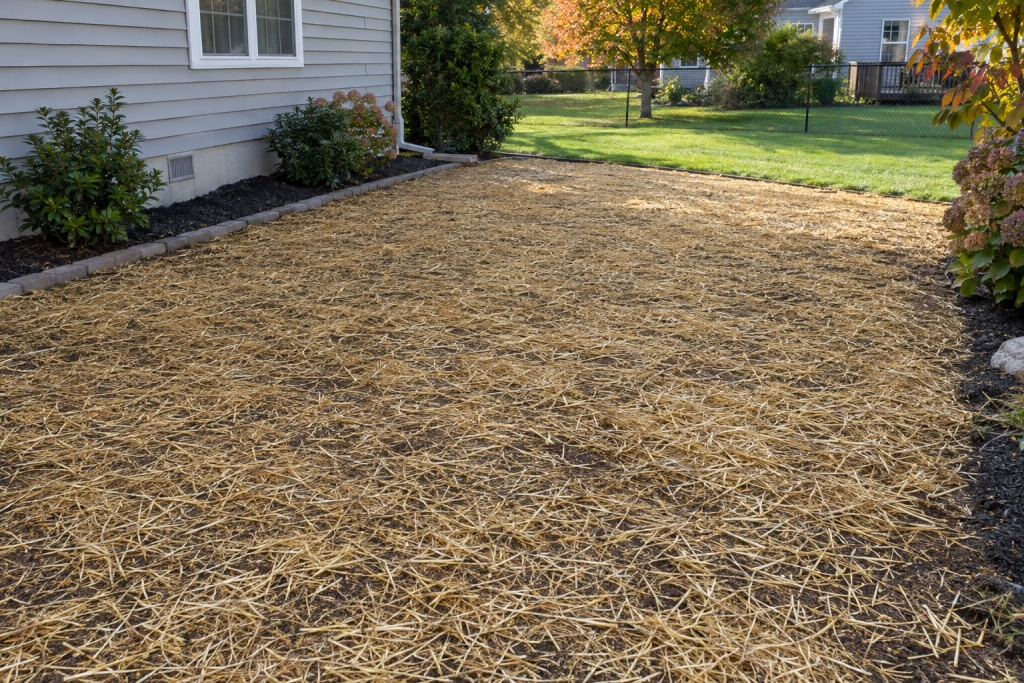
To seed the lawn, kill or clear what’s there, loosen and level the top 2 to 4 inches of soil, spread starter fertilizer and seed at the rate on the bag, rake the seed in no deeper than 1/4 inch, mulch lightly, and keep the top half inch of soil damp until the grass is up. Cool-season grasses go down in late August to early October; warm-season grasses go down from late spring once soil holds 65°F. Most new lawns are mowable in 3 to 6 weeks and ready for normal foot traffic in 8 to 10.
Quick steps: seed the lawn
- Measure the area and pick a seed species that fits your climate, sun and traffic.
- Soil test, then kill existing weeds or grass and wait 7 to 10 days.
- Loosen the top 2 to 4 inches, add compost, grade away from the house.
- Rake smooth, remove rocks and clods, firm the seedbed with a roller.
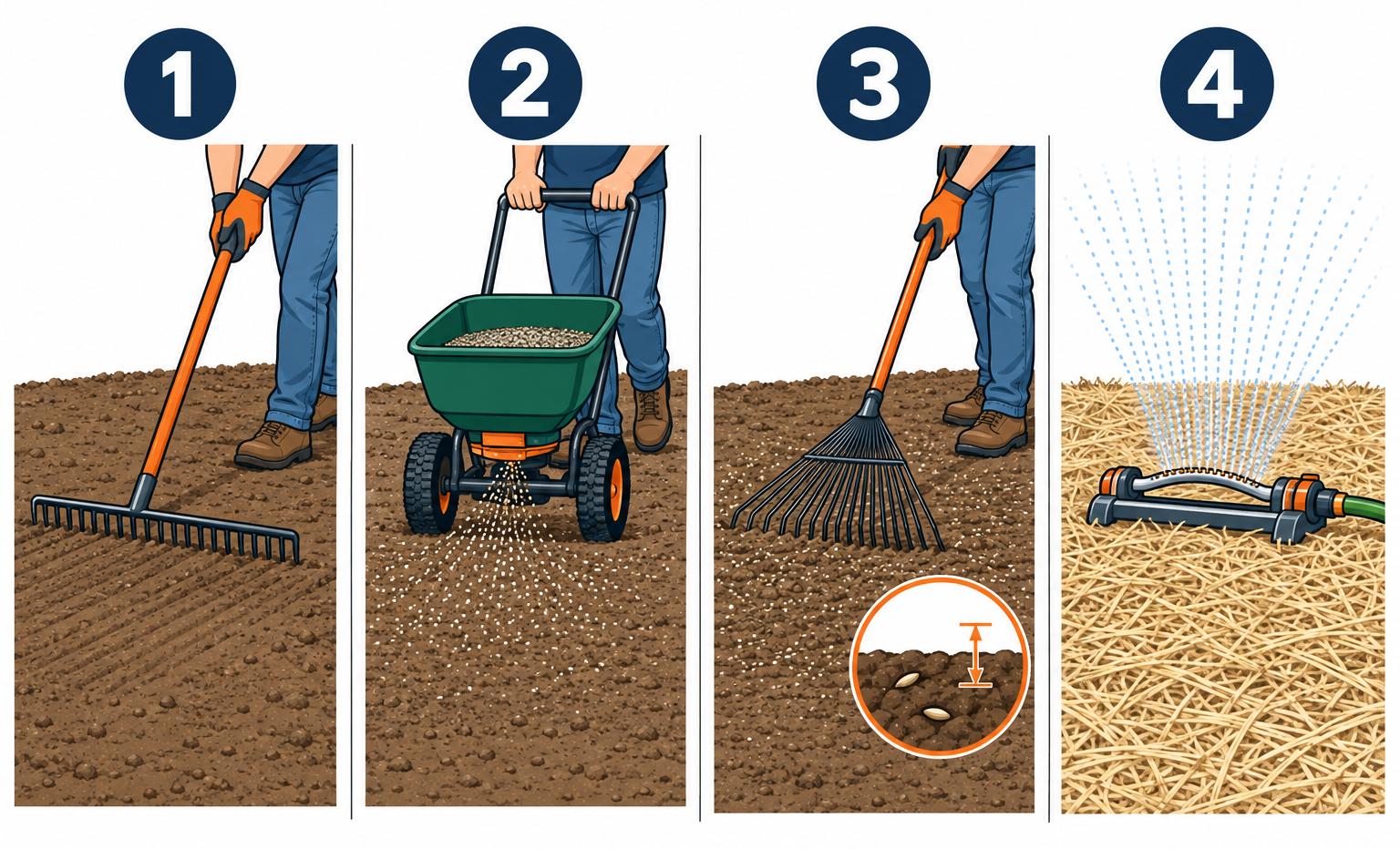
- Spread starter fertilizer, then seed in two half-rate passes at right angles.
- Rake seed in 1/8 to 1/4 inch, roll again, mulch with straw or peat.
- Water lightly 2 to 3 times a day until germination, then deeper and less often.
- Mow for the first time at 3 to 4 inches, and keep traffic off for 6 weeks.
Tools and materials
- Grass seed (see rate table; buy 10% extra)
- Starter fertilizer (something like 12-24-12 or 18-24-6, 0.5-1 lb N per 1,000 sq ft)
- Soil test kit or county extension lab test ($10-30)
- Broadcast or drop spreader
- Bow rake and leaf rake
- Rototiller (rental $60-90/day) or garden fork for small areas
- Lawn roller, water-filled 1/3 full (rental $20-30/day)
- Compost, 1 inch over the area (1 cubic yard covers about 325 sq ft)
- Clean wheat straw, 1 bale per 1,000 sq ft, or peat moss, 1/4 inch
- Erosion control blanket or jute netting for slopes over 3:1
- Non-selective herbicide (glyphosate) or sod cutter (rental $80-110/day)
- Slit seeder (rental $80-120/day) if overseeding an existing lawn
- Oscillating sprinkler and timer
- Flag stakes and string for marking edges
Calculators for this job
Safety first
Call 811 at least two working days before tilling, cutting sod or digging deeper than a few inches so gas, electric and cable lines get marked. Wear gloves, long sleeves and eye protection when spraying herbicide, and keep pets off treated grass until it dries.
Step 1: Pick the window and the right seed
Timing matters more than any product you buy. Grass seed germinates on soil temperature, not air temperature, and each species has a narrow band where it works well. Seed outside the band and you fight weeds, heat and disease the whole way.
When to seed by grass type
| Grass type | Best window | Second choice | Soil temp for germination |
|---|---|---|---|
| Kentucky bluegrass | Late Aug to mid Sept | Early to mid spring | 50-65°F |
| Tall fescue | Late Aug to early Oct | April to May | 50-65°F |
| Perennial ryegrass | Late Aug to early Oct | April to May | 50-65°F |
| Fine fescues | Late Aug to mid Sept | April | 50-65°F |
| Bermudagrass | Late May to July | Early Aug (Deep South) | 65-70°F+ |
| Zoysiagrass | Late May to June | None worth trying | 70°F+ |
| Centipedegrass | May to June | Early July | 70°F+ |
| Bahiagrass | April to July | None needed | 65-70°F+ |
Fall wins for cool-season grasses because the soil is still warm from summer, the air is cooling, rain picks up and the crabgrass seed that plagues spring seeding has quit germinating. Spring seeding works, but the grass has barely rooted when July hits. You’ll water constantly and still lose some of it.
Warm-season grasses are the opposite. They need heat to germinate and a long warm stretch to spread. A June seeding in Georgia fills in by September. The same seed spread in April sits there for weeks and lets weeds take the ground first.
A soil thermometer ($10-15) stuck 2 inches deep at 9 a.m. for three days running tells you where you are. No thermometer? Many state extension services and weather sites post 2-inch soil temperature maps.
Match the species to the yard
Pick for your climate first, then sun, then traffic. The table below uses rates for a new lawn on bare soil. Cut the rate roughly in half if you are overseeding thin turf.
| Grass | Seed rate, new lawn (lb per 1,000 sq ft) | Overseed rate | Days to germinate | Shade tolerance | Wear tolerance |
|---|---|---|---|---|---|
| Kentucky bluegrass | 2-3 | 1-1.5 | 14-30 | Poor to fair | Good, self-repairs |
| Tall fescue (turf-type) | 6-8 | 3-4 | 7-14 | Fair to good | Good |
| Perennial ryegrass | 6-9 | 3-5 | 5-10 | Fair | Good |
| Fine fescue (creeping red, chewings, hard) | 4-5 | 2-3 | 7-14 | Best of the cool-season group | Poor |
| Bermudagrass (hulled) | 1-2 | 0.5-1 | 7-21 | Poor | Excellent |
| Zoysiagrass | 1-2 | 0.5-1 | 14-21 | Fair | Excellent |
| Centipedegrass | 0.25-0.5 | 0.25 | 14-28 | Fair | Poor |
| Bahiagrass | 5-10 | 3-5 | 14-28 | Fair | Good |
A few practical notes. Tall fescue is the default for most of the transition zone and the mid-Atlantic because it handles heat better than bluegrass and shade better than bermuda. Kentucky bluegrass makes the thickest lawn in the North but takes three to four weeks to show up, so people often assume it failed and reseed on top of it. Perennial ryegrass is the fastest to green up and is worth 10 to 20% of a northern mix for that reason alone. Fine fescues are the only cool-season choice that survives real shade, and they do it on half the fertilizer.
For warm regions, bermuda is the hardest-wearing and the cheapest to seed. Zoysia seed is slow and costly (often $25-40 a pound), and sod or plugs are usually a better bet. Centipede is a low-input grass for acidic sandy soils in the Southeast and hates heavy fertilization.
Read the seed label before you buy
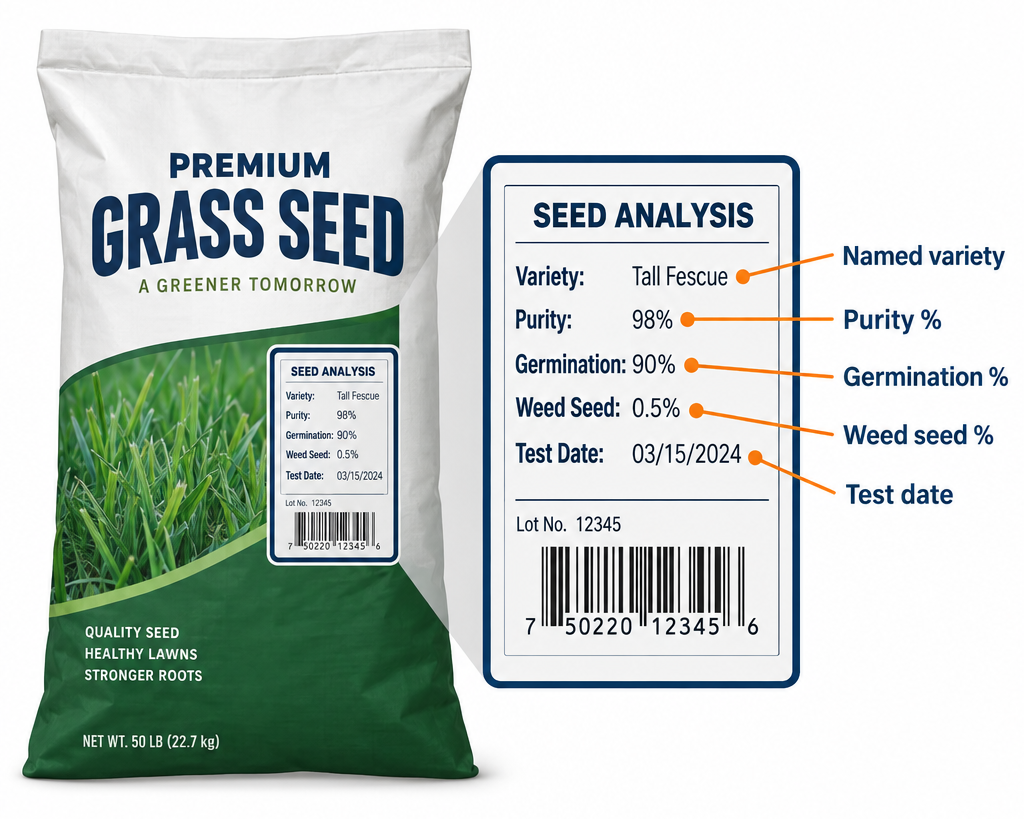
Every bag sold in the US carries an analysis tag. Spend 30 seconds on it:
- Named varieties, not “VNS” (variety not stated). Named turf-type varieties are what the National Turfgrass Evaluation Program tests; VNS is often pasture seed.
- Purity of 90% or higher for the named grasses.
- Germination of 85% or higher for most species, 80% for bluegrass.
- Weed seed under 0.5% and other crop at or near 0%.
- Noxious weeds: none.
- Test date within the past 9 to 12 months. Old seed loses germination fast in a hot garage.
- Inert matter low. Coated seed can show 40 to 50% inert by weight because the coating counts. That’s fine, but you need to buy more pounds to get the same number of seeds.
Watch for bags that list annual ryegrass as a major ingredient. It comes up in four days, looks great, and dies at the first frost or first heat wave. Fine for a temporary erosion cover, useless as a lawn.
Step 2: Measure the area and test the soil
Everything downstream (seed, fertilizer, compost, straw) is sold per 1,000 square feet, so you need a real number. Pace off or tape-measure length times width for rectangles. For odd shapes, break the yard into rectangles and triangles and add them up. A 60 by 40 foot backyard is 2,400 square feet; most seed bags cover far less than people think.
Then test the soil. A basic lab test through your county extension office costs $10-30 in most states and comes back in one to three weeks with pH, phosphorus, potassium and a lime recommendation. Retail test kits ($15-25) give you a rough pH and are better than guessing, but the lab number is the one worth planning around.
Grass wants a pH between 6.0 and 7.0. Below 5.5 you’ll apply fertilizer the grass can’t use. Lime takes months to move pH, so fall seeders should put it down in spring, or at least work it into the soil before seeding rather than topdressing it after. A typical correction on acidic soil runs 50 lb of pelletized lime per 1,000 square feet to raise pH about half a point, but go with the lab number.
Phosphorus matters because seedlings need it for root growth, and because a growing list of states (Minnesota, New Jersey, New York, Maryland, Wisconsin and others) restrict phosphorus lawn fertilizer unless you are establishing a new lawn or have a soil test showing a deficiency. Keep the test results if you buy a starter fertilizer with a middle number.
Pro tip
Take 8 to 10 soil plugs from across the area, 4 inches deep, and mix them in a clean bucket before bagging a cup for the lab. One scoop from one spot tells you about that spot and nothing else.
Step 3: Clear the ground and fix what’s wrong underneath
What you do here depends on what you’re starting with.
Starting from bare dirt or a dead lawn
New construction lots are the worst case. Builders scrape off topsoil, drive heavy equipment over the subsoil and spread an inch of fill back on top. Grass seeded straight into that will sprout and then stall.
Push a screwdriver into the ground after a rain. If it stops at 2 to 3 inches, the ground is compacted and needs tilling. Rent a rear-tine tiller and work the top 4 to 6 inches in two passes at right angles. Pick out rocks larger than an inch, root chunks and construction debris as you go. You’ll find more than you expect.
Then add organic matter. One inch of compost tilled into the top 4 to 6 inches improves both drainage on clay and water holding on sand. That’s about 3 cubic yards per 1,000 square feet, which typically runs $115-265 or more delivered depending on your region and the material. Skip bagged “topsoil” unless you’ve checked it; much of it is screened fill with little organic content.
If the lot has less than 4 inches of soil over hardpan or rubble, bring in real topsoil. Four to six inches is the minimum for a lawn that survives a dry August without daily watering.
Renovating a weedy or thin lawn
If more than half the area is weeds or bare, start over. Spray glyphosate on actively growing weeds and grass, wait 7 to 10 days for full kill, mow the dead material as short as the mower goes and bag it. You can seed right into the dead thatch with a slit seeder or power rake without tilling. Tilling an old lawn brings up decades of buried weed seed, so avoid it when the grade is already acceptable.
If the lawn is 50% or more decent grass, don’t kill it. Mow to 1.5 to 2 inches, dethatch or core aerate, and overseed into the existing turf. That’s a different job with lighter rates, and the rest of this article still applies to watering and care.
Grading and drainage
Water should move away from the foundation at about 1/4 inch per foot for the first 10 feet, which means the soil 10 feet out sits roughly 2.5 inches lower than it does at the wall. Use a string line and a line level, or a long straight board with a level on top. Fill low spots that hold water for more than a day after rain; they’ll drown seedlings and grow moss. Shave high spots the mower scalps.
Standing water that won’t grade away usually means a drainage problem you can’t fix with seed. A soggy strip along a fence line or at the bottom of a slope is a job for a “french drain” before you waste money on grass.
Rough grade, water the area to settle it, wait a day or two, and grade again. Fresh-tilled soil drops an inch or more once it’s wet. Seed on unsettled ground and you’ll get a lumpy lawn and bumps under the mower deck for years.
Step 4: Rake and firm the seedbed
The goal is a surface like coarse breadcrumbs. Clods bigger than a golf ball, fine dust and a hard crust all cause the same problem: seed either falls into gaps too deep to emerge or sits on top where it dries out in an afternoon.
Rake the entire area with a bow rake, pulling clods and debris to the edge. Work the rake across the slope rather than up and down so you don’t create channels for runoff. Break big clods with the back of the rake. Then flip to a leaf rake and smooth it. Any footprint deeper than half an inch means the soil is too fluffy.
Roll it. A water-filled roller at about a third full is enough. You want to firm the surface, not pack it. Walk the roller in one direction across the whole area. If your shoes now leave only a faint print, you’re ready. If the roller leaves ruts, let the soil dry another day.
On slopes steeper than 3 feet of run per 1 foot of rise, seed will wash on the first hard rain no matter how good the bed is. Plan on an erosion blanket (jute, straw or coconut fiber netting, roughly $40-80 for a 4 by 100 foot roll) stapled over the seed.
Step 5: Spread starter fertilizer and seed
Starter fertilizer
A starter blend is higher in phosphorus than a maintenance fertilizer, typically a ratio like 12-24-12, 18-24-6 or 16-20-0. Apply enough to deliver about 0.5 to 1 pound of nitrogen per 1,000 square feet. A 15-lb bag of 18-24-6 at the bag rate covers 5,000 square feet and costs $20-30. Spread it right before seeding and rake it in with the seed, or put it down immediately after. Either works.
Do not use a weed-and-feed, a product with crabgrass preventer, or a “lawn food” with no phosphorus unless your soil test shows plenty of P. The crabgrass preventer (prodiamine, pendimethalin, dithiopyr) stops grass seed as well as it stops crabgrass. The one exception is mesotrione, sold as Tenacity and in some starter fertilizers, which is labeled for use at seeding on most cool-season grasses and centipede. Read the label for your species; it’s not safe on fine fescue at seeding.
Set the spreader
Drop spreaders put seed exactly where you walk and are the better tool along driveways, beds and the house, where you don’t want seed in the mulch. Broadcast (rotary) spreaders cover ground three times faster and are fine for the open middle. Either way, use the setting on the seed bag for your spreader model. If your bag doesn’t list it, set it low, spread a weighed amount over a measured area, and adjust.
Split the total seed in half. Spread the first half walking north-south, the second half walking east-west. Overlap each pass by the width of the spreader’s throw. This is the single easiest way to avoid stripes and bare lanes.
Very small seed (bermuda, centipede, bluegrass) can run out of a spreader unevenly. Mix the seed with an equal volume of dry sand or dry milorganite to bulk it up and spread it at a higher setting.
Hand-seeding small patches is fine. Rub the seed between your palms as you fling it low to the ground to scatter it, and go back over thin spots.
How much is too much
More seed is not better. Seed at double the rate and the seedlings crowd each other, stretch thin and die off from damping-off fungus in the first humid week. Tall fescue at 6 to 8 lb per 1,000 square feet puts roughly 15 to 20 seeds per square inch, which is plenty. Count a few random square inches after spreading. If you see 25 or more seeds in a square inch of fescue, you’re heavy. Bluegrass seed is tiny, so 10 to 15 per square inch at the 2 to 3 lb rate is right.
Pro tip
Check your seeding rate on a tarp before you touch the lawn. Spread a measured area (say 10 by 10 feet) over a tarp, sweep up the seed, weigh it. A kitchen scale and two minutes will save you an uneven lawn or an extra $60 bag.
Step 6: Rake the seed in, roll, and mulch
Seed needs contact with soil and about 1/8 to 1/4 inch of cover. Seed left sitting on the surface dries out between waterings and feeds the birds. Seed buried half an inch deep runs out of energy before it reaches light.
Drag a leaf rake lightly across the area with the tines barely touching, or flip a bow rake and drag the back of it. One pass. You should still see about a quarter of the seed when you’re done. On a slit-seeded renovation, skip this; the machine already placed the seed in grooves.
Roll again with the same one-third-full roller. This presses seed into firm contact with moist soil and is the step most DIY seedings skip. Lawns that come up patchy usually got raked in and watered correctly but never rolled.
Mulch to hold moisture and stop washouts. Your options:
| Mulch | Rate per 1,000 sq ft | Cost | Notes |
|---|---|---|---|
| Clean wheat straw | 1 bale (about 35-50 lb) | $8-14 per bale | Spread so 50% of soil still shows through. Leave it; it rots in. |
| Peat moss | 1/4 inch, about 1 compressed bale (3.8 cu ft) | $15-20 per bale | Dark color shows dry spots. Can crust and shed water if it dries out. |
| Pelletized paper mulch | 1-2 bags | $20-40 | Clean, no weed seed, pricier. |
| Erosion blanket | 1 roll, 4×100 ft, covers 400 sq ft | $40-80 per roll | Required on slopes. Staple every 2-3 feet. Grass grows through it. |
| Nothing | – | $0 | Only on flat ground with reliable rain and twice-daily watering. |
Avoid hay. Hay is a cut field crop full of seed heads, and you’ll be pulling foxtail and orchardgrass all summer. Straw is the stalk left after grain harvest and is nearly seed-free. If a bale is labeled only “bedding,” ask.
Step 7: Water until the grass is up, then back off
Watering is where new lawns live or die. The rule is simple: the top half inch of soil never dries out until germination is done, and then you push water deeper and less often to force roots down.
| Phase | How often | How long | What you’re checking |
|---|---|---|---|
| Day 1 to germination | 2-3 times daily (morning, midday, late afternoon) | 5-10 minutes per zone, just enough to darken the surface | Soil surface stays damp, no puddles, no runoff |
| Germination to first mow (about weeks 2-4) | Once daily, early morning | 15-20 minutes, wetting the top 2 inches | Seedlings don’t wilt by late afternoon |
| First mow to week 8 | Every 2-3 days | 20-30 minutes, wetting 3-4 inches | Footprints spring back; soil moist at 3 inches when you dig |
| Week 8 onward | 1-2 times per week | About 1 inch total per week including rain | Normal lawn watering; use a tuna can to measure |
The germination window depends on species. Perennial ryegrass can be up in 5 days with warm soil. Tall fescue takes a week to two. Bluegrass takes two to four weeks and will test your patience. Most mixes show green in 7 to 10 days and look like a lawn, a thin one, in three weeks. Don’t declare failure on bluegrass before day 28.
A $25-40 hose-end timer with multiple start times makes this manageable. Without one, you’ll miss a midday watering during a hot week and lose the seedlings that had just cracked their seed coats. That’s the single most common way a seeding fails.
Water in the morning whenever you can choose. Evening watering on a new lawn in September leaves the surface wet all night and invites pythium and damping-off, which show up as greasy, matted patches that collapse overnight.
Keep an eye on the straw. Light straw floats, so if a thunderstorm moves it into windrows, rake it back out the next day and check for washed-out seed underneath.
Pro tip
Push a screwdriver into the soil before each watering. If it slides in 2 inches easily, skip that session. If it meets resistance at 1 inch, water. The schedule above is a starting point; the screwdriver tells you what the soil actually needs.
Step 8: First mow and the transition to a normal lawn
Mowing
Mow for the first time when the tallest blades reach 3 to 4 inches for cool-season grass, around 1 to 1.5 inches for bermuda. Set the mower high, use a sharp blade and mow when the ground is dry enough that the wheels don’t rut. A dull blade tears seedlings out by the roots instead of cutting them.
Take off no more than a third of the blade in any cut. After the first two or three mows, settle into normal heights: 3 to 4 inches for tall fescue and bluegrass, 2.5 to 3 for ryegrass and fine fescue, 1 to 2 for bermuda and zoysia. Mowing tall in the first season shades out weed seedlings and pushes roots deeper.
Bag the clippings for the first few mows if there’s straw mixed in. After that, mulch them.
Fertilization
Make a second feeding 4 to 6 weeks after germination with about 0.75 to 1 lb of nitrogen per 1,000 square feet from a normal lawn fertilizer. Fall-seeded cool-season lawns benefit from one more feeding in late fall (around Thanksgiving in the mid-Atlantic, earlier up north) and then a regular program the next spring. Warm-season lawns seeded in June want a feeding in July and another in August, then nothing after Labor Day.
Weeds
Expect them. A fresh seedbed grows whatever blew in. Most broadleaf weeds get crowded out as the turf thickens, and the ones that don’t can be sprayed with a standard 2,4-D or triclopyr lawn herbicide after you’ve mowed the new grass three or four times. Earlier than that and the herbicide damages seedlings.
Pre-emergent crabgrass control is the trickier one. Standard products block grass seed for 8 to 16 weeks after application, so a February or March pre-emergent means you can’t seed until late spring, and a spring seeding means no crabgrass preventer that year. Fall seeders are fine: by the time the next spring’s pre-emergent window opens, the lawn has been mowed many times and is established. If you must seed in spring in a crabgrass-prone yard, mesotrione is your option, or you accept some crabgrass and seed again in fall.
Foot traffic and use
Stay off the lawn entirely until the first mow. Light foot traffic is fine after the second or third mow. Hold off on kids’ play, dogs running, lawn furniture and parties for about 6 to 8 weeks total. Seedlings pull out easily until the root system knits, and a single afternoon of soccer on a three-week-old lawn leaves bare streaks that show until next season.
A fall-seeded cool-season lawn is fully established by the following June. A spring-seeded one needs the whole summer and will look thin until fall. Warm-season lawns seeded in early summer fill in by September but don’t reach full density until the second summer.
Dormant seeding and other timing exceptions
If you missed the fall window, you have two choices besides waiting for spring. The first is dormant seeding: prepare the bed in late fall and spread seed after the soil has dropped below about 40°F and stays there, generally late November through February in the northern half of the country. The seed sits all winter and germinates at the first warm spell in March or April, several weeks before you could have worked the ground in spring. Rates run 25 to 50% higher than normal because birds and washouts take a share, and you need to accept that a January thaw can trigger germination followed by a killing freeze.
Dormant seeding works best for Kentucky bluegrass and tall fescue on flat ground. Don’t bother with perennial ryegrass, which germinates on any warm week and then dies.
The second option is late-winter frost seeding into thin existing turf. Spread seed in late February or early March when the ground is freezing at night and thawing by day. The freeze-thaw cycle pulls seed into the soil. Results are hit-or-miss compared with a proper fall seeding, but it costs only the seed.
Overseeding versus starting over
| Overseed into existing lawn | Full renovation from bare soil | |
|---|---|---|
| When | Lawn is 50%+ good grass, just thin | Lawn is mostly weeds, wrong grass, or badly graded |
| Prep | Mow short, dethatch or core aerate, bag debris | Kill everything, till or sod-cut, add compost, grade |
| Seed rate | Half the new-lawn rate | Full rate from the table |
| Equipment | Slit seeder or aerator rental, $70-120/day | Tiller, roller, possibly sod cutter, $150-250 in rentals |
| Cost per 1,000 sq ft | $25-60 | $60-250 (more with imported topsoil) |
| Time on site | 2-3 hours | 4-8 hours plus settling days |
| Result | Thicker version of what you have | A different lawn |
Overseeding into a lawn that’s 70% crabgrass and ground ivy wastes seed. Overseeding a decent fescue lawn every fall at 3 to 4 lb per 1,000 square feet is the cheapest lawn maintenance there is and keeps it dense enough that weeds never get a foothold.
What a new lawn costs
Prices below are typical retail and rental ranges in the US for 1,000 square feet. Bulk seed from farm supply stores and landscape yards runs 30 to 50% less than the hardware store bag.
| Item | Low | High | Notes |
|---|---|---|---|
| Tall fescue seed, 7 lb | $20 | $45 | Named varieties at the top end |
| Kentucky bluegrass seed, 3 lb | $20 | $40 | Fewer pounds, pricier per pound |
| Perennial ryegrass seed, 8 lb | $20 | $40 | |
| Bermudagrass seed, 1.5 lb hulled | $15 | $30 | |
| Zoysia seed, 1.5 lb | $40 | $65 | Sod is often cheaper per result |
| Starter fertilizer | $5 | $8 | Share of a 5,000 sq ft bag |
| Soil test | $10 | $30 | Per yard, not per 1,000 sq ft |
| Compost, 3 cu yd | $100 | $150 | Delivered; skip if soil is already good |
| Straw, 1 bale | $8 | $14 | |
| Erosion blanket, 2.5 rolls | $100 | $200 | Slopes only |
| Tiller rental | $60 | $90 | Per day; covers a whole yard |
| Roller rental | $20 | $30 | |
| Slit seeder rental | $80 | $120 | Overseeding only |
| Hose timer | $25 | $40 | One-time |
A 5,000 square foot fescue lawn seeded from a killed-off weedy yard, with no compost or topsoil needed, runs about $300-400 in seed, fertilizer, straw and rentals. The same job done by lawn care companies runs $1,500-4,000 depending on the region and how much grading they do. Hydroseeding, where a truck sprays seed, mulch and tackifier in one slurry, prices out around $0.10-0.20 per square foot and is worth pricing on large lots or steep ground.
Troubleshooting
| Symptom | Likely cause | Fix |
|---|---|---|
| Nothing up after 3 weeks (ryegrass or fescue) | Surface dried out between waterings, or seed was buried too deep | Dig a spot. If seed is intact and dry, resume twice-daily watering. If it’s rotted or absent, reseed and roll. |
| Nothing up after 3 weeks (bluegrass) | Normal | Wait to day 28 to 30 before judging. |
| Green stripes or bare lanes | Single-pass spreading, no overlap | Reseed the lanes by hand, rake in, water. |
| Seedlings came up, then collapsed in patches overnight | Damping-off or pythium from evening watering and heavy seeding | Switch to morning watering, let the surface dry between sessions, reseed thin spots in two weeks. |
| Seed and straw moved into low spots | Washout from a hard rain or runoff from the sprinkler | Rake straw back, reseed bare spots, shorten watering times, add erosion netting on slopes. |
| Green and growing, then yellow and stalled at 2 inches | Ran out of nitrogen, or compacted subsoil under thin fill | Apply the 4-to-6-week feeding. If the screwdriver stops at 2 inches, core aerate next season and topdress with compost. |
| Lots of grassy weeds among the seedlings | Crabgrass (spring seeding) or hay instead of straw | Mow high and often; crabgrass dies at first frost. Pull foxtail before it seeds. Fall overseed to fill in. |
| Birds eating the seed | Exposed seed on the surface | Rake in and roll properly; mulch covers it. Bird loss is rarely more than 10% on a covered bed. |
| Thin, spindly seedlings that fall over | Seeded at 2x the rate | Nothing to do now. Mow when it’s tall enough; the stand thins itself. Don’t reseed over it. |
| Grass up everywhere except a few circles | Herbicide residue, buried debris, dog urine, or old gravel | Dig to 4 inches and look. Replace the soil in that spot and reseed. |
| Good lawn that goes brown in the first July | Spring seeding, shallow roots | Water deeply twice a week, mow at 4 inches, overseed in September. |
Why new lawns fail, in order of how often it happens
- Drying out during germination. One missed day in the first two weeks on a hot, windy afternoon kills more seedings than everything else combined.
- Wrong season. Fescue seeded in June or bermuda seeded in April is set up to lose.
- Seed on top of hard ground. No loosening, no raking in, no rolling. The seed sprouts, the roots can’t penetrate, and it dies in the first dry spell.
- Pre-emergent herbicide in the soil. Either a spring crabgrass application or a weed-and-feed used “to get ahead of the weeds.”
- Cheap seed. VNS mixes heavy in annual ryegrass, or a bag that’s been in a hot garage for two years.
- Too much traffic too soon.
- Underlying drainage or compaction the seed was supposed to fix.
Consider seeding less lawn
Before you seed every square foot, look at what you’ll actually mow and water. Lawn under dense tree canopy, strips less than 4 feet wide between the sidewalk and street, steep banks and the far corners nobody walks on are all candidates for something other than turf.
Fine fescue no-mow blends, seeded at the normal 4 to 5 lb rate, make a soft meadow look at knee height and need a single mowing each year in late fall. Microclover mixed into a fescue or bluegrass seeding at about 5% by weight fixes its own nitrogen and stays green through drought. Mulched beds with native shrubs cost more up front than seed but nothing in water or weekly mowing afterward. A smaller lawn you can keep thick and green beats a large one that’s half weeds by August.
When to call a pro
Call a licensed landscape contractor if the yard needs more than 6 inches of cut or fill to drain away from the house, if water pools against the foundation after rain, or if a slope steeper than 2:1 needs grading before it’ll hold seed. Call your utility locator (811) before any tilling. If a soil test shows contamination or you’re on a lot with a buried oil tank, septic field or unknown fill, get a soil contractor out before you spend money on grass. For lots over half an acre, get a hydroseeding quote; the labor savings usually beat DIY.
FAQ
How long does it take grass seed to grow?
Perennial ryegrass germinates in 5 to 10 days, tall fescue in 7 to 14, Kentucky bluegrass in 14 to 30. Most lawns are ready for a first mow at 3 to 6 weeks and are safe for normal use at 8 to 10 weeks. Full density takes a whole growing season.
Can I just throw grass seed on the ground?
You can, and about 10 to 20% of it will grow. Seed needs soil contact and light cover to survive its first dry afternoon. Loosening the top inch with a rake and pressing the seed in gets you to 70 to 80% establishment for almost no extra work.
Should I put topsoil over grass seed?
No. Seed goes on top of prepared soil and gets raked in 1/8 to 1/4 inch, then mulched with straw or peat. A layer of topsoil dumped on top of seed buries it too deep. If you want to topdress, do it before seeding and seed into it.
What’s the best month to seed the lawn?
September for cool-season grasses across most of the country, with late August in the far North and early October still workable in the transition zone. June for bermuda, zoysia and centipede. April is the fallback for cool-season grass if fall got away from you.
How much seed do I need for 1,000 square feet?
Tall fescue needs 6 to 8 lb, perennial ryegrass 6 to 9, Kentucky bluegrass 2 to 3, fine fescue 4 to 5, bermuda 1 to 2 and centipede a half pound. Cut those in half for overseeding. Buy 10% extra for touch-ups.
Can I seed and use a weed killer at the same time?
Not a standard one. Pre-emergent crabgrass products stop grass seed for 2 to 4 months and broadleaf herbicides damage seedlings. Mesotrione (Tenacity) is the exception and is labeled for use at seeding on most cool-season grasses. Otherwise wait until you’ve mowed three or four times.
Why did my grass come up and then die?
Usually one of three things: the surface dried out after germination when watering got lighter, a fungal disease from evening watering and overcrowding, or the seedlings hit compacted soil 2 inches down and couldn’t root. Dig a small hole and check moisture and resistance to figure out which.
Is it cheaper to seed or sod?
Seed costs $0.05-0.25 per square foot in materials; sod installed runs $1-2.50 per square foot. Sod gives an instant lawn you can use in 2 to 3 weeks, and it’s the realistic option for zoysia and for slopes that won’t hold seed. For everything else, seed wins on price and on long-term variety choice.