
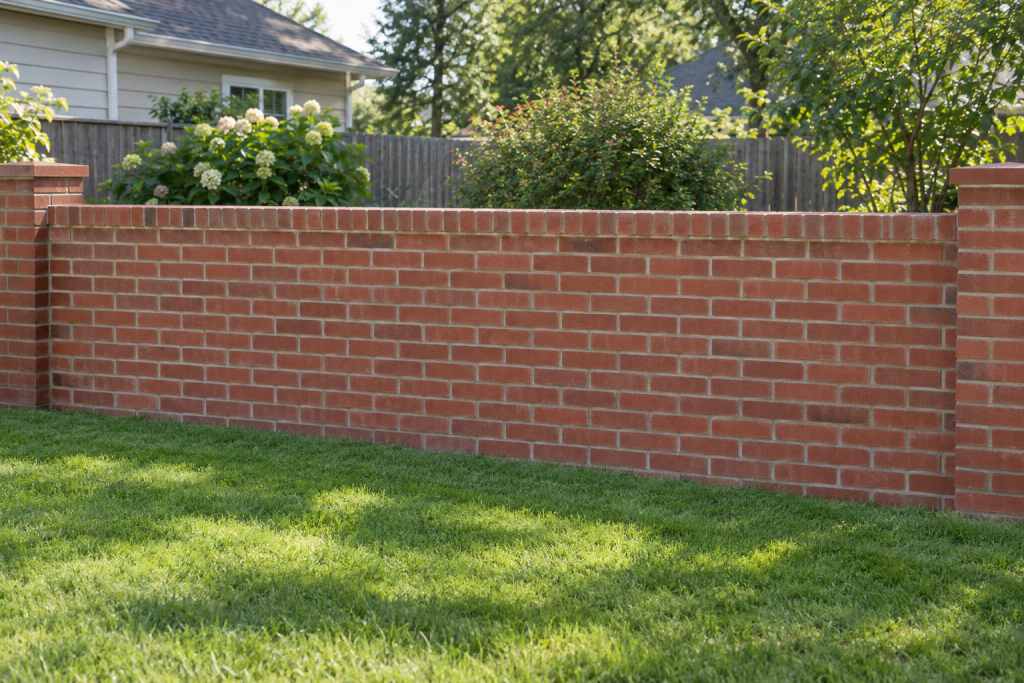
The brick calculator above tells you how many bricks and how many 80 lb bags of mortar mix you need for a wall, after subtracting doors and windows and adding waste. All you have to measure is the wall length, the wall height, and the square footage of any openings, then pick a brick size and joint width.
Quick steps: use the brick calculator
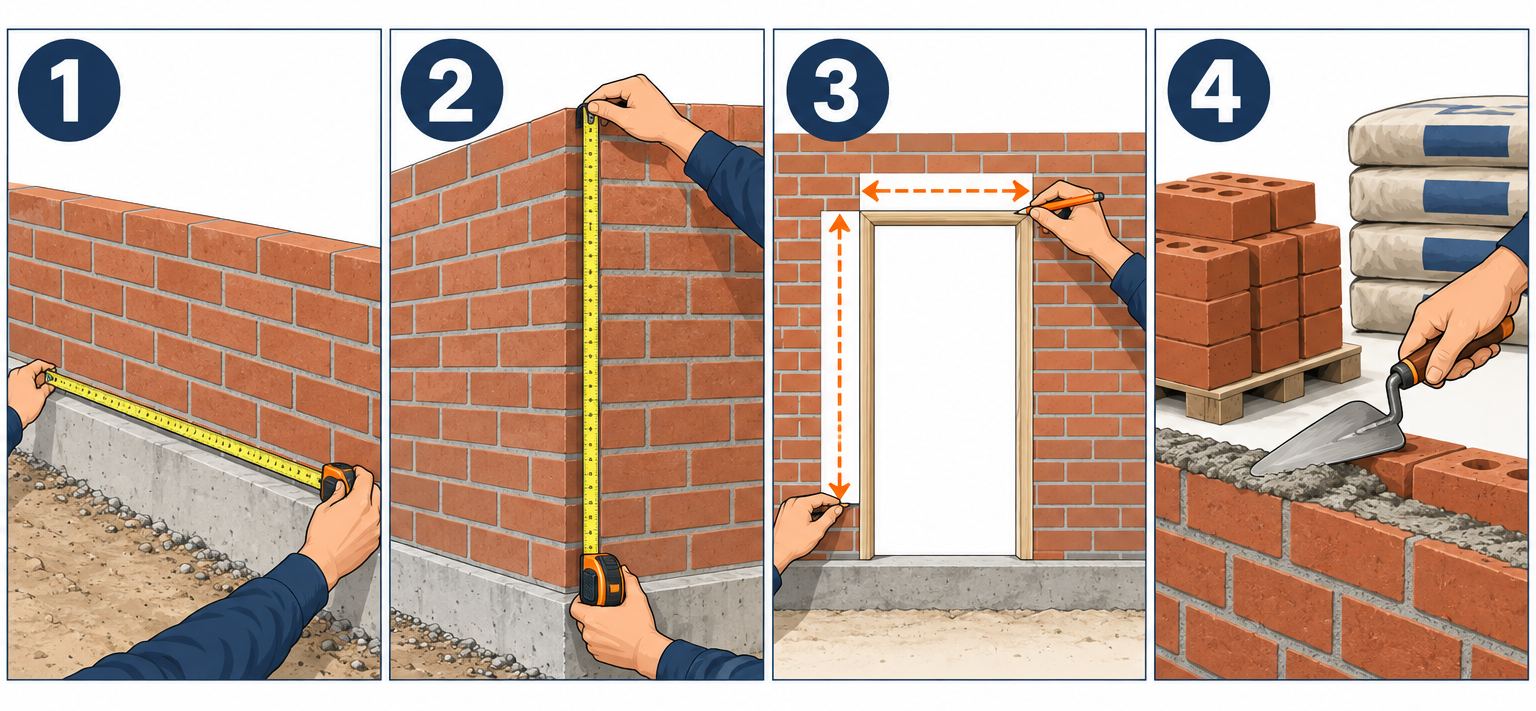
- Measure the wall length in feet along the base, corner to corner.
- Measure the wall height in feet from the footing or ledge to the top course.
- Add up every door and window as width x height in square feet.
- Pick your brick size: Modular, Queen or King.
- Leave the mortar joint at 0.375 in unless your spec says otherwise.
- Keep 5% waste for a straight wall, raise it to 10% for corners, arches or cuts.
How to use the brick calculator
Every field drives the result, so measure each one with a tape rather than pacing it off. A 6 inch error on an 8 ft wall is 6% of your order.
Wall length (ft)
Measure along the bottom of the wall from outside corner to outside corner. For an L-shaped wall, measure each leg and enter the total. For a wall that wraps a whole house, walk the perimeter with a 100 ft tape and add the four sides. Enter the number in decimal feet, so 20 ft 6 in becomes 20.5.
Wall height (ft)
Measure from where the first course sits to where the last course ends. On a veneer wall that usually means from the brick ledge on the foundation up to the soffit. On a garden wall it means from the top of the footing to the top of the cap course. If the ground slopes, measure the tallest and shortest points and use the average.
Openings to subtract (sq ft)
Multiply width by height for each door, window and vent, then add them together. A standard 3 ft by 6 ft 8 in entry door is 20 sq ft. A 3 ft by 4 ft window is 12 sq ft. Skip anything under 1 sq ft, such as a dryer vent or hose bib. The bricks you don’t lay around those tiny holes end up in the cut pile anyway.
Brick size
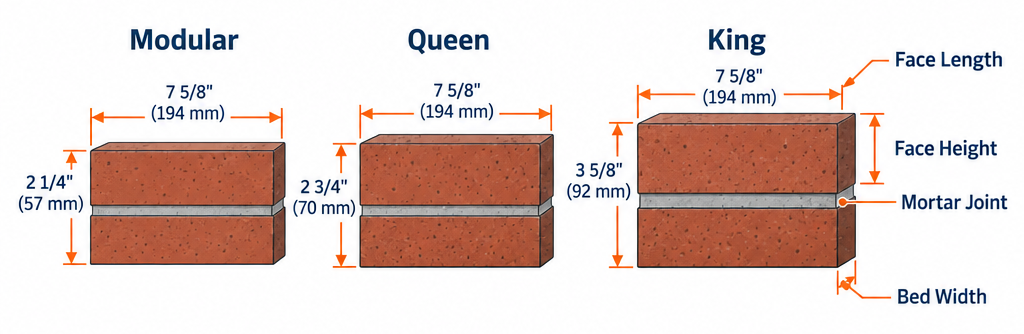
The calculator offers the three face sizes that cover most US residential work. The default is Modular, which is the brick most suppliers stock and the one a drawing means when it just says “brick”.
| Brick size | Face length | Face height | Bed width | Bricks per sq ft (3/8 in joint) |
|---|---|---|---|---|
| Modular | 7 5/8 in | 2 1/4 in | 3 5/8 in | 6.86 |
| Queen | 7 5/8 in | 2 3/4 in | about 3 in | 5.76 |
| King | 9 5/8 in | 2 5/8 in | about 3 in | 4.80 |
If the brick on your pallet tag says “standard” rather than “modular”, the length is a full 8 in and the count per square foot drops slightly. The modular setting is close enough for ordering, as long as you keep the 5% waste.
Mortar joint (in)
The default 0.375 in (3/8 in) is the joint nearly every manufacturer sizes its brick around. A 7 5/8 in modular brick plus a 3/8 in joint lands on an even 8 in, which is why three courses stack to exactly 8 in tall. Only change this if your plans call out a 1/2 in joint, which some historic restoration work or oversized brick uses. Thicker joints mean fewer bricks but noticeably more mortar.
Waste (%)
Five percent covers normal breakage in shipping, a few chipped corners, and the half bricks you cut at the ends of courses. Push it to 10% when the wall has more than two corners, any arches, soldier courses over windows, or a running bond that stops against a lot of trim. Masons who have done this a while often order 7 to 10% because a second delivery costs more than a few dozen extra bricks.
Common measuring mistakes
Measuring the inside of a room instead of the outside of the wall is the usual one on veneer jobs. Brick goes on the outside, where the wall is longer by the thickness of the framing and sheathing at every corner. Forgetting the gable triangle on a brick-to-the-peak house is the second. Measure the gable height and width, multiply, then halve it, and add that to your wall area. If you’re unsure of the triangle, a roof pitch calculator will give you the rise from the pitch and span.
The brick wall calculator formula, worked out
The math behind the brick calculator is three short steps. You can run it on paper to check an order or to size a wall shape the fields don’t cover.
Step 1: bricks per square foot
Bricks per sq ft = 144 / ((brick length + joint) x (brick height + joint))
The 144 is the number of square inches in one square foot. Adding the joint to each brick dimension gives you the real space one brick and its share of mortar take up on the wall face.
For a modular brick with a 3/8 in joint:
- 7.625 + 0.375 = 8.0 in
- 2.25 + 0.375 = 2.625 in
- 8.0 x 2.625 = 21.0 sq in per brick
- 144 / 21.0 = 6.86 bricks per sq ft
Step 2: total bricks
Bricks = (wall area – openings) x bricks per sq ft x (1 + waste)
Wall area is length times height. Waste is entered as a decimal, so 5% becomes 1.05.
Step 3: mortar
80 lb bags = total bricks / 35, rounded up
An 80 lb bag of pre-blended mortar mix lays about 35 modular bricks with 3/8 in joints. That assumes full head and bed joints and a mason who isn’t dropping half the mortar off the trowel.
Worked example 1: the calculator defaults
Wall length 20 ft, wall height 8 ft, no openings, Modular brick, 0.375 in joint, 5% waste.
- Wall area: 20 x 8 = 160 sq ft
- Minus openings: 160 – 0 = 160 sq ft
- Bricks before waste: 160 x 6.86 = 1,097 bricks
- Add 5% waste: 1,097 x 1.05 = 1,152 bricks
- Mortar: 1,152 / 35 = 32.9, so 33 bags
That matches what the calculator shows: 1,152 bricks, 6.86 bricks per sq ft, and 33 bags of 80 lb mortar mix.
Worked example 2: a garage wall with a door and window in queen brick
Say you’re veneering a 30 ft by 6 ft side wall of a garage. It has one 3 ft by 7 ft service door and one 3 ft by 4 ft window. The brick is Queen size, 3/8 in joint, 5% waste.
- Wall area: 30 x 6 = 180 sq ft
- Openings: (3 x 7) + (3 x 4) = 21 + 12 = 33 sq ft
- Net area: 180 – 33 = 147 sq ft
- Bricks per sq ft for Queen: 144 / ((7.625 + 0.375) x (2.75 + 0.375)) = 144 / (8.0 x 3.125) = 144 / 25 = 5.76
- Bricks before waste: 147 x 5.76 = 846.7 bricks
- Add 5% waste: 846.7 x 1.05 = 889 bricks, order 890
- Mortar: 890 / 35 = 25.4, so 26 bags
Had you used modular brick on that same wall, the count would be 147 x 6.86 x 1.05 = 1,059 bricks and 31 bags. The queen brick saves about 170 bricks and 5 bags on a single wall, which is the main reason builders spec it on big elevations.
Pro tip
The standard industry figure for modular brick at a 3/8 in joint is 6.75 bricks per square foot (BIA Technical Note 10), or 6.86 from the direct formula above. Memorize that one number and you can estimate any wall in your head: a 400 sq ft wall is 400 x 6.86, or about 2,744 bricks before waste (2,700 at the BIA figure), before you ever open the calculator.
Quick-reference brick quantities by wall area
Every figure below uses the calculator’s formula with a 3/8 in joint and 5% waste. Mortar bags are for modular brick; queen and king use roughly 15% and 30% less mortar respectively because there are fewer joints per square foot.
| Net wall area | Modular bricks | Queen bricks | King bricks | 80 lb mortar bags (modular) |
|---|---|---|---|---|
| 50 sq ft | 360 | 303 | 252 | 11 |
| 100 sq ft | 720 | 605 | 504 | 21 |
| 160 sq ft | 1,152 | 968 | 807 | 33 |
| 200 sq ft | 1,440 | 1,210 | 1,008 | 42 |
| 300 sq ft | 2,160 | 1,815 | 1,512 | 62 |
| 500 sq ft | 3,600 | 3,024 | 2,520 | 103 |
| 1,000 sq ft | 7,200 | 6,048 | 5,040 | 206 |
For a wall that isn’t a clean rectangle, get the net area from a square footage calculator first, then read across the table or enter the area as length x 1 ft in the calculator.
Brick calculator for a patio or walkway
The calculator above counts bricks on their face, which is how a wall is built. A patio lays bricks on their bed, so the exposed surface is 7 5/8 in by 3 5/8 in for a modular brick. Run the same formula with those numbers:
- Mortared on a concrete slab with 3/8 in joints: 144 / ((7.625 + 0.375) x (3.625 + 0.375)) = 144 / (8 x 4) = 4.5 bricks per sq ft
- Sand-set with tight joints: 144 / (7.625 x 3.625) = 144 / 27.64 = 5.21 bricks per sq ft
A 12 ft by 14 ft patio is 168 sq ft. Mortared, that’s 168 x 4.5 x 1.05 = 794 bricks. Sand-set, it’s 168 x 5.21 x 1.05 = 919 bricks. For a sand-set patio you’ll also need a compacted gravel base and a 1 in sand bed, which a gravel calculator and a sand calculator will size for you. Use a true clay paver rather than wall brick for anything you walk on, since many face bricks have cored holes and won’t hold up to freeze-thaw cycles when laid flat.
Buying and ordering bricks and mortar
Masonry yards don’t sell brick by the piece. Knowing their units keeps you from under-ordering by a few hundred.
How bricks are sold
Brick ships on strapped, shrink-wrapped pallets called cubes. A cube of modular brick is usually around 500 bricks, though counts run from 450 to 530 depending on the plant, and queen and king cubes hold fewer because each brick is bigger. The count is printed on the tag. Suppliers quote prices per thousand (written as “per M”) and will often sell a partial cube, but some charge a restocking or breaking fee to open one.
Order your whole job from one production run. Clay brick color shifts between kiln batches, and a second cube ordered a month later can be a shade off. If you have to order more, ask the yard to match the lot number on your tag.
Mortar: bags vs. bulk
Pre-blended mortar mix in 80 lb bags is the simplest option for a wall under about 500 sq ft. Buy Type N for above-grade veneer and garden walls, and Type S for retaining walls, below-grade work or anything a structural engineer has specified. For bigger walls, masons buy masonry cement in 70 or 75 lb bags and mix their own with mason sand at roughly 1 part cement to 2 1/2 to 3 parts sand. A common rule is about 1 cubic yard of mason sand and 7 to 8 bags of masonry cement per 1,000 modular bricks. Mason sand is sold by the ton or cubic yard, and a sand calculator will convert between the two.
Typical US prices
Prices move with region and brick style, so treat these as planning numbers and get a written quote.
| Item | Typical price range | Notes |
|---|---|---|
| Common clay face brick, modular | $0.50 to $1.50 each ($500 to $1,500 per thousand) | Reclaimed, glazed and thin brick cost more |
| Queen or king brick | $0.60 to $1.75 each | Fewer per sq ft, so wall cost is often similar |
| 80 lb mortar mix, Type N or S | $8 to $12 per bag | Buy a 10% cushion |
| Mason sand | $25 to $50 per ton delivered | Minimum loads often 1 to 2 tons |
| Delivery | $75 to $200 per trip | Flat fee plus mileage on some yards |
| Installed brick veneer, labor and material | $25 to $45 per sq ft | Complex patterns and second stories push it higher |
For the default 160 sq ft wall at $0.90 per brick, 1,152 bricks cost about $1,040 and 33 bags of mortar about $330, plus delivery. That lands near $1,500 in materials, or roughly $9 to $10 per square foot before labor, ties, flashing and weeps.
How much extra to order and why
Order to the calculator’s waste figure plus one more small cushion if the yard will let you buy loose bricks. Three things eat brick you didn’t plan on:
- Cuts at corners, jambs and sills where a half or three-quarter brick is needed on every course
- Chips and breakage during unloading, especially if the cube gets forked off a truck onto rough ground
- Culling, where you set aside bricks with surface cracks or bad color before they go on the wall
Running short costs a delivery fee, a day of lost labor and a possible color mismatch. Over-buying by a half cube costs the price of those bricks, and most yards won’t take open cubes back.
Safety first
Cutting brick with a dry saw releases crystalline silica dust. Use a wet saw or a dust-collecting shroud and wear a fitted N95 or better. A modular brick weighs around 4.5 to 5 lb, so a full cube is well over a ton. Never try to move one with anything but a forklift or a pallet jack on a firm, level surface.
Common mistakes that cause running short or over-buying
Using inside measurements. Framed walls are 4 to 6 in thick, and brick wraps the outside. On a house with four corners, inside dimensions can shave 20 or more bricks off every course.
Forgetting gables, soldier courses and rowlocks. A gable triangle on a 30 ft wide house with a 6/12 pitch is 7.5 ft tall and adds over 110 sq ft. Soldier courses above windows and rowlock sills use more brick per linear foot than a stretcher course, roughly 1 brick per 2 5/8 in of length for soldiers.
Leaving waste at 0%. Some people zero the field to “get the exact number”. There’s no such thing on a masonry job. Even a flawless wall with no cuts loses brick to breakage.
Subtracting openings twice. If you already measured net area with a square footage calculator, enter it as length x 1 ft and leave Openings at 0.
Mixing brick types in the formula. A yard quote in queen brick with a count you ran in modular will be 20% too high. Set the brick size in the calculator to match the quote.
Ignoring the second wythe. The calculator figures one thickness of brick, which is right for veneer. A double-wythe garden wall, with two rows of brick back to back, needs double the count plus header or tie bricks. Count the cap course separately as well if it’s laid as rowlocks.
Under-ordering mortar for wide joints. Bumping the joint from 3/8 in to 1/2 in cuts the brick count by about 6% but raises mortar use by roughly a third. Add bags accordingly rather than stretching the mix with extra sand, which weakens it.
Pro tip
Before the brick arrives, lay a dry course of 10 bricks along the base of the wall with 3/8 in spacers and mark the joints on the footing. If a full brick doesn’t land at the corner or jamb, shift the joint width a hair between 5/16 in and 7/16 in across the course so you aren’t cutting slivers at every end. That trick saves more brick than any waste percentage.
When to call a pro
Any brick wall that holds back soil, carries a load, rises above 4 ft without a pier design, or goes on a house that needs flashing, weep holes and wall ties integrated with the house wrap is a job for a licensed mason, and often a building permit. Structural brick walls and retaining walls usually need an engineered footing. Veneer on a garden shed or a mailbox pier is fine to tackle yourself.
FAQ
What are the standard brick dimensions in inches?
A modular brick, the most common size in the US, measures 7 5/8 in long by 3 5/8 in wide by 2 1/4 in tall. With a 3/8 in mortar joint it fills a nominal 8 in by 4 in by 2 2/3 in space, so three courses stack to exactly 8 in. Queen brick is 7 5/8 x about 3 x 2 3/4 in, and king brick is 9 5/8 x about 3 x 2 5/8 in. Utility brick runs 11 5/8 x 3 5/8 x 3 5/8 in and lays 3 per square foot.
How much brick do I need per square foot of wall?
With a 3/8 in joint you need 6.86 modular bricks, 5.76 queen bricks or 4.8 king bricks per square foot of wall face before waste. Add 5% and the modular figure becomes an easy 7.2 bricks per square foot.
How much does a brick weigh?
A solid or cored modular clay brick weighs about 4.5 to 5 lb. Queen brick is a little lighter, around 4.5 lb, and king brick runs closer to 5.5 lb. A full cube of about 500 modular bricks weighs in the range of 2,300 to 2,500 lb, which is why your supplier delivers on a boom truck or a flatbed with a forklift rather than a pickup.
How many bricks are in a cube or pallet?
Most modular brick cubes hold around 500 to 525 bricks, though the exact count varies by manufacturer from roughly 400 to 525. Queen cubes often hold 450 or so and king cubes fewer still. Always read the count off the cube tag and use that number to figure how many cubes to order.
How many bags of mortar do I need for 1,000 bricks?
About 29 bags of 80 lb pre-blended mortar mix, using the calculator’s rate of 35 bricks per bag. If you mix your own, plan on 7 to 8 bags of masonry cement and roughly 1 cubic yard of mason sand per 1,000 modular bricks.
Can I use the brick calculator for a patio?
Use it for the area and the waste, but swap in the bed dimensions. A modular brick laid flat covers 7 5/8 in by 3 5/8 in, which works out to 4.5 bricks per square foot with 3/8 in mortared joints or 5.21 per square foot sand-set with tight joints. The wall setting of 6.86 per square foot will over-order a patio by about 30%.
Does the calculator include wall ties, flashing and weep holes?
No. For veneer on a framed house, plan on one corrugated wall tie per 2 2/3 sq ft (every 16 in horizontally, every other course vertically), through-wall flashing at the base and over every opening, and weep holes every 24 in along the bottom course. Those are cheap compared with the brick but easy to forget on the shopping list.
How many bricks does a 10 ft by 10 ft wall need?
A 10 x 10 wall is 100 sq ft. In modular brick with a 3/8 in joint and 5% waste you need 100 x 6.86 x 1.05 = 720 bricks and 21 bags of 80 lb mortar mix. In queen brick it’s 605 bricks, and in king brick it’s 504.