
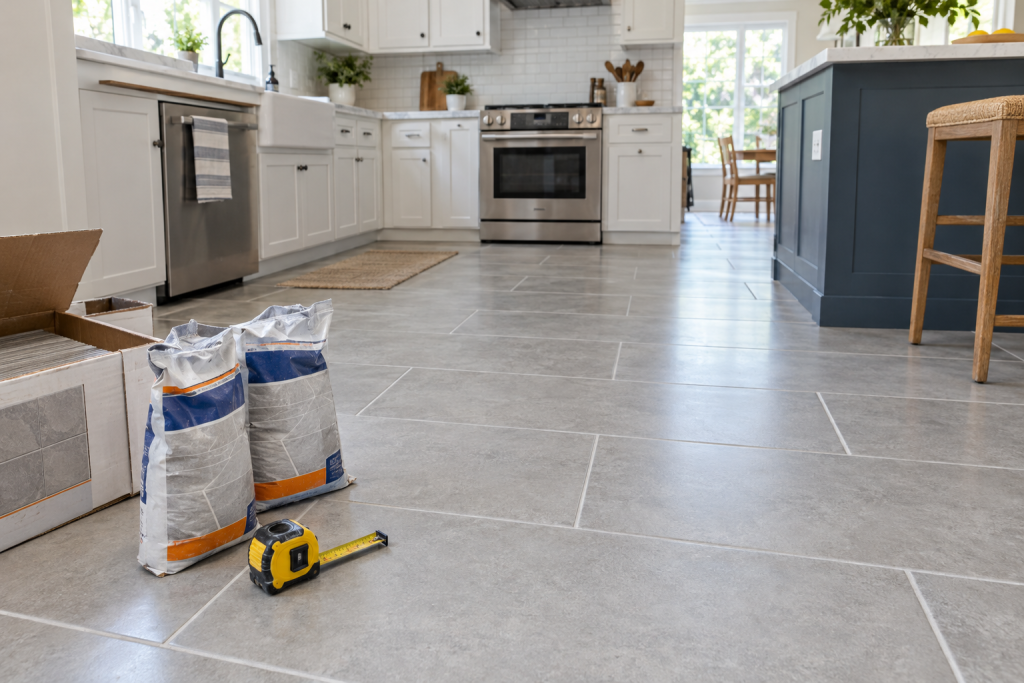
Our grout calculator turns your tiled area, tile size, joint width and tile thickness into pounds of sanded grout, the number of 10 lb or 25 lb bags to buy, and the 50 lb bags of thinset the same job needs. You only need a tape measure and the tile box label to fill in every field.
Quick steps: use the grout calculator
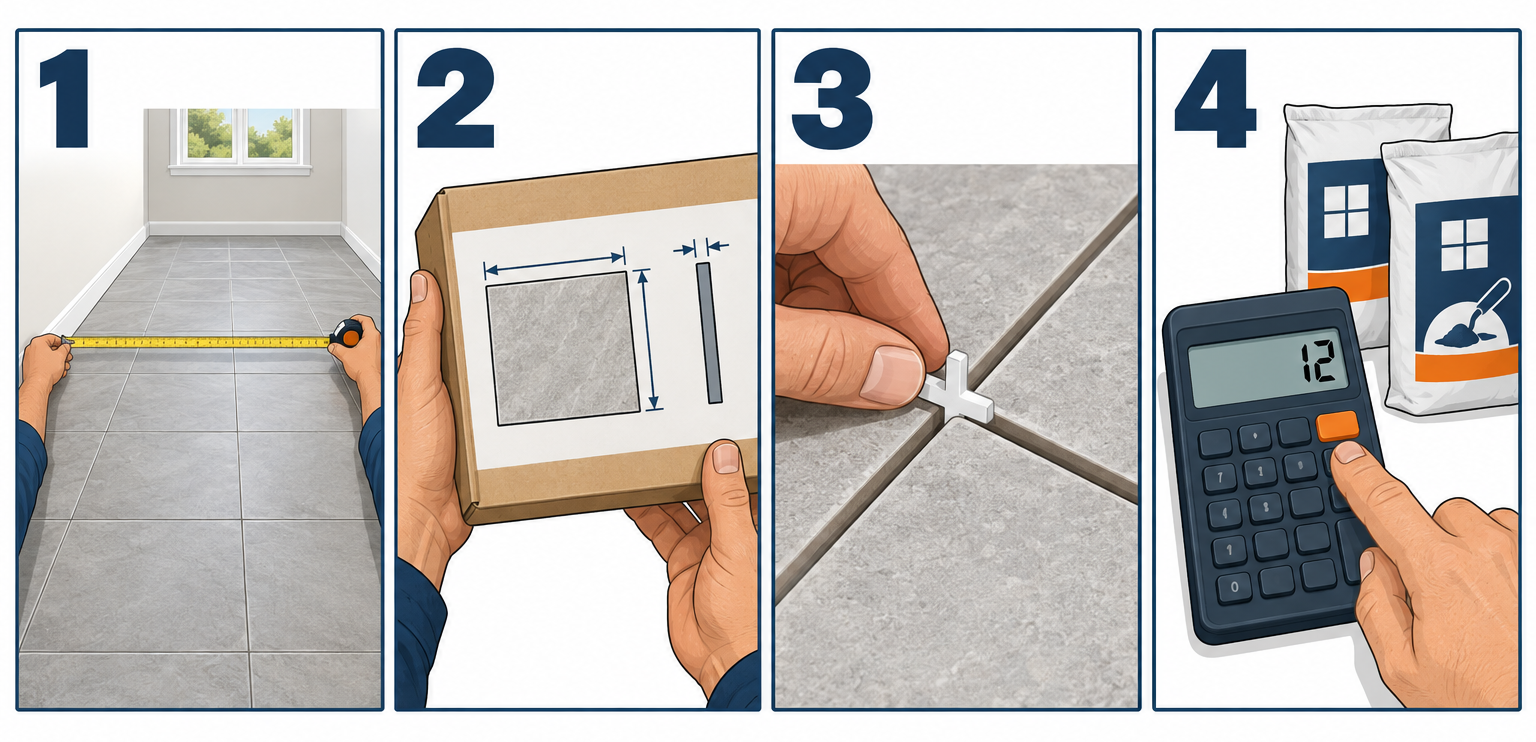
- Measure the length and width of each tiled surface in feet, multiply, and add the areas together.
- Enter that total in Tiled area (sq ft).
- Read the actual tile size off the box and enter Tile length (in) and Tile width (in).
- Pick the Grout joint width you plan to use from the dropdown.
- Enter the tile thickness from the box as Tile thickness (joint depth) (in).
- Choose the Thinset trowel notch that matches your tile size, then read pounds and bag counts.
Tools and materials
- 25 ft tape measure
- Tile box label or spec sheet (nominal size and thickness)
- Tile spacers in your chosen joint width (1/16 to 3/8 in)
- Notched trowel matching the calculator selection
- Sanded cement grout in 10 lb or 25 lb bags
- Modified thinset mortar in 50 lb bags
How to use the grout calculator
Every field maps to a measurement you can take in a few minutes. Here is what each one means, how we measure it, and where people usually go wrong.
Tiled area (sq ft)
This is the total surface you will tile, in square feet. Measure each rectangle in feet, multiply length by width, and add the pieces. A 10 ft by 12 ft kitchen floor is 120 sq ft. A tub surround with three walls of 60 in by 72 in, 30 in by 72 in and 60 in by 72 in comes to 30 + 15 + 30 = 75 sq ft.
Subtract large openings like a tub face or a vanity base that will not be tiled, but do not subtract small things like a toilet flange. For L-shaped rooms, split the space into rectangles. Our square footage calculator handles odd shapes if you want to check your math.
The biggest mistake here is entering square inches or square yards. If your number looks suspiciously huge or tiny, recheck the units. Another common slip is forgetting the shower curb, niche or the floor of the shower pan.
Tile length (in) and Tile width (in)
Enter the dimensions printed on the box. A “12 x 12” porcelain tile usually measures closer to 11-3/4 in because the manufacturer counts the grout joint in the nominal size. Enter the actual size if the box lists it. For calibrated or rectified tile, nominal and actual are nearly the same.
Orientation does not matter. A 12 in by 24 in plank gives the same result as 24 in by 12 in because the formula uses the sum and the product of the two sides.
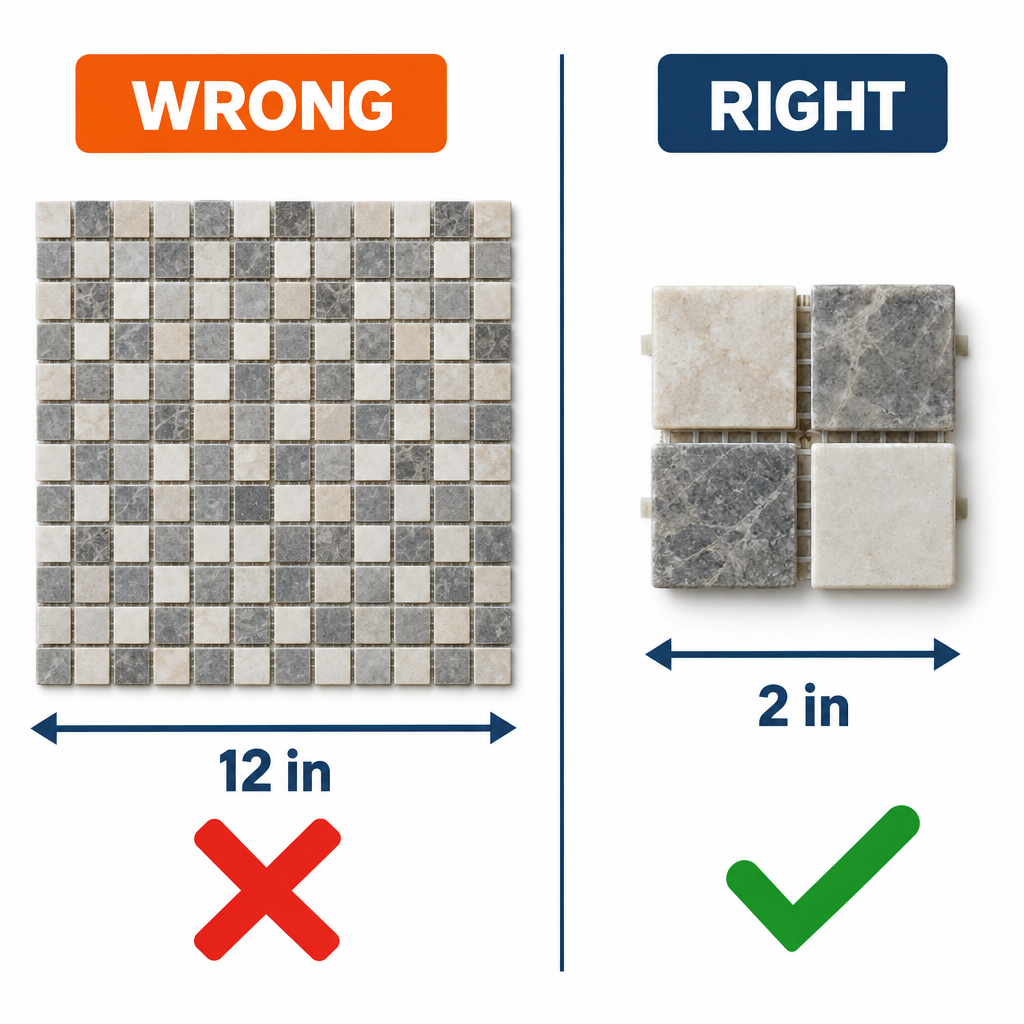
For mosaics on mesh sheets, enter the size of one individual chip, not the sheet. A 2 in by 2 in mosaic sheet is 2 and 2, never 12 and 12. Mosaics have far more linear feet of joint per square foot, so this mistake can undercount grout by a factor of five or six.
Grout joint width
Pick the spacer size you will actually use. The dropdown offers 1/16 in, 1/8 in, 3/16 in, 1/4 in and 3/8 in. Rectified porcelain is commonly set at 1/16 or 1/8 in. Standard pressed tile needs 1/8 to 3/16 in to hide size variation. Handmade or rustic tile, quarry tile and saltillo often run 1/4 to 3/8 in.
Joint width is the single most powerful input in the calculator. Doubling the joint roughly doubles the grout. We show exactly how much in the table further down.
Tile thickness (joint depth) (in)
The calculator treats the joint as a channel as deep as the tile is thick. Read the thickness off the box or spec sheet. Common values are 1/4 in (0.25) for glass and ceramic mosaics, 5/16 in (0.3125) for ceramic wall tile, 3/8 in (0.375) for most floor porcelain, and 1/2 in (0.5) for thick quarry tile and some natural stone.
In practice a little thinset squeezes up into the bottom of the joint, so the real fill is often shallower than full tile thickness. We leave the full depth in and add 10 percent on top, which is why the calculator consistently has you buying slightly more than the bare minimum.
Thinset trowel notch
This field does not change the grout number at all. It drives the thinset bags. Choose 1/4 x 1/4 in square notch for tile up to 8 in, 1/4 x 3/8 in for tile up to 15 in, and 1/2 x 1/2 in for larger format tile. Our coverage assumptions are 95, 60 and 45 sq ft per 50 lb bag respectively.
Those figures assume a flat substrate. A bowed subfloor or a wavy wall eats mortar fast, and the calculator cannot see that. If you will back-butter large tile, which you should on anything over 15 in, plan on an extra bag per 100 sq ft.
The grout calculator formula, worked out by hand
The calculator figures out how many cubic inches of empty joint sit inside one square foot of finished tile, multiplies by your area, converts to cubic feet, applies the density of sanded grout, then adds 10 percent.
The core equation for one square foot:
Joint volume per sq ft (cubic inches) = 144 × (tile length + tile width) ÷ ((tile length + joint) × (tile width + joint)) × joint width × joint depth
Here is what each piece does.
- 144 is the number of square inches in one square foot.
- (tile length + joint) × (tile width + joint) is the footprint one tile occupies including half a joint on every side. Dividing 144 by that tells us how many tiles fit in a square foot.
- (tile length + tile width) is the linear inches of joint each tile “owns” (one long side plus one short side, because the other two sides belong to neighbors).
- Multiplying those together gives linear inches of joint per square foot.
- Joint width × joint depth is the cross-section of the joint in square inches. Multiply by linear inches and you have cubic inches of grout.
Then the conversion to weight:
Pounds = total cubic inches ÷ 1,728 × 115 lb per cubic foot × 1.10
There are 1,728 cubic inches in a cubic foot, sanded cement grout weighs about 115 lb per cubic foot once cured in the joint, and the 1.10 multiplier adds 10 percent for waste, haze and the grout you wash out during cleanup.
Thinset is a straight coverage lookup. A 50 lb bag covers about 95 sq ft with a 1/4 x 1/4 in notch, 60 sq ft with 1/4 x 3/8 in, and 45 sq ft with 1/2 x 1/2 in. Bags are always rounded up.
Worked example 1: the default inputs
Tiled area 100 sq ft, tile 12 in by 12 in, joint 1/8 in (0.125), depth 3/8 in (0.375), 1/4 x 3/8 in notch.
- Tile length + tile width = 12 + 12 = 24.
- (12 + 0.125) × (12 + 0.125) = 12.125 × 12.125 = 147.016.
- 144 × 24 = 3,456. Then 3,456 ÷ 147.016 = 23.508 linear inches of joint per square foot.
- 23.508 × 0.125 × 0.375 = 1.102 cubic inches of joint per square foot.
- 1.102 × 100 sq ft = 110.2 cubic inches total.
- 110.2 ÷ 1,728 = 0.0638 cubic feet.
- 0.0638 × 115 = 7.33 lb of grout before waste.
- 7.33 × 1.10 = 8.07 lb, which the calculator shows as 8.1 lb.
Bags: 8.1 lb needs one 10 lb bag, or one 25 lb bag if that is what the store carries. Thinset: 100 ÷ 60 = 1.67, rounded up to 2 bags of 50 lb.
That matches exactly what the calculator displays with the defaults: Grout needed (with 10% extra) 8.1 lb, 10 lb bags 1, 25 lb bags 1, 50 lb bags of thinset 2.
Worked example 2: a 200 sq ft plank floor
Say we are laying 12 in by 24 in porcelain planks over a 200 sq ft living room, with 3/16 in joints, 3/8 in thick tile, and a 1/2 x 1/2 in notch because planks this size need full coverage.
- Tile length + tile width = 12 + 24 = 36.
- (12 + 0.1875) × (24 + 0.1875) = 12.1875 × 24.1875 = 294.785.
- 144 × 36 = 5,184. Then 5,184 ÷ 294.785 = 17.586 linear inches of joint per square foot.
- 17.586 × 0.1875 × 0.375 = 1.237 cubic inches per square foot.
- 1.237 × 200 = 247.4 cubic inches.
- 247.4 ÷ 1,728 = 0.1432 cubic feet.
- 0.1432 × 115 = 16.47 lb before waste.
- 16.47 × 1.10 = 18.1 lb of sanded grout.
Bags: two 10 lb bags (20 lb) or one 25 lb bag. Thinset: 200 ÷ 45 = 4.44, rounded up to 5 bags of 50 lb. If we back-butter every plank, which we would on this size, we would buy 6 or 7.
Notice the plank floor is twice the area of example 1 but needs only a bit more than double the grout, even with a wider joint. Bigger tile means fewer joints per square foot, and that offsets the wider gap.
Pro tip
Before you buy, divide your pounds by 10 and by 25 and compare the cost of each bag count. At typical big-box pricing, a single 25 lb bag is often cheaper than three 10 lb bags once you need more than 20 lb, and you get one consistent dye lot instead of three.
Quick-reference grout and thinset quantities
All grout figures below use the calculator’s formula with a 1/8 in joint, 3/8 in joint depth, 115 lb per cubic foot and 10 percent extra, for 100 sq ft of tile. Thinset is the suggested notch for that tile size.
| Tile size (in) | Sanded grout per 100 sq ft | Suggested notch | 50 lb thinset bags per 100 sq ft |
|---|---|---|---|
| 3 x 6 subway | 23.2 lb | 1/4 x 1/4 | 2 |
| 4 x 4 | 23.2 lb | 1/4 x 1/4 | 2 |
| 6 x 6 | 15.8 lb | 1/4 x 1/4 | 2 |
| 8 x 8 | 12.0 lb | 1/4 x 1/4 | 2 |
| 12 x 12 | 8.1 lb | 1/4 x 3/8 | 2 |
| 12 x 24 | 6.1 lb | 1/2 x 1/2 | 3 |
| 18 x 18 | 5.4 lb | 1/2 x 1/2 | 3 |
| 24 x 24 | 4.1 lb | 1/2 x 1/2 | 3 |
Two takeaways. Small tile with the same joint needs three to six times more grout than large tile. And thinset barely cares about tile size, only about the notch you choose.
Joint width changes things even faster. Here is 100 sq ft of 12 in by 12 in tile at 3/8 in depth with each joint option in the dropdown.
| Grout joint width | Sanded grout per 100 sq ft | 10 lb bags | 25 lb bags |
|---|---|---|---|
| 1/16 in | 4.1 lb | 1 | 1 |
| 1/8 in | 8.1 lb | 1 | 1 |
| 3/16 in | 12.0 lb | 2 | 1 |
| 1/4 in | 15.8 lb | 2 | 1 |
| 3/8 in | 23.2 lb | 3 | 1 |
Going from 1/8 in to 1/4 in joints nearly doubles the grout. Going to 3/8 in almost triples it. If you are debating a wider joint for a rustic look, this table tells you the material cost of that decision.
Joint depth works the same way. Dropping from 3/8 in to 1/4 in thick tile cuts grout by one third, so a 1/4 in thick glass mosaic at 2 in by 2 in with a 1/8 in joint still needs around 31 lb per 100 sq ft because the chips are so small.
For thinset planning across a whole house, this is the lookup the calculator uses.
| Trowel notch | Coverage per 50 lb bag | 100 sq ft | 200 sq ft | 300 sq ft |
|---|---|---|---|---|
| 1/4 x 1/4 in square | 95 sq ft | 2 bags | 3 bags | 4 bags |
| 1/4 x 3/8 in square | 60 sq ft | 2 bags | 4 bags | 5 bags |
| 1/2 x 1/2 in square | 45 sq ft | 3 bags | 5 bags | 7 bags |
Tile calculator with grout: counting the tiles too
Searchers asking for a tile and grout calculator usually also want the tile count, and the same footprint math gives it. Divide the area in square inches by the footprint of one tile plus its joint.
For the default example: 100 sq ft × 144 = 14,400 sq in. One 12 x 12 tile with a 1/8 in joint occupies 147.016 sq in. So 14,400 ÷ 147.016 = 97.9, call it 98 tiles. Add 10 percent for cuts and breakage on a straight lay (15 percent for diagonal or herringbone) and buy 108 to 113 tiles. Our flooring calculator does this for boxes and cartons if you want the carton count.
Mapei, Laticrete, TEC, Custom and Bostik grout calculators
Every major grout maker publishes its own estimator, and people search for the Mapei grout calculator, Laticrete grout calculator, TEC grout calculator, Custom grout calculator and Bostik grout calculator by name. They all ask for the same four things we do: tile length, tile width, joint width and tile thickness or joint depth. The differences are in the output.
- Mapei’s tool reports results in its own bag sizes for products like Keracolor S and Ultracolor Plus FA, and switches units for Flexcolor CQ, which is sold premixed by the gallon rather than by the pound.
- Laticrete’s calculator covers Permacolor Select, which is a base powder plus a separate color kit, and Spectralock epoxy, which is sold by the unit rather than the pound.
- TEC (an H.B. Fuller brand) estimates Power Grout and AccuColor in 10 lb and 25 lb bags.
- Custom Building Products’ estimator handles Polyblend Plus, Prism and premixed Fusion Pro, and the premixed product comes out in quarts and gallons.
- Bostik’s tool covers Hydroment, TruColor and Dimension grouts, and the Dimension urethane line is sold in small buckets with very different coverage per container.
- Merkrete, a Parex USA brand, publishes coverage charts in the same style for its cement grouts.
So which should you trust? The cubic inches of joint on your floor are the same no matter whose logo is on the bag. Our calculator gives you that volume as pounds of standard sanded cement grout at 115 lb per cubic foot. If you then switch to a specific product, check its coverage chart on the bag or spec sheet. A high-performance grout with lighter aggregate can cover 10 to 20 percent more per pound. Epoxy and urethane grouts are sold by the unit and the brand chart is the only reliable way to convert.
The one input that trips people up across all the brand calculators is joint depth. Some ask for tile thickness, some ask for grout depth, and some quietly assume 3/8 in. If a brand tool gives you a number far from ours, that assumption is almost always the reason.
Buying and ordering grout and thinset
Sanded cement grout sells by the pound, in 10 lb and 25 lb bags at nearly every big-box and tile store. Unsanded grout usually comes in 7 lb, 8 lb or 10 lb bags. Premixed single-component grouts are sold by volume, typically 1 quart and 1 gallon buckets. Epoxy grout is sold in “mini” and “full” or “commercial” units that combine two liquid parts and a colored powder.
Thinset mortar comes almost exclusively in 50 lb bags. Some lightweight and large-format mortars are packaged at 30 lb because the bag covers the same area at lower weight, so compare the coverage printed on the bag rather than the weight.
Typical US prices at the time of writing, with the usual regional variation:
- 10 lb sanded cement grout: roughly $10 to $20 per bag.
- 25 lb sanded cement grout: roughly $15 to $35 per bag, with designer or high-performance lines at the upper end.
- 50 lb modified thinset: roughly $15 to $45 per bag, with large-format and rapid-set mortars costing the most.
- Premixed grout, 1 gallon: roughly $50 to $90.
- Epoxy grout, full unit: roughly $60 to $150 depending on brand and color.
A 100 sq ft floor of 12 x 12 tile therefore runs about $25 to $60 in grout and thinset together, which is why the glance box says what it does.
There are no delivery minimums for bags at retail. Tile distributors selling to the trade often want full-case orders (for example four 25 lb bags) and may charge a small-order fee below a certain dollar amount, so a homeowner is usually better off at a retail counter for a single room.
How much extra to order? The calculator already builds in 10 percent. Buy one extra bag beyond what it shows when any of these apply:
- You are using mosaics or any tile under 4 in, where washing out waste is higher.
- Your tile has a textured or cleft face that traps grout during float work.
- You are a first-timer. Over-filling the joint and sponging it away is normal the first hour.
- You cannot easily get back to the store for the same color and dye lot.
Keep the receipt. Unopened bags return easily at the big-box stores, and an unopened bag in the garage is worth far more than a half-grouted floor on a Sunday night.
Safety first
Dry cement grout and thinset contain crystalline silica and are caustic when wet. Mix outdoors or with a fan, wear an N95 and nitrile gloves, and wear safety glasses. For epoxy grout, add a respirator with organic vapor cartridges and keep the parts off bare skin.
Common mistakes that run you short or over-buy
| Symptom | Likely cause | Fix |
|---|---|---|
| Calculator shows 2 lb for a whole bathroom | Area entered in square yards or a decimal slip | Recheck Tiled area (sq ft); a 5 ft by 8 ft bath floor is 40, not 4 |
| Calculator shows 200 lb for a backsplash | Sheet size entered instead of chip size, or sq in instead of sq ft | Enter the individual mosaic chip in Tile length (in) and Tile width (in) |
| Ran out of grout with one wall left | Joint width wider than the spacers you entered | Measure a finished joint with a tape; many 1/8 in “spacers” give 5/32 in with pressed tile |
| Mixed too much, half a bucket hardened | Mixed the whole bag at once | Mix only what you can spread and clean in 30 minutes; most cement grouts give 1 to 2 hours of pot life |
| Thinset gone with 30 sq ft to go | Bowed floor or back-buttering not accounted for | Add one 50 lb bag per 100 sq ft for back-butter or uneven substrate |
| Three bags left over | Entered tile thickness in millimeters (10) instead of inches | Convert first; 10 mm is 0.394 in, 8 mm is 0.315 in |
| Grout color looks blotchy between areas | Different dye lots or inconsistent water | Buy all bags at once from the same lot and measure water by volume every batch |
Two more mistakes that do not show up in the calculator at all.
First, treating unsanded grout like sanded. Unsanded grout is lighter and is meant for joints 1/8 in and narrower. It shrinks and cracks in wide joints. The calculator’s 115 lb per cubic foot assumes sanded, so if you use unsanded in a 1/16 in joint you will have a little extra, which is harmless.
Second, forgetting that grout coverage is not the same as thinset coverage. People read “covers 100 sq ft” on a thinset bag and assume the grout bag works the same way. Grout coverage depends entirely on tile size and joint, which is the whole reason the calculator exists.
Pro tip
Grout a 2 ft by 2 ft test area first, then weigh what is left in the bag on a bathroom scale. Scale that up to the full area and you have a field-verified number that beats any calculator, ours included.
When to call a pro
Call a licensed tile contractor when the job involves a shower pan or steam shower waterproofing, large-format tile over 24 in that needs a flattened substrate, epoxy grout in a commercial kitchen, or any floor where the subfloor flexes more than 1/360 of the span. Grout is the easy part; a failed waterproofing layer or a cracked tile field is a tear-out.
FAQ
How much grout do I need for 100 square feet of tile?
It depends on tile size and joint width far more than on area. With the calculator defaults (12 x 12 tile, 1/8 in joint, 3/8 in depth) you need 8.1 lb including 10 percent extra. The same 100 sq ft in 3 x 6 subway tile at the same joint needs about 23 lb, and in 24 x 24 tile only about 4 lb.
Is the grout calculator for sanded or unsanded grout?
The weight conversion uses 115 lb per cubic foot, which is a sanded cement grout figure. Unsanded grout is somewhat lighter, so the calculator will slightly over-estimate it, which is the safe direction. The cubic inches of joint are identical either way, so for epoxy or premixed grout take that volume to the brand’s coverage chart.
How does the Mapei grout calculator compare to this one?
Both ask for tile length, tile width, joint width and tile thickness. Mapei reports results in its own packaging, such as 10 lb and 25 lb bags of Keracolor or gallons of premixed Flexcolor CQ. If you enter the same joint depth in both, the pounds should land within a bag of each other. Differences usually come from Mapei assuming a different default joint depth or a lighter product density.
Why does the Laticrete grout calculator give me a different answer?
Laticrete’s tool is built around its specific products. Permacolor Select is a base plus a color kit, and Spectralock epoxy is sold by the unit, so the output is in units or kits rather than plain pounds. Use our pounds number to sanity-check the volume, then let the Laticrete chart tell you how many of its containers that volume fills.
Does the Custom grout calculator work for Fusion Pro premixed grout?
Custom’s estimator handles both its powdered Polyblend Plus and Prism lines and premixed Fusion Pro. For premixed grout the answer comes out in quarts and gallons because the product is sold by volume. Our calculator gives the same joint in pounds of sanded grout. As a rough check, a gallon of premixed grout covers about the same joint volume as 10 to 12 lb of dry sanded grout, but confirm against the bucket label for your tile size.
How do I use the TEC or Bostik grout calculator results with this page?
Enter identical numbers in both. TEC’s Power Grout and AccuColor and Bostik’s Hydroment and TruColor are powdered products sold in 10 lb and 25 lb bags, so their outputs are directly comparable to ours. Bostik Dimension is a glass-filled urethane sold in small buckets with its own coverage table, so for that product rely on Bostik’s chart.
How much thinset do I need per square foot?
A 50 lb bag covers about 95 sq ft with a 1/4 x 1/4 in notch, 60 sq ft with 1/4 x 3/8 in, and 45 sq ft with 1/2 x 1/2 in on a flat floor. That works out to roughly 0.5 to 1.1 lb of dry mortar per square foot. Add one bag per 100 sq ft if you back-butter large tile or the substrate is uneven.
Should I include the 10 percent extra when buying bags?
Yes, the calculator already includes it in the pounds figure, and the bag counts are rounded up from that. Buy one additional bag only for mosaics, textured tile, your first grouting job, or when you cannot easily return for the same dye lot.
What joint depth should I enter for tile that will sit in a thick thinset bed?
Enter the tile thickness, not the tile plus the mortar. Grout fills the gap between tile faces down to where the thinset squeezes up, and the calculator’s full-depth assumption plus 10 percent already covers the small amount of extra fill when the mortar bed is thin.
Can I use the grout calculator for outdoor pavers or stone?
For thin stone tile set in thinset, yes, because the joint geometry is the same. For thick pavers on a sand or gravel base, the joint is filled with polymeric or jointing sand rather than grout, and the depth is the paver height, often 2 in or more. Use our sand calculator for that, or run this page with the paver thickness as the depth and treat the pounds as a starting point.