
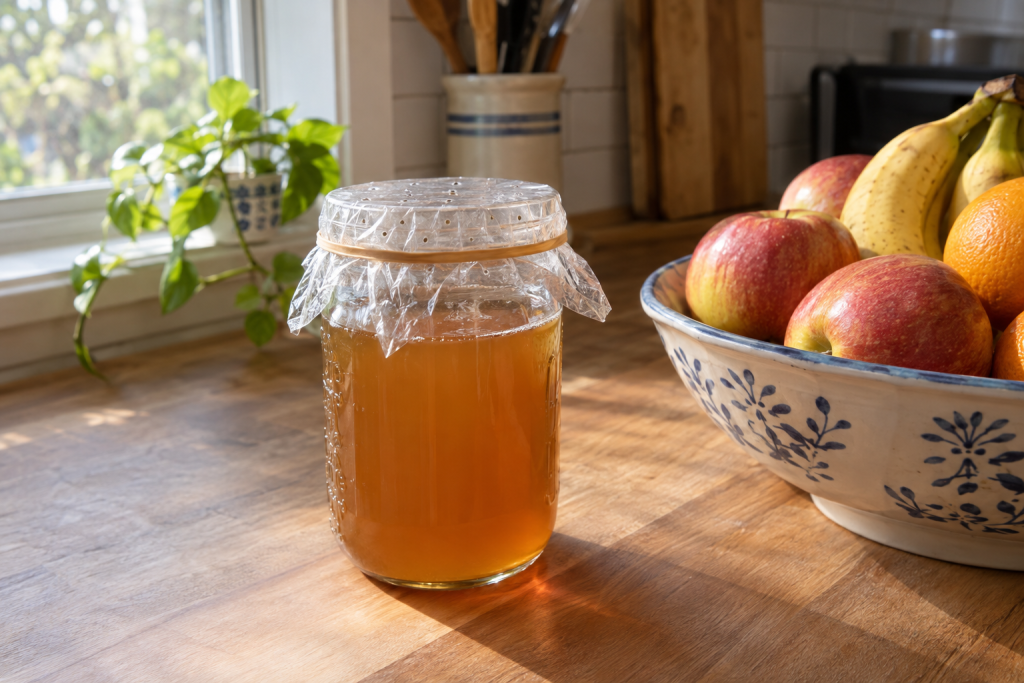
Pour half an inch of apple cider vinegar into a small bowl, add one drop of dish soap, and set it next to the fruit bowl. That is the whole trap, and it will be full of fruit flies by morning. The rest of this guide covers the cover styles that catch more, where to put the bowls, and how to find the rotting banana peel or sour drain that keeps breeding them.
Quick steps: build a vinegar fruit fly trap
- Pour 1/2 inch of apple cider vinegar into a small bowl, jar or cup.
- Add one drop of dish soap and swirl gently so it doesn’t foam.
- Cover the jar with plastic wrap and poke 4-6 pencil-tip holes, or leave a bowl uncovered.
- Set one trap within 3 feet of every spot where you see flies.
- Dump and refill every 2-3 days, or when the surface is crowded.
- Find and remove the breeding source, or the traps never win.
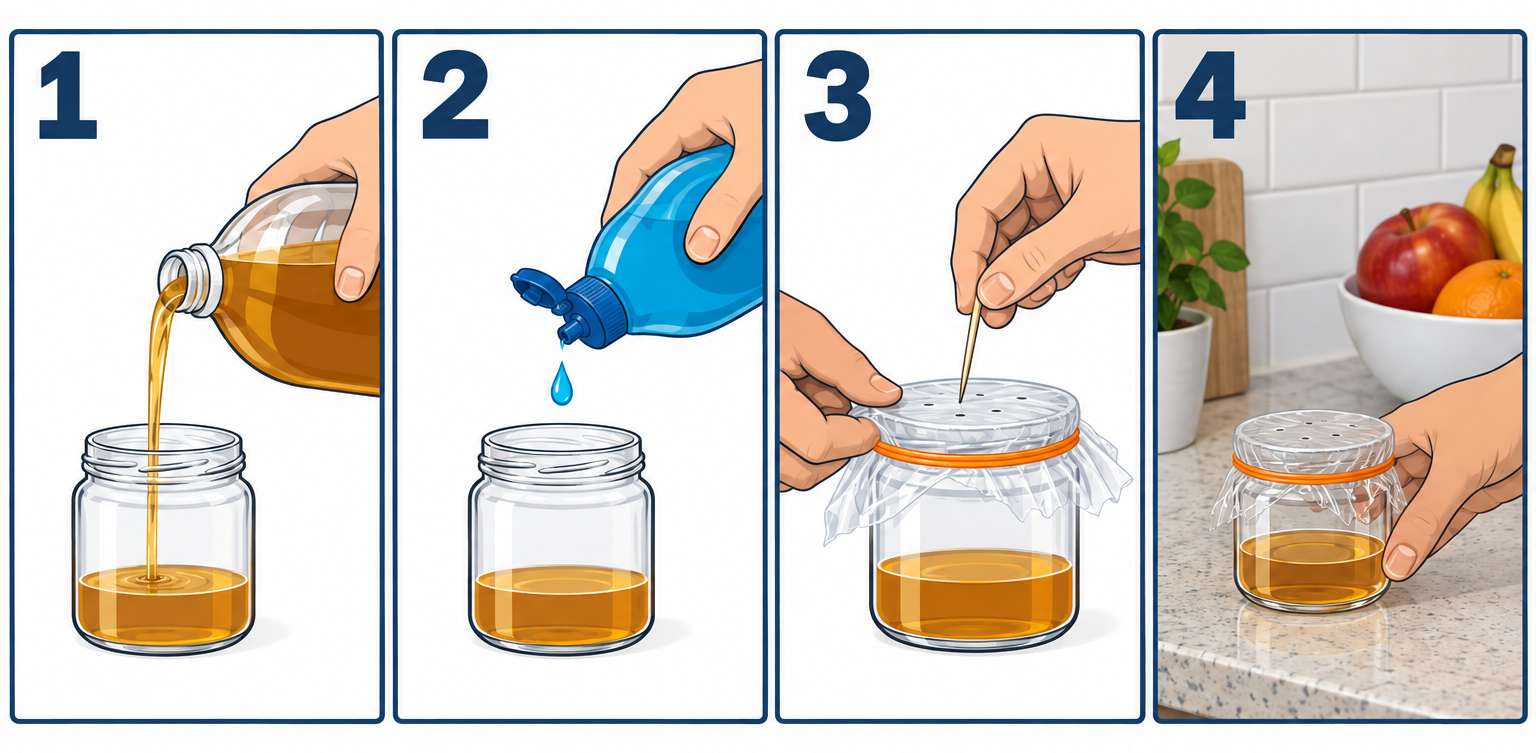
Tools and materials
- Apple cider vinegar (any brand, 5% acidity; store brand is fine)
- Liquid dish soap (Dawn, Palmolive or any brand that suds)
- Small bowl, ramekin, mason jar or disposable cup (4-8 oz)
- Plastic wrap, 6 inch square per jar
- Rubber band to secure the wrap
- Toothpick or sharp pencil for poking holes
- Optional: sheet of printer paper and tape for a funnel cone
- Optional: overripe banana or a splash of red wine for extra pull
Safety first
Keep bowls away from pets and toddlers; vinegar and soap won’t poison anyone, but a knocked-over trap is a sticky mess. Never pour vinegar down a drain you have just treated with a bleach-based cleaner, since the two react and release chlorine gas.
Step 1: Pick the bait, and why apple cider vinegar wins
Fruit flies don’t hunt for fruit. They hunt for fermentation. Yeast eating sugar produces alcohol and acetic acid, and those smells are what a fruit fly tracks from across the room. Apple cider vinegar is basically bottled fermentation, which is why it outperforms almost everything else in the pantry.
I have run white vinegar, apple cider vinegar, red wine, beer dregs and a banana slice side by side on the same counter. Apple cider vinegar and a mashed banana chunk sitting in it caught the most. Red wine was a close second. White vinegar caught a few, but barely enough to bother. Plain water with soap caught nothing at all, so skip anything that isn’t fermented.
A 16 oz bottle of apple cider vinegar runs about $4 to $5, and each trap uses roughly 1/4 to 1/2 cup. One bottle will last an entire fruit fly season. You do not need the raw, unfiltered kind with the “mother” in it; the cheap clear stuff smells just as ripe to a fly.
If you want to boost the pull, drop in one of these:
- A one-inch chunk of overripe banana, mashed against the side of the bowl
- A teaspoon of sugar or a squirt of honey
- A splash of red wine or the last swallow from a beer can
- A pinch of active dry yeast, which starts bubbling and pumping out CO2 within 20 minutes
The yeast trick is my go-to when I’m fighting a serious outbreak. Fruit flies find CO2 the same way mosquitoes do, and a bubbling bowl pulls them off the far side of the kitchen.
Step 2: Add the dish soap
Vinegar alone is a bait, not a trap. Flies land on the surface, drink, and lift off again because surface tension holds them up. One drop of dish soap breaks that tension. The fly touches the liquid, sinks, and drowns in seconds.
Use exactly one drop for a small bowl, maybe two for a quart jar. More soap just makes foam, and a foamy surface gives the flies a raft. Tilt the bowl and let the drop slide into the vinegar, then swirl once. Don’t stir hard.
Pro tip
Warm the vinegar for 10 seconds in the microwave before you add the soap. Warm vinegar throws off far more scent than cold, and I consistently see the first flies arrive within minutes instead of within the hour.
Step 3: Choose a cover style
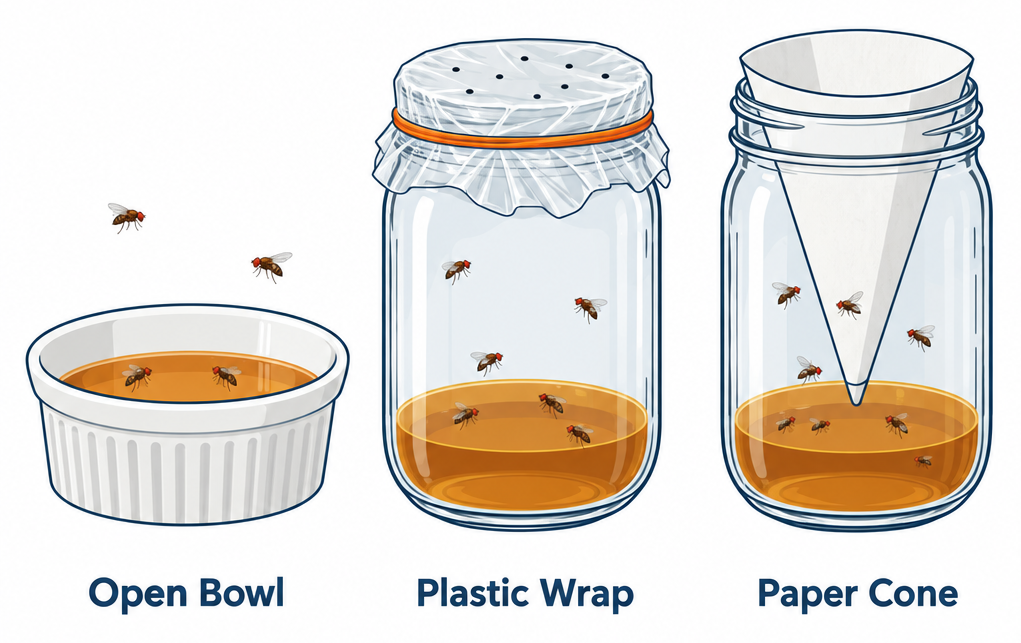
This is where most of the online advice splits, so I tested the three common designs in the same kitchen over three nights, swapping positions each night so location didn’t skew the count. Here is what I found.
| Cover style | What it is | My 24-hour count | Notes |
|---|---|---|---|
| Open bowl with soap | Ramekin, 1/2 inch vinegar, one drop soap | 30-40 flies | Fastest to build, easiest to clean, catches the most per night |
| Plastic wrap with holes | Jar covered in wrap, 4-6 small holes | 15-25 flies | Flies that get in can’t get out; good where the bowl might tip |
| Paper cone funnel | Jar with a paper cone, 1/4 inch opening at the tip | 10-20 flies | Classic design, works, but the cone gets soggy and the catch is lower |
The open bowl wins on raw numbers because nothing stands between the fly and the liquid. The soap does all the killing. The plastic wrap and cone versions catch fewer because some flies land on the cover, wander, and never find a hole. Their advantage is that you can use them without soap in a spot where a child or cat might slurp the bowl, and a sealed jar won’t slosh if it gets bumped.
How to make the plastic wrap trap
Pour your vinegar and soap into a mason jar or drinking glass. Stretch a 6-inch square of plastic wrap tight across the top and secure it with a rubber band around the rim. Poke four to six holes with a toothpick or a sharp pencil. The holes should be just big enough for a fruit fly, about the diameter of a pencil lead. If you can push a pencil tip all the way through, the hole is too big and flies will find their way back out.
How to make the paper cone trap
Roll a sheet of printer paper into a cone with a 1/4 inch opening at the point and tape the seam. Set it point-down into a jar so the tip sits an inch above the vinegar. The wide mouth guides the flies in, and the narrow tip is hard to find from the inside. Tape the cone to the jar rim so there’s no gap along the edge. Replace the cone every two days, because vinegar vapor softens the paper and it sags into the liquid.
The wine bottle version
An almost-empty bottle of red wine is a trap on its own. Leave an inch of wine in the bottom, add a drop of soap, and stand it on the counter uncovered. The long narrow neck does the same job as a cone. I keep one going in the recycling corner whenever we finish a bottle, since the recycling bin is one of the top breeding spots in any kitchen.
Step 4: Place the traps where the flies actually are
A single trap in the middle of the kitchen island is not enough. Fruit flies don’t roam far from where they hatched, so you want a bowl within about 3 feet of every cluster you notice. In a typical kitchen I run three or four at once:
- Next to the fruit bowl or wherever bananas and tomatoes sit out
- On the counter beside the sink, close to the drain and garbage disposal
- On top of or beside the trash can and recycling bin
- Near any houseplants or a wine rack, if flies hang out there
Set the traps where air is still. A bowl sitting under a ceiling fan or beside an open window loses its scent plume, and the flies never find it. If your kitchen has a fan running on hot evenings, move the trap to a corner out of the airflow.
Leave the traps out overnight. Fruit flies are most active in warm, still air, and you will typically see the biggest catch in the first 48 hours after you set a fresh bowl.
Step 5: Refresh every two to three days
A trap full of dead flies is a trap that stops working. The surface gets crowded, the soap film gets broken up by the bodies, and new arrivals can land on the dead ones and walk back off. Dump the bowl into the toilet (not the sink, for reasons covered next), rinse it, and refill with fresh vinegar and soap.
Vinegar also loses its punch as it sits open. After about 72 hours the acetic acid smell fades and the catch rate drops off a cliff. In a hot kitchen I refresh every other day.
Keep the traps running for at least ten days, even after you stop seeing flies. Eggs already laid in the drain or trash can will still hatch for most of that stretch, and the traps need to be there when those new adults emerge.
Step 6: Kill the source, or you’ll be doing this forever
A fruit fly goes from egg to breeding adult in about a week in a warm kitchen, and a single female lays hundreds of eggs. Traps thin out the adults, but if the nursery is still running, you are pulling flies out of a river that never stops. This step is what ends the problem.
Walk through the kitchen and check every one of these:
Produce on the counter. Bananas, tomatoes, peaches, onions and potatoes are the usual culprits. Check the bottom of the fruit bowl for a soft spot or a leaking tomato. Move ripe fruit to the fridge until the flies are gone.
The trash and recycling. A single beer can with a swallow left in it, or a wine bottle with dried dregs, is enough to breed a cloud. Rinse recyclables before they go in the bin, take the trash out nightly for a week, and wash the inside of the can with hot soapy water. Look under the trash can liner for juice that leaked past the bag.
The kitchen drain and disposal. Food film inside the drain pipe and under the disposal’s rubber splash guard is the number one hidden breeding site. Pull the splash guard up, scrub the underside with a brush and hot soapy water, then pour a kettle of boiling water down the drain. Run the disposal with a tray of ice cubes and a half cup of coarse salt to scour the chamber. If you suspect the drain, tape a piece of plastic wrap over it overnight with a smear of honey on the underside; if flies are stuck to it in the morning, that’s your nursery.
The forgotten spots. The potato bag in the pantry, the bottom of the onion basket, a mop bucket with sour water, a damp sponge, a dish rag, the drip tray under the fridge, and the gap between the stove and the cabinet where a tomato slice fell last month. Pull the stove forward and look. A sticky juice spill soaked into a dining rug will feed flies for a week too, so treat that the way you’d steam carpets after any sugary mess.
Pro tip
Not sure whether the source is the drain or the produce? Run the bread yeast test. Mix a teaspoon of yeast with a teaspoon of sugar in a cup of warm water, set it in a jar with plastic wrap and holes, and place it 3 feet from the drain. If it fills while your produce-side traps stay empty, the drain is the nursery and you can stop blaming the bananas.
Make sure you’re actually fighting fruit flies
I have watched people run vinegar traps for two weeks against a fly that doesn’t care about vinegar at all. Three small flies show up in kitchens and they need different fixes.
| Fly | How it looks | Where it comes from | Does the vinegar trap work? |
|---|---|---|---|
| Fruit fly | Tan body, red eyes, about 1/8 inch, hovers over produce | Overripe fruit, trash, recycling, drains | Yes, very well |
| Fungus gnat | Black, mosquito-shaped, weak flier, found around houseplants | Wet potting soil | Poorly; let soil dry out and use yellow sticky cards |
| Drain fly | Fuzzy, moth-like wings, sits on walls near sinks and showers | Slime inside drain pipes and overflow holes | No; scrub the drain and use an enzyme drain gel |
If the flies are sitting on your bathroom wall rather than circling the fruit bowl, you have drain flies, and the fix is a stiff pipe brush and a bacterial drain cleaner, not a bowl of cider vinegar.
Troubleshooting
| Symptom | Likely cause | Fix |
|---|---|---|
| Flies land on the vinegar and fly away | No soap, or soap didn’t break the surface | Add one drop of dish soap and swirl gently |
| Trap has a foam layer and catches nothing | Too much soap | Dump and remix with a single drop |
| Flies hover near the trap but never go in | Holes in the wrap too small, or cone gap sealed | Enlarge holes to pencil-lead size; check the cone tip is open 1/4 inch |
| Flies escape from the jar | Holes too big, or gap between cone and rim | Re-poke smaller holes; tape the cone to the rim |
| Traps full but flies keep coming for weeks | Breeding source still active | Hunt the drain, trash, recycling and produce; run the yeast test |
| Catch drops off after a few days | Vinegar lost its smell | Refresh every 2-3 days; warm it before setting out |
| Trap works in one room, not another | Airflow carrying scent away | Move away from fans, vents and open windows |
| Lots of flies but none in traps | They’re fungus gnats or drain flies, not fruit flies | Identify the fly; use sticky cards or drain treatment instead |
What a vinegar trap can’t do
A homemade vinegar fly trap is a cheap, fast way to knock down the adults, and in most kitchens the problem is gone in a week once you combine it with a real cleanup. It will not sterilize a drain, and it will not reach eggs tucked inside a potato bag. Expect the traps to do about half the job, and the hunt for the source to do the other half.
Store-bought traps like the Terro two-pack (roughly $6 to $9) and the Aunt Fannie’s FlyPunch jar (about $8 for a single jar) use a ready-made lure, with Terro relying on a vinegar-based attractant and Aunt Fannie’s using its own formula. They work, but a ramekin and a drop of Dawn does the same thing for pennies, and you can scale up to five or six bowls without spending anything.
When to call a pro
If fruit flies persist past three weeks with traps running and the kitchen clean, the source is somewhere you can’t reach: a cracked drain line under the slab, a sump or floor drain in the basement, a dead animal in a wall, or standing water under a dishwasher or refrigerator. A pest control company will run a drain inspection and treat with a bacterial foam, usually $100 to $250 for a visit. If the flies trace to a leaking drain or sewer line, you need a licensed plumber, not an exterminator.
FAQ
Does a fruit fly trap need apple cider vinegar, or will white vinegar work?
Apple cider vinegar works far better. White vinegar is distilled and lacks the fruity fermentation notes that pull fruit flies in. In my side-by-side tests the cider vinegar bowl caught several times more flies than the white vinegar bowl. If all you have is white vinegar, add a chunk of banana or a spoon of sugar to make it worth a fly’s attention.
How long does it take for a vinegar fly trap to work?
You’ll usually see the first flies in the bowl within an hour, and a noticeable catch overnight. Clearing the kitchen takes about a week to ten days, because eggs already laid keep hatching. Keep the traps running that long even after the counter looks clear.
Why are fruit flies not going into my trap?
Three usual reasons. There’s no soap, so they drink and leave. The trap is in moving air, so the scent never reaches them. Or they aren’t fruit flies at all; fungus gnats and drain flies ignore vinegar. Check the fly against the identification table above before you change the bait.
Can I use a fruit fly trap without dish soap?
Yes, if you cover the jar with plastic wrap and poke small holes, or use a paper cone. Flies get in and can’t find their way back out, and they eventually drown or starve. Without a cover, you need the soap or the flies simply fly off after a drink.
Where do fruit flies come from if I don’t have fruit out?
Almost always the drain, the garbage disposal, the recycling bin or the trash. A rinsed-looking beer can with a few drops in the bottom is enough. Check under the disposal’s splash guard, and run the plastic-wrap-over-the-drain test overnight to confirm.
How often should I change the vinegar in a fruit fly trap?
Every two to three days. The scent fades, and a surface crowded with dead flies lets new ones land safely. In a warm kitchen, change it every other day.