
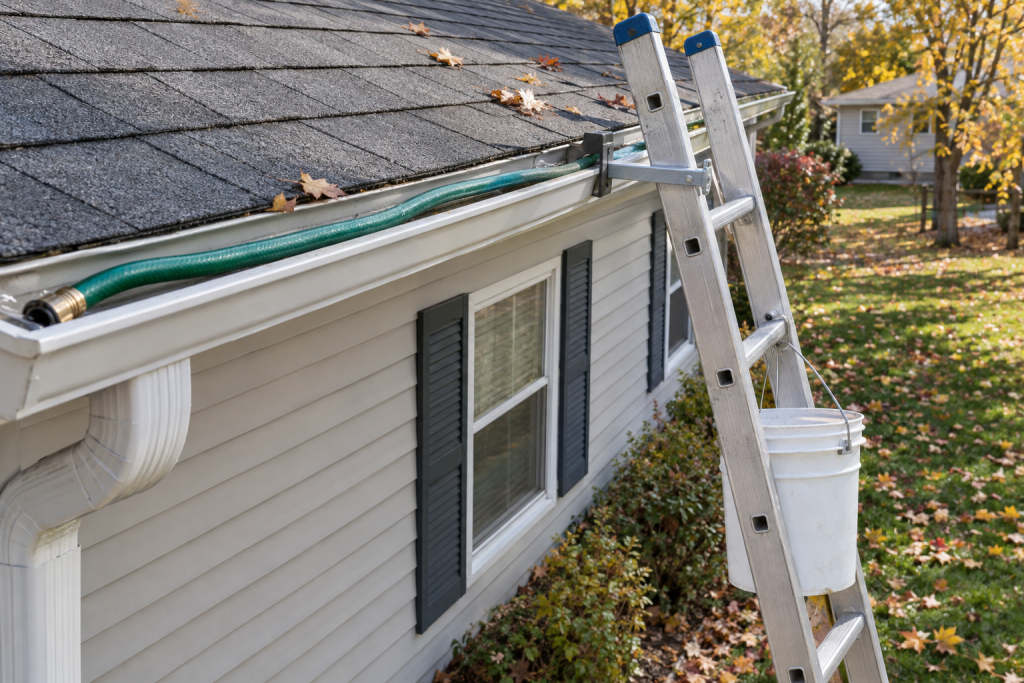
Clean gutters from a properly set extension ladder, not from the roof: scoop the debris by hand, flush the run with a hose, then clear each downspout from the top. A single-story house takes 1 to 2 hours and costs under $50 if you already own a ladder. Do it every spring and fall, and more often if a tree hangs over the roof.
Quick steps: cleaning rain gutters
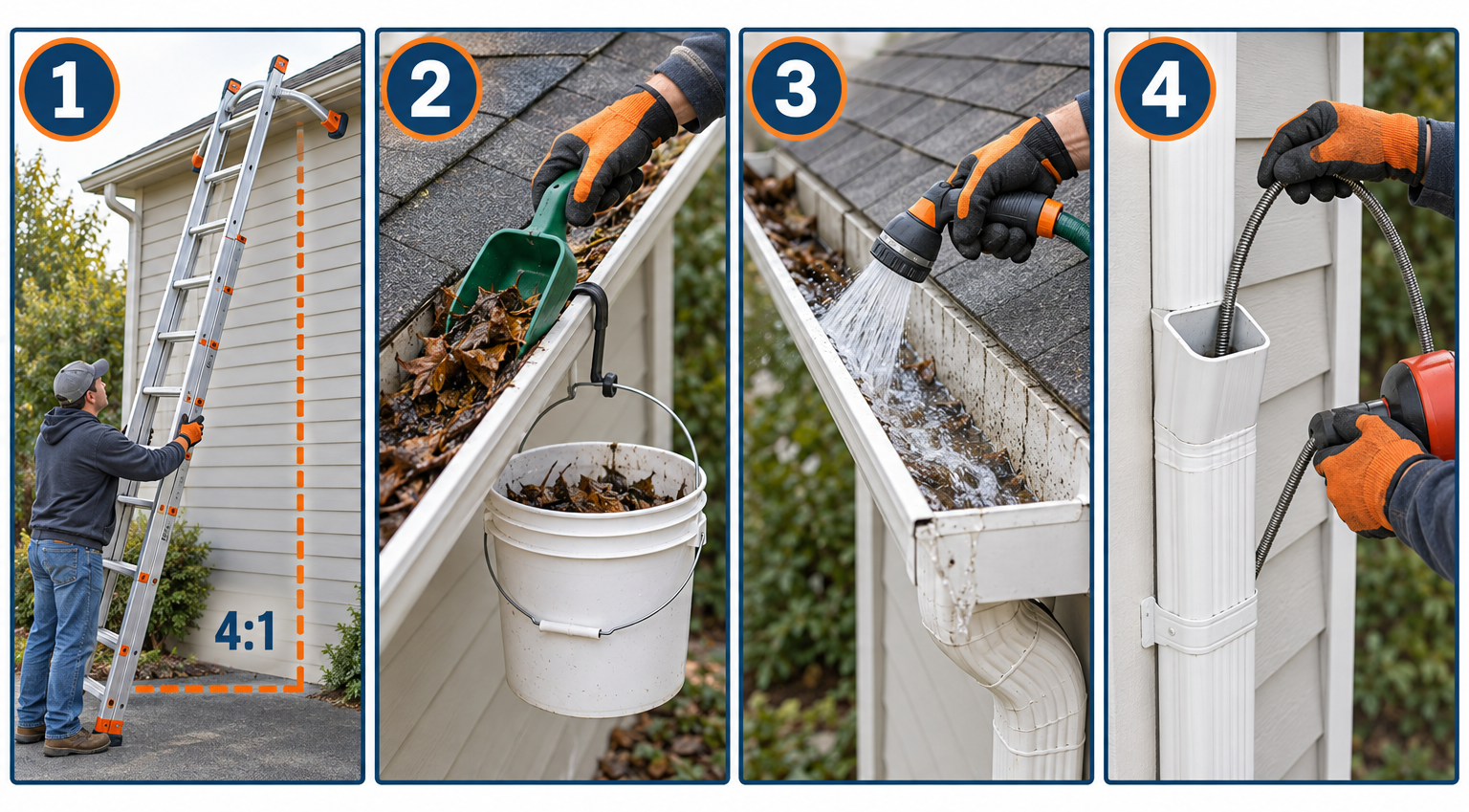
- Pick a dry, calm day and set the ladder at a 4:1 angle with a standoff.
- Hang a bucket from the ladder and scoop debris starting next to the downspout.
- Move the ladder every 3 to 4 feet; never reach past the side rails.
- Flush the gutter with a hose from the far end toward the downspout.
- Run the hose down each downspout; snake it from below if water backs up.
- Check for standing water, loose hangers and leaking seams while you’re up there.
- Reattach downspout extensions and bag the debris.
Tools and materials
- Extension ladder, Type IA (300 lb rated), 20 ft for single-story, 24-28 ft for two-story
- Ladder stabilizer or standoff bracket ($30-60)
- Plastic gutter scoop ($5-10) or a cut-down plastic milk jug
- Heavy rubber-coated or nitrile work gloves
- 5-gallon bucket with an S-hook or bucket hanger
- Garden hose with a pistol-grip spray nozzle
- 25 ft plumber’s drain snake or drum auger for downspouts
- Safety glasses
- Contractor trash bags (3 mil)
- Gutter sealant, polyurethane type, for any leaking seams ($8-12 per tube)
- Hidden gutter hangers with screws, 2 or 3 spares ($2-3 each)
- Cordless drill with hex driver for hanger screws
- Optional: leaf blower gutter kit or wet/dry vac gutter kit ($30-60)
Calculators for this job
Safety first
Keep every part of the ladder at least 10 feet from overhead power lines; aluminum conducts. Wear gloves and safety glasses, keep three points of contact on the ladder, and never stand on the top three rungs. Stay off the roof entirely if it is wet, steep, tile or slate.
Step 1: Pick the day and set up the ladder
Almost every gutter injury happens on the ladder, not in the gutter. Spend ten minutes here and the rest of the job is easy.
Wait for a day after two or three dry days. Dry leaves scoop out in handfuls; wet leaves and shingle grit turn into a sludge that weighs three times as much and sticks to everything.
Avoid wind above about 15 mph. A gust catches an extended ladder like a sail, and you’ll feel it twist under you.
Choose the right ladder
Measure the height to the gutter edge. A single-story gutter sits around 10 to 12 feet up, a two-story gutter around 18 to 22 feet.
Your ladder needs to reach about 3 feet past that so you can work at waist height without stretching. That means a 20-foot extension ladder for one story and a 24- to 28-foot ladder for two.
Check the duty rating sticker on the rail. Type IA carries 300 pounds, which covers you plus a bucket of wet muck. A Type III household ladder rated at 200 pounds is not enough for this work.
Fiberglass is the safer choice near any service drop. Aluminum is lighter and fine if the lines are nowhere near your work.
Set the angle and the feet
Use the 4:1 rule: for every 4 feet of height to the contact point, the base sits 1 foot out from the wall. At a 12-foot gutter, the feet go 3 feet out.
Quick check: stand with your toes against the ladder feet and reach straight out. Your palms should land on a rung at shoulder height. If you have to lean in, the ladder is too flat; if the rung is past your fingertips, it’s too steep.
Set the feet on firm, level ground. On soft lawn, flip the feet to their spike side and stomp them in. On a slope, dig a flat spot for the downhill foot rather than stacking blocks under it.
Lock both rung locks and check that the fly section has a 3-rung overlap at minimum.
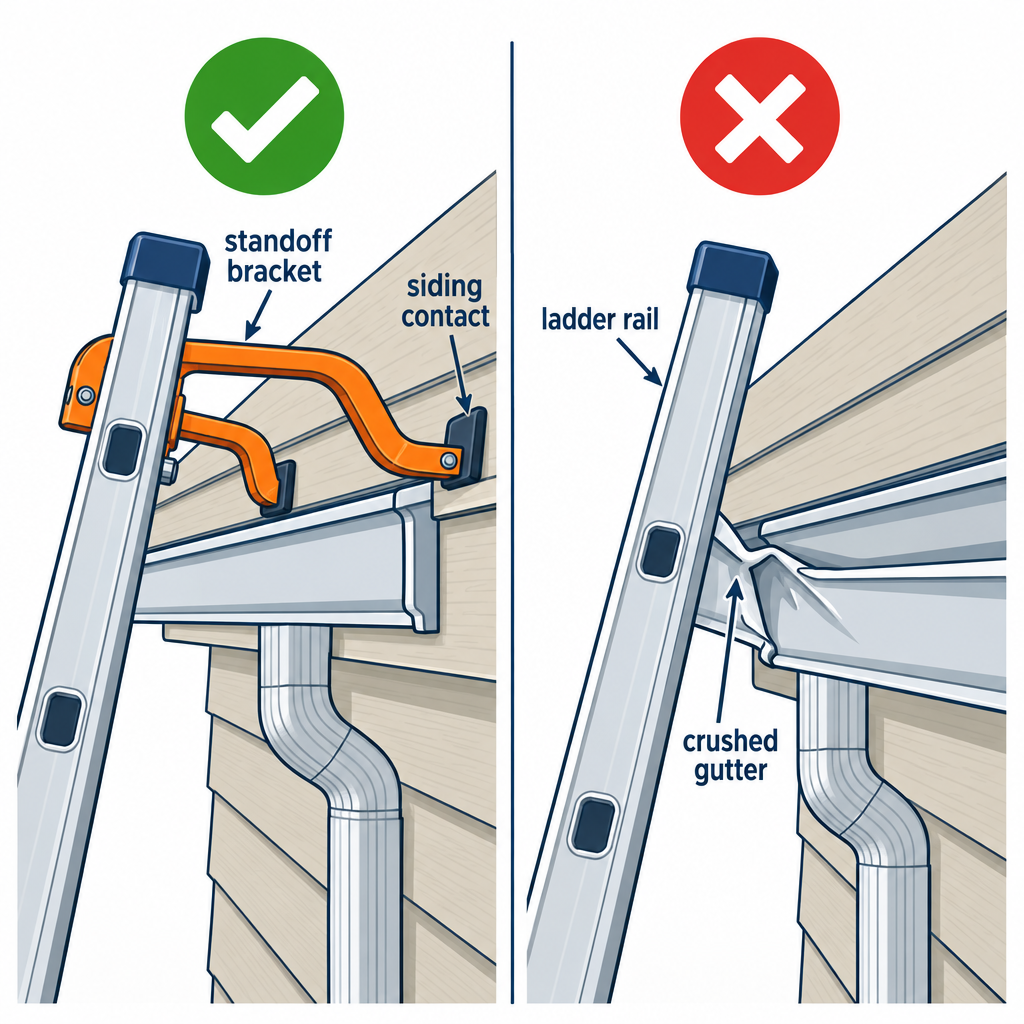
Never lean a ladder on the gutter
Aluminum gutters crush under a ladder. Hidden hangers pull loose, the front lip bends inward, and water starts spilling over that spot every time it rains.
A ladder standoff (sometimes sold as a stabilizer) is a U-shaped bracket that bolts to the top rungs and rests on the roof or siding on either side of the gutter. It also widens the top of the ladder, which cuts side-to-side wobble by half.
If you don’t own one, buy one before you start. It is the single best $40 you will spend on this job.
Pro tip
Tie a 20-foot length of rope to the top rung and let it hang. When you move the ladder, you can lower the extended section by the rope instead of wrestling it from the bottom, which is where most backs get pulled.
Step 2: Scoop the debris
Climb until the gutter is between your waist and chest. Hang the bucket from a rung at hip height with an S-hook so you can drop debris without looking.
Start at the downspout outlet. If you work the other direction, the loose debris you push along will pack into the outlet and plug it.
Pull out the big handfuls first. Leaves, twigs, seed pods and tennis balls come out faster by hand than with any tool.
Then use the scoop for the layer underneath. That bottom layer is shingle granules, pine needles and decomposed leaves, and it holds water like a sponge.
Work in short reaches
Only clean what you can reach with your belt buckle between the rails. That’s roughly 18 inches to each side, or about 3 feet of gutter per ladder position.
Climb down and move the ladder every 3 to 4 feet. On a 40-foot gutter run, that’s about 10 to 12 ladder moves. Yes, it feels slow. It is also why your weight never leaves the centerline of the ladder.
A standard 2,000-square-foot house with 150 feet of gutter takes 40 to 50 ladder positions. Budget 2 hours for the scooping alone on a bad fall cleanout.
What you’ll find in there
Roof granules look like coarse black sand. A quarter-inch layer is normal on a 10-year-old asphalt roof. A half-inch or more on a roof under 5 years old means the shingles are shedding early.
Moss and small plants mean the gutter has held water for a long time. Look for a low spot or clog later in Step 5.
Shiny black or dark-red debris near a chimney is usually flaking from the cap or crown and is worth a look from the ground with binoculars.
Wasps and yellowjackets nest under the gutter lip and inside downspout elbows. Work early in the morning when they’re sluggish, and carry a can of wasp spray in your back pocket rather than leaving it on the ground.
Pro tip
Cut the bottom off a plastic 1-gallon milk jug at an angle and keep the handle. The flexible plastic flexes to the gutter’s shape and gets under the hangers, which a rigid scoop can’t do.
Step 3: Flush the gutter with a hose
Scooping leaves roughly a quarter of the debris behind as grit stuck to the gutter floor. Water moves it.
Start at the end farthest from the downspout. Set the nozzle to a flat fan or jet, and sweep the floor of the gutter toward the outlet in 3-foot passes, moving the ladder as you go.
Watch where the water goes. It should move steadily and drain within 30 to 60 seconds after you stop.
Water that pools behind a hanger or at a seam shows you a low spot. Mark it mentally; you’ll fix it in Step 5.
Don’t blast upward under the shingles. A hose jet aimed at the drip edge forces water under the first course and into the fascia, which is the exact rot you’re trying to prevent.
Keep the hose off the gutter
A hose draped over the gutter edge pulls on it with every tug. Loop it over the ladder rung instead, or clip a hose hook to the rail.
Pull the hose up from the ground before you climb. Dragging 50 feet of hose up a ladder one-handed is how people lose three-point contact.
Step 4: Clear the downspouts
Nine out of ten overflow calls are a plugged downspout, not a dirty gutter. Clogs almost always lodge in one of three spots: the outlet screen, the top elbow, or the bottom elbow.
Test it first
Put the hose in the downspout outlet at the top and run it full blast for a minute. Watch the bottom.
Water that comes out the bottom as fast as it goes in means you’re done with that downspout. Water that backs up and rises in the gutter means a clog.
Clear from the top
Pull any outlet strainer out and clean it. Those wire baskets catch leaves on purpose and then plug the opening they were supposed to protect.
Feed the hose nozzle a foot or two into the outlet with the water running. The pressure alone pushes a soft leaf clog through about half the time.
If the water keeps backing up, feed the drain snake into the outlet. Crank it down 2 to 3 feet, pull back, and push again. The top elbow sits 6 to 12 inches below the outlet, so you’ll feel it bind there first.
Clear from the bottom
Go to the ground and pull off the downspout extension or splash block elbow. Most are held by a single sheet-metal screw.
Look up the pipe with a flashlight. You’ll often see a plug of black compost right at the bottom elbow.
Run the snake up from the bottom. The bottom elbow is where tennis balls, bird nests and small toys stop, so expect something solid.
On a two-story downspout with a mid-run elbow that won’t clear, take the downspout apart at a seam. Downspout sections slip together with the upper piece inside the lower, held by a screw or rivet on each side. Drill out the rivets, pull the section, clear it on the ground, and reassemble with #8 x 1/2-inch zip screws.
Underground drains
Some downspouts run into a 4-inch corrugated or PVC pipe that goes underground to a pop-up emitter or storm drain. Those clog with roots and silt and need a different approach.
Disconnect the downspout and run the hose into the pipe. Water that backs up means the buried line is plugged. A 50-foot drum auger clears some of them. If not, a drain cleaning company with a sewer jetter handles it for $150 to $350.
Pro tip
Before you reassemble, drop a tennis ball or golf ball into the top of each downspout. If it rolls out the bottom, every elbow is clear. If it doesn’t, you know exactly which section to pull.
Step 5: Check slope, hangers and seams
The gutter is empty and wet, which is the best moment to inspect it. Three things cause most problems.
Standing water
Gutters should slope toward the downspout about 1/4 inch for every 10 feet of run. Water left behind after the flush shows you where the slope is wrong.
A puddle of an inch or less in one spot usually means a hanger pulled loose and the gutter sagged. Push up on the gutter from below. If it moves, the hanger above it has lost its grip.
Puddles along the whole length mean the original install was flat or the fascia has settled. Rehanging a full run to correct slope is a half-day job and a reasonable point to hire a gutter company.
Loose hangers and spikes
Older gutters hang on 7-inch spikes driven through ferrules into the fascia. Spikes work out over the years and the gutter droops.
Don’t hammer the old spike back in. It’s a nail in a hole that has already wallowed out, and it’ll back out again in a season.
Pull the spike and install a hidden hanger in its place. Hidden hangers clip over the front lip and back edge, then screw into the fascia with a 2-inch screw. Space them every 24 inches, or every 18 inches in areas with heavy snow.
If the screw spins without biting, the fascia behind it is rotten. Probe with a screwdriver. Soft wood for more than a few inches means the fascia board needs replacing, which is a carpentry job before any gutter work.
Leaking seams and end caps
Sectional aluminum gutters have a seam every 10 feet and at every corner. The original sealant dries out after 10 to 15 years.
Dry the seam with a rag, then look for a tan or white residue trail below it on the outside. That’s the leak path.
Scrape out the old sealant with a putty knife, wipe the metal with rubbing alcohol, and lay a bead of polyurethane gutter sealant over the inside of the seam. Smooth it with a gloved finger. It needs 24 dry hours before rain.
Silicone caulk from the hardware store will hold for a season. Gutter-specific polyurethane holds for 5 to 10 years.
Step 6: Fix the ground end
Everything above only matters if the water ends up away from the house. This step takes 10 minutes and prevents most wet basements.
Each downspout should discharge at least 4 feet from the foundation, and 6 feet is better. A splash block alone dumps water 18 inches out, which is still on top of the footing.
Add a rigid or hinged extension to any downspout that doesn’t reach 4 feet. A 4-foot aluminum extension costs $10 to $15. Hinged versions flip up for mowing and cost about $20.
Check that the extension pitches away from the house. Water pooling at the end of the extension and running back along it toward the wall happens more than you’d think.
Look at the soil and any slab around the discharge point. Soil should slope away from the foundation at about 6 inches over the first 10 feet. Eroded trenches under a downspout mean the gutter has been overflowing there for a while.
Splash and overflow also stain and spall concrete walks and stoops. If yours look chalky and pitted, a concrete sealer applied after the surface dries out will slow further damage, but only once the gutter stops dumping on it.
Step 7: Clean up and write it down
Bag the debris in contractor bags rather than leaving it on the lawn. Wet gutter muck kills grass in two days.
Most of it can go in yard waste if your town takes it. The granule layer at the bottom of the bucket is roofing material and goes in the trash.
Hose off the siding below any spot where you dropped debris. Gutter sludge stains vinyl and fiber cement if it dries on.
Rinse your gloves and tools. The scoop goes in the bucket, the bucket goes in the garage, and you’ll find them next fall.
Take 2 minutes and note what you found: which downspout was clogged, where the water pooled, which seam leaked. Next spring, you’ll know where to look first, and the job gets faster every time.
While the ladder is still up, look at anything else on that wall. The clothes dryer vent hood is often near the gutter line on a side wall, and a hood packed with lint is a 30-second fix from the same ladder position.
Cleaning gutters without climbing
You can keep gutters reasonably clear from the ground or a short stepladder with the right attachment. None of these matches a hand cleaning, but they stretch the time between climbs.
| Method | Cost | Works well for | Weak spot |
|---|---|---|---|
| Leaf blower gutter kit (curved tubes) | $30-50 plus blower | Dry leaves and needles on single-story | Wet packed debris, can’t see results |
| Wet/dry vac gutter kit | $30-60 plus vac | Wet sludge and granules on single-story | Slow, hose clogs, heavy to hold overhead |
| Telescoping hose wand with curved tip | $25-45 | Light rinsing after blowing | Just moves debris toward the downspout and often into it |
| Robotic gutter cleaner | $150-200 | Long straight runs with light debris | Stalls at hangers and corners, needs placing by ladder anyway |
The blower kit is the most useful of the four. Hold the tubes so the nozzle points along the gutter toward the downspout, start at the far end, and sweep. Wear safety glasses and a dust mask; everything in the gutter comes out at your face.
Then check each downspout with the hose as in Step 4. Ground tools don’t clear downspouts, and that’s where the real clog lives.
For two-story gutters, ground methods don’t reach. That’s where a hired cleaning earns its money.
How often to clean gutters
Twice a year is the standard answer. Your trees decide the real number.
| Tree cover | Cleanings per year | When |
|---|---|---|
| No trees within 50 feet | 1 | Late fall |
| Deciduous trees nearby (oak, maple) | 2 | Late spring after seed drop, late fall after leaf drop |
| Pines, spruce or other conifers overhead | 3-4 | Every season; needles fall year-round |
| Heavy overhanging canopy of any kind | 4 | Quarterly, plus a check after major storms |
Late fall means after the last leaves come down, not the first weekend of October. Clean too early and you do it again in December.
Late spring catches maple helicopters, oak tassels and cottonwood fluff. That spring debris mats into a felt that blocks a downspout outlet in one storm.
Two signs you waited too long: water sheeting over the front edge during rain, and small plants growing from the gutter in summer.
Why the schedule matters for the house
A 10-foot run of 5-inch gutter packed with wet leaves and standing water weighs 50 pounds or more. Multiply that along a 40-foot run and the hangers are holding a couple hundred pounds they were never sized for.
Clogged gutters also send water behind the fascia and into the soffit, and over the edge onto the foundation. Rotted fascia runs $8 to $20 per foot to replace. A basement waterproofing contractor starts around $4,500 and commonly runs up to $15,500. A fall afternoon with a scoop is cheap by comparison.
In cold climates, a gutter that holds water freezes solid. The ice adds weight, backs meltwater under the shingles, and is the start of an ice dam. Clean gutters don’t prevent ice dams by themselves (attic insulation does that), but full ones make them worse.
What about gutter guards?
Guards cut the frequency; they don’t end the job. Every type still needs a check at least once a year.
Micro-mesh guards (stainless mesh on an aluminum frame, $2 to $5 per foot installed yourself, $7 to $15 per foot professionally installed, with premium name-brand systems reaching $15 to $25 per foot) block the most debris. Pine needles and shingle grit still build up on top and need brushing off.
Reverse-curve guards shed leaves but overshoot water in heavy rain, especially on steep roofs. Foam inserts fill with grit and grow moss in 2 to 3 seasons. Brush inserts catch more than they stop.
If you install any guard, know that downspouts still clog from what gets through. Keep doing the hose test in Step 4 each year.
Troubleshooting gutter problems
| Symptom | Likely cause | Fix |
|---|---|---|
| Water pours over the front edge at one spot during rain | Downspout clog below that section, or a low spot | Hose-test the nearest downspout; snake from the bottom elbow |
| Water overflows along the whole run in heavy rain | Gutter undersized for roof area, or downspouts too few | Add a downspout, or upgrade 2×3 downspouts to 3×4; 6-inch gutter for large roof planes |
| Drips from under the gutter between rain showers | Leaking seam or end cap | Clean, dry, reseal with polyurethane gutter sealant |
| Gutter sags visibly in the middle | Pulled spike or failed hanger | Replace with hidden hangers every 24 inches |
| Water pools 1 inch deep and won’t drain | Lost slope at a hanger | Rehang the low section so water runs toward the downspout |
| Stains or rot on the fascia behind the gutter | Water getting behind the gutter, missing drip edge, or back lip too low | Install a gutter apron flashing under the shingles into the gutter |
| Downspout clears with the hose, then clogs again in a week | Outlet strainer catching debris, or a flattened elbow | Remove the strainer; replace crushed elbow sections |
| Wet basement wall under a downspout | Discharge too close to the foundation | Add a 4- to 6-foot extension and regrade the soil away from the wall |
| Gutter pulls away from the house at the corner | Rotted fascia board | Replace the fascia section before rehanging |
| Mosquitoes swarming near the roofline | Standing water in the gutter | Fix the slope or clog; mosquitoes breed in a week |
Realistic costs
Doing it yourself with a ladder you already own costs the price of a scoop, gloves and trash bags, about $20. Add a standoff for $40 the first time.
Buying a 24-foot Type IA extension ladder runs roughly $320 to $600, with most models priced between $350 and $500. It pays for itself against one pro visit a year within two years.
Hiring it out typically runs $120 to $200 for a single-story house and $200 to $400 for two stories, depending on linear feet and tree cover. Many companies offer seasonal plans with a discount for a standing spring-and-fall schedule, and that’s worth taking if you’d otherwise skip a year.
Ask whether the price includes flushing downspouts and bagging debris. Some low quotes cover scooping only and leave the sludge on your lawn.
When to call a pro
Hire a gutter cleaning company for any gutter above a second-story eave, any roof over a 6/12 pitch you would need to walk, and any gutter within 10 feet of a service drop. Call a gutter installer if you need to rehang more than one section for slope or replace fascia. Call a drain cleaning service for underground downspout lines that won’t clear with a 50-foot auger. If you find exposed wiring, a leaking service mast or damaged meter base near the gutter, stop and call an electrician before anyone goes back up.
FAQ
What is the safest way to clean gutters?
From an extension ladder with a standoff bracket, set at a 4:1 angle on firm ground, moving it every 3 to 4 feet. Keep both feet and one hand on the ladder, work between the rails, and stay off the roof. Ground tools like a leaf blower gutter kit are safer still for single-story homes, but they don’t clear downspouts.
How much does gutter cleaning cost?
Expect $120 to $200 for a single-story house and $200 to $400 for a two-story house from a professional service in most US markets. Doing it yourself costs $20 to $60 in tools if you own a ladder. Prices climb with heavy tree cover, gutter guards that must be removed, or steep lots.
Can I clean gutters from the roof?
Don’t. Leaning over the edge of a roof puts your weight past the eave with nothing to hold, and asphalt shingles are slippery with any dew or granule dust. The gutter edge is also the weakest footing on the roof. Use a ladder with a standoff instead.
How do I know if my gutters are clogged?
Watch during a rain. Water sheeting over the front edge, dripping from behind the gutter, or spilling at a corner means a blockage or a slope problem. Between rains, look for plants growing in the gutter, staining on the fascia, or a downspout that stays dry while others run.
What time of year should I clean my gutters?
Late fall after the last leaves drop, and late spring after seed and flower drop. Homes under pines need a third or fourth cleaning because needles fall year-round. Check after any storm with heavy wind.
How do I unclog a downspout?
Run a hose into the top at full pressure first. If water backs up, feed a drain snake from the top, then from the bottom after removing the extension. Most clogs sit at the top or bottom elbow. For a stubborn mid-run clog, drill out the rivets at the nearest seam, remove the section, and clear it on the ground.
Do gutter guards mean I never have to clean gutters?
No. Guards cut cleaning from twice a year to roughly once, but grit and needles build up on the mesh and small debris still washes into the downspouts. Plan on an annual check and a downspout flush with any guard system.
How do I fix a gutter that holds water?
Find the low point, then push up on the gutter from below to see if it moves. A loose hanger is the usual cause; replace it with a hidden hanger screwed into solid fascia. The gutter should slope about 1/4 inch per 10 feet toward the downspout. If a whole run is flat, it needs rehanging.