
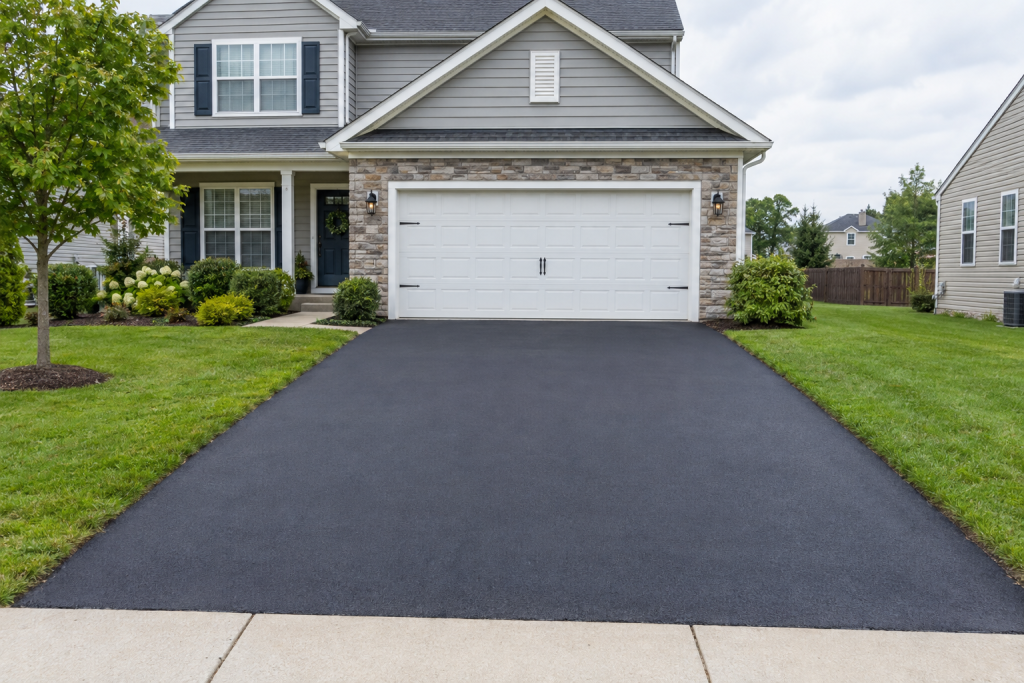
This asphalt calculator turns three measurements (length, width and compacted thickness) into the tons of hot mix you need to order, the cubic yards it fills and, if you enter a price per ton, what the material will cost. Measure your driveway or patch in feet, decide on a finished thickness in inches, and the tonnage comes out ready to phone in to the plant.
Quick steps: use the asphalt calculator
- Measure the length and width of the area in feet with a 100 ft tape, rounding up to the nearest foot.
- Pick a compacted thickness in inches: 2 in for a thin overlay, 3 in for a new residential driveway, 4 in for anything a truck parks on.
- Leave Density (lb/cu ft) at 145 unless your supplier quotes a different compacted density for their mix.
- Enter the plant’s price per ton (optional) to see material cost.
- Read the tons, add 5 to 10 percent for waste and compaction loss, and round up to the plant’s minimum load.
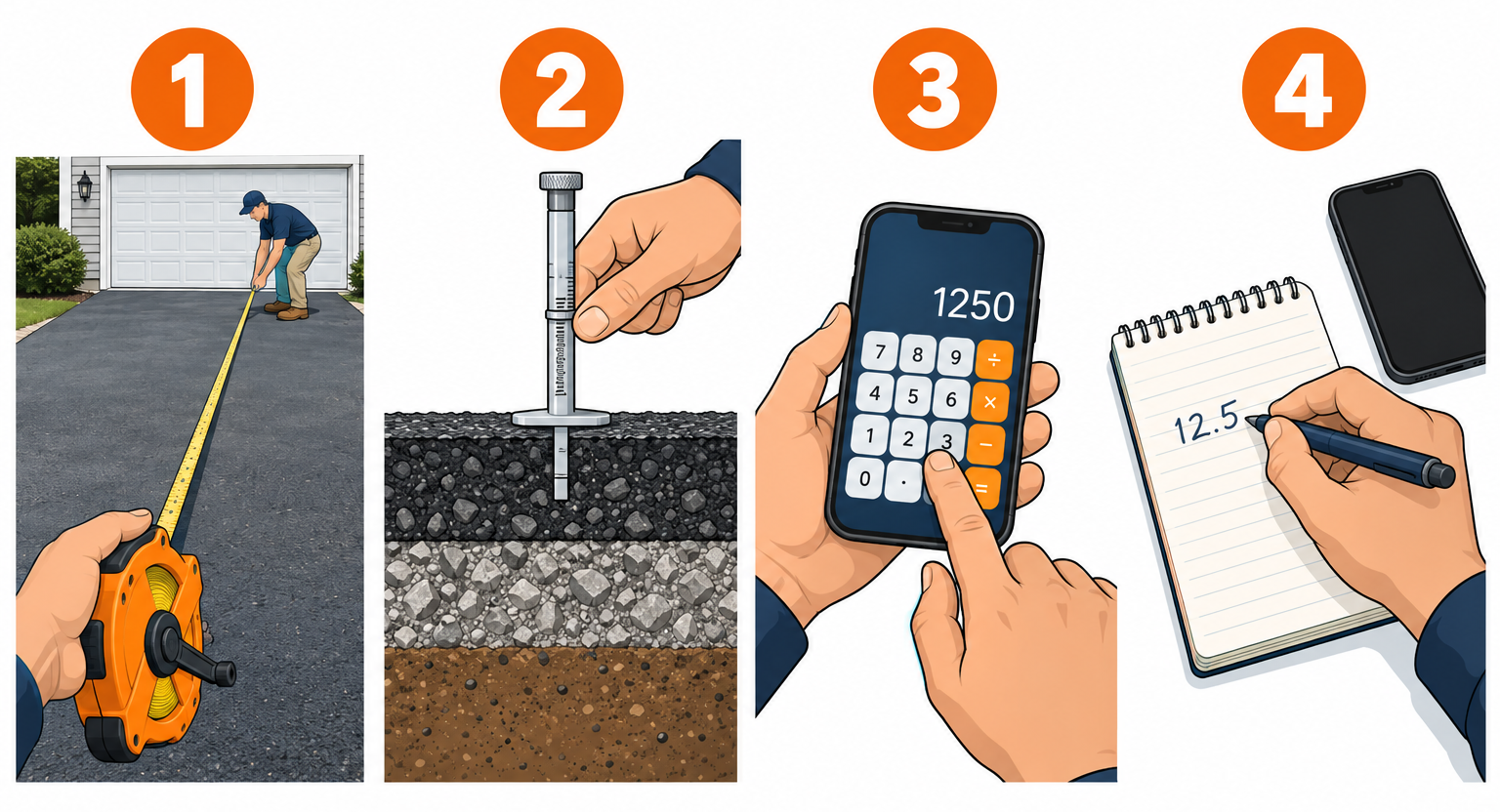
Tools and materials
- 100 ft open-reel tape measure
- Marking paint or stakes and string for odd shapes
- Notepad or phone for sketching sections
- Supplier quote: mix type (e.g., 9.5 mm surface mix), compacted density, price per ton
How to use the asphalt calculator
Every field in the calculator maps to something you can measure on the ground or read off a supplier quote. Here is what each one means and how to get the number right.
Length (ft)
Measure the longest dimension of the paved area in feet. The default is 50, which is a typical single-car driveway from the street to a detached garage. Run the tape along the ground, not along a sloped retaining wall or the fence line, because the pavement follows the ground.
If the driveway curves, measure down the centerline from end to end. A gentle curve adds almost nothing to the area, but a sharp bend around a tree is better measured as two straight sections.
Width (ft)
Measure across the area at the narrowest and widest points and use the average. The default of 12 ft is the standard single-car width. Many driveways flare out to 20 to 24 ft at the garage apron, so measure that flare as its own rectangle rather than guessing one width for the whole run.
Compacted thickness (in)
This is the finished depth after the roller has done its work, not the depth of loose mix you rake out. The default of 2 in suits an overlay on sound existing asphalt. For a brand new driveway on a prepared gravel base, 3 in compacted is the common residential spec and 4 in handles boats, RVs and delivery trucks.
Loose hot mix compresses roughly 20 to 25 percent under the roller. The calculator already accounts for that because it works from compacted thickness and compacted density. Do not enter the loose spread depth here or you will order about a quarter more than you need.
Density (lb/cu ft)
Hot mix asphalt compacts to somewhere between 140 and 150 lb per cubic foot depending on the aggregate and the mix design. The 145 default is the figure most plants and paving contractors use for quick tonnage estimates. If your supplier gives you a density from their mix design sheet, enter it. A 5 lb difference changes the order by about 3.5 percent, which matters on a 60 ton commercial lot and not much on a 7 ton driveway.
Price per ton (optional)
Enter what the plant quoted you for picked-up or delivered hot mix. Leave it at 0 and the calculator simply returns quantity. The cost shown is material only: no base gravel, no excavation, no paving labor, no sealcoat.
Measuring mistakes that throw the number off
- Measuring in paces or guessing from a satellite map. A 10 percent error in both length and width is a 21 percent error in area.
- Measuring the inside of the forms or edge restraint but ordering for the outside. Measure the edge the asphalt will actually reach.
- Forgetting the apron, turnaround or walkway stub that will be paved at the same time.
- Mixing units. Feet for length and width, inches for thickness. A 3 ft thickness entry will ask for 36 times the material.
- Ignoring a bad base. If the gravel is rutted, the low spots eat extra mix before you reach your target thickness anywhere.
For L-shaped or irregular areas, split the shape into rectangles, run each one through the calculator and add the tons. If you want to work out the footprint first, a square footage calculator handles the odd shapes and you can enter that area as a 1 ft wide rectangle of that many feet long.
The asphalt calculator formula: tons from cubic feet
The calculator uses the same two-step arithmetic a plant dispatcher does on scrap paper.
Cubic feet = Length (ft) × Width (ft) × Compacted thickness (in) ÷ 12
Dividing the thickness by 12 converts inches to feet so all three dimensions are in the same unit. The result is the volume of compacted pavement.
Tons = Cubic feet × Density (lb/cu ft) ÷ 2,000
Multiplying by density gives the weight in pounds. Dividing by 2,000 converts pounds to US short tons, which is how every asphalt plant in the country sells the product.
Cubic yards = Cubic feet ÷ 27 (shown for reference, since some people think in yards from ordering concrete or gravel)
Cost = Tons × Price per ton (when a price is entered)
Worked example 1: the default inputs
Length 50 ft, Width 12 ft, Compacted thickness 2 in, Density 145 lb/cu ft.
- Area: 50 × 12 = 600 sq ft
- Cubic feet: 600 × 2 ÷ 12 = 100 cu ft
- Cubic yards: 100 ÷ 27 = 3.7 cu yd
- Pounds: 100 × 145 = 14,500 lb
- Tons: 14,500 ÷ 2,000 = 7.25 tons
So a 50 by 12 ft driveway overlaid at 2 in compacted needs 7.25 tons of hot mix asphalt, which is exactly what the calculator shows with its defaults. Add 10 percent for waste and you would order 8 tons.
Worked example 2: a two-car driveway at full depth
Say you are replacing a 24 by 40 ft two-car driveway and the contractor specifies 3 in compacted over the existing gravel base. The plant quotes $110 per ton.
- Area: 24 × 40 = 960 sq ft
- Cubic feet: 960 × 3 ÷ 12 = 240 cu ft
- Cubic yards: 240 ÷ 27 = 8.9 cu yd
- Pounds: 240 × 145 = 34,800 lb
- Tons: 34,800 ÷ 2,000 = 17.4 tons
- Material cost: 17.4 × $110 = $1,914
Order 19 tons to cover waste and the inevitable soft spot in the base. That is one tri-axle dump truck, which is convenient, because the mix stays hot in a single load rather than cooling in a pickup bed over three trips.
Why asphalt is sold by the ton and not the yard
A cubic yard of compacted hot mix weighs 27 × 145 = 3,915 lb, or just under 2 tons. Plants weigh every truck on a scale on the way out, so the ton is the only unit the ticket shows. If a contractor quotes you “yards” of asphalt, multiply by 2 to get a rough tonnage and ask them to confirm in tons.
Asphalt quick-reference tables
All figures below use the calculator’s formula at 145 lb/cu ft and are rounded to one decimal. Add your waste allowance on top.
Tons of asphalt per 100 sq ft by compacted thickness
| Compacted thickness | Cubic feet per 100 sq ft | Tons per 100 sq ft | Typical use |
|---|---|---|---|
| 1 in | 8.3 | 0.6 | Thin skim patch, not recommended for traffic |
| 1.5 in | 12.5 | 0.9 | Minimum overlay on sound pavement |
| 2 in | 16.7 | 1.2 | Standard overlay, walkways |
| 2.5 in | 20.8 | 1.5 | Light residential driveway over good base |
| 3 in | 25.0 | 1.8 | New residential driveway |
| 4 in | 33.3 | 2.4 | RV pads, commercial parking, heavy vehicles |
| 6 in | 50.0 | 3.6 | Truck lanes, dumpster pads, roadways |
To use this table, divide your area by 100 and multiply by the tons column. A 1,500 sq ft lot at 3 in is 15 × 1.8 = 27 tons (the exact figure is 27.2).
Common driveway sizes: tons needed at 2, 3 and 4 in
| Driveway size | Area | Tons at 2 in | Tons at 3 in | Tons at 4 in |
|---|---|---|---|---|
| 10 × 20 ft (single parking pad) | 200 sq ft | 2.4 | 3.6 | 4.8 |
| 20 × 20 ft (short two-car) | 400 sq ft | 4.8 | 7.3 | 9.7 |
| 12 × 50 ft (single-car run) | 600 sq ft | 7.3 | 10.9 | 14.5 |
| 24 × 40 ft (two-car) | 960 sq ft | 11.6 | 17.4 | 23.2 |
| 24 × 60 ft (long two-car) | 1,440 sq ft | 17.4 | 26.1 | 34.8 |
| 30 × 100 ft (small commercial lot) | 3,000 sq ft | 36.3 | 54.4 | 72.5 |
How density changes the order
Same 600 sq ft driveway at 2 in compacted (100 cu ft), different mix densities:
| Density entered | Pounds | Tons |
|---|---|---|
| 140 lb/cu ft | 14,000 | 7.0 |
| 145 lb/cu ft (default) | 14,500 | 7.25 |
| 150 lb/cu ft | 15,000 | 7.5 |
| 155 lb/cu ft | 15,500 | 7.75 |
The spread from lightest to heaviest is three-quarters of a ton on a small driveway. On a 50 ton commercial job it is about 5 tons, which is why contractors pull the actual density from the mix design rather than guessing.
Asphalt driveway cost calculator: material cost at common prices
The calculator multiplies tons by whatever price per ton you enter. Here is the default 7.25 ton driveway at a range of plant prices so you can see how fast the number moves.
| Price per ton | 7.25 tons (600 sq ft at 2 in) | 17.4 tons (960 sq ft at 3 in) |
|---|---|---|
| $90 | $653 | $1,566 |
| $110 | $798 | $1,914 |
| $130 | $943 | $2,262 |
| $150 | $1,088 | $2,610 |
| $200 | $1,450 | $3,480 |
Notice that material works out to roughly $1.00 to $2.50 per square foot. A paving contractor’s installed price for a driveway is several times that because it includes excavation, base gravel, hauling, the paver and roller, labor and profit. Use the calculator’s cost figure to sanity-check the material line on a quote, not to predict the whole invoice.
Buying and ordering asphalt
Units suppliers use
Hot mix plants sell by the US short ton (2,000 lb) and the scale ticket is the only record of what you got. Ask for the ticket with every load and compare it against your calculated tonnage. If you ordered 8 tons and the ticket reads 7.2, you are going to run short at the far end of the driveway.
Plants also quote by mix type. Common residential names include “surface mix,” “top mix,” “fine mix” or a Superpave designation like 9.5 mm or 12.5 mm, which refers to the largest aggregate size. Base or binder course uses larger stone (19 mm or 25 mm) and is laid under the surface course on thick commercial pavements. For a driveway overlay or a 3 in single lift, the fine surface mix is what you want.
Bulk hot mix vs bagged cold patch
Hot mix only comes in bulk, loaded into a truck at the plant at roughly 275 to 325°F. It has to be placed and rolled before it cools below about 185°F, which gives you around 30 to 60 minutes in mild weather and much less in cold or wind. That is why hot mix is not a one-person-and-a-wheelbarrow job for anything larger than a small patch.
Bagged cold patch (50 or 60 lb bags, roughly $15 to $25 each at home centers) is a different product entirely. It is a pothole and edge repair material that can sit at room temperature and be tamped by hand. A 50 lb bag covers only about 2 sq ft at 2 in depth, so a single parking pad would need around 100 bags and cost far more than a ton of hot mix. Use the calculator for cold patch by dividing the pounds figure (tons × 2,000) by the bag weight, then expect the bagged product to compact less densely than 145 lb/cu ft and buy one or two extra bags.
Delivery minimums and truck sizes
Most plants will sell a small quantity, often with a one-ton minimum, to someone who shows up with a pickup or trailer. A half-ton pickup has a payload around 1,000 to 1,500 lb, so you are hauling well under a ton per trip, and the mix is cooling the whole drive home. For anything over 2 tons, have it delivered.
Typical delivery trucks:
- Single-axle dump truck: 5 to 8 tons
- Tandem dump: 12 to 16 tons
- Tri-axle dump: 20 to 25 tons
Delivery fees vary widely by distance and region, and many plants will not dispatch a truck for less than a few tons. If your job is 4 tons, ask whether the plant can tack you onto a route or whether a small paving contractor will sell you the load off their truck.
How much extra to order
Add 5 percent for a simple rectangle on a well-graded base, 10 percent for anything with curves, edges you have to feather or a base with ruts. Then round up to a whole ton, since that is how the ticket will read anyway.
Three things eat the extra:
- Low spots in the base take more mix before the screed hits grade.
- Edges get hand-raked wider than the string line, and the mix that falls off the edge is waste.
- The last few hundred pounds in a truck bed cool and clump, and you will scrape some of it out as unusable.
Running short is worse than over-ordering. A second trip means a cold joint between loads, a visible seam and a weak line that cracks first. A few hundred pounds of leftover mix, by contrast, fills the edges or goes into a pothole on the street.
Pro tip
Ask the plant for the compacted density from the mix design sheet and enter it in the Density (lb/cu ft) field. Then ask what their scale tolerance is. Many plants load to the nearest 0.1 ton but “8 tons” might arrive as 7.8 or 8.3, so a 10 percent cushion in your order keeps a light load from leaving you a bare strip at the garage.
Realistic US prices
Hot mix asphalt at the plant generally runs $100 to $200 per ton in 2025, with coastal and remote markets at the high end and plants near their own quarries at the low end. Prices follow crude oil because the liquid asphalt binder is a petroleum product, so a quote from last year will not hold.
Installed driveway pricing from a contractor commonly falls between $7 and $13 per square foot for new construction including base and grading, with overlays on sound existing pavement cheaper because there is no excavation. Running the default 600 sq ft driveway through that range gives roughly $4,200 to $7,800 installed, against $800 or so for the material alone at $110 per ton. The gap is base gravel, equipment and crew time, not markup on the asphalt.
If you are building the base yourself before the paver arrives, a gravel calculator will size the 6 to 8 in of crushed stone that goes under a residential driveway, and that stone is sold by the ton the same way.
Common mistakes that cause running short or over-buying
Entering loose depth as compacted thickness. You rake hot mix 25 percent deeper than the finished grade so the roller can bring it down. Enter 3 in in the calculator for a 3 in finished driveway, then spread about 3.75 in loose on site. Entering 3.75 in as the thickness orders a quarter more than you need.
Using the width at the street only. Most driveways widen at the garage. A 12 ft driveway that flares to 20 ft over the last 15 ft has an extra 8 × 15 ÷ 2 = 60 sq ft in the taper, which is close to a ton at 3 in once you add waste. Measure the flare as a triangle and add it.
Forgetting the base is not flat. A target thickness of 3 in assumes the gravel underneath is graded to a true plane. If the base has 1 in ruts, those ruts hold mix, and the real average thickness ends up more like 3.5 in. Grade and compact the base first, then measure thickness from the compacted base.
Ordering for the wrong density. Some online tables use 2,400 lb per cubic yard or 110 lb per cubic foot. Those are loose figures. The calculator’s 145 lb/cu ft is compacted, and since you enter compacted thickness, the two assumptions match. Mixing a loose density with a compacted thickness under-orders by about 20 percent.
Skipping the waste allowance to save money. Being one ton short on an 18 ton driveway means a second delivery fee, a cold joint and a crew standing around. Ten percent extra is cheap insurance.
Confusing surface area with volume. Contractors often talk in square feet and then convert mentally. If you ask for “600 square feet of asphalt” without specifying thickness, you could get anywhere from 4 to 15 tons depending on what the dispatcher assumes. Always order in tons and state the compacted thickness.
Measuring a sloped driveway on the map. A steep driveway is longer than its horizontal projection. Run the tape on the ground surface, not from a plat drawing or aerial photo.
Not re-checking after excavation. If the old driveway comes out and the hole is wider than planned, the new area is bigger too. Re-measure after demo and before the truck is dispatched.
Asphalt thickness: what to enter for your project
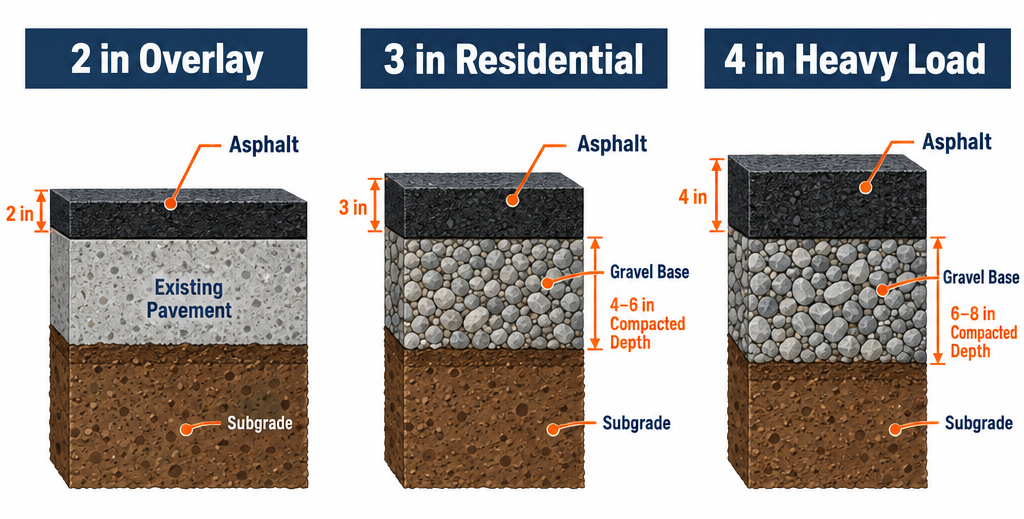
The right compacted thickness depends on what will drive on the pavement and what is under it. These are the common specs a residential paving contractor would quote.
| Project | Compacted thickness | Base under it |
|---|---|---|
| Overlay on sound existing asphalt | 1.5 to 2 in | Existing pavement, cleaned and tack-coated |
| New driveway, cars only | 2.5 to 3 in | 6 to 8 in compacted crushed stone |
| Driveway with RV, boat or box truck traffic | 4 in (often as two lifts) | 8 to 10 in compacted crushed stone |
| Walkway or patio | 2 in | 4 in compacted crushed stone |
| Small commercial lot | 3 in surface, sometimes over 2 in binder | 8 in or more compacted stone |
| Pothole or utility cut patch | Match the existing pavement, usually 3 to 4 in | Existing base, recompacted |
A single lift thicker than about 4 in is hard to compact uniformly with a small roller, so thick pavements go down as two layers, a coarser binder course and a finer surface course. Run each layer through the calculator separately, since the binder course often has a slightly different density and a different price.
Safety first
Hot mix arrives above 275°F and stays hot enough to cause serious burns for an hour. Wear leather gloves, long sleeves, long pants and boots with thick soles that will not melt. Keep children and pets away from the truck, the pile and the roller, and never stand between a backing dump truck and the paver.
Checking a contractor’s quote against the calculator
A paving quote should list the area, the compacted thickness and usually the tonnage. Run those numbers through the calculator yourself. If the contractor promises 3 in on 960 sq ft but the quote shows 12 tons of mix, something is off: 12 tons at 145 lb/cu ft covers 960 sq ft at only about 2 in. Either the thickness claim is wrong or the tonnage is, and you want to know which before the truck arrives.
The reverse check works too. Divide the tons delivered (from the scale tickets) by the area to find the actual average thickness:
Thickness (in) = Tons × 2,000 ÷ Density ÷ Area × 12
For 17.4 tons on 960 sq ft: 17.4 × 2,000 = 34,800 lb; ÷ 145 = 240 cu ft; ÷ 960 = 0.25 ft; × 12 = 3 in. If the tickets add up to 12 tons on the same driveway, you received about 2.1 in and you have grounds to question the invoice.
Pro tip
Measure thickness during the pour, not after. Push a stiff wire or a nail into the loose mat behind the screed and compare it to the loose target (compacted thickness × 1.25). Two or three checks per truckload catch a thin spot while there is still hot mix on the truck to fix it.
Cubic yards, cubic feet and tons: converting between them
Because the calculator shows volume as well as weight, here are the conversions it uses so you can move between units when a supplier or a spec sheet uses something different.
- 1 cu ft of compacted hot mix = 145 lb (at the default density)
- 1 cu yd = 27 cu ft = 3,915 lb = 1.96 tons
- 1 ton = 2,000 lb = 13.8 cu ft = 0.51 cu yd
- 1 ton covers 165.5 sq ft at 1 in, 82.8 sq ft at 2 in, 55.2 sq ft at 3 in, 41.4 sq ft at 4 in
That last line is the fastest mental check on a job site. At 3 in compacted, one ton covers about 55 sq ft, so a 960 sq ft driveway needs 960 ÷ 55 ≈ 17.5 tons. Close enough to the calculator’s 17.4 to confirm you entered the numbers correctly.
If you are more comfortable in yards from ordering gravel or concrete, a cubic yard calculator will give you volume and you can multiply by 1.96 for tons of asphalt. Just remember the comparison does not carry across materials: concrete is heavier (about 150 lb/cu ft) and is sold by the yard, which is why a concrete calculator reports yards and this one reports tons.
Cold weather, cooling and how it affects your order
Hot mix loses workability fast once it leaves the plant. The thinner the lift and the colder the day, the less time you have. A 1.5 in overlay on a 50°F day with wind can be too stiff to roll properly within 15 minutes of leaving the truck, while a 3 in lift at 80°F stays workable for the better part of an hour.
This affects ordering in two ways. First, order the whole job in as few loads as possible so there are no cold joints. Second, in marginal weather consider going slightly thicker rather than thinner, since a thicker mat holds heat longer and compacts better. Most contractors will not pave below about 50°F air temperature for thin overlays, and most plants in northern states shut down from roughly November to April, so plan the order inside the paving season.
When to call a pro
Any area over about 200 sq ft of hot mix is a paving crew job: you need a paver or at least a skilled rake crew, a 1 to 3 ton roller and enough hands to place a truckload before it cools. Also call a licensed paving contractor if the existing driveway has alligator cracking or sinking (the base has failed and needs excavation and new stone), if the driveway connects to a public street (most municipalities require a curb cut or right-of-way permit), or if the grade drains toward the house or garage. DIY is realistic for pothole repair with cold patch, small walkway patches and sealcoating.
FAQ
How many tons of asphalt do I need for a driveway?
Multiply length by width in feet, multiply by compacted thickness in inches, divide by 12 for cubic feet, multiply by 145 and divide by 2,000. A 12 by 50 ft driveway at 2 in needs 7.25 tons; the same driveway at 3 in needs 10.9 tons. Add 5 to 10 percent and round up to a whole ton.
How much does an asphalt driveway cost according to the calculator?
The calculator gives material cost only: tons multiplied by your price per ton. At $110 per ton, the default 600 sq ft driveway is 7.25 × $110 = $798 in asphalt. Installed driveway prices from a contractor typically run $7 to $13 per square foot, so budget $4,200 to $7,800 for that same driveway built new with base and grading.
How thick should asphalt be on a driveway?
Three inches compacted over 6 to 8 in of compacted crushed stone is the standard for a residential driveway used by cars. Go to 4 in for RVs, boats or delivery trucks. An overlay on existing sound asphalt can be 1.5 to 2 in. Enter the finished, compacted figure in the calculator, not the loose spread depth.
What is the difference between a blacktop driveway cost calculator and an asphalt calculator?
Nothing. Blacktop is the everyday name for hot mix asphalt, so a blacktop driveway cost calculator uses the identical formula: area times thickness gives volume, volume times density gives weight, weight gives tons, tons times price gives cost.
How many square feet does a ton of asphalt cover?
At 145 lb/cu ft, one ton covers about 83 sq ft at 2 in compacted, 55 sq ft at 3 in and 41 sq ft at 4 in. At a thin 1 in it covers 165 sq ft, but 1 in is too thin for anything with traffic.
Why does the asphalt calculator use 145 lb per cubic foot?
That is the typical compacted density of hot mix asphalt across most mix designs, and it is the figure most plants and contractors use for quick tonnage. Actual mixes range from about 140 to 150. If your supplier gives you a density from the mix design, enter it in the Density (lb/cu ft) field for a tighter estimate.
How many tons of asphalt fit in a dump truck?
A single-axle dump hauls 5 to 8 tons, a tandem 12 to 16 tons and a tri-axle 20 to 25 tons. A modern half-ton pickup has a payload rating of roughly 1,500 to 3,000 lb depending on configuration, so even a well-equipped one hauls at most about a ton and a half per trip, which is why hot mix for anything over a small patch gets delivered.
Should I add a waste factor to the calculator result?
Yes. Add 5 percent for a simple rectangle on a well-graded base and 10 percent if the shape has curves, feathered edges or a rutted base. Then round up to a whole ton. Running short forces a second delivery and leaves a cold joint that cracks early.
Can I use the asphalt calculator for cold patch bags?
Use it to get pounds (tons × 2,000), then divide by the bag weight. The default driveway’s 14,500 lb would be 290 bags of 50 lb cold patch, which is why bagged product is for potholes and edges, not whole driveways. Cold patch compacts less densely than hot mix, so buy a couple of extra bags.
Does the calculator include base gravel or sealcoating?
No. It covers the asphalt layer only. Size the crushed stone base separately (6 to 8 in compacted for a residential driveway) and budget sealcoat as a per-square-foot item applied a year after the pavement cures.