
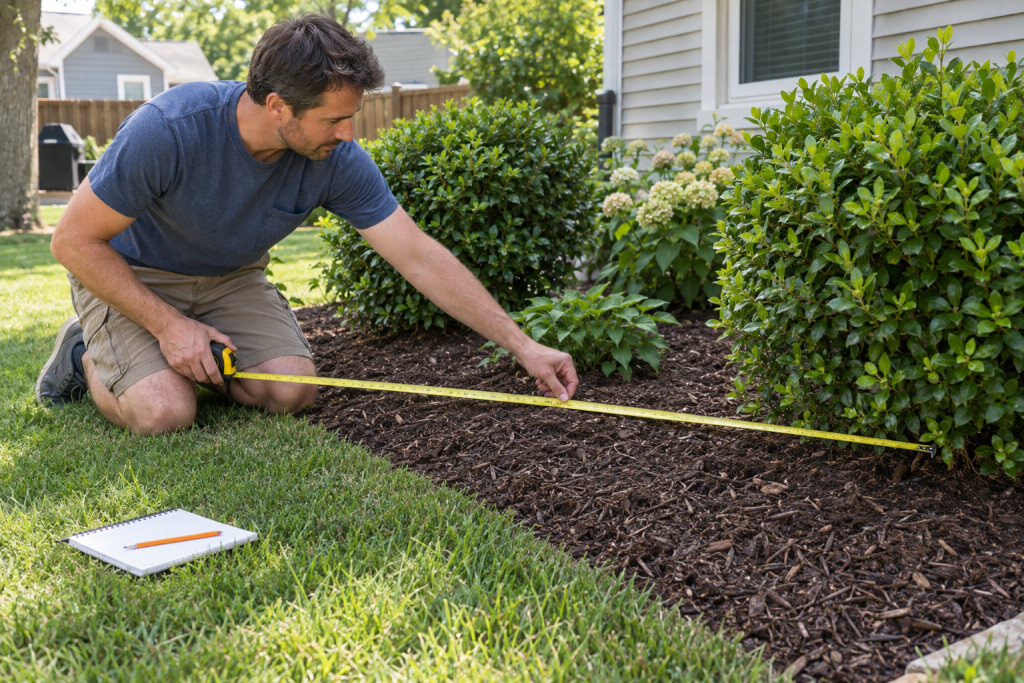
This cubic yard calculator turns three tape-measure numbers into the volume of topsoil, mulch, gravel, sand or concrete you need to order, in cubic yards, cubic feet, cubic meters and cubic inches. Measure the length and width of the area in feet, decide how deep the material will sit in inches, and enter how many identical areas you are filling. The result is the figure a bulk supplier or ready-mix plant will quote against.
Quick steps: use the cubic yard calculator
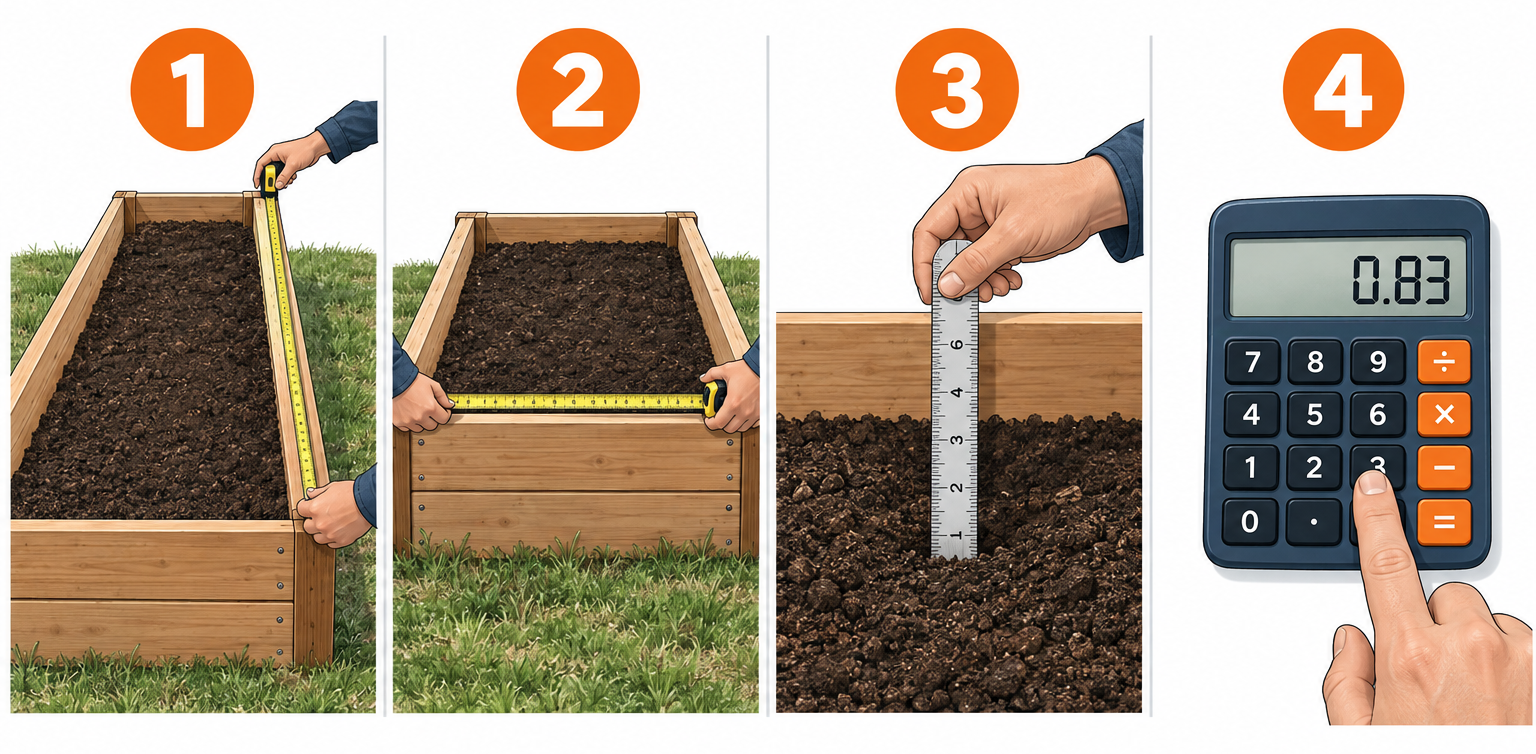
- Measure the longest side of the area in feet and enter it as Length (ft).
- Measure the shorter side in feet and enter it as Width (ft).
- Decide the finished depth in inches and enter it as Depth or height (in).
- Enter how many identical areas you are filling as Quantity.
- Read the Volume in cubic yards and the cubic feet figure for bagged material.
- Add 10 to 20 percent for compaction and settling before you order.
Tools and materials
- 25 ft or 100 ft tape measure (open-reel for driveways and lawns)
- Marking paint or garden stakes and string to outline the area
- 4 ft level or a straight 2×4 to check existing grade
- Notepad or phone to record each rectangle separately
- Wheelbarrow (6 cu ft) and square shovel for spreading
How to use the cubic yard calculator
The calculator has four fields. Each one needs a specific measurement, and most ordering mistakes trace back to one field being measured wrong.
Length (ft)
Measure the longest side of the area at ground level, in feet. Convert any inches to a decimal before entering: 12 ft 6 in is 12.5, not 12.6. Divide the inch figure by 12 to get the decimal. For a lawn or driveway, pull a 100 ft open-reel tape along the ground rather than pacing it off. Pacing is typically off by 5 to 10 percent, which on a long driveway can mean a full yard of gravel.
Width (ft)
Measure the shorter side in feet, again as a decimal. If the width changes along the length, as it does on most planting beds, take three measurements (each end and the middle) and use the average. For a bed that tapers from 6 ft to 2 ft, the average width is 4 ft.
Depth or height (in)
Enter the finished thickness of the material in inches, not feet. This is the field people get wrong most often, because it is the only one measured in inches. The calculator divides this number by 12 for you. Use these working depths:
- Mulch on established beds: 2 to 3 in
- Mulch on new beds for weed control: 3 to 4 in
- Topsoil for a new lawn: 4 to 6 in
- Lawn topdressing: 0.25 to 0.5 in
- Compacted gravel base under pavers: 4 to 6 in
- Gravel driveway surface course: 3 to 4 in per layer
- Concrete slab for a patio or shed: 4 in
- Concrete slab for a driveway: 5 to 6 in
- Raised bed fill: measure the inside height of the frame, usually 12 to 18 in
Measure depth from the finished grade you want, not from the current surface. If you are replacing old mulch, scrape the old layer first or enter only the thickness you are adding.
Quantity
Enter the number of identical areas. Four 4 x 8 ft raised beds at 12 in deep is Length 8, Width 4, Depth 12, Quantity 4. The calculator multiplies the single-bed volume by four. If your beds are different sizes, run each size separately and add the cubic yard totals.
Measuring irregular shapes
The calculator works on rectangles, so break any odd shape into rectangles and add them up with the Quantity field or separate runs. For an L-shaped bed, measure the two legs as two rectangles. For a circle, multiply the diameter by itself and then by 0.785 to get the square footage, then enter that figure as Length with Width set to 1. A 12 ft diameter fire pit area becomes 12 x 12 x 0.785 = 113 sq ft, entered as Length 113, Width 1. If you already have an area figure from a square footage calculator, the same trick works: enter the square footage as Length and 1 as Width.
Common measuring mistakes
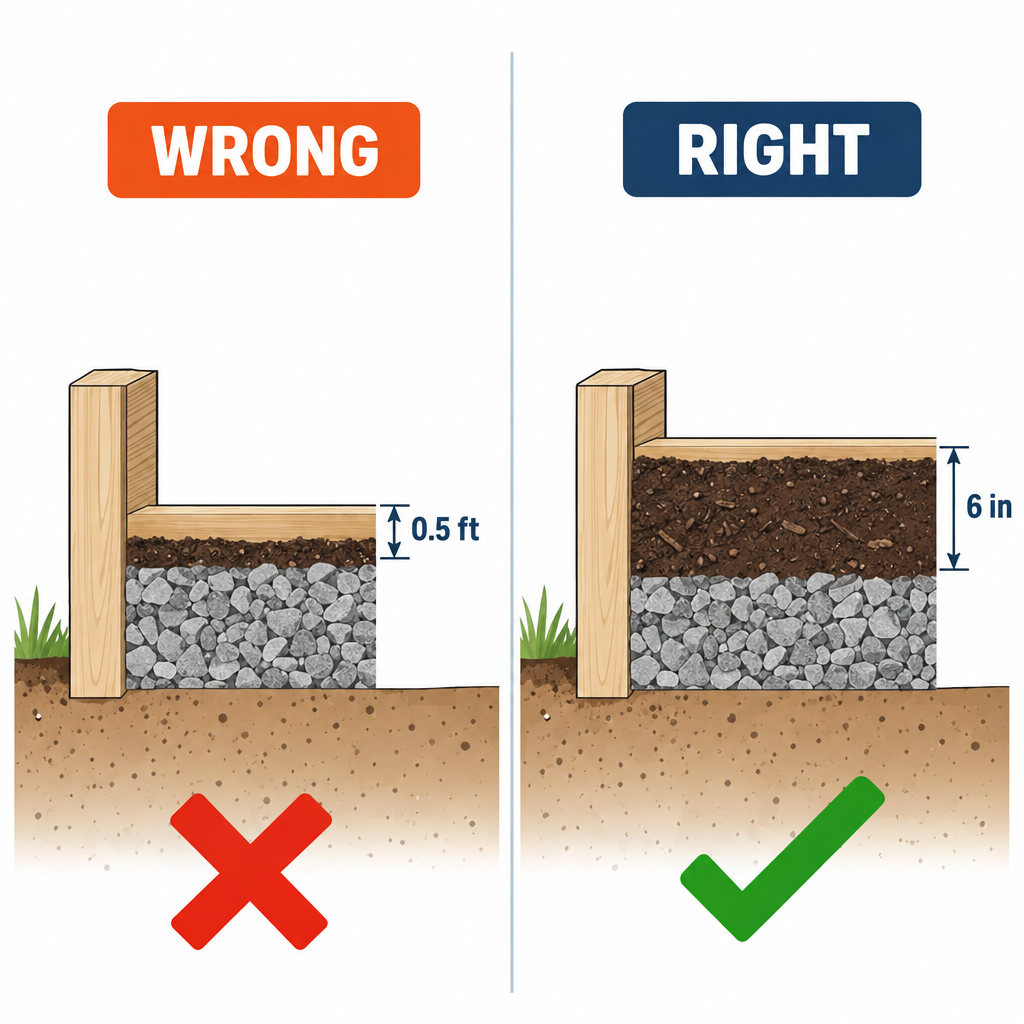
- Entering depth in feet instead of inches. A 0.5 in the depth field means half an inch, not six inches.
- Entering 10 ft 6 in as 10.6 instead of 10.5.
- Measuring the top of a sloped bed rather than the ground surface.
- Forgetting that a raised bed frame built from 2x lumber loses 1.5 in on each inside dimension. A frame built to 4 x 8 ft outside measures 3.75 x 7.75 ft inside.
- Measuring a driveway from the garage door to the street but forgetting the flared apron at the road.
The cubic yard formula, written out
The calculator uses one formula for every material:
Length (ft) x Width (ft) x Depth (in) / 12 x Quantity = cubic feet
Then it converts:
Cubic yards = cubic feet / 27
Cubic meters = cubic feet x 0.0283168
Cubic inches = cubic feet x 1,728
Each piece does one job. Length times width gives square feet of area. Dividing depth by 12 converts inches to feet so all three dimensions match. Multiplying by quantity scales for repeated areas. Dividing by 27 converts to cubic yards because a cubic yard is a 3 ft cube, and 3 x 3 x 3 = 27 cubic feet. The 0.0283168 figure is the exact number of cubic meters in one cubic foot.
Worked example with the default inputs
The calculator loads with Length 10, Width 10, Depth 6, Quantity 1. That is a 10 x 10 ft shed pad or patio at 6 in deep.
- Area: 10 x 10 = 100 sq ft
- Depth in feet: 6 / 12 = 0.5 ft
- Cubic feet: 100 x 0.5 x 1 = 50 cu ft
- Cubic yards: 50 / 27 = 1.85 cu yd
- Cubic meters: 50 x 0.0283168 = 1.42 m³
- Cubic inches: 50 x 1,728 = 86,400 cu in
So the calculator shows Volume 1.85 cu yd, Cubic feet 50, Cubic meters 1.42 and Cubic inches 86,400. Order 2 cubic yards of gravel for that pad, since suppliers sell in whole or half yards and a compacted base loses volume.
Second worked example: two mulch beds
Say you have two matching foundation beds along the front of the house, each 24 ft long and 4 ft wide, and you want a fresh 3 in layer of hardwood mulch.
- Area: 24 x 4 = 96 sq ft per bed
- Depth in feet: 3 / 12 = 0.25 ft
- Cubic feet per bed: 96 x 0.25 = 24 cu ft
- Both beds: 24 x 2 = 48 cu ft
- Cubic yards: 48 / 27 = 1.78 cu yd
- Cubic meters: 48 x 0.0283168 = 1.36 m³
Enter Length 24, Width 4, Depth 3, Quantity 2 and the calculator returns 1.78 cu yd. Mulch is sold by the yard in bulk or by the 2 cu ft bag, so you would order 2 yards delivered, or 24 bags (48 / 2). The mulch calculator on this site runs the same math with bag counts built in.
Third example: a gravel driveway
A 12 ft wide, 50 ft long driveway needs a 4 in surface course of 3/4 in crushed stone.
- Area: 12 x 50 = 600 sq ft
- Depth in feet: 4 / 12 = 0.333 ft
- Cubic feet: 600 x 0.333 = 200 cu ft
- Cubic yards: 200 / 27 = 7.41 cu yd
Crushed stone compacts roughly 10 to 20 percent under a plate compactor, so order 8.5 to 9 yards, not 7.5. That is close to a full tandem dump truck load, which usually gets you a better per-yard price than two small loads.
Quick-reference table: cubic yards for a 10 x 10 ft area
Every figure below uses Length 10, Width 10, Quantity 1 and the formula above. For a different area, multiply the cubic yard figure by your square footage divided by 100. A 250 sq ft bed at 3 in needs 0.93 x 2.5 = 2.3 cu yd.
| Depth (in) | Cubic feet | Cubic yards | Typical use |
|---|---|---|---|
| 0.5 | 4.17 | 0.15 | Lawn topdressing with compost |
| 1 | 8.33 | 0.31 | Thin refresh over existing mulch |
| 2 | 16.67 | 0.62 | Mulch on established beds |
| 3 | 25 | 0.93 | Standard mulch depth, pea gravel path |
| 4 | 33.33 | 1.23 | Patio concrete slab, paver base |
| 6 | 50 | 1.85 | Driveway slab, new lawn topsoil |
| 8 | 66.67 | 2.47 | Heavy gravel base, footing trench |
| 12 | 100 | 3.70 | Raised bed fill, fill dirt |
Cubic yards for common projects
These are computed with the same formula. Measure your own job, but use these to sanity-check your result before ordering.
| Project | Dimensions | Cubic feet | Cubic yards | Order (with extra) |
|---|---|---|---|---|
| One 4 x 8 ft raised bed, 12 in deep | 8 x 4 x 12 | 32 | 1.19 | 1.5 yd garden mix |
| One 4 x 8 ft raised bed, 18 in deep | 8 x 4 x 18 | 48 | 1.78 | 2 yd garden mix |
| Garden path, 3 ft wide, 20 ft long, 4 in pea gravel | 20 x 3 x 4 | 20 | 0.74 | 1 yd pea gravel |
| Paver patio base, 12 x 12 ft, 6 in crushed stone | 12 x 12 x 6 | 72 | 2.67 | 3 yd crushed stone |
| Shed slab, 10 x 12 ft, 4 in concrete | 12 x 10 x 4 | 40 | 1.48 | 1.75 yd ready-mix |
| Single-car driveway, 10 x 40 ft, 4 in gravel | 40 x 10 x 4 | 133.33 | 4.94 | 5.5 to 6 yd gravel |
| Two-car driveway slab, 20 x 24 ft, 5 in concrete | 24 x 20 x 5 | 200 | 7.41 | 8 yd ready-mix |
| New lawn, 50 x 40 ft, 4 in topsoil | 50 x 40 x 4 | 666.67 | 24.69 | 28 yd screened topsoil |
| Lawn topdress, 50 x 40 ft, 0.5 in compost | 50 x 40 x 0.5 | 83.33 | 3.09 | 3.5 yd compost |
Pro tip
Before a bulk delivery, lay a tarp where the truck will dump and mark the pile footprint with paint. One cubic yard dumped from a truck makes a cone roughly 5 ft across and 3 ft tall. Three yards of gravel on a driveway blocks a car for the afternoon, so plan the drop spot where it does not trap your vehicle.
Buying and ordering: bulk, bags and delivery
Units suppliers use
Landscape yards and quarries sell soil, mulch, sand and stone by the cubic yard, usually in half-yard increments. When a supplier says “a yard,” they mean a cubic yard. Some quarries sell stone and sand by the ton instead. Convert with the material weight: crushed stone and gravel run about 1.4 tons per cubic yard, sand about 1.3 to 1.5 tons, screened topsoil about 1 to 1.3 tons depending on moisture, and hardwood mulch only 0.2 to 0.4 tons. Ready-mix concrete is ordered by the cubic yard to the nearest quarter yard, and a concrete calculator will add the bag count if you are mixing your own.
Bulk vs bags
Bags make sense below about one cubic yard, or anywhere a dump truck cannot reach. Above that, bulk is cheaper per yard and spares you the lifting. A single cubic yard of soil is 36 bags at 0.75 cu ft each, which is roughly 1,400 lb of bags to carry from the car.
| Bag size | Bags per cubic yard | Common products |
|---|---|---|
| 0.5 cu ft | 54 | 40 to 50 lb bags of gravel, sand, paver base |
| 0.75 cu ft | 36 | Bagged topsoil, garden soil |
| 1 cu ft | 27 | Compost, manure, potting mix |
| 1.5 cu ft | 18 | Premium garden soil, raised bed mix |
| 2 cu ft | 13.5 (buy 14) | Standard hardwood and dyed mulch |
| 3 cu ft | 9 | Bulk-size mulch and bark bags |
| 60 lb concrete mix (0.45 cu ft yield) | 60 | Small slabs, post footings |
| 80 lb concrete mix (0.60 cu ft yield) | 45 | Slabs, steps, footings |
To get a bag count from the calculator, take the cubic feet figure and divide by the bag’s cubic feet. The 50 cu ft default pad in 0.5 cu ft gravel bags is 100 bags, which is the point where a bulk delivery pays for itself.
Delivery minimums and fees
Most landscape suppliers set a minimum delivery of 1 to 3 cubic yards and charge a flat delivery fee, commonly $50 to $150 depending on distance. Many will let you mix materials on one truck, so 2 yards of mulch and 1 yard of topsoil can share a fee. A standard single-axle dump truck carries about 5 to 7 yards of soil or stone, and a tandem carries 10 to 15 yards. Ready-mix plants charge a short-load fee on any order under a full truck, usually 8 to 10 yards, so a 1.5 yard slab pour can cost nearly as much as 3 yards. For small pours, bagged mix or a tow-behind mixer trailer from a rental yard is often cheaper.
Realistic bulk prices
Prices vary widely by region and distance from the quarry. These are typical material-only ranges per cubic yard at a landscape supply yard, before delivery:
| Material | Typical price per cubic yard |
|---|---|
| Fill dirt (unscreened) | $10 to $25 |
| Screened topsoil | $20 to $50 |
| Garden mix or compost blend | $35 to $70 |
| Hardwood mulch (natural) | $25 to $50 |
| Dyed or cedar mulch | $35 to $70 |
| 3/4 in crushed stone (#57) | $35 to $65 |
| Crusher run or road base | $25 to $55 |
| Pea gravel | $40 to $75 |
| Decorative river rock | $80 to $200 |
| Mason or concrete sand | $25 to $50 |
| Ready-mix concrete (3,000 to 4,000 psi) | $125 to $175, plus short-load fee |
Call two suppliers with your yardage and ask for the delivered price. A yard 30 miles closer can beat a lower per-yard price once the delivery fee is added.
How much extra to order
Add 10 percent to any order as a baseline. Go to 15 or 20 percent for crushed stone, road base and fill dirt that will be compacted, because the plate compactor or roller squeezes out air and the pile that measured 5 yards loose settles to 4.2 yards packed. Add 5 to 10 percent for mulch to cover edges and low spots. For concrete, order 10 percent over the calculated figure for a slab on grade, because subgrades are never perfectly flat and running 0.3 yards short mid-pour means a cold joint and a second truck fee. Leftover gravel and soil keep indefinitely in a pile under a tarp, so over-ordering costs far less than the second delivery charge.
Pro tip
Ask the supplier for the weight ticket when stone or sand is sold by the ton. Divide tons by 1.4 to check you received the yardage you paid for. Loader buckets are not calibrated, and a “yard” scooped by a generous operator can be 0.8 yards, which is why a job that calculated cleanly still comes up short.
Common mistakes that cause running short or over-buying
| Problem | Likely cause | Fix |
|---|---|---|
| Ordered half what you needed | Entered depth in feet, or inches as a decimal of feet | Depth field is inches; 6 means 6 in |
| Ordered double what you needed | Entered width twice or used outside dimensions of a raised bed | Measure inside the frame, enter each dimension once |
| Gravel base is thin after compacting | Did not add compaction allowance | Order 15 to 20 percent over for crushed stone and base |
| Mulch ran out on the last bed | Beds narrower in the middle than at the ends were measured at the widest point | Average three width measurements per bed |
| Pile looks far smaller than expected | Supplier sold by the ton and loader scoops were light | Check the weight ticket; 1 yard of stone is about 2,800 lb |
| Concrete truck came up short on the slab | Subgrade dug deeper in places than planned | Measure depth at 6 to 8 points, use the deepest, add 10 percent |
| Topsoil settled below the edging in a month | No settling allowance on loose soil | Mound soil 1 to 2 in above finished grade; order 15 percent over |
| Too many bags, paid a restocking fee | Divided cubic yards by bag size instead of cubic feet | Bags are in cubic feet; use the calculator’s cubic feet output |
Safety first
A cubic yard of gravel, sand or wet topsoil weighs 2,000 to 3,000 lb. A modern half-ton pickup is typically rated for roughly 1,500 to 2,300 lb of payload depending on configuration, with some trucks rated higher, so check the door-jamb sticker, haul no more than half a yard of stone or soil per trip, and never load a yard of wet soil in a bed meant for mulch. Keep delivery trucks off septic drain fields, buried utilities and paver edges.
When to call a pro
Any slab over about 3 cubic yards, any slab with structural footings, or a driveway that needs a graded, compacted base to a spec is a job for a concrete contractor or excavation contractor. Lawn regrading that changes drainage toward a house or a neighbor’s lot needs a grading contractor and often a permit. Fill over 12 in deep near a foundation should be engineered and compacted in lifts.
Converting cubic yards: feet, inches, meters and tons
The calculator reports every result in cubic yards, cubic feet, cubic meters and cubic inches at the same time, which handles the usual cubic yard conversion questions without a second tool.
- 1 cubic yard = 27 cubic feet
- 1 cubic yard = 46,656 cubic inches
- 1 cubic yard = 0.7646 cubic meters
- 1 cubic foot = 0.037 cubic yards (or 1/27)
- 1 cubic foot = 1,728 cubic inches
- 1 cubic foot = 0.0283168 cubic meters
- 1 cubic yard of water = about 202 gallons
- 1 cubic yard = 4.5 standard 6 cu ft wheelbarrow loads
To go from cubic yards back to cubic feet, multiply by 27. To go from cubic feet to cubic yards, divide by 27. A 100 cu ft figure from a bag label or a dumpster quote is 3.7 cu yd. Roll-off dumpsters are sized in cubic yards too, so a 10-yard container holds 270 cubic feet of debris. If you break out an old 10 x 10 x 4 in slab with a jack hammer, the solid concrete is 1.23 cu yd, but broken rubble bulks up by about 50 percent and fills nearly 2 yards of dumpster. The same bulking applies when you excavate soil: 3 yards dug out needs 4 to 4.5 yards of hauling space.
FAQ
How many cubic feet in a cubic yard?
There are 27 cubic feet in a cubic yard. A cubic yard is a cube measuring 3 ft on every side, and 3 x 3 x 3 = 27. Divide any cubic foot figure by 27 to get cubic yards, which is exactly what the calculator does with the cubic feet it computes.
How many cubic yards are in a cubic foot?
One cubic foot is 0.037 cubic yards, or 1/27 of a yard. Three cubic feet is 0.11 cubic yards, and 13.5 cubic feet is half a yard. This is why a 2 cu ft bag of mulch covers so little: it takes 13.5 of them to make one yard.
How many feet are in a cubic yard?
A cubic yard measures 3 ft long, 3 ft wide and 3 ft tall. The question mixes a length unit with a volume unit, so the useful answer is that a cubic yard is a 3 x 3 x 3 ft cube holding 27 cubic feet. Spread out, that same yard covers 81 sq ft at 4 in deep, 108 sq ft at 3 in, or 324 sq ft at 1 in.
What is the difference between a yard and a cubic yard?
A yard is a length of 3 ft. A cubic yard is a volume of 27 cubic feet. When a landscape supplier or concrete plant quotes “per yard,” they always mean cubic yards. There is no cubic yard to yard conversion in the length sense; the two measure different things.
How do I calculate cubic yardage of a driveway in feet and inches?
Measure length and width in feet, converting inches to decimals (14 ft 3 in is 14.25). Pick the depth in inches, say 4. Multiply length x width x 4 / 12 for cubic feet, then divide by 27. A 14.25 x 60 ft driveway at 4 in is 14.25 x 60 x 0.333 = 285 cu ft, which is 10.56 cu yd. Order 12 yards of crushed stone to allow for compaction.
How many cubic yards fit in a pickup truck?
A half-ton pickup with a 6.5 ft bed can carry about 2 cubic yards of mulch by volume but only about half a yard of gravel, sand or wet soil by weight. A three-quarter-ton truck handles about 1 yard of stone. The limiting factor is almost always payload, not bed space, so check the door-jamb sticker before loading.
How much does a cubic yard weigh?
Hardwood mulch weighs 400 to 800 lb per cubic yard, dry screened topsoil about 2,000 lb, wet topsoil up to 2,700 lb, crushed stone and gravel 2,400 to 3,000 lb (crushed stone itself usually 2,800 to 3,000 lb), sand 2,600 to 3,000 lb and cured concrete about 4,000 lb. Suppliers that sell by the ton use roughly 1.4 tons per yard for stone and 1.3 tons for sand.
How many bags of concrete are in a cubic yard?
An 80 lb bag of standard concrete mix yields about 0.6 cu ft, so one cubic yard takes 45 bags. A 60 lb bag yields 0.45 cu ft, which is 60 bags per yard. For the default 10 x 10 ft, 6 in pad at 1.85 cu yd, that is 84 bags of 80 lb mix, or 50 cu ft divided by 0.6. At that quantity, ready-mix delivery or a mixer trailer beats bags on both cost and labor.
How much area does one cubic yard cover?
Divide 324 by the depth in inches to get square feet. One yard covers 324 sq ft at 1 in, 162 sq ft at 2 in, 108 sq ft at 3 in, 81 sq ft at 4 in and 54 sq ft at 6 in. Use this to size an order quickly when you know the bed area from a gravel calculator or square footage calculator and want a rough yardage before measuring depth precisely.