
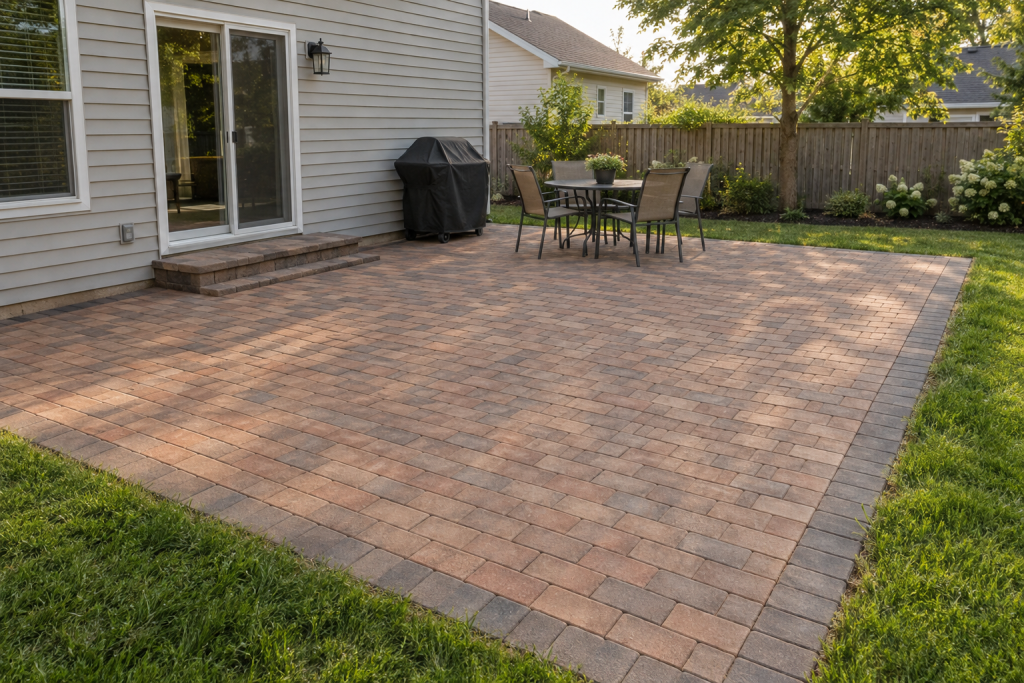
This paver calculator tells you how many pavers to buy, plus the cubic yards and tons of gravel base and bedding sand under them, with waste already added. You only need four numbers: the length and width of the patio in feet, and the length and width of one paver in inches. Everything else has a sensible default you can change.
Quick steps: use the paver calculator
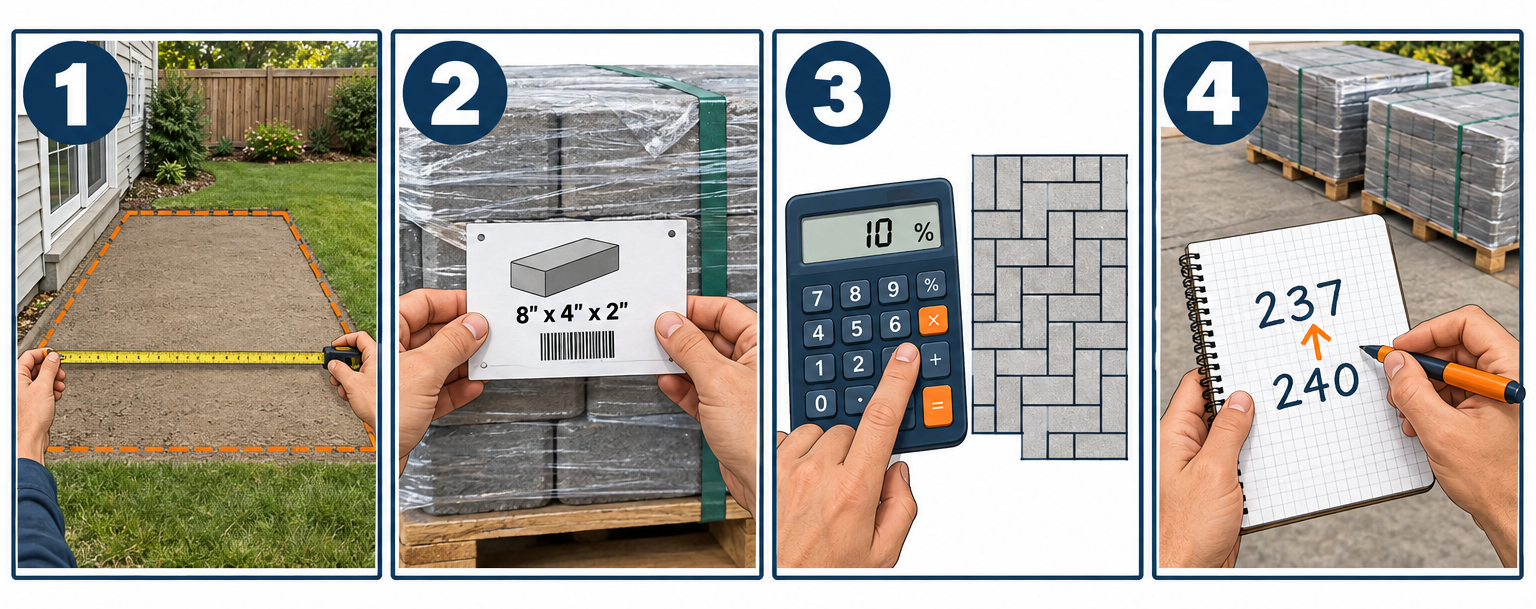
- Measure the patio length and width in feet; for an L shape, measure each rectangle and add the areas.
- Read the paver size off the pallet tag or box in inches, not the “nominal” size on the sign.
- Enter the numbers, then set Waste to 10% for running bond or 15% for herringbone and curves.
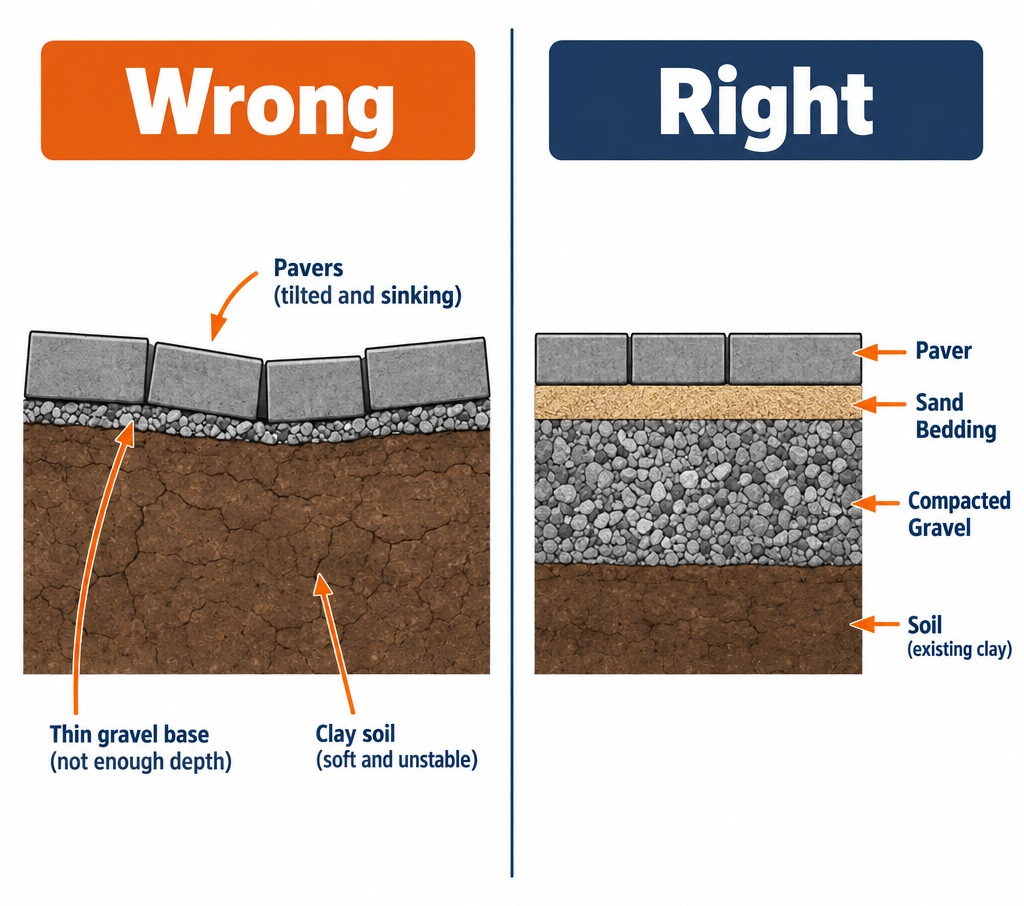
- Set Gravel base depth: 4 in for a patio on well-drained soil, 6 in on clay, 8 to 12 in for a driveway.
- Leave Sand bedding depth at 1 in unless your paver maker says otherwise.
- Round every result up to whole pavers, whole bags or the supplier’s delivery minimum.
How to use the paver calculator
The calculator sits at the top of this page. Each field below matches a field in it, and the measuring notes are where most people go wrong.
Patio length (ft) and Patio width (ft)
Measure the finished paved area, not the yard. Run a tape along the longest edge for the length, then across the widest point for the width. Enter feet as decimals, so 12 ft 6 in becomes 12.5.
For an L-shaped or T-shaped patio, break it into rectangles. Calculate each one, add the paver counts, and add the gravel and sand totals. A fast way to do that is a square footage calculator for the whole footprint, then enter the total as a single rectangle such as 1 ft by the total area.
For a round or curved patio, measure the largest rectangle that contains the curve. Pavers along a curve get cut, so the “wasted” offcuts are real. Keep the rectangle measurement and bump the waste field, not the dimensions.
Measuring mistakes that cost money:
- Measuring inside an existing edge instead of to the outside of the planned edge restraint. Add about 2 in on every side if you want the pavers to overhang a step or wall.
- Mixing feet and inches. A 10 ft 4 in width is 10.33, not 10.4.
- Forgetting the border course. A soldier course of the same paver still counts as area, so it is already in the number. A different-size border paver needs its own run through the calculator.
Paver length (in) and Paver width (in)
Use the actual face dimensions printed on the pallet tag. Most concrete pavers sold in the US as “4 x 8” measure closer to 3-7/8 by 7-7/8 in to leave room for a sand joint, and the calculator math already treats that gap as part of the paver, so the nominal 4 by 8 is correct to enter. Natural stone and large-format slabs vary more. A “12 x 24” porcelain paver is often 11-3/4 by 23-5/8, and on a big patio that difference adds up to a few extra pieces. If you have one in hand, measure it.
The default is 4 in by 8 in, the most common holland-style brick paver. Other common sizes are 6 x 6, 6 x 9, 12 x 12, 6 x 12, 16 x 16 and 12 x 24 in.
Multi-size kits (a 6 x 6, 6 x 9 and 9 x 9 in a repeating pattern) are sold by the square foot per pallet, not by the piece. For those, set the paver size to 12 x 12 in. The calculator then returns square feet with waste, which is how you order them.
Waste (more for herringbone and curves) (%)
Waste covers cuts along edges, broken pieces on the pallet, and spares for repairs years later. Use 5% for a square patio in running bond with no cuts, 10% for a typical rectangular patio, 15% for herringbone or a 45-degree layout, and 15 to 20% for curves and circles. Never go below 5%. Dye lots change, and matching three pavers from next year’s pallet to a patio laid this year rarely works.
Gravel base depth (in)
This is the compacted depth of crushed stone under the sand. Use 4 in for a patio or walkway on sandy or gravelly soil that drains well, 6 in on clay or anywhere the ground stays wet, and 8 to 12 in for a driveway that carries cars. The number is the finished, compacted thickness, so you will order more loose material than this; the buying section covers that.
Sand bedding depth (in)
One inch is the industry standard for a screeded bedding layer of coarse concrete sand. Go thicker and the pavers shift and settle unevenly; go thinner and you cannot screed a flat plane. The only reason to change this is a manufacturer spec for permeable pavers, which often call for 2 in of small chip stone instead of sand.
The paver calculator formula, with two worked examples
Every number the calculator shows comes from three short formulas. Running them by hand lets you check an estimate from a contractor or a big-box store.
Pavers = patio area ÷ (paver length × paver width ÷ 144) × (1 + waste)
The 144 converts square inches to square feet, so the bracket is the area of one paver in square feet. Dividing the patio area by that gives the bare count, and the waste multiplier adds the spares.
Gravel base, cubic yards = area × base depth (in) ÷ 12 ÷ 27, and tons = cubic yards × 1.4
Dividing by 12 turns inches of depth into feet, which gives cubic feet. Dividing by 27 turns cubic feet into cubic yards. Compacted crushed stone weighs roughly 1.4 tons per cubic yard.
Bedding sand, cubic yards = area × sand depth (in) ÷ 12 ÷ 27, and tons = cubic yards × 1.35
Same conversion, with 1.35 tons per cubic yard for damp concrete sand.
Worked example 1: the default inputs
A 12 ft by 12 ft patio with 4 x 8 in pavers, 10% waste, 4 in of base and 1 in of sand.
- Area: 12 × 12 = 144 sq ft
- One paver: 8 × 4 = 32 sq in, ÷ 144 = 0.2222 sq ft
- Bare count: 144 ÷ 0.2222 = 648 pavers
- With waste: 648 × 1.10 = 712.8, rounded to 713 pavers
- Gravel: 144 × 4 = 576, ÷ 12 = 48 cu ft, ÷ 27 = 1.78 cu yd, × 1.4 = 2.49 tons
- Sand: 144 × 1 = 144, ÷ 12 = 12 cu ft, ÷ 27 = 0.44 cu yd, × 1.35 = 0.6 tons
That is exactly what the calculator shows with the defaults.
Worked example 2: a 20 x 16 ft herringbone patio on clay
A bigger patio using 6 x 12 in pavers laid in herringbone, so waste goes to 15%, on clay soil with a 6 in base.
- Area: 20 × 16 = 320 sq ft
- One paver: 12 × 6 = 72 sq in, ÷ 144 = 0.5 sq ft
- Bare count: 320 ÷ 0.5 = 640 pavers
- With waste: 640 × 1.15 = 736 pavers
- Gravel: 320 × 6 = 1,920, ÷ 12 = 160 cu ft, ÷ 27 = 5.93 cu yd, × 1.4 = 8.30 tons
- Sand: 320 × 1 = 320, ÷ 12 = 26.67 cu ft, ÷ 27 = 0.99 cu yd, × 1.35 = 1.33 tons
Notice the gravel more than tripled while the area only doubled. The deeper base is the bigger cost driver on poor soil, not the pavers.
Quick-reference tables
All three tables use the same formula as the calculator, with 10% waste unless stated.
Pavers needed for a 144 sq ft patio by paver size
| Paver size (in) | Area per paver (sq ft) | Bare count | With 10% waste |
|---|---|---|---|
| 4 x 4 | 0.111 | 1,296 | 1,426 |
| 4 x 8 | 0.222 | 648 | 713 |
| 6 x 6 | 0.25 | 576 | 634 |
| 6 x 9 | 0.375 | 384 | 422 |
| 6 x 12 | 0.5 | 288 | 317 |
| 12 x 12 | 1.0 | 144 | 158 |
| 16 x 16 | 1.778 | 81 | 89 |
| 12 x 24 | 2.0 | 72 | 79 |
To scale to your patio, divide your area by 144 and multiply the last column. A 288 sq ft patio in 6 x 9 pavers needs 844.
Gravel base and bedding sand by patio area (4 in base, 1 in sand)
| Area (sq ft) | Gravel cu yd | Gravel tons | Sand cu yd | Sand tons |
|---|---|---|---|---|
| 100 | 1.23 | 1.73 | 0.31 | 0.42 |
| 144 | 1.78 | 2.49 | 0.44 | 0.60 |
| 200 | 2.47 | 3.46 | 0.62 | 0.83 |
| 300 | 3.70 | 5.19 | 0.93 | 1.25 |
| 400 | 4.94 | 6.91 | 1.23 | 1.67 |
| 500 | 6.17 | 8.64 | 1.54 | 2.08 |
| 600 | 7.41 | 10.37 | 1.85 | 2.50 |
Gravel base for a 144 sq ft area by depth (paver base calculator)
| Base depth (in) | Typical use | Cu yd | Tons |
|---|---|---|---|
| 4 | Patio or walk, sandy soil | 1.78 | 2.49 |
| 6 | Patio on clay, heavy foot traffic | 2.67 | 3.73 |
| 8 | Driveway, light vehicles | 3.56 | 4.98 |
| 10 | Driveway, clay soil | 4.44 | 6.22 |
| 12 | Driveway, trucks or frost-prone clay | 5.33 | 7.47 |
For a driveway, run your area through this same formula at 8 to 12 in. If you are comparing against a poured slab or blacktop, a concrete calculator or asphalt calculator gives the competing material quantities for the same footprint.
Buying and ordering: bags, bulk, tons and minimums
Suppliers do not sell in the units you measured in, so the last step is converting.
Pavers
Big-box stores sell pavers by the piece, and often by the pallet or “band.” A pallet of 4 x 8 concrete pavers is commonly around 480 to 500 pieces, roughly 100 to 110 sq ft, though it varies by maker. Masonry yards and stone suppliers usually sell by the square foot and ship by the pallet. Ask for the exact pallet count before you decide whether 713 pavers means one pallet plus loose pieces or two full pallets.
Realistic US pricing in 2024 and 2025 for material only runs about $2 to $5 per sq ft for basic concrete pavers at a home center, $5 to $10 per sq ft for premium concrete and porcelain, and $10 to $25 per sq ft for natural stone such as bluestone or travertine. Prices move with region and freight, so treat these as planning ranges and get a local quote.
Gravel base
Crushed stone for a base goes by several names: crusher run, ABC, road base, 3/4-in minus, or “paver base” in a bag. You want a blend of 3/4 in stone down to fines, not clean washed stone, because the fines lock up when compacted.
Bulk is sold by the ton or cubic yard. Most yards deliver with a minimum of 1 to 3 tons, and delivery runs roughly $50 to $150 depending on distance. Bulk crushed stone itself typically costs $25 to $60 per ton. For the default patio, 2.49 tons of base is one small dump delivery, or two to three loads in a half-ton pickup with a trailer. A loaded half-ton truck safely carries about half a ton of stone, so hauling it yourself only makes sense for walkways.
Bagged paver base comes in 0.5 cu ft bags at $4 to $7 each. A cubic yard is 27 cu ft, so 1.78 cu yd is 48 cu ft, or 96 bags. That is $400 to $650 for base that costs about $80 to $150 in bulk. Bags make sense under about 50 sq ft, or where a dump truck cannot reach.
Order more than the calculator’s cubic yards. The depth you entered is compacted, and loose crushed stone loses 10 to 20% of its volume under a plate compactor. Add 15% to the cubic yard figure when ordering loose bulk. The ton figure already reflects compacted weight, so if your supplier sells by weight, the 1.4 tons per cubic yard assumption holds whether it is loose or compacted. Weight does not compact; volume does.
Bedding sand
Ask for coarse concrete sand, washed, meeting ASTM C33. Do not use play sand, mason sand or “paver sand” meant for joints; fine sand holds water and lets pavers rock. Bulk concrete sand runs about $20 to $50 per ton plus delivery. Bagged, it is the same 0.5 cu ft size at $4 to $6 a bag, so the default 0.44 cu yd (12 cu ft) is 24 bags, or 0.6 tons bulk. Sand does not compact much under screeding, so order the calculator’s figure plus 10% for the sand that disappears into the gravel voids.
Pro tip
Have the sand and gravel dumped on a tarp, with the gravel pile closest to the patio and the sand behind it. You move every ton of base first, and nobody wants to wheel sand across a pile of stone twice.
Joint sand and edging
The calculator does not count joint sand or edge restraint, so add them to your order. Polymeric joint sand comes in 50 lb bags, and a bag typically fills the joints on roughly 35 to 75 sq ft of standard 4 x 8 pavers depending on joint width, so a 144 sq ft patio needs two to four bags at about $25 to $45 each. Plastic or aluminum edge restraint is sold in 8 or 10 ft sticks; measure the exposed perimeter (48 ft for a 12 x 12 patio, less any edge against a house wall) and add 10% for cuts. Budget about $1 to $3 per linear foot plus 10 in spikes every 12 in.
Paver installation cost calculator: what the whole job costs
If you hire the job out, the material numbers above become a minor line. Installed paver patio prices in most of the US run about $10 to $25 per sq ft, and driveways run $12 to $30 per sq ft because of the thicker base and heavier compaction. The default 144 sq ft patio is roughly $1,500 to $3,600 installed, versus about $600 to $1,300 in materials if you do it yourself with mid-range concrete pavers.
Rough DIY material budget for the default 144 sq ft patio, using the ranges above:
| Item | Quantity | Typical cost |
|---|---|---|
| 4 x 8 concrete pavers, 713 pcs | ~158 sq ft incl. waste | $320 to $800 |
| Crushed stone base, bulk | 2.5 tons (order ~2.9) | $65 to $175 plus delivery |
| Concrete sand, bulk | 0.6 tons (order ~0.7) | $15 to $35 plus delivery |
| Delivery | 1 trip | $50 to $150 |
| Polymeric sand | 2 to 3 bags | $50 to $135 |
| Edge restraint and spikes | 48 ft | $50 to $150 |
| Plate compactor rental | 1 day | $60 to $120 |
The Lowe’s paver calculator and Home Depot’s version both stop at paver count and roughly estimated sand. That is fine for choosing a pallet, but they do not give you base tonnage by depth, which is the number that decides whether you need a dump truck.
Common mistakes that leave you short or over-bought
- Using the sign size instead of the tag size. A “12 x 12” slab that measures 11-3/4 in square covers 4% less area. On 400 sq ft that is 17 missing pavers.
- Entering 10% waste for a herringbone or circle. Every edge paver in a 45-degree herringbone gets cut, and you cannot use both halves. Use 15% minimum.
- Ordering compacted volume as loose volume. The calculator’s 1.78 cu yd is after compaction. Order 2 to 2.1 cu yd loose, or 2.5 tons by weight.
- Buying washed stone for the base. Clean 3/4 in stone never locks; it rolls under the compactor. You want crusher run with fines.
- Skipping the excavation math. The hole depth is base plus sand plus paver thickness. For a 4 in base, 1 in sand and a 2-3/8 in paver, you dig 7-3/8 in below finished grade. Most first-timers dig too shallow, then “fix” it with 3 in of sand, and the patio dips within a year.
- Measuring the area after excavation. Dig the hole 6 to 8 in wider than the patio on every open side so the base extends past the edge restraint. The extra base is real material, so add about 1 ft to each open dimension in the gravel calculation, but not the paver calculation.
- Buying one pallet because it is “close enough.” A 480-piece pallet is 233 short of 713. The second pallet is cheaper per piece than loose pavers, and the leftovers are your repair stock.
- Forgetting slope. A patio needs to fall 1/8 to 1/4 in per foot away from the house. That does not change quantities, but it does change string line heights, and it is the thing contractors fix most when they take over a stalled DIY job.
Pro tip
Screed the sand in sections about 3 ft wide using two lengths of 1 in EMT conduit as rails and a straight 2×4. Pull the rails as you go and fill the grooves. Do not walk on screeded sand, ever. Lay pavers from the finished edge forward and stand on the pavers.
Safety first
Call 811 before you dig; a 7 in excavation easily reaches gas service lines, irrigation and low-voltage lighting. Wear hearing protection and steel-toe boots around a plate compactor, and keep the cut-off saw wet to control silica dust.
When to call a pro
Hire a hardscape contractor when the area carries vehicles, when the patio needs a retaining wall taller than 2 ft, when a sloped yard needs more than about 12 in of cut or fill, or when drainage runs toward the house. Permeable paver systems with engineered sub-bases, and anything tied into a pool deck, also belong with a licensed installer. Many municipalities require a permit for hardscape over a set square footage or anything with a wall, so check before ordering material.
FAQ
How much sand do I need for pavers?
For a 1 in bedding layer, divide the area in square feet by 324 to get cubic yards, then multiply by 1.35 for tons. A 144 sq ft patio needs 0.44 cu yd, or 0.6 tons, or 24 bags of 0.5 cu ft. Add 10% for sand lost into the gravel. This is the sand for pavers calculator built into the tool above; joint sand is separate and runs about one 50 lb bag per 50 to 100 sq ft.
How much gravel base do I need under pavers?
Multiply the area by the depth in inches, divide by 12, then by 27 for cubic yards, and by 1.4 for tons. A 4 in base under 144 sq ft is 1.78 cu yd or 2.49 tons compacted. Order about 15% more loose volume to allow for compaction. If you are also spreading stone elsewhere on the property, a gravel calculator handles paths and drainage beds the same way.
How many pavers do I need for a 10 x 10 patio?
A 10 x 10 ft patio is 100 sq ft. With 4 x 8 in pavers (0.222 sq ft each) that is 450 bare, or 495 with 10% waste. With 12 x 12 in pavers it is 100 bare, 110 with waste. Enter 10 and 10 in the calculator with your real paver size for an exact count.
What waste percentage should I use?
Use 5% for a square area with no cuts, 10% for a typical rectangle in running bond, basket weave laid square to the edges or 90-degree herringbone, 15% for 45-degree herringbone or any diagonal layout, and 15 to 20% for curves and circles. Always keep some spares; dye lots rarely match later.
How much does a paver patio cost per square foot?
Installed, expect about $10 to $25 per sq ft in most US markets for concrete pavers, more for natural stone. Material only for DIY is typically $4 to $9 per sq ft including base, sand, edging and joint sand. Run your area through the calculator, then multiply the square footage by a local installed rate for a quick paver patio cost estimate.
How much does a paver driveway cost?
Driveways run about $12 to $30 per sq ft installed because the base is 8 to 12 in instead of 4, and compaction is done in multiple lifts. A 600 sq ft driveway with a 10 in base needs about 18.5 cu yd of crushed stone, roughly 26 tons, which is two or three dump truck loads before a single paver goes down.
Does the calculator include joint sand and edge restraint?
No. It returns pavers, gravel base and bedding sand only. Add polymeric joint sand at about one bag per 50 to 100 sq ft and edge restraint for the exposed perimeter plus 10%.
Can I use the calculator for an irregular or round patio?
Yes. Break the shape into rectangles and add the results, or measure the smallest rectangle that contains a circle and raise waste to 15 to 20%. For the gravel and sand, the true area matters less than you would think, because the base should extend 6 to 8 in beyond the pavers anyway.
What size pavers are easiest for a first patio?
A 6 x 9 in or 12 x 12 in concrete paver in running bond. Fewer pieces means fewer joints to fill and fewer chances to drift off the string line. The 4 x 8 default is cheap and widely stocked, but 713 pieces for 144 sq ft is a lot of bending, and small pavers show every bump in the screed.