
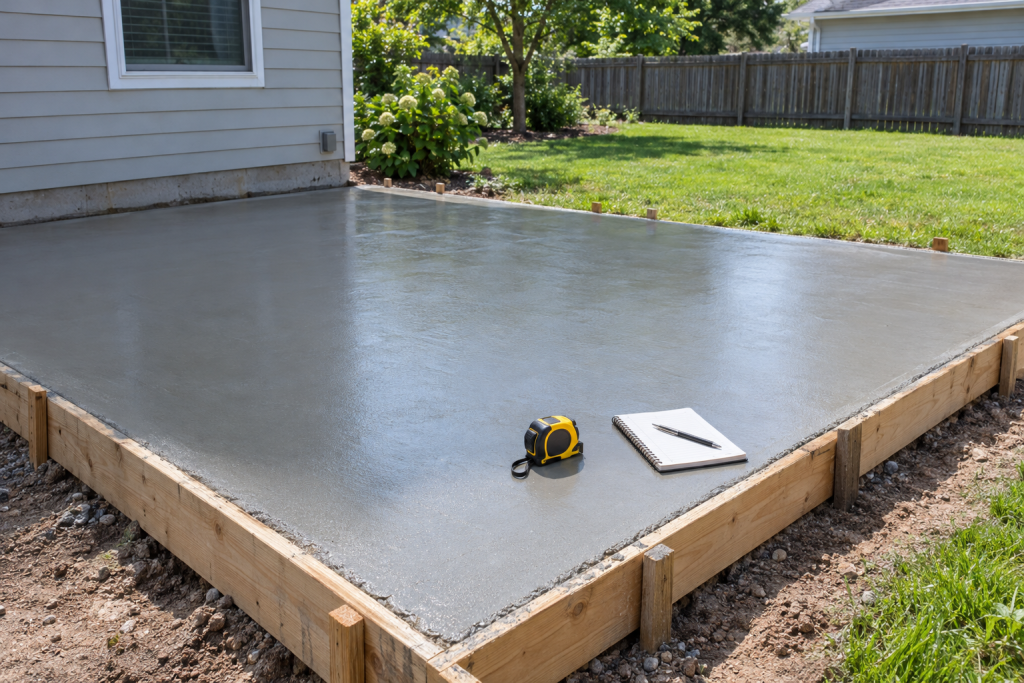
This concrete calculator converts the length, width and thickness of your pour into cubic yards, cubic feet, cubic meters and the number of 80, 60 or 40 lb bags you need, with waste already built in. Measure the formed area in feet, measure thickness in inches, and the rest is arithmetic. The guide below explains every field, shows the math with two worked examples, and tells you how to buy the right amount without paying for a truckload you cannot use.
Quick steps: use the concrete calculator
- Pick the shape under “What are you pouring?”: rectangular slab, patio or footing, or round column or post hole.
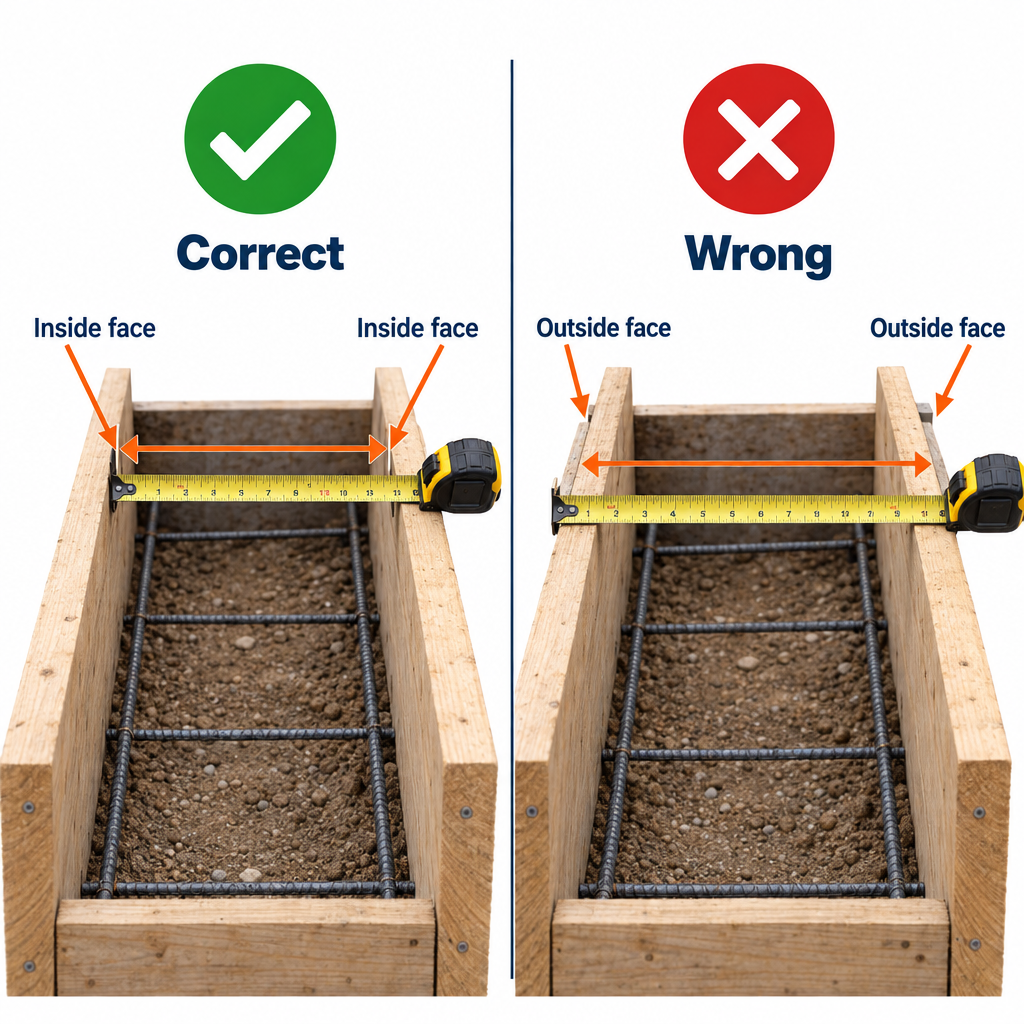
- Measure Length (ft) and Width (ft) inside the forms, not outside the lumber.
- Measure Thickness (in) at several spots on the gravel base and use the deepest reading.
- Set Quantity to the number of identical pours, such as 8 post holes or 3 pier footings.
- Leave Extra for waste and spillage (%) at 10 for forms on a graded base; raise it to 15 for rough ground.
- Read cubic yards for a ready-mix order or the bag count for a bagged mix, then round up at the store.
Tools and materials
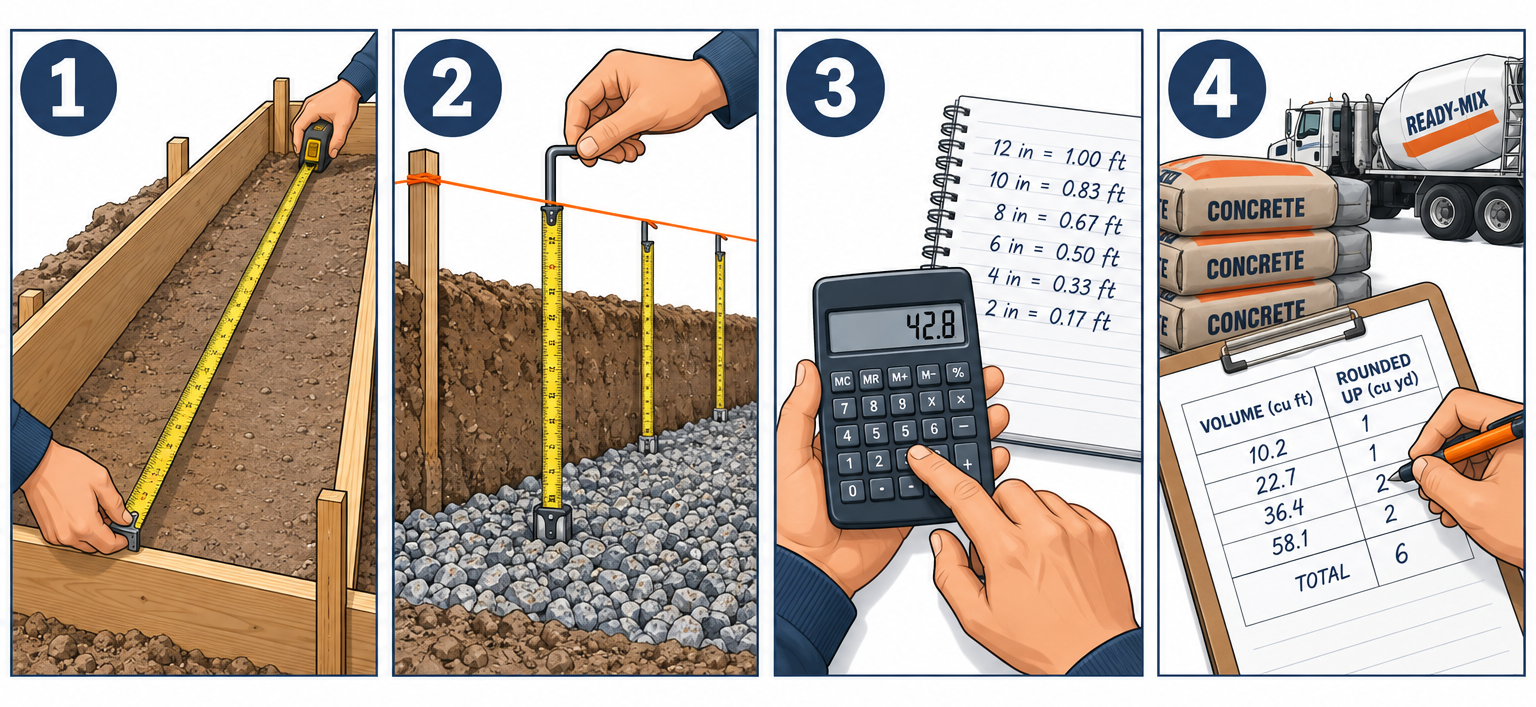
- 25 ft tape measure (fractions of a foot convert as inches divided by 12)
- 4 ft level or string line and line level for checking base depth
- Stakes and mason’s twine to mark the pour outline
- Notebook or phone to record every measurement before entering it
- Calculator for odd shapes you split into rectangles
Safety first
Wet concrete is caustic. Wear nitrile or rubber gloves, safety glasses and rubber boots, and rinse skin immediately if it gets splashed. Never kneel in fresh mix without knee pads.
How to use the concrete calculator
The calculator has five inputs. Each one maps to a specific measurement on the job site, and most short pours trace back to one field being measured wrong.
What are you pouring?
The default is Slab, patio or footing (rectangular). Use it for floor slabs, patios, sidewalks, driveways, continuous footings, stem walls, pads for air conditioning condensers and steps you have broken into rectangles. Anything with four straight sides and a consistent thickness belongs here.
Switch to Round column or post hole for fence posts, deck piers in cardboard tube forms, mailbox posts, lamp posts and any cylindrical pour. When you choose this option, you enter the diameter in inches and the depth in feet instead of length, width and thickness.
Length (ft) and Width (ft)
Measure the inside of the forms, because that is the space concrete will fill. A form built from 2×4 lumber set outside a 10 ft mark is actually 10 ft 3 in inside to inside, so measure after the forms are staked, not from the plan.
Enter decimals, not inches. 10 ft 6 in is 10.5. 12 ft 3 in is 12.25. 8 ft 9 in is 8.75. A reading of 11 ft 2 in becomes 11.17 (2 divided by 12 is 0.167). Entering “10.6” for 10 ft 6 in is the most common mistake on this field and it overestimates by about 1 percent, which is harmless, but entering “10.2” for 10 ft 2 in on a long driveway side runs the other way and leaves you short.
For slabs that are not square, measure both widths and both lengths. Forms spread. If one end reads 10 ft 1 in and the other 10 ft 3 in, use the larger number.
Thickness (in)
This is the field that causes the most trouble. A “4 inch slab” is rarely 4 inches everywhere. Gravel bases have high and low spots, and the low spots eat concrete.
Run a string line across the top of the forms and measure down to the compacted base at six or more points, including the corners and the center. Enter the deepest reading, or the average plus half an inch if the base varies by more than an inch. A patio measured at 4 in at the edges and 5 in in the middle needs the 5 in figure or you will be scraping the last wheelbarrow across bare gravel.
Typical thicknesses: 4 in for patios, walkways and shed floors, 5 to 6 in for driveways that carry pickups, 6 in for garage floors with vehicle traffic, 8 to 12 in for footings depending on the span and your local code.
Quantity
Quantity multiplies the single-pour volume. Eight identical post holes at a Quantity of 8 gives you one total. Three pier footings, each 2 ft by 2 ft by 10 in, enter as one footing with Quantity set to 3.
Do not use Quantity for pours of different sizes. Run each size separately and add the totals.
Extra for waste and spillage (%)
The default 10 percent covers concrete left in the mixer, splashed over forms, lost to an uneven base and the inevitable last-minute decision to fill a low spot. Increase it to 15 percent when the base is rough or you are hand-mixing from bags, because bagged yield is a laboratory figure and real-world water content changes it. Drop to 5 percent only for a small pour in tight, smooth forms where you have already measured depth in a dozen spots.
Set it to zero if you want to see the raw volume for comparing against a supplier’s quote, then put it back before ordering.
Common measuring mistakes
- Measuring the forms from the outside, which can add 3 in in each direction.
- Using plan thickness instead of measured depth on the base.
- Forgetting the thickened edge on a monolithic slab, which can add 20 to 30 percent to a small pad.
- Measuring a sloped driveway along the slope with the tape sagging, which shortens the reading.
- Converting inches to decimal feet by moving the decimal instead of dividing by 12.
- Running the round calculator with diameter in feet instead of inches, which inflates volume by a factor of 144.
Pro tip
Measure the base depth with a bent nail on the end of your tape pressed against the string line. Then write every reading on the form lumber in marker. When the truck shows up and the driver asks “how much?”, you have proof of your number instead of a guess.
The concrete calculator formula, step by step
Every number the calculator shows comes from four operations: find cubic feet, multiply by quantity, add waste, then convert.
Slab, patio or footing
Length (ft) x Width (ft) x Thickness (in) / 12 = cubic feet
Dividing thickness by 12 turns inches into feet so all three dimensions match. The result is the volume of one pour in cubic feet.
Round column or post hole pi x (Diameter (in) / 24)^2 x Depth (ft) = cubic feet
Dividing diameter by 24 does two things at once. Dividing by 2 gives the radius, and dividing by 12 converts inches to feet. Squaring the radius and multiplying by pi (3.1416) gives the circular area in square feet. Multiplying by depth in feet gives cubic feet.
Quantity, waste and conversions
- Multiply cubic feet by Quantity.
- Multiply by 1 plus the waste percentage. At 10 percent, that is x 1.10.
- Cubic yards = cubic feet / 27, because a yard is 3 ft and 3 x 3 x 3 is 27.
- Cubic meters = cubic feet x 0.028317.
- Bags: divide cubic feet by the yield per bag and round up. An 80 lb bag yields 0.60 cu ft, a 60 lb bag yields 0.45 cu ft, a 40 lb bag yields 0.30 cu ft.
Worked example 1: the default inputs
The calculator opens with a 10 ft by 10 ft slab, 4 in thick, Quantity 1, 10 percent waste. Here is how it reaches the figures on screen.
- Cubic feet before waste: 10 x 10 x 4 / 12 = 100 x 0.3333 = 33.33 cu ft.
- Times Quantity 1: 33.33 cu ft.
- Plus 10 percent waste: 33.33 x 1.10 = 36.67 cu ft. The calculator shows 36.7 cubic feet.
- Cubic yards: 36.67 / 27 = 1.358, shown as 1.36 cu yd.
- Cubic meters: 36.67 x 0.028317 = 1.038, shown as 1.04.
- 80 lb bags: 36.67 / 0.60 = 61.1, rounded up to 62.
- 60 lb bags: 36.67 / 0.45 = 81.5, rounded up to 82.
- 40 lb bags: 36.67 / 0.30 = 122.2, rounded up to 123.
That 1.36 cu yd is what you tell the ready-mix dispatcher. Most plants sell in quarter-yard increments, so you would order 1.5 yards.
Worked example 2: a 12 x 16 patio
Say you have formed a 12 ft by 16 ft patio for a grill and table. String-line readings on the base run from 4 in at the house to 4.5 in at the far edge, so you enter 4.5 for Thickness. Quantity stays at 1 and waste at 10 percent.
- Cubic feet: 12 x 16 x 4.5 / 12 = 192 x 0.375 = 72 cu ft.
- Times Quantity 1: 72 cu ft.
- Plus 10 percent: 72 x 1.10 = 79.2 cu ft.
- Cubic yards: 79.2 / 27 = 2.93 cu yd.
- Cubic meters: 79.2 x 0.028317 = 2.24.
- 80 lb bags: 79.2 / 0.60 = 132 bags.
- 60 lb bags: 79.2 / 0.45 = 176 bags.
- 40 lb bags: 79.2 / 0.30 = 264 bags.
At 132 bags of 80 lb mix, you are moving over 5 tons of material through a mixer. That is a ready-mix job. Order 3 yards and have a place to put the extra.
Worked example 3: eight deck footings in tube forms
Eight piers, 12 in diameter cardboard tube forms, 3 ft deep to get below frost line. Choose Round column or post hole, enter 12 for diameter, 3 for depth, Quantity 8, waste 10 percent.
- Radius in feet: 12 / 24 = 0.5 ft.
- Area: 3.1416 x 0.5^2 = 3.1416 x 0.25 = 0.7854 sq ft.
- One pier: 0.7854 x 3 = 2.356 cu ft.
- Times Quantity 8: 18.85 cu ft.
- Plus 10 percent: 18.85 x 1.10 = 20.73 cu ft.
- Cubic yards: 20.73 / 27 = 0.77 cu yd.
- 80 lb bags: 20.73 / 0.60 = 34.6, rounded up to 35.
- 60 lb bags: 20.73 / 0.45 = 46.1, rounded up to 47.
- 40 lb bags: 20.73 / 0.30 = 69.1, rounded up to 70.
Thirty-five bags is a long Saturday with a rented mixer but entirely doable, and well under the volume where a short-load fee makes ready-mix worthwhile.
Quick-reference tables for common pours
All figures below use the calculator’s formula with 10 percent waste already included and bags rounded up.
Slab sizes at 4 inches thick
| Slab size (ft) | Square feet | Cubic feet (with 10% waste) | Cubic yards | 80 lb bags | 60 lb bags |
|---|---|---|---|---|---|
| 8 x 8 | 64 | 23.5 | 0.87 | 40 | 53 |
| 10 x 10 | 100 | 36.7 | 1.36 | 62 | 82 |
| 10 x 12 | 120 | 44.0 | 1.63 | 74 | 98 |
| 12 x 12 | 144 | 52.8 | 1.96 | 88 | 118 |
| 12 x 16 | 192 | 70.4 | 2.61 | 118 | 157 |
| 16 x 20 | 320 | 117.3 | 4.35 | 196 | 261 |
| 20 x 20 | 400 | 146.7 | 5.43 | 245 | 326 |
| 24 x 24 | 576 | 211.2 | 7.82 | 352 | 470 |
A useful rule from this table: at 4 in thick, one cubic yard without waste covers 81 sq ft. With 10 percent waste it covers about 73.6 sq ft.
Thickness changes for a 10 x 10 slab
| Thickness (in) | Cubic feet (with 10% waste) | Cubic yards | 80 lb bags | 60 lb bags | 40 lb bags |
|---|---|---|---|---|---|
| 3 | 27.5 | 1.02 | 46 | 62 | 92 |
| 4 | 36.7 | 1.36 | 62 | 82 | 123 |
| 5 | 45.8 | 1.70 | 77 | 102 | 153 |
| 6 | 55.0 | 2.04 | 92 | 123 | 184 |
| 8 | 73.3 | 2.72 | 123 | 163 | 245 |
Every extra inch on a 100 sq ft slab adds about 9.2 cu ft with waste, or 15 to 16 bags of 80 lb mix. That is why measuring depth on the base matters more than measuring length.
Post holes and round footings, per hole
| Diameter (in) | Depth (ft) | Cubic feet per hole (with 10% waste) | 80 lb bags | 60 lb bags | 40 lb bags |
|---|---|---|---|---|---|
| 8 | 2 | 0.77 | 2 | 2 | 3 |
| 8 | 3 | 1.15 | 2 | 3 | 4 |
| 10 | 3 | 1.80 | 3 | 4 | 6 |
| 12 | 3 | 2.59 | 5 | 6 | 9 |
| 12 | 4 | 3.46 | 6 | 8 | 12 |
| 16 | 4 | 6.14 | 11 | 14 | 21 |
| 18 | 4 | 7.78 | 13 | 18 | 26 |
The calculator rounds once on the total, not once per hole, so 8 holes will usually need fewer bags than 8 times the per-hole figure. Use the Quantity field rather than multiplying this table by hand.
For fence posts you are setting with fast-setting mix poured dry into the hole, subtract the post itself. A 4×4 post (actually 3.5 x 3.5 in) in a 10 in hole 3 ft deep displaces about 0.26 cu ft, roughly 15 percent of the hole. The calculator does not subtract the post, which gives you a small built-in cushion on top of the waste percentage.
Adapting the calculator to other shapes
The two shape options cover more than they first appear to.
Walls and stem walls. A wall is a slab on its side. Enter wall length as Length, wall height in feet as Width, and wall thickness in inches as Thickness. A 24 ft long, 2 ft tall, 8 in thick stem wall: 24 x 2 x 8 / 12 = 32 cu ft, plus 10 percent is 35.2 cu ft, or 1.30 cu yd.
L-shaped and T-shaped slabs. Split the outline into rectangles along one edge, run each rectangle separately with waste set to 0, add the cubic feet, then multiply the sum by 1.10. Adding waste to each piece separately produces the same total, so either way works, but the single sum is easier to check.
Steps. Treat each tread as its own rectangular slab stacked on the one below. A set of three 4 ft wide steps with 12 in treads and 7 in rises, poured solid against a wall, works out as: step 1 is 4 x 3 ft deep x 7 in, step 2 is 4 x 2 x 7, step 3 is 4 x 1 x 7. That is 7 + 4.67 + 2.33 = 14 cu ft, or 15.4 cu ft with waste.
Monolithic slab with thickened edge. Run the slab at its field thickness, then run the perimeter as a footing. A 12 x 12 shed slab at 4 in with a 12 in wide, 12 in deep perimeter footing: slab is 48 cu ft, footing is 48 linear ft x 1 ft x 12 in / 12 = 48 cu ft, but you have already counted the top 4 in of the footing in the slab, so the footing adds 48 x 8/12 = 32 cu ft. Total 80 cu ft, 88 with waste, 3.26 cu yd.
Circular slab or patio. Use Round column or post hole. Enter the diameter in inches (a 10 ft circle is 120 in) and the slab thickness as depth in feet (4 in is 0.333). pi x (120/24)^2 x 0.333 = 3.1416 x 25 x 0.333 = 26.2 cu ft, or 28.8 with waste, about 1.07 cu yd.
Curb and gutter. Measure the cross-section as a rectangle that fully contains the profile and accept a little over. A 6 in wide curb 12 in tall plus a 12 in wide, 6 in thick gutter: estimate as 18 in wide by 12 in tall for the Width and Thickness, with Length as the run. The over-estimate replaces the waste factor, so set waste to 0.
Driveway on a slope. Measure the length along the ground, not horizontally. The concrete follows the slope.
Pro tip
For a slab with a thickened edge, dig the footing trench first, then shoot the base grade with the string line and set your Thickness from the actual trench depth. Trenches always end up deeper than the drawing, and a 2 in overdig on a 48 ft perimeter trench eats a quarter yard.
Buying and ordering concrete
The calculator gives you volume. Turning that into an order depends on whether you go bagged or ready-mix.
Units suppliers use
Ready-mix plants sell by the cubic yard, usually in quarter-yard increments, with a one-yard minimum. Bag retailers sell by the bag, and the bag label states the yield in cubic feet. Both measure the same thing, so the calculator shows both.
If a supplier or a contractor quotes in square feet, they are assuming a thickness. Ask what thickness, then compare using cubic yards.
Bagged mix: yields and realistic prices
| Bag size | Yield per bag | Bags per cubic yard | Typical 2025 US price per bag | Approximate cost per cubic yard |
|---|---|---|---|---|
| 80 lb standard mix | 0.60 cu ft | 45 | $6 to $8 | $270 to $360 |
| 60 lb standard mix | 0.45 cu ft | 60 | $5 to $7 | $300 to $420 |
| 40 lb standard mix | 0.30 cu ft | 90 | $4 to $6 | $360 to $540 |
| 50 lb fast-setting | 0.375 cu ft | 72 | $7 to $9 | $500 to $650 |
Prices vary by region and swing with the season, so treat these as planning numbers and check the shelf tag. The pattern holds everywhere: bigger bags cost less per cubic foot, and fast-setting mixes cost roughly double per yard. Fast-setting is worth it for fence posts set dry in the hole. It is not worth it for a slab, where you want working time.
Standard bagged concrete mix is rated around 4,000 psi at 28 days when mixed with the labeled water. High-strength 5,000 psi bags and crack-resistant fiber bags cost more and are worth it for driveway aprons and steps.
Ready-mix: pricing and delivery rules
Ready-mix in most US markets runs about $125 to $180 per cubic yard for a 3,000 to 4,000 psi mix in 2025, delivered. Add-ons that change the price:
- Short-load fee. Trucks carry 8 to 10 yards. Orders below the plant’s minimum, typically 7 to 10 yards, carry a short-load fee that commonly runs $50 to $250 for each yard under that minimum. On a 1.5 yard order this can push the effective price past $200 per yard.
- Minimum order. Typically 1 cubic yard. Some plants will not send a truck for less than 2.
- Standby time. The driver gets a set number of minutes per yard to unload, commonly 5 to 7. After that you pay by the minute. Have wheelbarrows, three people and the forms ready before the truck arrives.
- Mix upgrades. Air entrainment for freeze-thaw climates, fiber reinforcement, accelerators for cold weather and retarders for hot weather each add a few dollars per yard.
- Pump truck. If the truck cannot reach within a wheelbarrow run of the forms, a line pump adds several hundred dollars. Budget for it on backyard patios with no side-yard access.
Bags or truck: where the break-even sits
Bags win below roughly 1 cubic yard. One yard is 45 bags of 80 lb mix, about $315 in material plus a $60 to $90 mixer rental for the day. Ready-mix at $150 plus a $100 short-load fee is $250 for the same yard and you do not lift 3,600 lb of bags. Between 1 and 2 yards it is close and comes down to whether you have helpers. Above 2 yards, order the truck every time.
Your back is a factor the price table ignores. Eighty-eight bags of 80 lb mix for a 12 x 12 shed floor weighs over 7,000 lb and needs to be mixed and placed before the first batches start to set.
How much extra to order, and why
For ready-mix, order the calculator’s figure with 10 percent waste, rounded up to the next quarter yard. The driver cannot go back for a half yard, and a cold joint from a second truck two hours later is a permanent weak line across your slab. Have a plan for leftover concrete: a few 12 in tube forms for future posts, a short walkway section, or pre-dug splash blocks.
For bags, buy the calculator’s count plus two or three. Big box stores take back unopened bags on the same receipt, so the cost of over-buying is a return trip, while the cost of under-buying is a half-finished pour.
Pro tip
Form a small “sacrifice” pour next to the main slab, like a 2 x 2 pad for a trash can or a step stone, before the truck arrives. Any extra goes there instead of into a pile you have to break up with a jack hammer later.
Common mistakes that cause running short or over-buying
Trusting plan thickness. The single biggest cause of shortages. A base that averages 4.75 in on a “4 inch” slab needs 19 percent more concrete, which is more than the waste factor covers.
Measuring outside the forms. Adds about 3 in each way with 2x lumber. On a small pad the error is a few percent. It over-buys rather than under-buys, so it is the cheaper mistake.
Skipping the thickened edge or footing. Monolithic slabs and turned-down edges can add a third of the volume on small buildings. See the shed example above.
Not subtracting nothing. People sometimes subtract rebar, wire mesh or the post from their total. Reinforcing steel displaces a negligible amount. Leave it in.
Confusing yield with weight. An 80 lb bag does not make 80 lb of concrete at some convenient volume. It yields 0.60 cu ft, so 45 bags per yard, not 50 or 40. Using a round number instead of the real yield leaves a gap.
Mixing bagged concrete too wet. Extra water increases volume slightly at the cost of strength and shrinkage cracks. Do not plan on it as a way to stretch the yield.
Forgetting form spread. Long form runs bow outward under the weight of wet concrete if stakes are more than 3 ft apart. A half-inch bow on each side of a 40 ft driveway adds real volume. Stake every 2 to 3 ft and measure after bracing.
Ordering exact for a round number of bags. If the calculator says 62 bags, buy 65. If the ready-mix figure is 1.36 yards, order 1.5, not 1.25.
Ignoring the sub-base. Concrete volume is only half the material. A 4 in compacted gravel base under a 10 x 10 patio is another 33 cu ft, about 1.25 yards of crushed stone, and it has to be in and compacted before you measure depth for the concrete. If the site holds water, install a “french drain” along the uphill side before the gravel goes in.
After the pour: a few things the calculator cannot tell you
Concrete reaches walking strength in 24 to 48 hours and most of its design strength at 28 days. Keep the surface damp or covered for the first 5 to 7 days, especially in heat and wind, or it loses strength at the surface and dusts. Once it has cured for about 28 days, a penetrating “concrete sealer” keeps de-icing salts and oil out and makes the slab easier to clean.
Control joints every 8 to 12 ft on a 4 in slab, cut to a quarter of the thickness, tell the concrete where to crack. Skip them and it chooses for itself.
When to call a pro
Call a licensed concrete contractor, and check with your building department, for any pour over about 5 yards, any structural footing for a house addition or deck attached to a dwelling, retaining walls over 3 ft, driveways that meet a public sidewalk (these need a right-of-way permit in most cities), and any slab where a pump truck is required. Footing depth and size are set by code and soil, not by a calculator, and an inspector usually has to see the trench before concrete goes in.
FAQ
How many bags of concrete do I need for a 10×10 slab?
At 4 in thick with 10 percent waste, a 10 x 10 slab needs 36.7 cu ft of concrete. That is 62 bags of 80 lb mix, 82 bags of 60 lb mix or 123 bags of 40 lb mix. As ready-mix it is 1.36 cubic yards, so order 1.5 yards.
How does a concrete slab calculator differ from a concrete floor calculator?
They are the same calculation. A floor slab, a patio, a shed pad and a driveway are all rectangular volumes: length times width times thickness. The only thing that changes is the thickness you enter. Interior floor slabs are usually 4 in, garage floors 5 to 6 in, and driveways 5 to 6 in with a thicker apron where they meet the street.
How much concrete is in a cubic yard?
A cubic yard is 27 cubic feet, enough for 81 sq ft at 4 in thick, 54 sq ft at 6 in, or 108 sq ft at 3 in before waste. In bags, one cubic yard is 45 bags of 80 lb mix, 60 bags of 60 lb mix or 90 bags of 40 lb mix. It weighs roughly 4,000 lb once placed.
Why does the calculator add 10 percent?
Because the volume inside the forms is never the volume you place. Concrete sticks to the mixer and wheelbarrow, splashes over forms, settles into low spots on the base and gets scraped off during screeding. Ten percent is the standard allowance for a formed pour on a graded gravel base. Use 15 percent for hand-mixed bags on rough ground.
Should I measure in inches or feet?
Length and Width in feet, Thickness in inches. Convert any leftover inches on length and width to decimal feet by dividing by 12, so 10 ft 6 in becomes 10.5 and 10 ft 2 in becomes 10.17. The calculator handles the thickness conversion for you by dividing by 12 inside the formula.
How do I measure a post hole for the concrete calculator?
Measure the diameter of the hole in inches at the top (an 8 in auger makes a hole that is usually 9 to 10 in across after cleanup) and the depth in feet from grade to the bottom. Enter those, set Quantity to the number of holes, and read the bag count. The calculator does not subtract the post, which gives you a little extra beyond the waste factor.
Can I use this calculator for mortar, stucco or surface bonding cement?
No. Those products are sold by coverage area, not volume. A bag of mortar mix is rated by the number of blocks or bricks it lays, stucco and surface bonding cement by square feet at a given coat thickness. Use the coverage figure printed on the bag for those. This calculator is for concrete mix placed as a volume: slabs, footings, walls, columns and posts.
How accurate is a concrete estimator compared with what the truck delivers?
The math is exact. The inputs are where accuracy lives. If you measure inside the forms and take real depth readings off the base, the calculator with 10 percent waste will land within a quarter yard on pours up to about 5 yards. Ready-mix trucks are batched by weight and are accurate to within a few percent, so the number you order is very close to what shows up.
Is it cheaper to mix my own concrete from bags?
Only for small pours. Bagged mix works out to roughly $270 to $315 per cubic yard for 80 lb bags at $6 to $7 a bag, versus $125 to $180 delivered for ready-mix, but ready-mix carries a short-load fee on orders below the plant’s minimum, which is often 7 to 10 yards even though some suppliers will send a truck for as little as 1 yard. Bags make sense under about 1 yard, ready-mix above 2 yards, and the range between is a judgment call based on labor and site access.
What thickness should I enter for a driveway?
Enter the deepest reading you get on the base, not the design thickness. Residential driveways are normally 5 in thick, 6 in if you park a heavy truck or trailer, with a 6 to 8 in thick apron at the street edge. Most municipalities specify the apron, so check before you form it.