Plant calla lily rhizomes 3 to 4 inches deep in warm, well-drained soil after your last frost, give them six hours of sun and steady water once shoots appear, and you will have blooms in about 60 to 90 days. The one decision that changes everything is which type you have: the big white Zantedeschia aethiopica is a near-bog plant that is winter hardy in zone 8 and can survive zone 7 with protection, while the colored hybrids want drier soil and are usually lifted for winter in colder zones. Here is the whole job, from choosing the rhizome to storing it for next year.
Quick steps: plant and grow calla lilies
- Pick your type: white aethiopica for wet spots and mild winters, colored hybrids for sun and containers.
- Wait until nights stay above 50°F and soil hits 60°F, then choose a spot with 6 hours of sun.
- Loosen soil 10-12 inches deep and work in 2 inches of compost.
- Set rhizomes 3-4 inches deep, eyes up, 12 inches apart.
- Water once at planting, then hold off until shoots show.
- Keep soil evenly moist and feed monthly with a low-nitrogen fertilizer.
- Cut spent flower stalks at the base and let foliage yellow naturally.
- In zones 7 and colder, lift and dry the rhizomes before frost and store them at 50-60°F.
Tools and materials
- Calla lily rhizomes (14/16 cm grade or larger for hybrids)
- Garden fork or spade
- Compost or aged manure (2-inch layer per bed)
- Trowel with depth markings
- Soil thermometer (any probe type, $10-15)
- Low-nitrogen fertilizer such as 5-10-10 or a tomato formula
- 2-3 inches of shredded bark mulch
- 12-14 inch containers with drainage holes (for pot growing)
- Peat moss or vermiculite and paper bags (for winter storage)
- Nitrile gloves
Calculators for this job
Safety first
Every part of a calla lily contains calcium oxalate crystals that burn the mouth and throat of people, dogs and cats. Wear gloves when cutting stems or dividing rhizomes, wash your hands after, and keep pots out of reach of pets and toddlers.
Know Which Calla Lily You Have Before You Plant
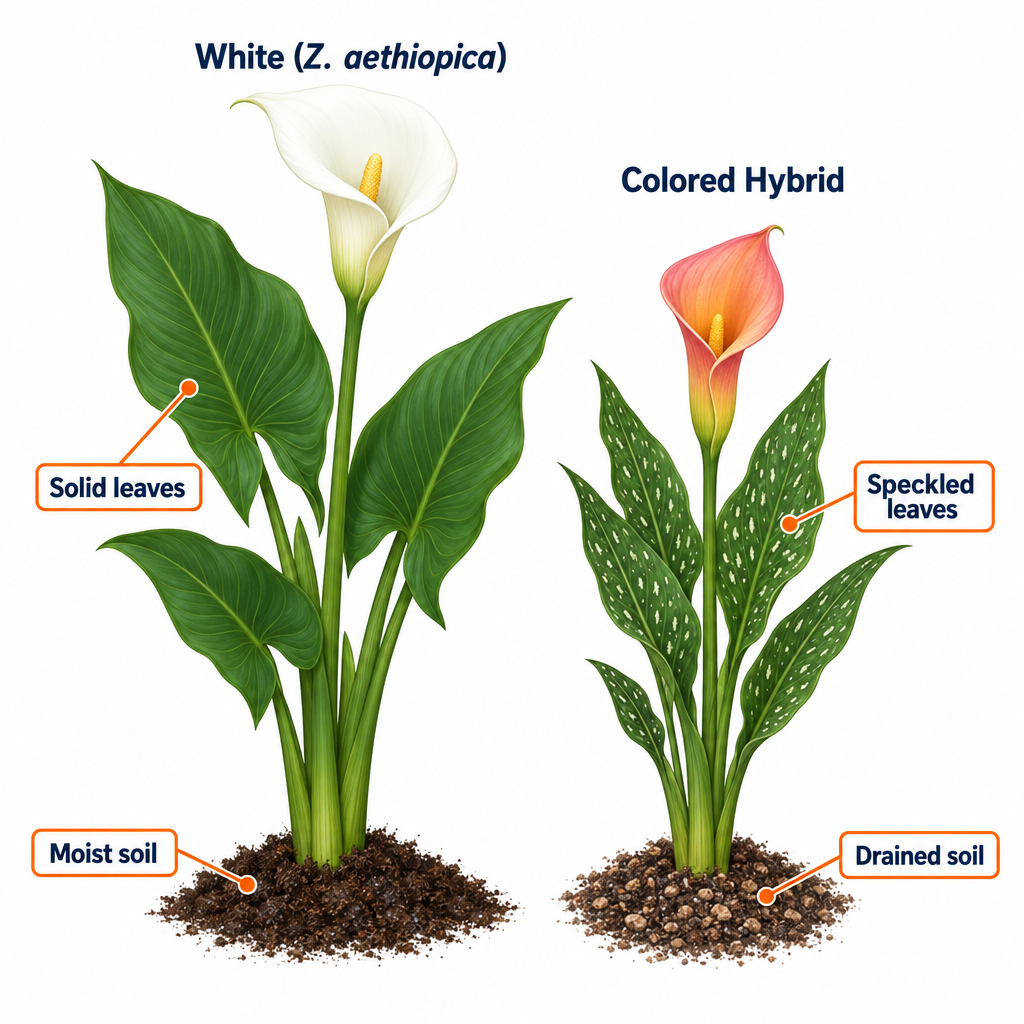
Garden centers sell two very different plants under the same name, and most calla lily failures come from treating one like the other.
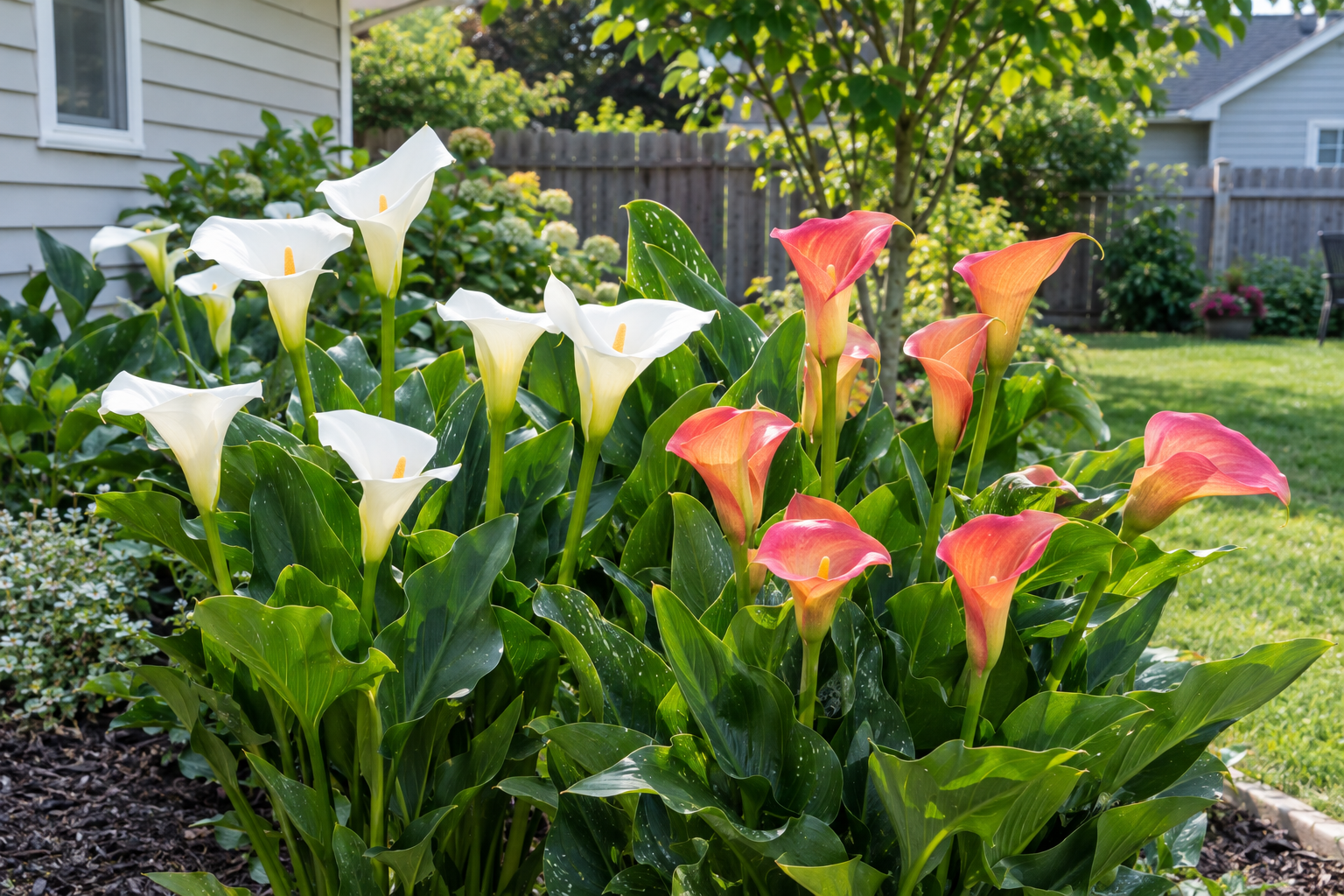
The classic white calla, Zantedeschia aethiopica, grows 2 to 3 feet tall with arrow-shaped solid green leaves and a thick, almost tuber-like rhizome. It comes from streambanks and seasonally wet ground in South Africa. It tolerates heavy soil, standing water and light frost. In zones 8 through 10 it is a perennial that often blooms in late winter or spring and stays evergreen in mild winters.
The colored callas are hybrids, mostly bred from Z. rehmannii, Z. elliottiana and Z. albomaculata. These are the pink, yellow, orange, purple, lavender and near-black varieties, usually 12 to 24 inches tall, often with white-speckled leaves. They want sharp drainage, warm soil and a true dry dormancy. Wet feet rot them fast. They are reliably hardy only in zone 9 and warmer, so most gardeners grow them as summer bulbs and lift them in fall, or simply treat them as annuals.
| Trait | White calla (Z. aethiopica) | Colored hybrid callas |
|---|---|---|
| Height | 24-36 inches | 12-24 inches |
| Leaf | Solid green, arrow-shaped | Often white-speckled, narrower |
| Soil | Moist to boggy, tolerates clay | Well-drained, loamy or potting mix |
| Water | Can sit in up to 12 inches of water | Evenly moist, never soggy |
| Hardiness | Zones 8-10, zone 7 with heavy mulch | Zones 9-10, lift elsewhere |
| Bloom time | Late winter to early summer | 60-90 days after planting, midsummer |
| Planting depth | 4-6 inches | 3-4 inches |
| Spacing | 18-24 inches | 12 inches |
| Winter | Leave in ground in zone 8+ | Lift, cure and store dry |
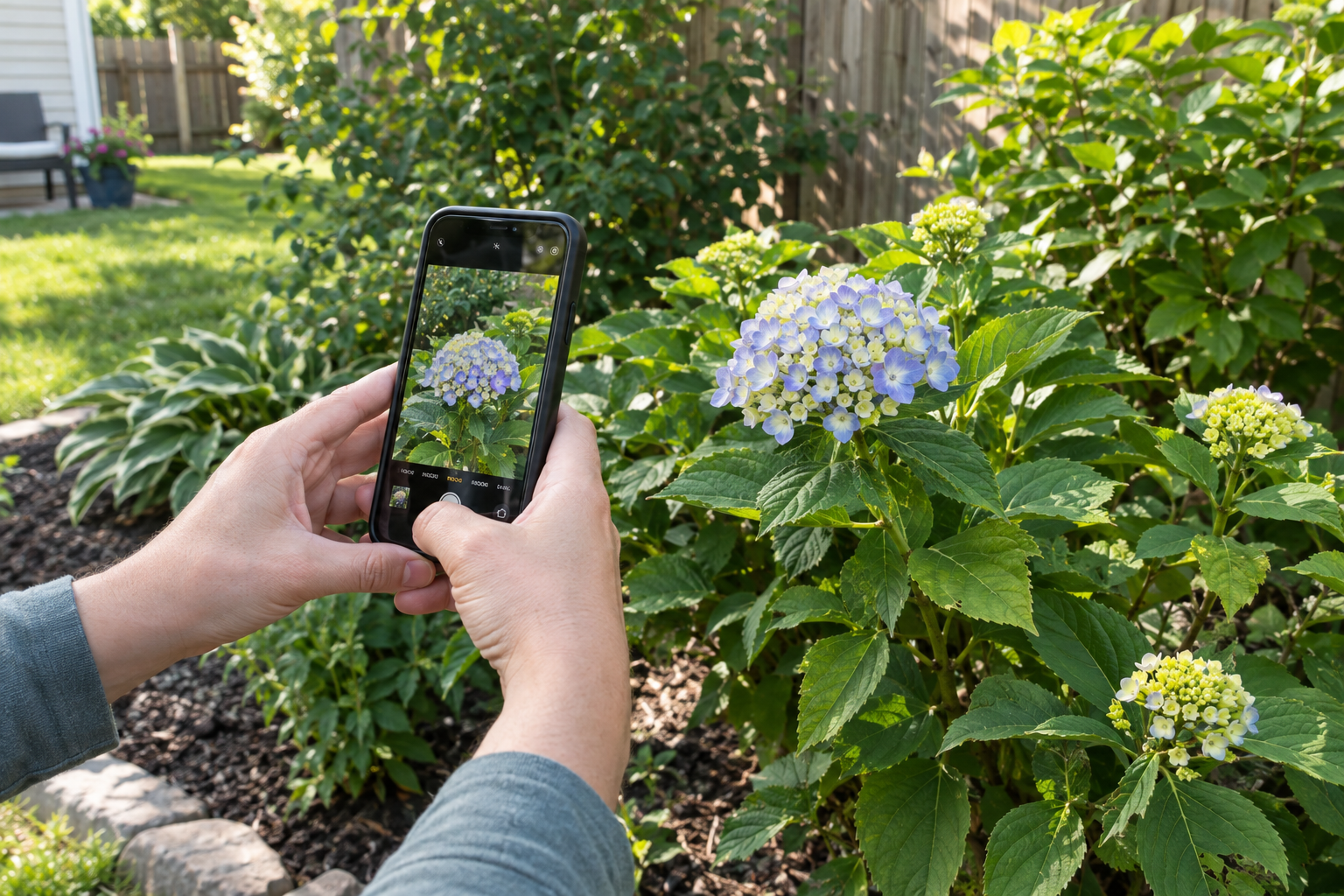
If you inherited plants and cannot tell which you have, look at the leaves. Speckled foliage means a hybrid almost every time. A thick clump of plain green leaves two feet tall that stayed through winter is aethiopica. When a plant tag is long gone, the same approach you would use to identify plants and flowers elsewhere in the yard works here: leaf pattern, mature height and how it behaved last winter tell you more than the flower color.
Step 1: Pick the Site and the Planting Date
Calla lilies need warmth to start and sun to bloom. Plant too early and the rhizome sits in cold, wet soil and rots before it sprouts.
Wait until night temperatures stay above 50°F and a soil thermometer pushed 4 inches down reads 60°F or higher in the morning. For most of the US that lands 1 to 2 weeks after the average last frost date. In Atlanta that is mid-April. In Chicago it is late May. In short-season areas like Minneapolis, you can start rhizomes indoors in pots 4 to 6 weeks earlier and move them out after frost.
For light, aim for six hours of direct sun in zones 7 and colder. From zone 8 south, give them morning sun and afternoon shade. Full sun in Texas or Arizona bleaches the spathes and scorches leaf edges by July, and the dark purple and black varieties fade to muddy brown in intense heat.
Drainage is the make-or-break test for hybrids. Dig a hole 12 inches deep, fill it with water and time how long it takes to drain. If water is still standing after four hours, grow your colored callas in raised beds or containers instead. White aethiopica callas pass this test either way, and they will thrive in the one soggy corner of the yard where nothing else grows.
Step 2: Prepare the Soil
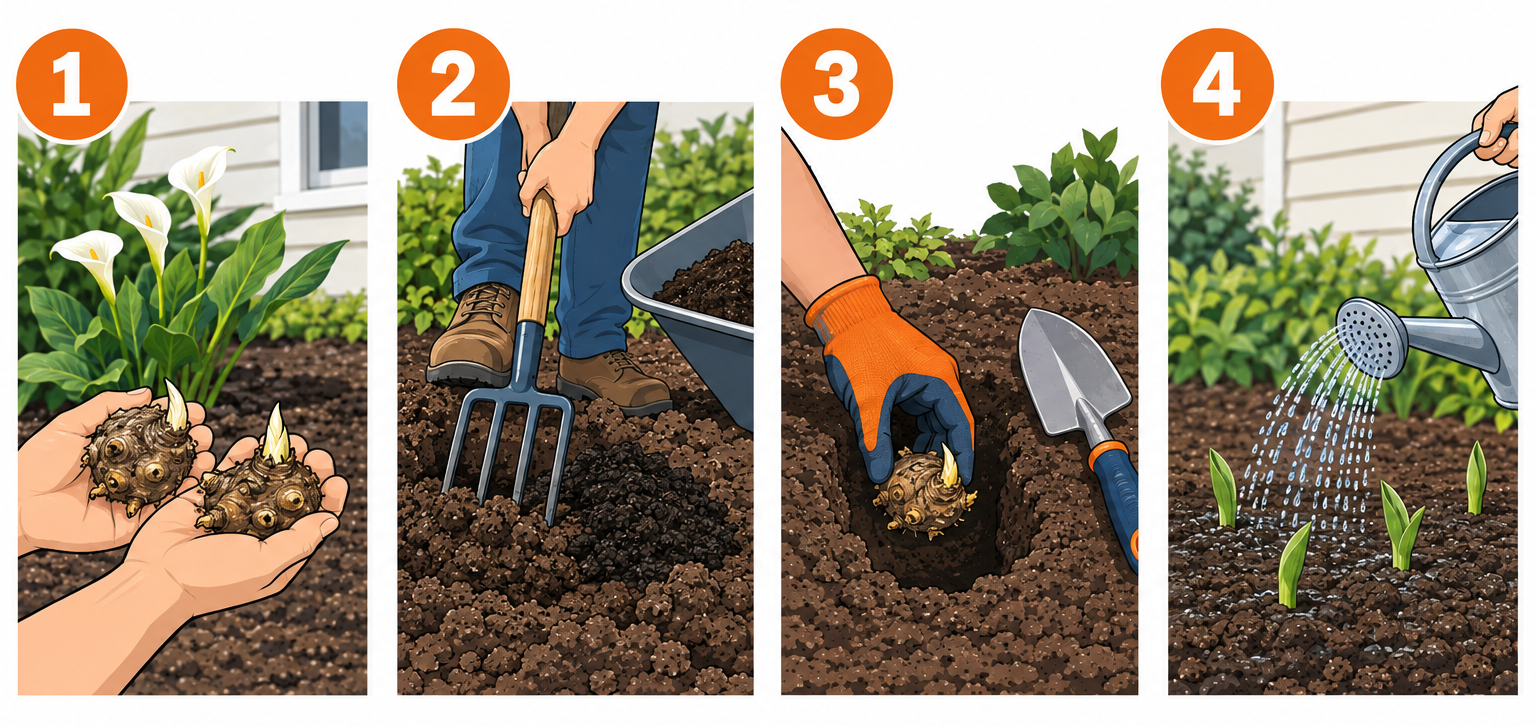
Loosen the bed with a garden fork to a depth of 10 to 12 inches. Rhizomes send roots down from their underside and sideways from the eyes, and compacted soil below them keeps the plant stunted.
Spread 2 inches of compost or well-aged manure over the bed and fork it in. The target is a crumbly loam that holds moisture without staying waterlogged. Calla lilies are not fussy about pH, anywhere from 6.0 to 7.0 is fine, so skip the lime and sulfur unless a soil test shows something extreme.
For heavy clay beds where you want colored hybrids, build a raised mound 6 to 8 inches high and 2 feet wide with a 50/50 mix of native soil and compost, plus a shovel of coarse sand or fine pine bark per square foot. The mound sheds surface water and keeps the rhizomes above the saturated layer.
Mix a handful of bulb fertilizer or bone meal into the planting area now rather than later. Low-nitrogen, higher-phosphorus formulas feed root and flower development. Skip lawn fertilizer and any product with a first number above 10. High nitrogen gives you a beautiful stand of leaves and almost no flowers.
Pro tip
Buy the biggest rhizomes you can find. Hybrid callas are graded by circumference, and a 16/18 cm rhizome typically throws two to three times as many flower stems as a 12/14 cm one. The price difference is usually a dollar or two per rhizome, and it is the cheapest way to double your bloom count.
Step 3: Plant the Rhizomes
Look at each rhizome before it goes in the ground. One side has small raised bumps or pinkish nubs. Those are the eyes, and they face up. The smoother, often slightly concave side with dried root scars faces down. If you truly cannot tell, lay the rhizome on its side. The shoots will find the surface on their own, it just takes an extra week.
Dig a hole 3 to 4 inches deep for hybrids and 4 to 6 inches deep for aethiopica. Set the rhizome flat, eyes up, and backfill with loose soil. Firm gently with your palm, not your foot. Space hybrids 12 inches apart and the big white callas 18 to 24 inches apart, because a healthy aethiopica clump spreads to 2 feet across within three seasons.
Water the bed thoroughly once, enough to settle the soil around the rhizomes. Then stop. This is the step people get wrong. Until you see green shoots breaking the surface, the rhizome has no leaves pulling moisture and no need for more water. A damp bed is fine. A wet bed in cool weather invites soft rot. Shoots usually appear in 2 to 3 weeks when the soil is warm, longer if a cold snap hits.
Mulch after shoots are up, not before. A 2 to 3 inch layer of shredded bark keeps the root zone cool and moist in summer, but mulching bare soil in spring delays warming and sprouting.
Step 4: Water and Feed Through the Season
Once shoots are 4 to 6 inches tall, switch to steady moisture. Calla lilies in active growth want about 1 inch of water per week from rain and irrigation combined, and closer to 2 inches in July heat or sandy soil. Check with your finger. If the top inch is dry, water deeply enough to wet the soil 6 inches down.
White aethiopica callas can take far more. In a bog garden or pond margin they grow with the crown submerged a few inches to as much as a foot below the surface, and they will bloom heavier there than in an ordinary bed. Plant them in a mesh aquatic basket with heavy loam, top with pea gravel, and set the basket on a shelf at the pond edge.
Hybrids need the opposite discipline. Let the top inch dry between waterings. Drip irrigation or a soaker hose is better than overhead sprinklers, because water sitting in the leaf funnels and on the spathes encourages botrytis gray mold.
Feed every 3 to 4 weeks from the time shoots appear until the first flower opens. Use a liquid or granular fertilizer with a low first number, such as 5-10-10, or a tomato and vegetable formula. Water-soluble feed at half the label rate every two weeks works well in containers, where nutrients leach out quickly. Stop feeding once blooming finishes. The plant is heading toward dormancy and extra nitrogen now only produces soft foliage that rots in storage.
Watch for two signs you are overdoing it. Leaf tips that turn brown and crispy while the soil is moist usually mean fertilizer burn. Spathes that open green and stay green on a hybrid often mean too much nitrogen or too little light.
Pro tip
Growers in hot climates plant hybrids in two batches three weeks apart. Each rhizome blooms for roughly 4 to 6 weeks, so staggering the plantings stretches the display from June through August without buying twice as many rhizomes.
Step 5: Manage the Bloom and Cut Flowers
The colored “petal” on a calla lily is a spathe, a modified leaf wrapped around the yellow spadix that carries the actual tiny flowers. Each spathe lasts 2 to 3 weeks on the plant. As it ages it fades, turns green on aethiopica, and finally rolls shut around the spadix. Cut the whole stalk at the base when that happens. Leaving it to set seed drains energy from next year’s rhizome.
Hybrids typically produce 3 to 8 stems per rhizome over a 4 to 6 week window. A mature aethiopica clump can push 15 or more stems over a longer season. Expect fewer flowers in the first year from small or newly divided rhizomes.
For cut flowers, harvest when the spathe has fully unfurled but before yellow pollen dusts the spadix. Grip the stem low and pull with a slight twist rather than cutting. The stem releases cleanly from the rhizome, you get the full length, and the wound seals faster than a cut. Commercial calla growers harvest this way.
Calla stems split and curl at the bottom when they stand in deep water. Keep only 2 to 3 inches of water in the vase, change it every two days and recut the base each time. Done right, callas last 7 to 14 days in a vase, which is why they are a wedding florist staple. The miniature hybrids in the 12 to 18 inch range are the ones sold as “mini callas” for bouquets and boutonnieres. The 24 to 36 inch white aethiopica stems are the “standard callas” in tall arrangements.
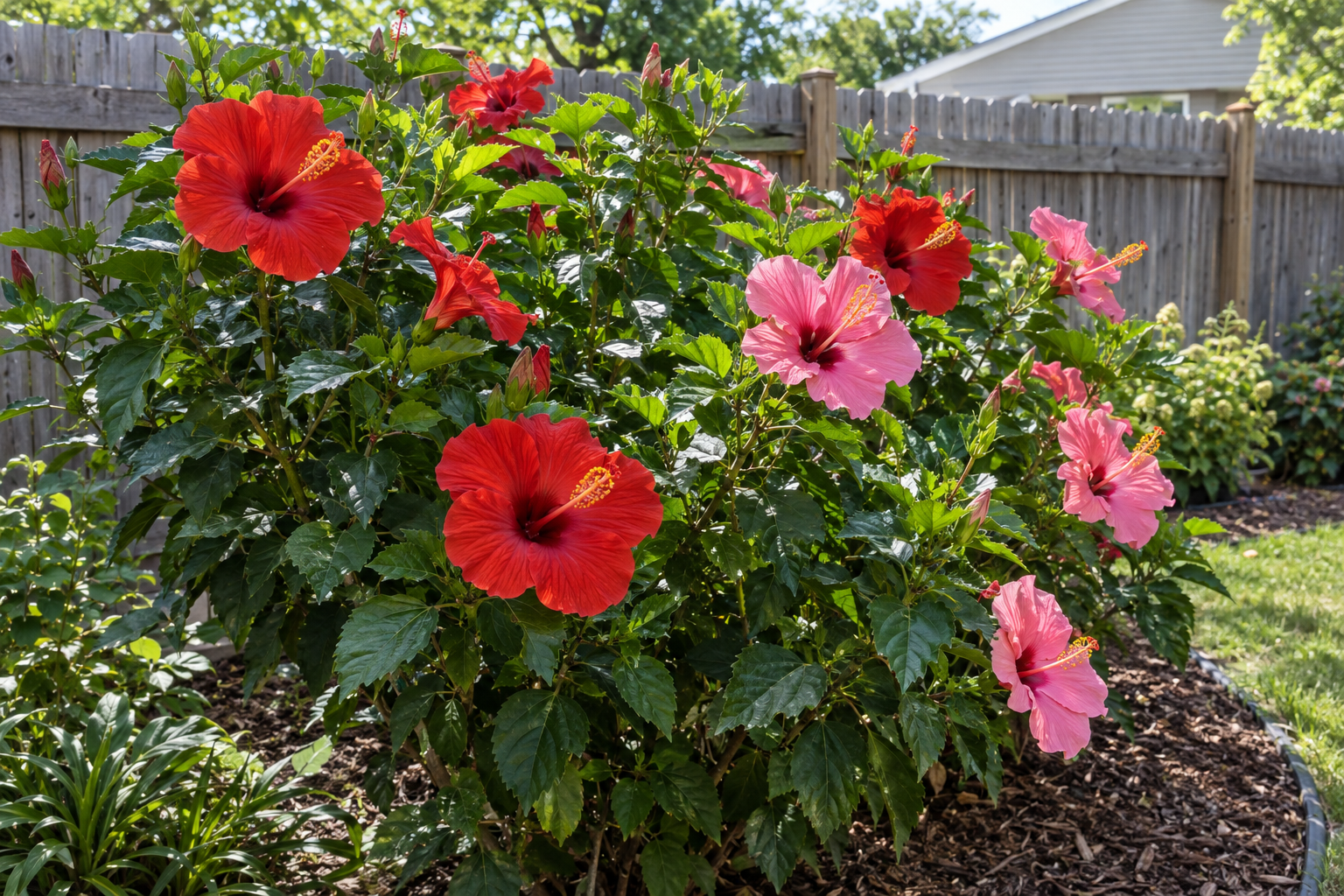
Pair them in the border with plants that like the same conditions. Hybrids sit well in front of tropical-looking hibiscus flowers, which share their appetite for sun and summer water. The white aethiopica looks right with ferns, hostas and Japanese iris in a damp, part-shade bed.
Step 6: Handle Dormancy and Winter
Calla lilies need a rest period of 2 to 3 months each year, and they flower poorly without it. How you give them that rest depends on your zone and your type.
In the ground, zone 8 and warmer
Leave aethiopica in place. After bloom, the foliage may yellow and die back in dry summers, which is normal, or stay evergreen in moist shade. Cut dead leaves off at the base and water sparingly until new growth appears in fall or late winter. In zone 7, pile 4 to 6 inches of shredded leaves or straw over the crown after the first frost and remove it in early spring. The hardier selection ‘Crowborough’ is the one to try at the cold edge of its range.
Hybrids left in the ground in zone 9 and 10 need the soil to go dry during dormancy. If your winters are wet, lift them anyway. Rhizomes sitting in cold, saturated soil for three months rot even in frost-free climates.
Lifting rhizomes, zone 7 and colder
Wait until the first light frost blackens the foliage, or until leaves have yellowed and flopped on their own, whichever comes first. Foliage that has yellowed naturally has already moved its stored sugars down into the rhizome, so do not rush this step.
Lift the clumps with a fork, working from 8 inches outside the stems to avoid spearing the rhizome. Shake off loose soil but do not wash them. Cut the foliage back to 1 inch. Lay the rhizomes in a single layer on newspaper in a dry, airy spot at 60 to 70°F for 1 to 2 weeks until the skin feels dry and papery and any remaining stems pull away cleanly.
Store cured rhizomes in paper bags or open boxes of dry peat moss or vermiculite at 50 to 60°F. An unheated basement, insulated garage or crawl space works. Never store them in plastic, and keep them away from the refrigerator fruit drawer, where ethylene from apples causes problems. Check once a month. Toss any rhizome that has gone soft or smells sour, and lightly mist the peat if the healthy ones look shriveled.
Pro tip
If your hybrids are in containers, skip the lifting entirely. Stop watering when the foliage yellows, let the pot dry out completely, cut the leaves off and move the whole pot to the garage. In spring, scrape off the top inch of mix, add fresh potting soil and a dose of bulb fertilizer, and start watering again. The rhizomes wake up undisturbed and bloom a week or two earlier than freshly planted ones.
Growing Calla Lilies in Containers
Containers suit the colored hybrids better than any bed. You control drainage completely, the soil warms faster in spring so they bloom earlier, and overwintering is as simple as moving the pot.
Use a pot at least 12 inches wide and 10 inches deep with drainage holes. One 14-inch pot holds three hybrid rhizomes, which gives a full look. A single rhizome in a 6-inch pot looks sparse and dries out too fast. Fill with a quality peat or coir-based potting mix, not garden soil, and blend in a tablespoon of slow-release bulb fertilizer per gallon of mix.
Plant rhizomes 2 to 3 inches deep in pots, slightly shallower than in the ground, since the mix settles and the warmer environment speeds sprouting. Water once, then wait for shoots as you would in the garden.
Container callas dry out quickly in July. Check daily and water when the top inch is dry, which can mean every day for a dark pot in full sun. Feed every two weeks with half-strength liquid fertilizer. Pots also give you the option of moving dark varieties into afternoon shade when a heat wave threatens to fade them.
Aethiopica grows well in a large pot too, but it needs a 16 to 20 inch container to reach full size and wants a saucer kept full of water through summer. Many gardeners in zone 6 and 7 grow it this way and roll the pot into an unheated garage for winter.
Potted Gift Callas and Indoor Growing
The blooming callas sold in 6-inch foil-wrapped pots at grocery stores from February through Mother’s Day are hybrids forced in greenhouses, often with a growth regulator to keep them compact. They are perfectly good garden plants once you understand their schedule.
Enjoy the bloom indoors in a bright window out of direct afternoon sun, and water when the top inch is dry. Pull off the foil sleeve or punch holes in it so the pot drains. Once the flowers fade, usually within 3 to 4 weeks, cut the stalks off and keep watering until the leaves yellow. Then let the pot dry, store it cool and dry for 2 to 3 months, and plant the rhizomes outside in late spring.
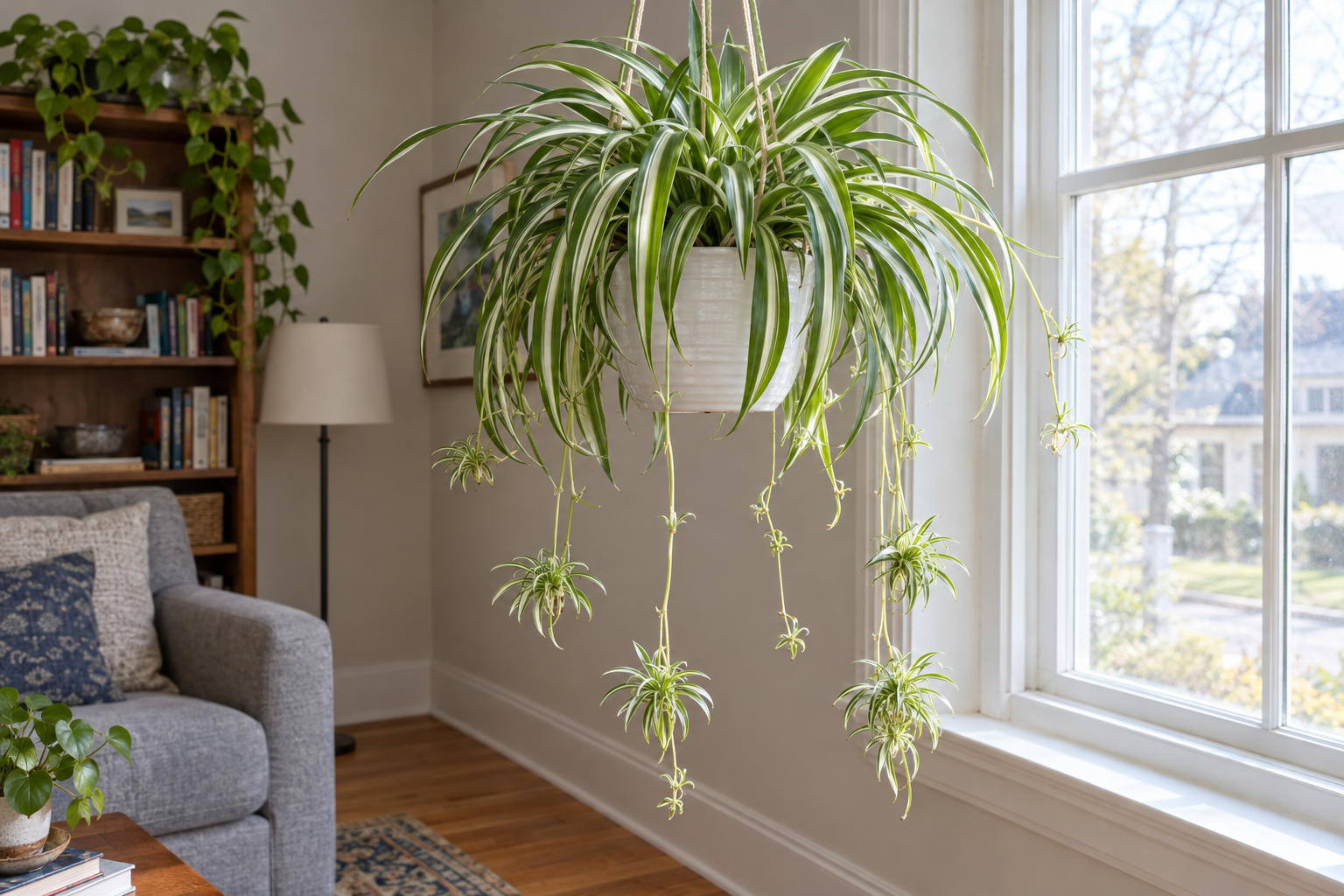
Do not expect that plant to rebloom indoors on the same windowsill right away. It needs the dormancy, and it needs more light than most homes provide. Treat it like a tropical houseplant with a seasonal rest, more like a flowering bulb than a year-round foliage plant such as a spider plant. Plants moved to the garden after their rest usually bloom again the following summer at full garden size, often taller than they were in the gift pot once the growth regulator wears off.
For deliberate indoor forcing, pot rhizomes in late winter, keep them at 65 to 70°F in your brightest window or 6 inches under a grow light for 14 hours a day, and expect flowers in 8 to 10 weeks.
Calla Lily Varieties by Color
The hybrid market changes every year as Dutch and New Zealand breeders release new selections, but these are widely sold, proven performers. Height is the typical garden height; forced pot plants run shorter.
| Color | Variety | Height | Notes |
|---|---|---|---|
| White | Z. aethiopica | 24-36 in | The classic, hardy to zone 8, loves wet soil |
| White | ‘Crowborough’ | 24-30 in | Hardiest white, worth trying in zone 7 |
| White, green edge | ‘Green Goddess’ | 30-36 in | Spathes flushed green, long-lasting cut flower |
| White blush | ‘Crystal Blush’ | 16-20 in | Opens white, blushes pink with age |
| Yellow | ‘Sunshine’ | 18-22 in | Clear golden yellow, speckled leaves |
| Yellow to red | ‘Flame’ | 18-24 in | Yellow spathe flushed orange-red at edges |
| Orange | ‘Mango’ | 16-20 in | Deep orange, strong stems for cutting |
| Orange | ‘Captain Safari’ | 16-20 in | Compact, heavy blooming container variety |
| Pink | ‘Pink Melody’ | 18-24 in | Soft pink shading to cream center |
| Pink | ‘Captain Romance’ | 14-18 in | Rose pink, short and tidy in pots |
| Lavender | ‘Lavender Gem’ | 16-20 in | Lilac-lavender, lighter in part shade |
| Purple and white | ‘Picasso’ | 18-24 in | White spathe with deep purple throat |
| Purple | ‘Night Cap’ | 16-20 in | Dark plum, holds color better than most blacks |
| Black | ‘Schwarzwalder’ | 18-24 in | Near-black maroon, speckled foliage |
| Black | ‘Black Star’ | 18-22 in | Deepest dark red-black, best in afternoon shade |
| Red | ‘Majestic Red’ | 16-20 in | Deep burgundy red, popular cut flower |
A few things to know about color. Dark purple and black varieties hold their depth best in cooler weather and afternoon shade. In full sun above 90°F they often bleach to brownish red. Yellow and orange varieties are the most sun-tolerant. Many hybrids shift shade as the spathe ages, so a “pink” calla may open peach and finish rose. Bicolors like ‘Picasso’ and ‘Flame’ show the most contrast when nights are cool.
Calla Lily Growing Calendar
Dates are for a zone 6 or 7 garden with a last frost in late April to mid-May. Shift everything 3 to 4 weeks earlier in zone 8 and 9, and plan on leaving aethiopica in the ground there.
| Month | Task |
|---|---|
| February-March | Order rhizomes. Pot gift callas can be enjoyed indoors now. |
| Early April | Start hybrids indoors in pots for a jump on the season. |
| Mid-May | Plant outdoors once soil reaches 60°F. Water once, then wait. |
| Early June | Shoots up. Begin regular watering and first feeding. Mulch beds. |
| Late June-July | First blooms on hybrids. Feed monthly, cut spent stalks at base. |
| August | Bloom winds down. Stop feeding. Harvest cut flowers. |
| September | Reduce water as foliage yellows. Let plants go dormant. |
| October | Lift after first light frost. Cure 1-2 weeks. |
| November-February | Store at 50-60°F in dry peat. Check monthly for rot. |
Dividing and Propagating Calla Lilies
Rhizomes multiply every year, and clumps crowd themselves and bloom less after three or four seasons. Divide at lifting time in fall or just before replanting in spring.
Break or cut the rhizome into sections, making sure each piece has at least one visible eye and a chunk of the fleshy body behind it. Pieces smaller than a golf ball usually take an extra year to bloom. Let cut surfaces dry overnight before storing or planting so the wound seals. Dusting the cut with garden sulfur or ground cinnamon reduces rot in storage.
Seed is possible but slow. Aethiopica sets orange berries after flowering, and seedlings take two to three years to bloom. Hybrid seed rarely comes true. Division gives you an identical plant that flowers the next season, so there is little reason for a home gardener to bother with seed.
Note that Zantedeschia aethiopica is listed as an invasive plant in parts of coastal California and in several other mild, wet regions worldwide, where it spreads by seed and rhizome fragments into creeks and wetlands. If you garden in those areas, cut flower stalks before berries form and never dump divisions in a wild or drainage area. Hybrids rarely set viable seed and are not a concern.
Troubleshooting Calla Lilies
| Symptom | Likely cause | Fix |
|---|---|---|
| No shoots 4 weeks after planting | Soil too cold or rhizome rotted | Dig one up. Firm and white inside means wait. Mushy and smelly means replace and plant later next year. |
| Lush leaves, no flowers | Too much nitrogen, too little sun, or no dormancy last winter | Switch to 5-10-10, move to a sunnier spot, ensure a 2-3 month dry rest. |
| Spathes open green and stay green | Low light or excess nitrogen (hybrids) | More sun, stop feeding. Green on aging aethiopica spathes is normal. |
| Dark varieties fade to brown | Heat and intense afternoon sun | Provide afternoon shade, or grow in pots you can move. |
| Leaves yellow in midsummer with wet soil | Root rot or soft rot | Let soil dry, lift and inspect rhizome, cut away soft tissue and dust with sulfur. |
| Leaves yellow in late summer, soil fine | Natural dormancy | Reduce water and let it happen. |
| Stems flop over | Too much water or shade, or weak small rhizome | Cut back watering, increase light, upgrade to larger rhizomes next year. |
| Gray fuzzy mold on spathes or leaves | Botrytis from overhead watering and humidity | Remove affected parts, water at soil level, improve air flow. |
| Streaked, twisted, mottled leaves | Dasheen mosaic virus (spread by aphids) | No cure. Remove and trash the plant. Control aphids on the rest. |
| Holes in leaves, slime trails | Slugs and snails | Iron phosphate bait, hand pick at dusk, keep mulch pulled back from stems. |
| Stippled, dusty leaves, fine webs | Spider mites in hot dry weather | Hose leaves off every few days, insecticidal soap on undersides. |
| Rhizomes shriveled in storage | Storage too warm or dry | Move to 50-55°F, lightly mist peat moss. |
| Rhizomes soft in storage | Stored wet or not fully cured | Discard soft ones, cure the rest longer next fall. |
Soft rot deserves a closer look because it kills more calla lilies than anything else. The bacteria enter through wounds or stressed tissue in cool, saturated soil. An infected rhizome turns to foul-smelling mush from the inside, and the leaves above it yellow and collapse at the base. If you catch it early, dig the rhizome, cut back to clean white tissue, let it dry two days, dust with sulfur and replant in fresh, drier mix. Any rhizome more than half gone goes in the trash, not the compost.
When to call a pro
Growing calla lilies is a DIY job start to finish, and there is no trade to call for a plant. The exceptions are around the plant, not in it. If you are building a bog bed or pond margin for aethiopica that involves a liner, pump or electrical for a pump, hire a licensed electrician for any outdoor circuit and GFCI protection. If a pet or child chews on a calla lily and shows drooling, mouth swelling or trouble swallowing, call your vet or Poison Control right away rather than waiting it out.
FAQ
Are calla lilies annuals or perennials?
They are tender perennials. White Zantedeschia aethiopica comes back every year in the ground in zone 8 and warmer, and often in zone 7 with mulch. Colored hybrids are perennial only in zone 9 and 10. Everywhere else they return reliably if you lift the rhizomes in fall and store them dry at 50 to 60°F, or they can be treated as inexpensive annuals.
How deep do you plant calla lily bulbs?
Plant hybrid rhizomes 3 to 4 inches deep and white aethiopica rhizomes 4 to 6 inches deep, with the bumpy eyes facing up. In containers, 2 to 3 inches is enough. Space hybrids 12 inches apart and aethiopica 18 to 24 inches apart.
How long do calla lilies take to bloom?
Hybrids bloom 60 to 90 days after planting in warm soil, so a mid-May planting flowers in July. Each rhizome blooms for 4 to 6 weeks. Aethiopica planted in spring may bloom lightly the first summer and then settle into a late winter or spring schedule in mild climates.
Do calla lilies need full sun?
They need about six hours of direct sun in zones 7 and colder. From zone 8 south, morning sun with afternoon shade gives better color and fewer scorched leaves. Dark purple and black varieties fade in hot full sun anywhere.
Why are my calla lily leaves turning yellow?
In late summer after blooming, yellowing is normal dormancy and you should cut back on water. In early or midsummer with wet soil, it points to root rot or soft rot. Dig up one rhizome and check. Firm and white means the plant is fine, mushy and sour-smelling means rot.
Are calla lilies poisonous to dogs and cats?
Yes. All parts contain insoluble calcium oxalate crystals that cause intense mouth pain, drooling, swelling and vomiting when chewed. They are rarely fatal but always need a call to your vet. Keep pots out of reach and wear gloves when handling cut stems.
Can calla lilies grow in water?
Zantedeschia aethiopica can. Plant it in a mesh aquatic basket at a pond margin with the crown anywhere from a few inches to about 12 inches below the surface, and it will bloom heavier than in a border. Colored hybrids cannot. Standing water rots them within weeks.
Is a calla lily a real lily?
No. Calla lilies belong to the arum family, Araceae, alongside peace lilies, caladiums and jack-in-the-pulpit. The colored part is a spathe, a modified leaf, and the true flowers are the tiny bumps on the yellow spadix in the center. The name “lily calla” or “calla lily” stuck from an old botanical misclassification and never left.