
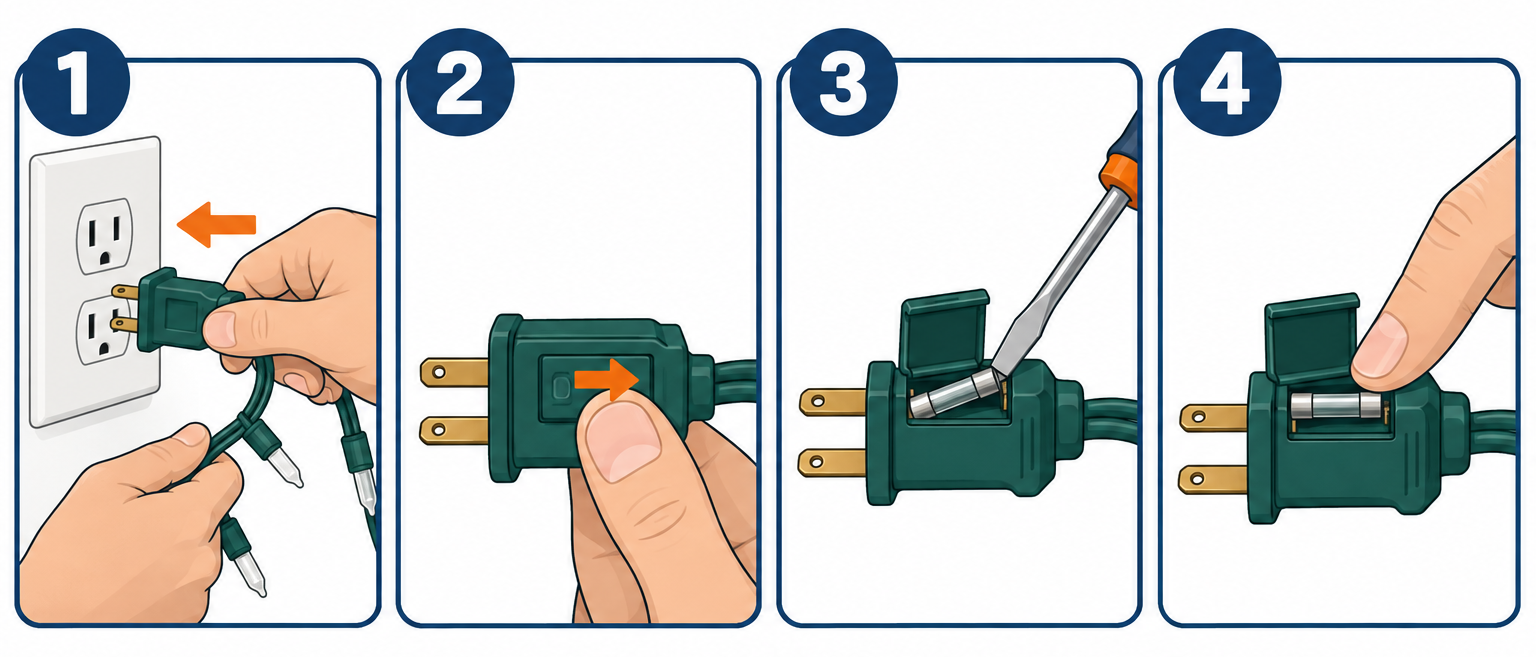
To replace fuses in Christmas tree lights, unplug the string, slide open the small door on the male plug, pry out the two glass fuses, and press in new fuses with the exact same amp rating. Most strings come with spares in a small plastic bag, so the whole fix usually costs nothing and takes about five minutes.
Quick steps: replace a Christmas light fuse
- Unplug the string and anything plugged into its end.
- Find the spare fuses taped to the cord or in the box.
- Slide open the fuse door on top of the male plug.
- Pry out both fuses with a small screwdriver.
- Press in new fuses with the same amp rating.
- Close the door, plug in, and check the whole string lights.
- Remove extra strings from the chain so the fuse doesn’t blow again.
Tools and materials
- Replacement fuses matching the rating printed on the old fuse or the cord tag (commonly 3A or 5A, 125V)
- Small flathead screwdriver (1/8 in tip) or a jeweler’s screwdriver
- Flashlight or headlamp
- Multimeter with continuity or ohms setting (optional, for testing)
- Magnifying glass or phone camera zoom for reading the tiny print
Safety first
Always unplug the string before opening the plug, and never bypass a fuse with foil, wire, or a higher-amp fuse. A fuse that keeps blowing means something in the string is shorted, and forcing more current through it is how plugs melt and trees catch fire.
How to Tell It’s Actually the Fuse
Before you open anything, look at how the string failed. A blown fuse kills power at the plug, so the entire string goes dark at once. Any strings plugged into its end go dark too.
If only one section is out, the fuse is fine. Mini-light strings are wired in series sections, usually 50 bulbs per section on a 100-light set. A half-dark string almost always means a loose, broken, or missing bulb in that section. That needs a bulb hunt, not a fuse swap.
Also rule out the outlet. Plug a lamp or phone charger into the same receptacle. Outdoor outlets and garage outlets are usually GFCI protected, and a tripped GFCI looks exactly like a blown fuse from across the yard. Press the reset button and try again.
Step 1: Unplug the String and Find the Spare Fuses
Pull the plug from the wall, not the cord. If this string is part of a chain, unplug the strings attached to its female end as well, so you’re working on one set at a time.
Now find the spares. Manufacturers usually tape a small plastic bag to the cord near the plug, or tuck it in the box with an extra bulb or two. Many people throw that bag away the first year, which is why fuse packs sell so well in December.
If you can’t find spares, don’t buy anything yet. You need to read the rating on the old fuse first.
Pro tip
When you unbox new lights, tape the spare fuse bag directly to the male plug with clear packing tape. Next year the replacements are right where you need them, and they stay matched to that exact string.
Step 2: Open the Fuse Door on the Plug
Look at the top of the male plug, the end with the prongs. Most fused plugs have a small sliding cover with an arrow or the words “slide open” molded into the plastic. On some sets the door is on the side of the plug instead.
Hold the plug with the prongs facing away from you. Push the door toward the prongs with your thumbnail or the tip of a small flathead screwdriver. It slides about 1/4 inch and exposes two fuse compartments.
Some doors are stiff, especially on new sets or plugs that have been outside. Wedge the screwdriver tip into the small groove at the edge of the door and lever it gently. Don’t force it hard enough to crack the housing. A cracked plug can’t be safely closed again, and the string should be retired.
Step 3: Remove and Inspect the Fuses
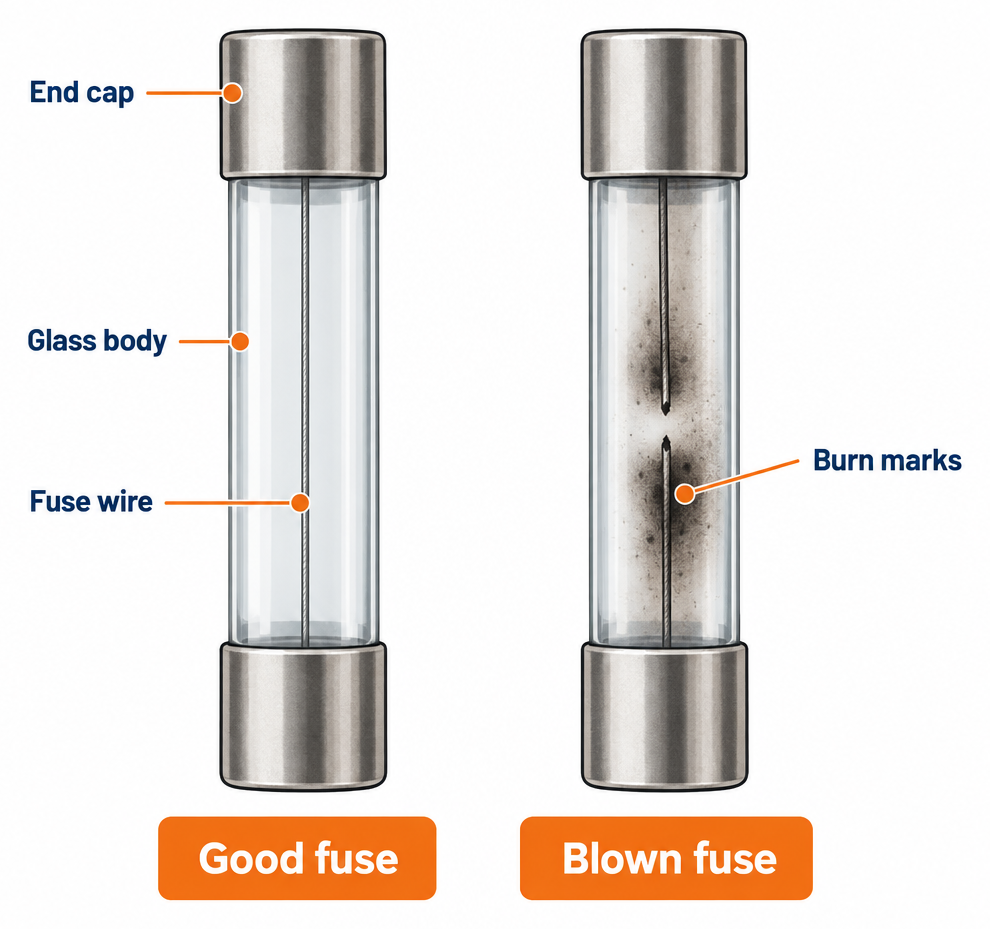
You’ll see two tiny glass cartridge fuses, each under half an inch long, sitting side by side. One protects each conductor in the cord.
Slip the screwdriver tip under one metal end cap and lift. The fuse should pop up out of its clips. Pull it out with your fingers and repeat for the second one. Replace both, even if only one looks bad. They’re cheap, and an old fuse that took a surge may be weakened.
Hold each fuse up to a light. Here’s what you’re looking for:
- Good fuse: clear glass with a thin, unbroken wire running end to end.
- Blown fuse (overload): the wire is broken, often with a small gap in the middle.
- Blown fuse (hard short): the glass is blackened, smoky, or silvered inside. This means a sudden high current, usually from a short in a socket or a damaged cord.
A blackened fuse is a warning sign. Replace it, but pay close attention in Step 6, because a hard short often blows the new fuse immediately.
Step 4: Test the Fuses With a Multimeter (Optional)
Sometimes the wire inside is so fine you can’t tell if it’s broken. A multimeter settles it in seconds.
Set the meter to continuity (the setting with the sound wave or diode icon) or to the lowest ohms range. Touch one probe to each metal end cap of the fuse.
- A beep, or a reading close to 0 ohms, means the fuse is good.
- No beep, or “OL” on the display, means the fuse is blown.
If both fuses test good and the string is still completely dark, the problem is somewhere else. Skip ahead to the troubleshooting table.
Step 5: Read the Rating and Install New Fuses
Every fuse has its rating stamped on one of the metal end caps, something like “3A 125V” or “5A 125V.” The print is tiny, so use a magnifying glass or zoom in with your phone camera. The rating is also printed on the white tag near the plug, along with the maximum connected wattage.
Match the amp rating exactly. Most mini-light sets, incandescent or LED, use 3-amp fuses, while C7 and C9 strings commonly use 5-amp fuses. Don’t assume. Read it.
| What you have | What to buy | Never use |
|---|---|---|
| 3A 125V fuse | 3A 125V replacement | 5A, 7A, or any higher rating |
| 5A 125V fuse | 5A 125V replacement | Higher amps, foil, wire, a paper clip |
| Rating worn off | Check the cord tag or box | A guess |
| Plug with no fuse door | No user-replaceable fuse | Cutting the plug open |
A lower-amp fuse is safe but will blow too easily. A higher-amp fuse is dangerous. The fuse exists to fail before the thin wire in your light string overheats, and an oversized fuse removes that protection.
If you need to buy fuses, holiday light fuse packs run roughly $3 to $6 at hardware stores, big-box stores, and online. Many packs mix 3A and 5A fuses, so sort them by rating before you start.
To install, set each fuse over its clips and press down on both ends with your fingertip until it snaps in. It should sit flat and centered. A fuse sitting crooked or loose in its clips won’t make contact.
Pro tip
If the clips are loose and the new fuse wobbles, the plug is worn out. Gently pinching metal clips tighter with needle-nose pliers is a common trick, but on a $10-20 string it’s usually smarter to replace the whole set than to trust a sloppy plug next to a dry tree.
Step 6: Close the Door and Test the String
Slide the fuse door back until it clicks shut. It needs to close fully. An open door exposes live metal parts and lets in moisture on outdoor strings.
Plug just this one string into the outlet, with nothing attached to its end. Then watch what happens:
- The whole string lights: you’re done with the fuse. Move on to Step 7 so it doesn’t happen again.
- The string stays dark: the new fuses may be blown already. Unplug and inspect them.
- The new fuses blow instantly: there’s a short in the string. Stop here. Don’t install a third set of fuses.
A string that eats fuses as fast as you put them in has a damaged socket, a pinched or chewed wire, or water in the plug. Retire it. Mini-light strings aren’t worth repairing at that point, and LED replacements draw far less current.
Step 7: Find Out Why the Fuse Blew
A fuse doesn’t fail on its own. Something pulled too much current through it. Fixing the cause is the step most people skip, and it’s why the same string blows fuses every season.
Too many strings chained together. This is the most common cause by far. The fuse in the first plug carries the current for every string plugged in after it. Check the tag near the plug for the maximum connected wattage or the maximum number of sets. Incandescent mini-light sets typically allow anywhere from 3 to 10 sets end to end, depending on the manufacturer and bulb count. LED sets allow many more because each one draws so little.
Mixed LED and incandescent strings. People often plug an old incandescent string onto the end of an LED chain. The LED string’s fuse is rated for LED-level current, and the incandescent load blows it. Keep the two types on separate runs.
A damaged cord or socket. Run the string through your hands from plug to end. Feel for flattened spots from a door or window, cracked insulation, chewed wire from pets or squirrels, and scorched or melted sockets. Any of these means the string goes in the trash.
Water. Outdoor plugs that sit in puddles or snow can short out. Keep connections raised off the ground, and use a covered outdoor connection box for plug-to-plug joints.
Broken or missing bulbs. An empty socket, or a bulb with exposed bare wires, can create a short. Make sure every socket has a bulb seated all the way in.
Pro tip
Instead of chaining eight strings off one plug, run two or three separate chains back to a power strip or outdoor-rated extension cord. Each chain gets its own first-plug fuse, none of them work near their limit, and one blown fuse only takes out part of the display.
Pre-Lit Trees, LED Sets, and Other Special Cases
Pre-lit artificial trees. Each tree section usually has its own light strings, and each string has a fused plug that connects to an outlet on the trunk or to the next section. If one section of your pre-lit tree goes dark, follow its cord to the plug and check those fuses. On trees with pole-to-pole connectors, the fuses are often in the main plug at the base, so start there.
LED light strings. Many LED sets use the same sliding-door plug with two fuses. Some, especially sets with a control box for flashing modes or color changes, have the fuse in the plug and electronics in the box. If the fuse is good and the controller’s indicator light stays off, the box itself has likely failed.
C7 and C9 large-bulb strings. These draw more current per bulb than mini-lights, so they reach their connected-wattage limit faster. Check the tag carefully before chaining them.
Smart and pixel lights. App-controlled and pixel-style strings often run on a low-voltage power supply rather than a standard fused plug. If yours uses a plug-in adapter brick, the problem is more likely the adapter, the controller, or the app connection. Check the manufacturer’s support pages before opening anything.
Plugs with no fuse door. Some cheaper or older sets have no replaceable fuse. When those fail at the plug, the string is done.
Troubleshooting
| Symptom | Likely cause | Fix |
|---|---|---|
| Whole string dark, outlet works | Blown fuse | Replace both fuses with the same amp rating |
| New fuses blow immediately | Short in socket, cord, or plug | Retire the string |
| Half or one section dark | Loose, broken, or missing bulb | Check every bulb in the dark section; use a bulb tester |
| Fuses good, string still dark | Broken wire inside plug or cord | Replace the string |
| Fuse blows after an hour or a day | Too many strings chained, or mixed LED/incandescent | Split into shorter chains on separate outlets |
| Outdoor lights die after rain | Tripped GFCI or water in a connection | Reset GFCI, dry and cover connections, raise plugs off ground |
| Fuse looks fine but meter says open | Internal break in fuse wire | Replace the fuse |
| Fuse door won’t stay closed | Cracked or worn plug housing | Replace the string |
| Plug feels warm or looks scorched | Overload or failing connection | Unplug now and retire the string |
| Only strings at the end of the chain are dark | Blown fuse in the first dark string’s plug, or its female end failed | Check fuses in that string, then test it alone |
If a section is dark but the fuses are good, a bulb tester such as the LightKeeper Pro can find the failed bulb and fire the shunts that let current pass a dead one. That’s a faster route than pulling and testing every bulb by hand.
When to call a pro
The light string itself never needs a pro. If it shorts out, replace it. Call a licensed electrician if the outlet is scorched, discolored, or warm; if the circuit breaker trips every time you plug in the lights, even with a single string; if an outdoor GFCI won’t reset or trips with nothing plugged in; or if you smell burning near the outlet or inside the wall. Those point to a wiring problem in the house, not the lights.
FAQ
Where is the fuse in Christmas lights?
It’s in the male plug, the end with the prongs. Look for a small sliding door on top of the plug, usually marked with an arrow. The female end, where you plug in the next string, doesn’t hold fuses.
What size fuse do Christmas lights use?
The rating is stamped on the fuse’s metal end cap and printed on the tag near the plug. Incandescent mini-light sets commonly use 3A or 5A fuses rated for 125V. Always match the original rating exactly.
Can I use a higher-amp fuse in Christmas lights?
No. The fuse is sized to protect the thin wire in that specific string. A higher-amp fuse lets the wire overheat before the fuse fails, which creates a real fire risk on a dry tree.
Why do both fuses come out if only one is blown?
Each fuse protects one conductor, and both carried the same overload. Replacing the pair costs pennies and avoids a weakened fuse failing a week later.
Why do my Christmas light fuses keep blowing?
Usually it’s too many strings chained off one plug, or an incandescent string plugged onto an LED chain. If a new fuse blows instantly with only one string plugged in, the string has a short and should be thrown away.
Can I replace a Christmas light fuse with a regular household fuse?
No. Christmas light fuses are tiny glass cartridges made to fit the clips inside the plug. Buy fuses sold specifically for holiday light strings, in the amp rating stamped on your old fuse.
Is it worth fixing a string that blows fuses, or should I just buy new lights?
Replace the fuses once. If the string lights up and stays lit, keep it. If it blows the new fuses, has damaged wire, or has a scorched plug, a new LED string costs less than your time and draws a fraction of the current.