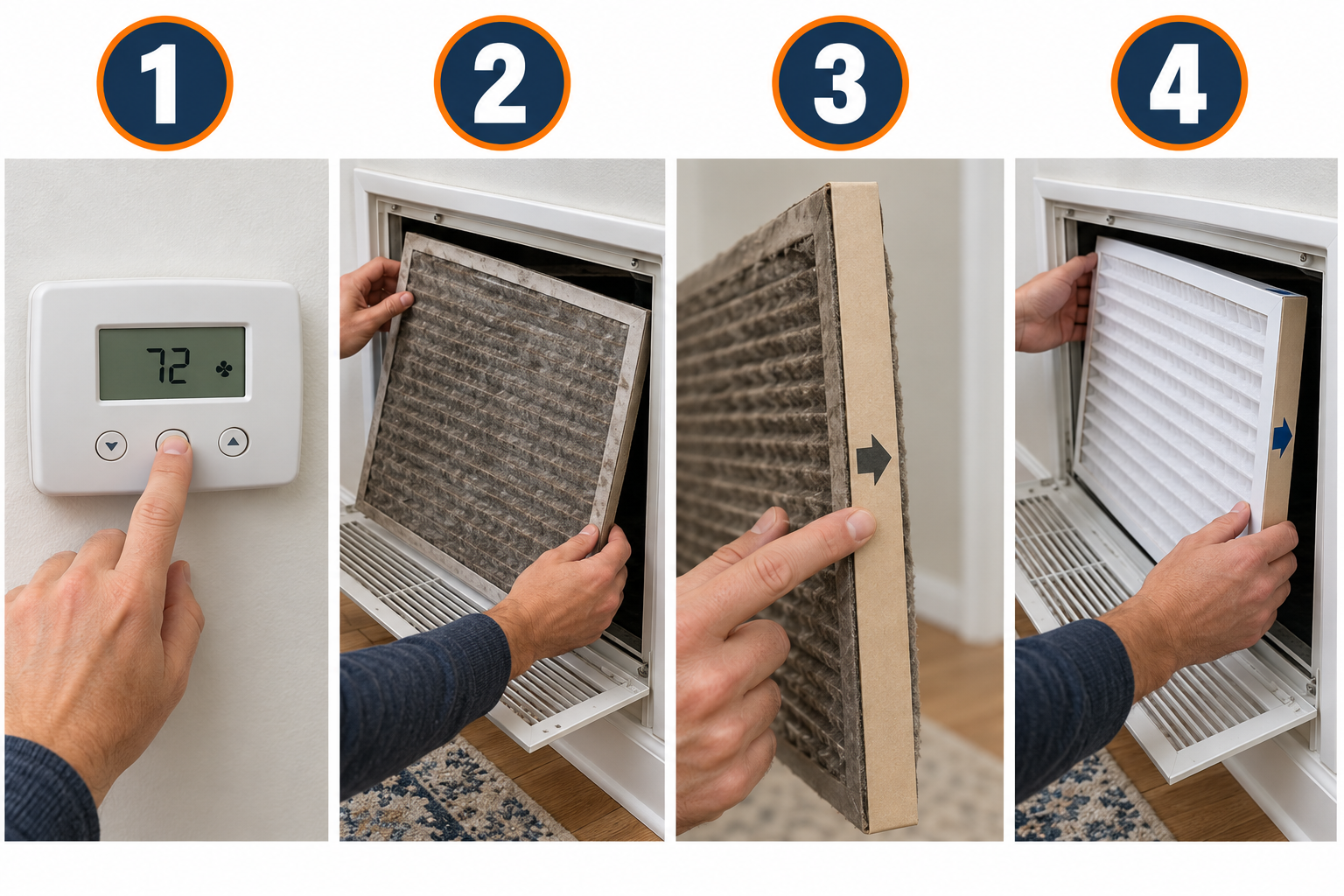
Changing an AC filter takes about five minutes: shut the system off, slide the old filter out of the return grille or the slot at the air handler, note the size and arrow direction printed on the frame, and slide the new one in with the arrow pointing toward the blower. Do it every 30 to 90 days for a standard 1-inch filter, or every 6 to 12 months for a 4- or 5-inch media filter. Skip it and the first things you lose are airflow, cooling, and money.
Quick steps: change ac filter
- Set the thermostat to Off so the blower stops.
- Find the filter at the return grille or in the slot next to the air handler.
- Pull the old filter and read the size and airflow arrow on the frame.
- Buy the same nominal size, in the thickness the slot was built for.
- Slide the new filter in with the arrow pointing toward the blower.
- Close the grille or slot cover, write the date on the frame, and turn the system back on.
Tools and materials
- Replacement filter (match the size printed on the old frame, e.g. 16x25x1)
- Permanent marker (to date the new filter)
- Tape measure (only if the old filter is missing or unreadable)
- Flashlight (filter slots are often in dark closets or attics)
- Screwdriver or nut driver (only for grilles held by screws rather than latches)
- Shop vacuum with brush attachment (to clean the slot while it is empty)
- Trash bag (carry the dirty filter out without shaking dust loose)
Calculators for this job
Safety first
Switch the thermostat to Off before pulling the filter. A running blower with no filter pulls dust straight into the evaporator coil, and reaching into a running blower compartment can cost you a finger. If the filter sits inside the furnace cabinet, kill power at the service switch on the side of the unit as well.
Step 1: Turn the system off
Set the thermostat to Off, not just a higher temperature. A higher setpoint only stops cooling; the fan can still run if the fan switch is on Auto and a cycle is mid-way, or constantly if it is set to On.
Wait 30 seconds and listen. The blower winds down and the return grille stops hissing. If you can still feel suction at the grille, the fan is running and you need to find the fan setting on the thermostat.
For filters inside the furnace or air handler cabinet, flip the light-switch style disconnect mounted on or beside the unit. Most air handlers also have a door safety switch that cuts power when the blower door is removed, but do not rely on it.
Step 2: Find the filter
Central systems hide the filter in one of four places. Check them in this order.
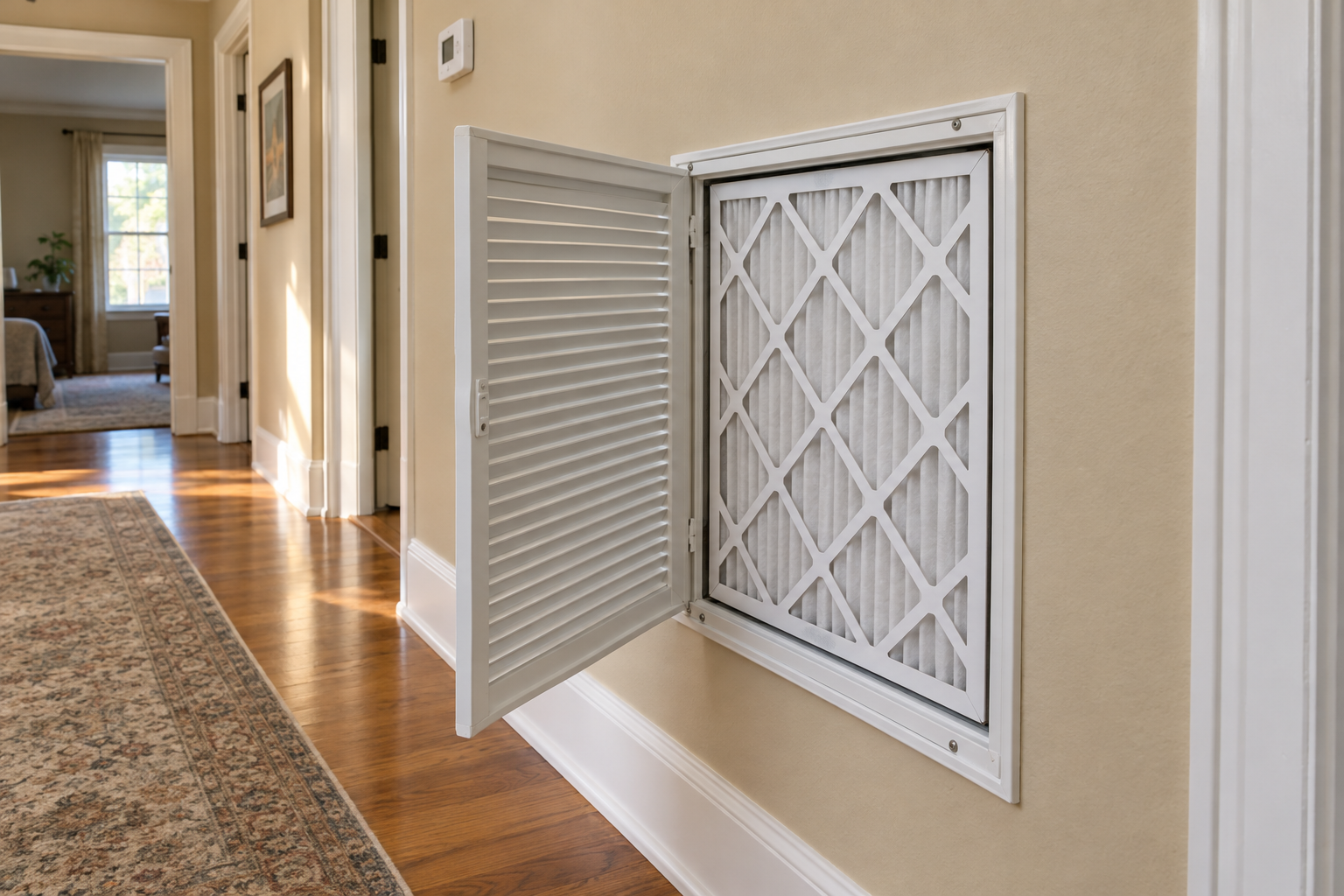
Return air grille. A large louvered panel on a wall or ceiling, usually 14×20 inches or bigger, often in a hallway. It swings open on hinges or clips, and the filter sits right behind it. Larger homes have two or three of these, each with its own filter.
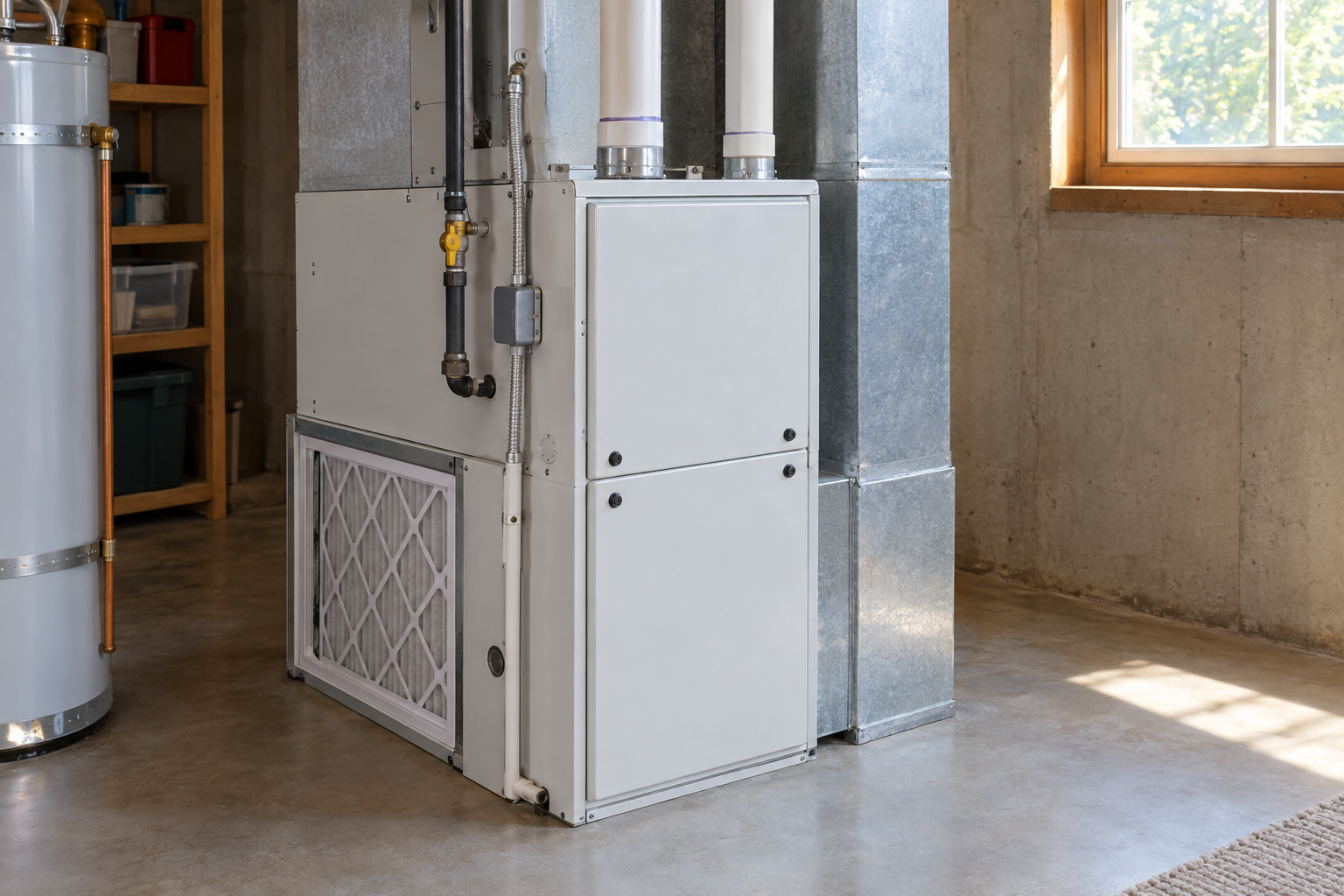
Filter slot at the air handler. A 1-inch or 4-inch wide slot cut into the return duct right where it meets the furnace or air handler, with a sheet-metal cover or a plastic door. This is the most common setup on gas-furnace systems and sits in a closet, basement, garage, or attic.
Inside the blower compartment. Older furnaces and some air handlers hold the filter in a rack inside the lower door. Remove the door and the filter sits in front of the blower wheel.
Media cabinet. A separate box, typically 4 or 5 inches deep, attached to the return side of the unit with its own door. Brands like Aprilaire, Honeywell, and Lennox Healthy Climate use these. They take a thick pleated filter and nothing else.
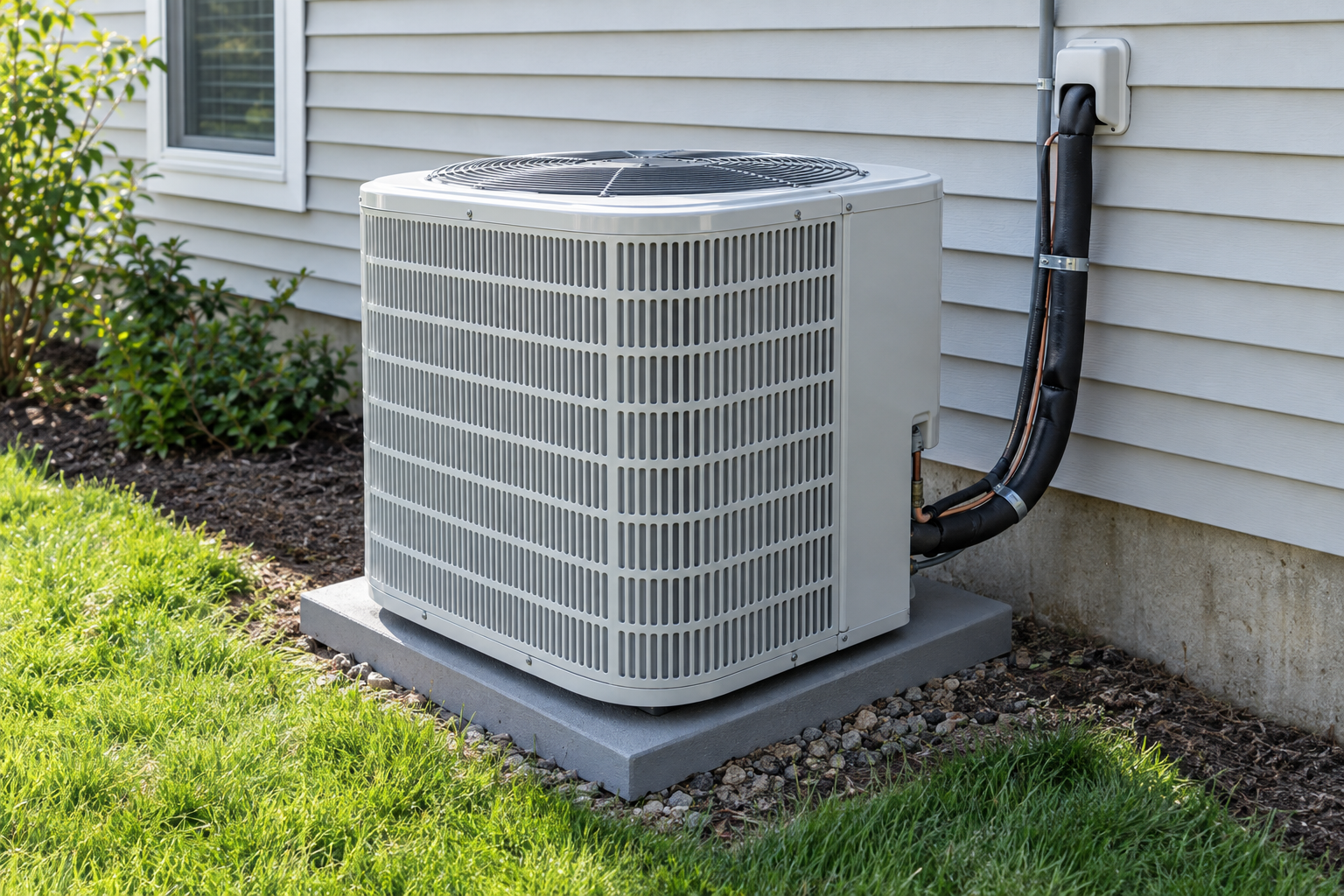
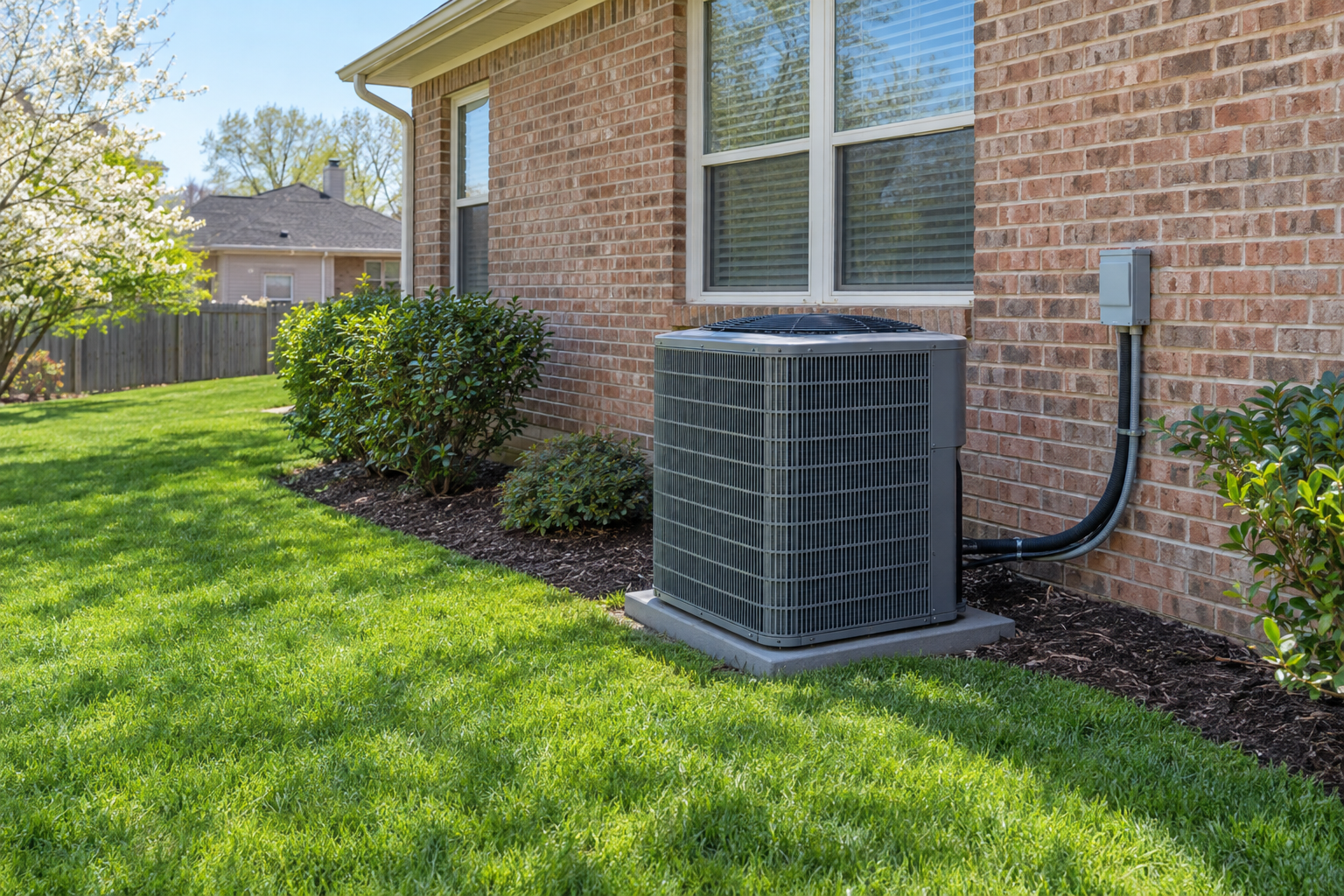
If you have a heat pump or an electric air handler, the filter is in the same spots. The outdoor condenser (the part most people call the ac unit) has no filter at all; it has a coil you rinse with a hose, which is a separate job.
Ductless mini-splits are different. The washable mesh filters live inside the wall-mounted indoor head, behind the front panel. Window and portable units also use washable mesh behind the front grille.
Pro tip
Can’t find a filter anywhere? Put your hand over each supply register and feel which rooms blow hardest, then follow the biggest duct backward to the air handler. Some installers leave the filter slot unlabeled and tape the cover shut. If there is truly no filter rack, a tech can add a 1-inch slot to the return plenum for roughly $150-250, and the system needs one.
Step 3: Pull the old filter and read the frame
Open the grille or slot cover and slide the filter out slowly. Keep it flat so the dust mat stays on the filter instead of landing on the floor. Drop it straight into a trash bag.
Before you throw it out, read three things on the cardboard frame:
- Nominal size, printed large, like 16x25x1 or 20x25x4.
- Actual size, printed small, like 15.5 x 24.5 x 0.75. This is what the filter really measures.
- Airflow arrow, usually with the words “Air Flow” next to it.
Note which way the arrow was facing. If the previous filter was installed backward, do not copy it. The arrow must point in the direction air travels: into the slot, toward the blower, away from the room.
Now look at the filter itself. Hold it up to a light. If you cannot see light through the pleats, it was overdue. A grey mat that peels off in sheets means it ran well past 90 days. A filter that bowed or collapsed inward was starving the blower for air.
While the slot is empty, run a shop vacuum around the opening and as far into the return duct as the hose reaches. Dust that sits here gets pulled onto the back of every new filter.
If there is no old filter or the printing is gone
Measure the slot opening, not the filter. Length, width, and depth, to the nearest quarter inch. If you need a refresher on fractions, read a measuring tape marking by marking before you order. Filters are sold by nominal size, which rounds up from the actual size, so a slot that measures 15.5 by 24.5 takes a 16×25 filter.
| Nominal size on the box | Actual size you will measure | Typical use |
|---|---|---|
| 14x25x1 | 13.5 x 24.5 x 0.75 | Smaller furnaces, 2-2.5 ton systems |
| 16x20x1 | 15.5 x 19.5 x 0.75 | Return grilles, older air handlers |
| 16x25x1 | 15.5 x 24.5 x 0.75 | Most common 1-inch slot size |
| 20x20x1 | 19.5 x 19.5 x 0.75 | Ceiling return grilles |
| 20x25x1 | 19.5 x 24.5 x 0.75 | 3-5 ton systems, large return grilles |
| 16x25x4 | 15.5 x 24.5 x 3.75 | Honeywell and Lennox media cabinets |
| 20x25x4 | 19.5 x 24.5 x 3.75 | Honeywell F100 style cabinets |
| 20x25x5 | 19.75 x 24.25 x 4.75 | Aprilaire 213 style cabinets |
Media cabinet filters are the exception to the “nominal is fine” rule. Aprilaire, Honeywell, Carrier, and Trane cabinets each have slightly different actual dimensions, and a generic 20x25x5 may be a quarter inch too tall for the door to close. Buy the cabinet brand’s own filter or a replacement that lists your cabinet model number.
Step 4: Pick the right replacement
A/c filter replacement goes wrong at the store more often than at the slot. Three things matter: size, thickness, and filtration rating.
Size comes straight off the old frame. Never go up a size and squeeze it in; a filter that bows lets air bypass around the edges.
Thickness is set by the slot. A 1-inch slot takes a 1-inch filter. A 4-inch cabinet takes a 4-inch filter. A 2-inch filter will not seal in a 1-inch slot, and a 1-inch filter rattles around in a 4-inch cabinet and lets dust past.
Filtration rating is where the real decision sits. The industry standard is MERV, a 1 to 16 scale for residential filters. The higher the number, the smaller the particles it stops, and the harder the blower has to work to pull air through it.
| Filter type | MERV | Stops | Cost each (1-inch) | Change interval | Good for |
|---|---|---|---|---|---|
| Spun fiberglass | 1-4 | Lint, large dust, carpet fiber | $1-4 | 30 days | Protecting the coil only; does little for air quality |
| Pleated, basic | 6-8 | Dust, pollen, mold spores, dust mite debris | $5-10 | 60-90 days | Most homes, best airflow-to-filtration balance |
| Pleated, mid | 10-11 | Adds pet dander, finer dust, some auto exhaust | $10-16 | 60-90 days | Pets, mild allergies |
| Pleated, high | 12-13 | Adds smoke, bacteria, most fine particles | $14-25 | 60-90 days | Allergy or asthma sufferers, wildfire season |
| Washable electrostatic | 4-8 claimed | Large dust, lint | $20-60 once | Wash monthly | Rentals and window units; weak on fine particles |
| 4-5 inch media | 11-13 | Same as high pleated, with far more surface area | $30-60 | 6-12 months | Any system with a media cabinet |
Retailers add their own scales on top of MERV. 3M Filtrete uses MPR (a 1000 MPR filter sits around MERV 11, 1900 MPR around MERV 13). Home Depot uses FPR 4 through 10. Ignore both and look for the MERV number, which is printed somewhere on every box.
The 1-inch MERV trap
A MERV 13 filter in a 1-inch slot sounds like a free upgrade. It is not. The dense media restricts airflow enough that many residential blowers cannot hit their designed static pressure, and the symptoms look exactly like a dirty filter: weak airflow, longer run times, and a coil that ices up on hot afternoons.
The fix for better filtration is more surface area, not a denser 1-inch filter. A 4-inch MERV 11 has roughly four times the pleat area of a 1-inch MERV 11, so it filters more, restricts less, and lasts six months or longer. If you want MERV 13 and only have a 1-inch slot, the right move is having a media cabinet installed. Expect $400-800 installed, most of that labor.
For a 1-inch slot, MERV 8 is the safe default. MERV 11 is fine on most systems newer than about 2010 with a variable-speed blower. Go higher only if the system was designed for it or a tech has measured static pressure and said it is fine.
Pets, smokers, and allergies
Every extra dog or cat in the house shortens filter life by a few weeks. Pet hair clogs the pleats on the surface, and dander loads the media behind it. Two shedding dogs on a 1-inch pleated filter in summer means 30 to 45 days, not 90.
Allergy sufferers benefit most from MERV 11 to 13 in a media cabinet, changed on schedule. A MERV 13 that has been in place for a year is worse than a fresh MERV 8, because the loaded filter forces air to leak around its edges unfiltered.
Step 5: Install the new filter, arrow toward the blower
Pull the plastic wrap off and check the arrow on the frame. Face it toward the air handler or furnace and away from the room.
At a return grille in a wall or ceiling, the arrow points into the wall, away from you.
At a filter slot beside the air handler, the arrow points toward the unit cabinet. Air enters from the return duct and exits into the blower.
Inside a blower compartment, the arrow points toward the blower wheel.
Slide it in square. It should move freely with light friction and sit flat against the rack with no gaps along the edges. If you have to force it, the size is wrong. If it flops around with a half-inch gap on one side, the size is also wrong.
Close the cover. Slot covers should seal; if yours is a loose sheet-metal plate, a strip of foil HVAC tape along the top edge stops it sucking unfiltered air past the filter. Do not use duct tape, which dries out and fails within a season.
Pro tip
Write the install date on the frame edge in permanent marker before you slide it in. Three months from now you will not remember whether it was May or July. Buy filters by the 6-pack or 12-pack; a 16x25x1 MERV 8 runs about $5-7 each that way versus $10-12 as a single at a hardware store.
Step 6: Restart and confirm airflow
Flip the service switch back on if you turned it off, then set the thermostat back to Cool at your normal setpoint.
Walk to the furthest supply register and hold your hand over it. Within a minute of the fan starting you should feel firm, steady airflow. Stand near the return grille and listen; a healthy system hums, while a whistling or sucking sound means air is squeezing past a bad seal or an undersized filter.
Give it 15 minutes. Supply air should feel noticeably cold, and the return air should feel room temperature. If the supply air is cold at first and then turns lukewarm, the coil may have been frozen before you started; see the troubleshooting table below.
Set a phone reminder for 60 days out. That first check tells you how fast your house actually loads a filter, and you can adjust the schedule from there.
How often to change an air conditioner filter
The honest answer depends on filter thickness, how many people and animals live in the house, and how hard the system runs. Use this as the starting point and let the hold-to-light test correct it.
| Household | 1-inch fiberglass | 1-inch pleated | 4-5 inch media |
|---|---|---|---|
| Vacation home, single occupant, no pets | 30 days | 90 days | 12 months |
| Family of 2-4, no pets | 30 days | 60-90 days | 9-12 months |
| One dog or cat | 30 days | 60 days | 6-9 months |
| Two or more pets, or a smoker | 30 days | 30-45 days | 6 months |
| Allergy or asthma sufferer | Not recommended | 30-45 days | 6 months |
| Active renovation or dusty construction nearby | 2 weeks | 30 days | 3 months |
| Peak summer with the system running 10+ hours a day | 30 days | 45-60 days | 6 months |
The simplest rule: check the filter on the first of every month during cooling season. Pull it, hold it to a window, and replace it when you can no longer see light through the pleats. Summer loads a filter faster than spring because the blower runs more hours.
The US Department of Energy puts the energy penalty of a dirty filter at 5 to 15 percent of a system’s consumption. On a $200 summer electric bill with the AC as the main load, that is roughly $10-30 a month, which pays for a year’s worth of filters by August.
Mark filter changes on the same calendar as the rest of your seasonal air conditioning maintenance, like rinsing the condenser coil and clearing the condensate drain. Changing the filter also keeps the furnace side of the system healthy; the same filter slot serves it all winter, and most furnace tips lists start with it.
How to clean a washable air con filter
Washable filters are standard on window units, portable units, and ductless mini-splits. Some central systems have a washable electrostatic filter in a metal frame.
Quick steps: clean a washable filter
- Turn the unit off and unplug it.
- Open the front panel and lift the mesh filter straight out.
- Vacuum the dust side with a brush attachment.
- Rinse with lukewarm water from the back side so dirt flows out the way it came in.
- Scrub stubborn grime with a drop of dish soap and a soft brush.
- Shake off the water and air-dry fully, 1-2 hours in shade.
- Reinstall with the frame oriented the same way it came out and close the panel.
Never put a damp filter back. Moisture on a mesh filter in front of a cold coil grows mildew in days and the whole unit starts smelling like a wet basement.
Window units: clean the filter every 2 to 4 weeks in summer. Most 5,000 to 12,000 BTU units have a single mesh panel that slides up and out behind the front grille.
Mini-splits: the indoor head has two mesh filters behind the lift-up front cover. Clean them monthly. Many heads also have a smaller deodorizing or enzyme filter clipped onto the mesh; rinse it gently or replace it annually per the manual.
Central-system washable electrostatic filters: hose them off monthly, let them dry, and plan to replace them every 5 to 8 years as the frame warps and the media loses its charge. They stop lint and large dust but do little for fine particles, so most techs prefer a disposable pleated filter.
Common mistakes with a c unit filter replacement
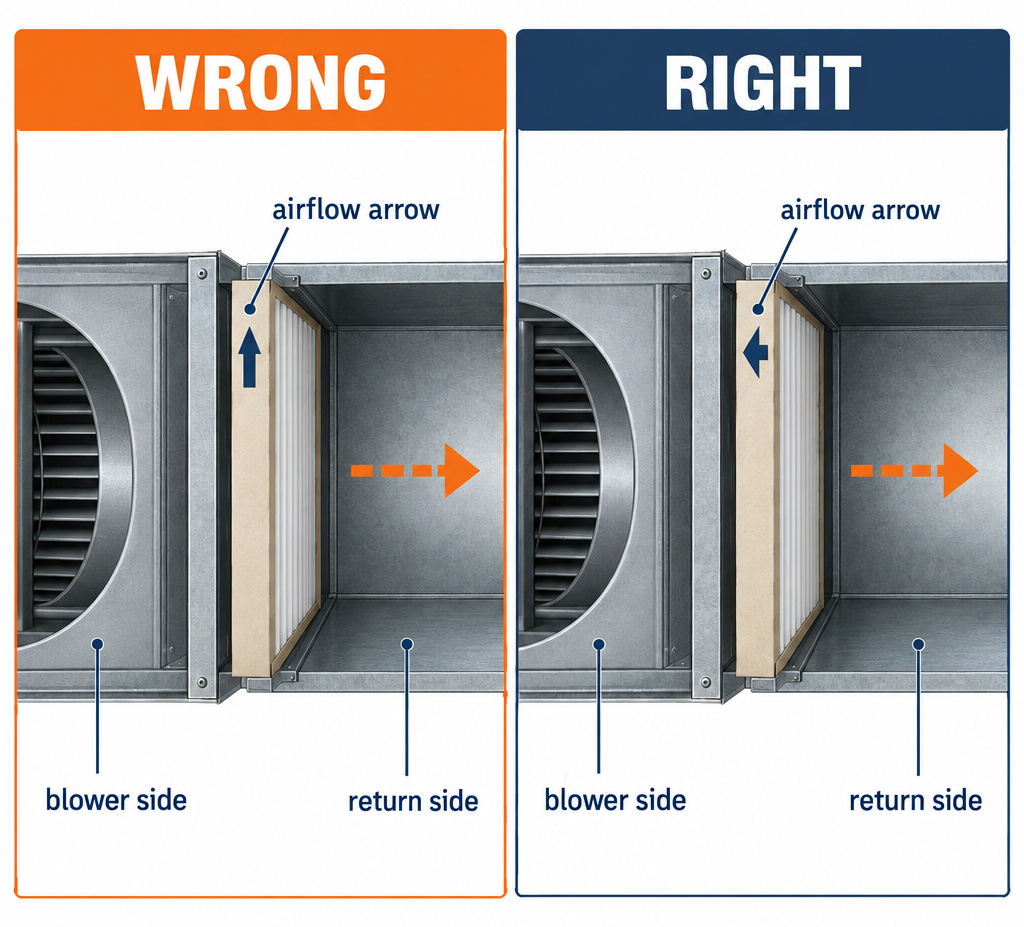
Arrow backward. The filter still catches dust for a few weeks, then the pleats collapse inward because they were designed to be pushed from the other side. Airflow drops hard. Check the arrow every time.
Wrong thickness. A 1-inch filter dropped in a 4-inch cabinet leaves a 3-inch gap. Dust goes around it, straight onto the coil, and the coil fouls in a year.
Running without a filter “just for now.” One week with no filter during a kitchen remodel coats the evaporator coil. A coil cleaning runs $150-400 when a tech can reach it, more if it has to be pulled.
Doubling up filters. Two 1-inch filters stacked in one slot restricts air roughly as badly as one MERV 13, and neither seals.
Buying by actual size. A 15.5×24.5 search online gives you nothing. Search the nominal 16×25.
Forgetting the second return. Two-story homes often have a return grille on each floor, each with its own filter, plus sometimes a filter at the air handler. Replace all of them; one clogged filter chokes the whole system.
Troubleshooting after a filter change
| Symptom | Likely cause | Fix |
|---|---|---|
| Weak airflow at every register, new filter installed | Filter too restrictive for the blower, or arrow backward | Flip the arrow toward the blower. If correct, drop to MERV 8 and see if airflow returns |
| Whistling or sucking noise at the return grille | Air bypassing a loose filter or unsealed slot cover | Verify size matches the slot. Seal the cover with foil HVAC tape |
| Ice on the refrigerant line or coil, water on the floor | Coil froze from weeks of restricted airflow before the change | Set thermostat to Off and fan to On for 2-4 hours to thaw, then run Cool. If it refreezes with a clean filter, call a tech to check refrigerant charge |
| New filter grey within 2 weeks | Return duct leaking in an attic or crawlspace, or active construction dust | Inspect return duct joints for gaps and seal with mastic. Change filter monthly until dust source is gone |
| System runs but air is not cold | Unrelated to the filter if airflow is good | Check breaker and outdoor unit; if the air conditioner is still not cooling, the problem is in the refrigerant circuit or a failed capacitor |
| Musty smell starting right after a filter change | Damp washable filter reinstalled, or a wet media filter from a leaking coil drain | Dry washable filters fully. For media filters, check the condensate drain pan under the coil |
| Filter bows or pulls out of the rack | Filter collapsing from a dead blower motor pulling too hard, or a cheap flimsy frame | Buy a filter with a stiffer frame. If a quality pleated filter still bows, have static pressure measured |
| Thermostat shows “Change Filter” after you changed it | Reminder is a timer, not a sensor | Reset the filter reminder in the thermostat menu |
What a dirty filter actually costs you
Dust on a filter is the cheap problem. Dust past the filter is the expensive one. A loaded filter makes the blower pull harder, which on older PSC motors means higher amp draw and heat, and on newer ECM motors means the motor speeds up to compensate until it hits its limit and airflow drops anyway.
Reduced airflow across the evaporator coil drops the coil temperature below freezing. Condensation on the fins turns to ice, the ice blocks more air, and within an afternoon you have a frozen block where the coil should be. The compressor keeps running against it. That is how a $7 filter turns into a $1,500 compressor.
Dust that gets past a gapped or missing filter settles on the coil fins and the blower wheel. A coated blower wheel moves measurably less air and throws the motor out of balance. A coated coil insulates itself from the air it is supposed to cool. Both need a tech with a coil cleaner and a few hours.
A fresh filter every 60 to 90 days is the single highest-return maintenance task on a residential HVAC system. It costs less than a cup of coffee a month and protects a system that costs $5,000 to $12,000 to replace.
When to call a pro
Call an HVAC tech if a clean, correctly installed MERV 8 filter still leaves you with weak airflow, if the coil freezes again after a full thaw, if you see water pooling under the air handler, or if the blower motor hums without spinning. Those point to a failed capacitor, low refrigerant, a clogged drain, or a dead motor, none of which a filter fixes. Also call one if you want a 4-inch media cabinet added to a system that only has a 1-inch slot; it involves cutting the return plenum and should include a static pressure reading to confirm the blower can handle the new filter.
FAQ
How often should you do an AC filter replacement?
Every 30 to 90 days for a 1-inch filter and every 6 to 12 months for a 4- or 5-inch media filter. Check monthly in summer and replace sooner with pets, smokers, or anyone with allergies in the house.
Which way does the arrow go on an AC filter?
Toward the blower, in the direction air moves. At a wall or ceiling return grille, the arrow points into the wall. At a slot beside the furnace or air handler, it points toward the unit cabinet.
Can I run my AC without a filter for a few days?
No. Dust goes straight onto the evaporator coil and blower wheel, and cleaning those costs $150-400 or more. If you are out of filters, leave the system off until you buy one.
Is a higher MERV filter always better?
Not in a 1-inch slot. MERV 13 in a 1-inch frame restricts airflow enough to cause weak cooling and frozen coils on many systems. Use MERV 8 to 11 in 1-inch slots and MERV 11 to 13 in 4- or 5-inch media cabinets.
What size AC filter do I need?
The nominal size printed on the old filter frame, like 16x25x1. If there is no old filter, measure the slot to the nearest quarter inch and round up to the nearest whole-inch nominal size.
Why is my new filter dirty after only two weeks?
Usually a return duct leak pulling attic or crawlspace dust into the system, or construction dust in the house. Seal duct joints with mastic and change filters monthly until the dust source is gone.
Does changing the AC filter lower the electric bill?
Yes. The Department of Energy estimates a dirty filter raises energy use by 5 to 15 percent. On a $200 summer bill, a clean filter is worth roughly $10-30 a month.
Do I change the same filter for the furnace in winter?
Yes. A central system uses one filter slot for both heating and cooling. Keep the same schedule year-round, with more frequent checks during peak summer and peak winter.