Cleaning a steam cleaner comes down to one job: dissolving the mineral scale that builds up inside the boiler and clogs the nozzle. A soak with diluted white vinegar or citric acid, a thorough rinse, a quick pin through the nozzle and a pad wash brings most units back to full steam in about an hour, with most of that time spent waiting.
Quick steps: descale a steam cleaner
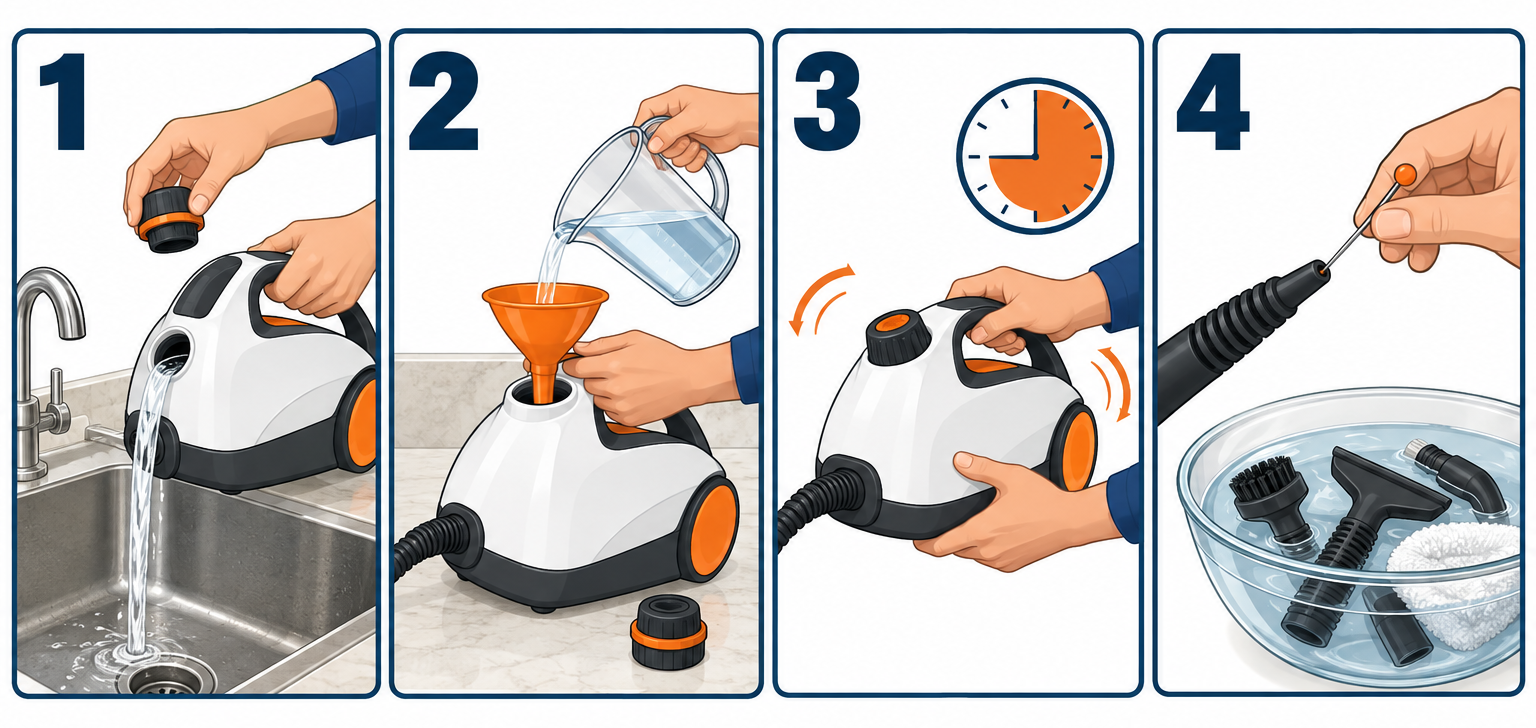
- Unplug the unit and let it cool for at least 30 minutes.
- Drain any leftover water from the boiler or tank.
- Fill with a 50/50 white vinegar and water mix, or 2 tablespoons citric acid per quart of warm water.
- Let it soak 30-60 minutes (overnight for heavy scale), swirling a few times.
- Drain, then rinse with clean water two or three times until it runs clear.
- Run a tank of distilled water through as steam to flush the hose and nozzle.
- Clear the nozzle with a pin, scrub attachments and machine wash the pads.
- Dry everything and store with the cap loose.
Tools and materials
- Distilled white vinegar (5% acidity, about 1 quart)
- Citric acid powder (optional alternative, 2-4 tablespoons)
- Distilled water (1 gallon for rinsing and flushing)
- Funnel or the measuring cup that came with the unit
- Straight pin, sewing needle or the descaling pin from the box
- Old toothbrush
- Microfiber cloths
- Small bowl for soaking attachments
- Towels to catch drips
Safety first
Unplug the unit and wait until the boiler is cool to the touch before opening the cap. Canister units hold steam at roughly 45-60 psi and the cap will blast scalding water if opened under pressure. Never pour vinegar into a hot boiler.
Why scale is the whole problem
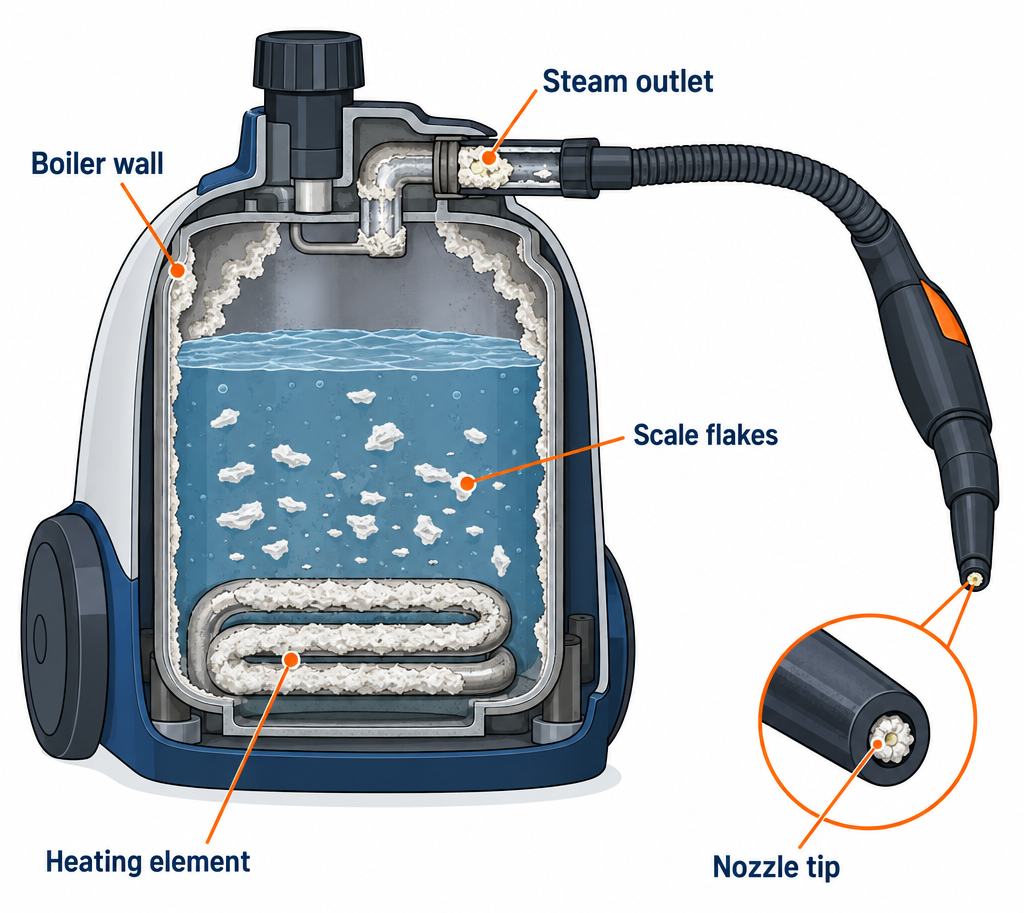
Every steam cleaner boils water, and every drop of tap water leaves its minerals behind when it turns to steam. Calcium and magnesium carbonate coat the heating element, line the boiler walls and collect in the narrowest spot in the system, which is the steam outlet in the nozzle.
You notice it as weak steam, long heat-up times, spitting or dribbling, and a white film on dark floors after mopping. A cleaner that used to hit full pressure in 8 minutes starts taking 15. Eventually the thermostat trips repeatedly because the scaled element cannot shed heat, and the unit dies early.
Distilled water prevents nearly all of this, which is why almost every manual asks for it. Scale from filtered or softened tap water still builds, just slower. Softened water swaps calcium for sodium, and sodium salts leave their own crust. Descaling on a regular schedule keeps a $150 to $400 machine running for a decade instead of two or three years.
Step 1: Cool it down and empty it
Switch the unit off, unplug it and leave it alone. A canister steam cleaner with a 1 to 1.5 liter boiler needs 30 to 45 minutes to drop below boiling. Steam mops with small flow-through heaters cool in 10 to 15 minutes.
Check the pressure before opening a canister. Most good units have a safety cap that will not unscrew while there is pressure inside. If you feel resistance and hear hissing, stop and wait. If your unit has a pressure gauge, it should read zero. Press the trigger with the cap still on to release any residual steam into a sink.
Once cool, unscrew the cap fully and tip the unit over a sink to drain. Watch what comes out. Clear water means light scale. Cloudy water or gritty white flakes means the boiler is well coated and you should plan for the longer overnight soak.
Steam mops are simpler. Pull the removable tank, dump it and wipe it out. The scale on a mop lives in the heater channel and the steam vents under the head, so the real descaling happens when you run solution through it in Step 3.
Step 2: Mix the descaling solution
Three options work. Pick based on what you have and how bad the scale is.
White vinegar, 50/50 with water. Cheapest and always on hand. A gallon costs a few dollars and you need about a quart for one descale. Vinegar is 5% acetic acid, so a half-and-half mix lands at 2.5%, strong enough to dissolve scale without attacking seals. Do not use it straight. Full-strength vinegar swells rubber gaskets over time and leaves a smell that takes several flushes to clear.
Citric acid, 2 tablespoons per quart of warm water. Works faster than vinegar, rinses cleaner and has no odor. A one-pound bag costs $8 to $12 and does 15 to 20 descales. Dissolve the powder fully in warm (not boiling) water before pouring it in. This is the better choice for stainless boilers and for anyone whose family objects to the vinegar smell.
Commercial descaler. Products sold for espresso machines, kettles and irons run $10 to $20 and are usually citric or lactic acid in a measured dose. Follow the ratio on the bottle. They offer no real advantage over plain citric acid except convenience.
Check your manual first. A few manufacturers specifically prohibit vinegar or any descaler and tell you to rely on distilled water only, mainly because acid can damage certain aluminum heater castings. If your manual says no, stick to the distilled-water flush in Step 4 and a mechanical clean of the nozzle. Running acid through a machine against the manufacturer’s instructions is an easy way to void the warranty.
Pro tip
Warm the solution to about 120°F (hot tap water temperature) before pouring it in. Acid dissolves scale roughly twice as fast when warm, which turns an overnight soak into a 45 minute one on moderately scaled units.
Step 3: Soak the boiler or tank
Canister and handheld pressurized units. Pour the solution through the funnel until the boiler is about three-quarters full. Do not fill to the top, because the fizzing reaction between acid and carbonate needs headspace. Leave the cap off or rest it loosely on top. Let it stand 30 to 60 minutes for routine maintenance, or 6 to 8 hours overnight for a unit that is spitting and slow.
Every 15 minutes or so, pick the unit up and swirl it gently. You will hear and feel loose scale sliding around. That is the point. Swirling also moves fresh acid against the walls instead of letting a spent layer sit on the deposit.
Never heat the boiler with descaler in it unless the manual tells you to. Boiling vinegar pushes acetic fumes out of every seam and can overpressurize the fizzing solution.
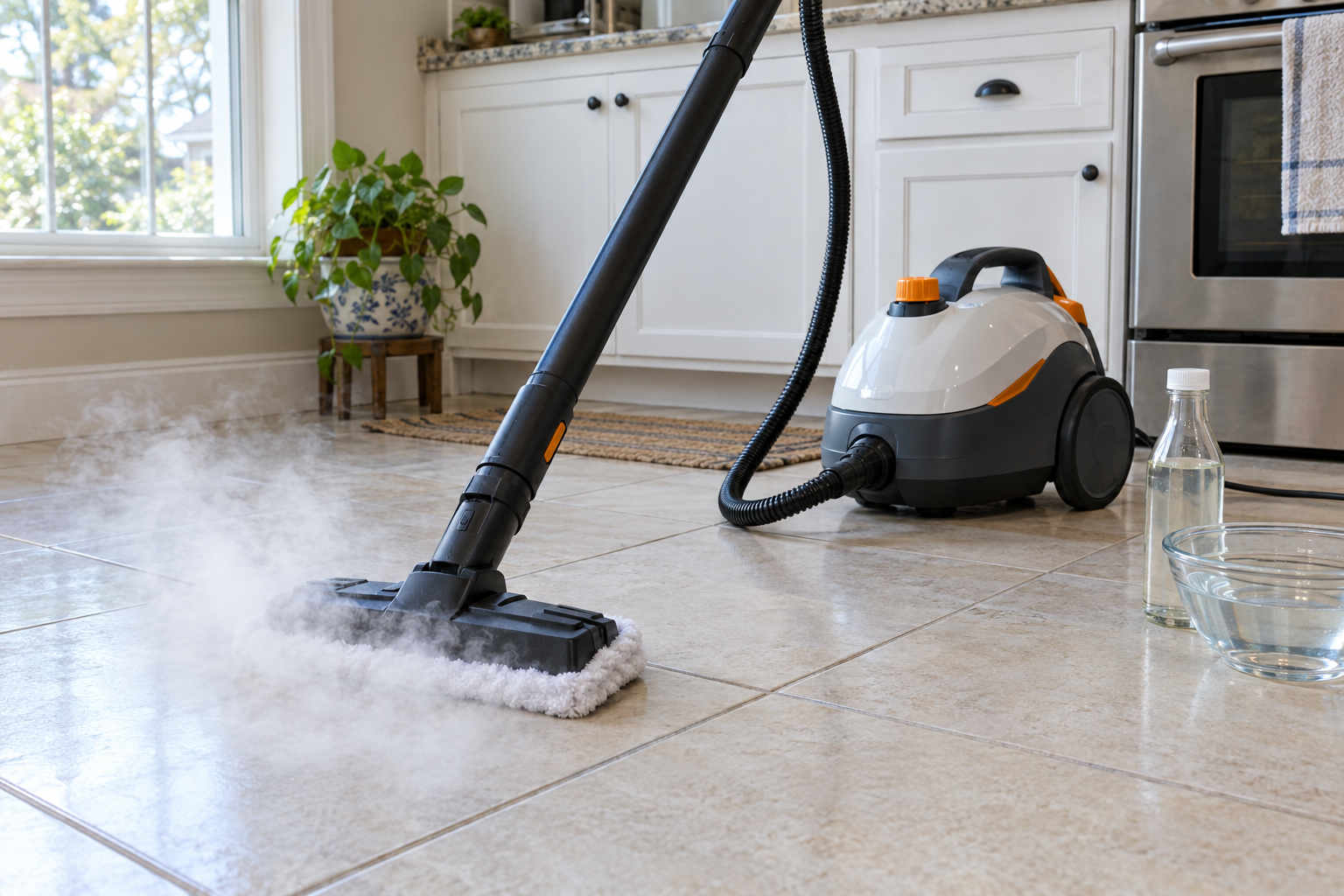
Steam mops and flow-through handhelds. These do not hold water against the heater, so a static soak does little. Fill the tank with solution, plug the mop in, let it heat, then pump or trigger steam into a sink or a bucket for 30 to 60 seconds. Switch it off and let the solution sit in the heater channel for 15 to 20 minutes. Repeat the heat-and-steam cycle three or four times until the tank is empty. Do this in a well ventilated room, because the vinegar steam is sharp.
Some steam mops ship with a small descaling pin and instructions to clear the steam vents under the head. Use it after the solution cycle, once the mop has cooled, pushing the pin into each vent and wiggling it to break loose any softened plug.
While the boiler soaks, drop the nozzle tip, jet nozzle, brush attachments and any metal extension tubes into a bowl of the same solution. Fifteen minutes loosens the crust that forms around the tip where steam exits.
Step 4: Rinse until it runs clear
Drain the solution into the sink. Expect a stream that looks cloudy and faintly grey with specks of white scale. Fill the boiler halfway with clean water, cap it loosely, shake for 20 seconds and drain. Repeat two more times. On the third rinse the water should be clear and no longer smell of vinegar.
Now the flush. Fill with distilled water, cap it properly, plug in and heat to full pressure. Trigger steam into a sink or a towel-lined bucket for a full minute. The first burst often comes out brownish or carries small flakes. That is the last of the loosened scale leaving the hose and nozzle. Keep triggering until the steam is clean and dry. Then run the rest of the tank out, cool, and drain.
Skipping this flush is the most common mistake. Loose scale that was softened but not expelled migrates to the nozzle and causes a blockage the first time you use the unit on a floor.
On a steam mop, run one full tank of distilled water through as steam over the sink before you put a pad on and go back to the floor. Vinegar left in the heater will spray onto hardwood and can dull a polyurethane finish.
Step 5: Clear the nozzle, hose and attachments
Pull the attachments out of their soak and rinse them under the tap. Scrub the brush heads with the toothbrush to clear hair, grout paste and crusted minerals from between the bristles. Nylon brushes last years if you rinse them after every job; brass detail brushes should be dried immediately or they tarnish and shed.
Look straight into the steam outlet on the main nozzle and the jet nozzle. A healthy outlet is a clean round hole roughly 1 to 2 mm across. Scale shows as a white or tan ring narrowing the hole, or a full plug. Push a straight pin in and rotate it to break the deposit, then blow through from the back. A needle that is too big will enlarge the hole and ruin the jet, so match the pin to the opening.
Inspect the hose. Flex it along its length and look for cracks, especially near the handle and the connector. Steam hoses are the weak link on most canister units and a replacement runs $25 to $60 depending on the brand. A cracked hose leaks hot condensate onto your hand, so replace rather than tape it.
Check the boiler cap gasket. It should be pliable and seated flat in its groove. A gasket that is cracked, flattened or hard means the cap will weep steam under pressure and the unit will never build full heat. Replacement gaskets cost $5 to $15 and the swap takes thirty seconds.
Pro tip
Keep a sewing needle taped inside the lid of the attachment box. Most “my steamer stopped working” calls are a nozzle plug that takes ten seconds to clear, and having the pin where you use the machine means you actually do it.
Cleaning the pads and the outside of the machine
Microfiber pads trap everything the steam loosens, and a dirty pad just redistributes grime. Rinse pads in hot water right after use, then wash them in the washing machine on warm with regular detergent, no fabric softener and no bleach. Softener coats the fibers and kills their grip. Air dry or tumble on low. A pad that has gone stiff, grey and thin after 40 or 50 washes is done, and replacements run $10 to $20 for a pair.
Wipe the body with a damp cloth. Avoid solvent cleaners on the plastic housing, since they haze it and can degrade the rubber feet. Wipe the cord and check it for nicks. Clean the water fill opening and the area around the cap where mineral drips crust up. A cotton swab dipped in vinegar lifts the white residue around the threads.
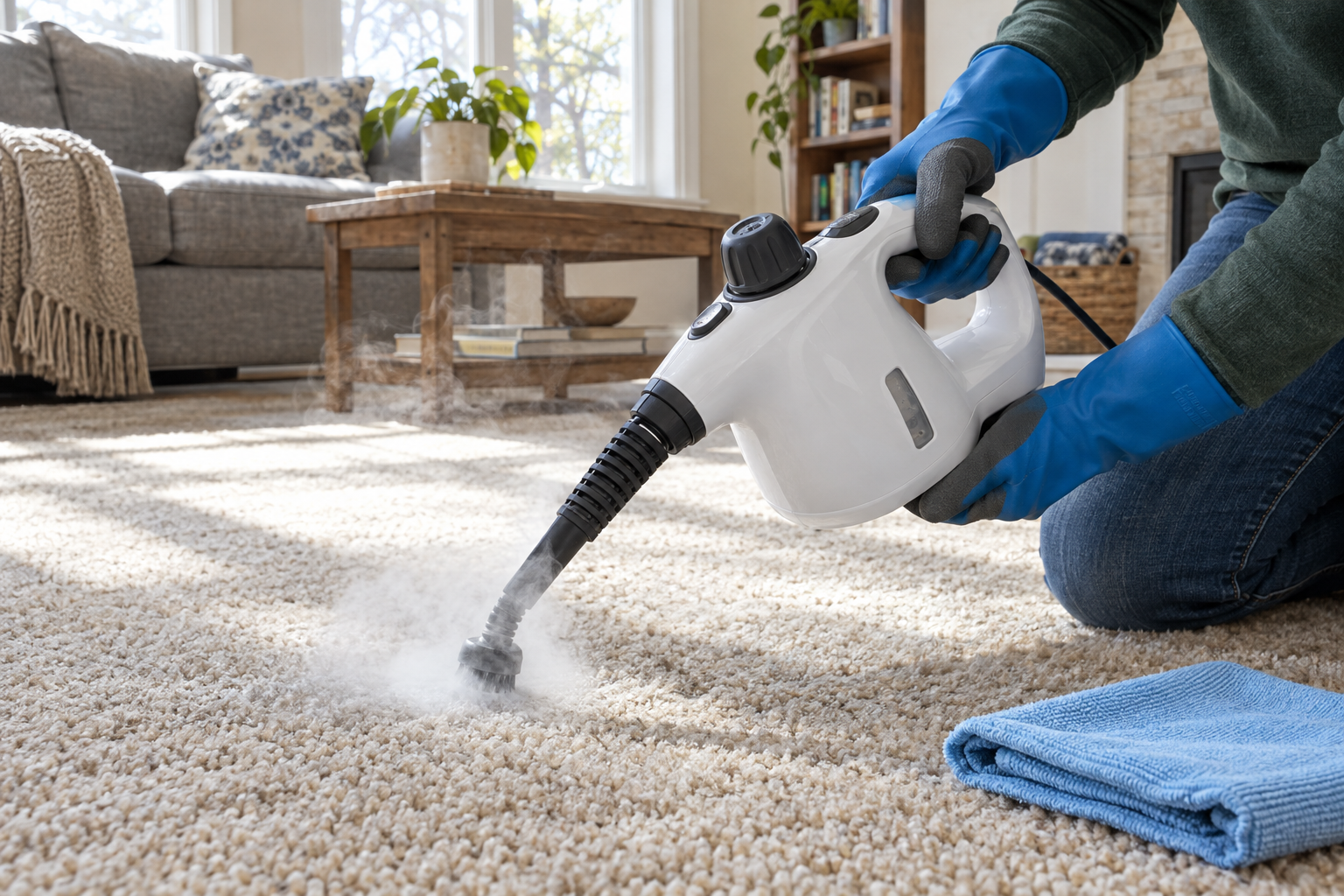
Carpet and upholstery attachments deserve extra attention, since they pull up pet hair and fibers that wrap around the steam outlet. If you regularly steam carpets, pull the carpet glider off and clean the underside, where lint collects and blocks the steam distribution slots.
Storage between jobs
Scale forms fastest in a boiler left half full. Water sitting against the element between uses evaporates slowly and concentrates minerals into a crust that is harder to dissolve than fresh deposits. Always drain the boiler after the unit cools, then store it with the cap threaded on loosely so the inside can dry out and the gasket is not compressed for weeks.
Coil the hose in wide loops rather than folding it. Hang the attachments or keep them in the storage caddy so the brush bristles are not crushed. Store the unit somewhere above freezing. Water trapped in the hose or heater will expand if it freezes in a garage and split the fittings.
Before the first use after a few weeks in storage, heat a tank of distilled water and run it through over the sink. This clears any dust or dried residue in the nozzle and confirms the unit is building pressure normally.
How often to descale
The honest answer depends on your water and your water choice. This schedule is a reasonable starting point.
| Water used | Hardness | Descale interval |
|---|---|---|
| Distilled only | None | Every 6-12 months, mostly to inspect and flush |
| Filtered tap | Soft (under 60 mg/L calcium carbonate) | Every 3-4 months |
| Tap | Moderately hard (60-120 mg/L) | Every 6-8 weeks |
| Tap | Hard or very hard (over 120 mg/L) | Monthly, or every 10-15 fills |
| Softened tap | Varies | Every 2-3 months, sodium residue still builds |
Check your water hardness on your utility’s annual water quality report, or use a $10 strip test kit sold for aquariums and pools. Most of the US Midwest, Southwest and the Mountain states run hard to very hard, which is why complaints about steam mops dying after a year cluster there.
A cheaper habit than descaling is simply buying distilled water. A gallon costs $1 to $1.50 and fills a typical canister boiler three times. If you run the cleaner twice a month, that is under $15 a year to nearly eliminate the problem.
Do not use essential oils, cleaning solutions or carpet shampoo in the boiler unless the manufacturer sells a solution designed for that model. Oils and surfactants foam under pressure, coat the element and gum up the pressure switch. Anything that is not plain water goes on the surface, never in the tank.
Troubleshooting a steam cleaner that still acts up
| Symptom | Likely cause | Fix |
|---|---|---|
| Weak or no steam after descaling | Nozzle still plugged with loosened scale | Pin the outlet, then run a full distilled tank through over the sink |
| Spitting water instead of steam | Boiler overfilled, or heavy scale on the element | Fill only to the marked line; repeat the soak overnight |
| White film or streaks on dark floors | Mineral-laden water spraying onto the surface | Switch to distilled water; descale; rinse the floor with a damp microfiber |
| Brown or rusty discharge on first trigger | Dislodged scale and iron deposits from the boiler | Normal after descaling; keep flushing until it runs clean |
| Unit takes much longer to reach pressure | Scaled element insulating the heater | Full descale; if no change, thermostat or element is failing |
| Steam leaks around the boiler cap | Worn or cracked cap gasket | Replace the gasket ($5-15) |
| Hissing or dripping from the hose | Cracked hose or loose connector | Reseat the connector; replace a cracked hose |
| Vinegar smell in steam days later | Insufficient rinsing | Run two more distilled tanks through over the sink |
| Pump runs constantly on a refillable unit | Air lock or clogged inlet screen | Prime per manual; clean the inlet filter |
| Thermal cutoff trips repeatedly | Scale, low water or failed thermostat | Descale and refill; if it persists, stop using the unit |
Canister versus steam mop: what changes
The two designs scale differently, and the cleaning routine follows the design.
A canister or handheld pressurized unit boils all the water in a sealed tank. Scale sits on the bottom and on the element. The static acid soak works well because the acid sits right on the deposit. These units tolerate descaling for years, and a stainless boiler with a replaceable gasket is a 10 to 15 year machine with care.
A steam mop or flow-through handheld pumps small amounts of water from a cold tank through a short heated channel. There is no reservoir of boiling water, so scale forms in the channel and at the steam vents. The only way to get acid where it matters is to run it through as steam, in cycles. Because the channel is narrow and the heater is often cast aluminum, these units are less forgiving. Many steam mop failures that look like a dead pump are actually a scaled channel, and many that look like a scaled channel are a dead pump. If descaling and vent clearing do not restore flow, the mop is usually not worth repairing at $60 to $120 for the whole appliance.
When to call a pro
Stop and get the unit serviced if the safety valve has ever vented, if the boiler leaks at a seam, if the cord or plug is damaged, or if the unit trips the breaker. Heating element and thermostat replacement on a $300-plus canister is a job for the manufacturer’s service center or a small appliance repair shop, typically $60-120 plus parts. Never bypass a thermal cutoff or safety cap.
FAQ
Can I use vinegar in any steam cleaner?
No. Most canister units with stainless boilers tolerate a 50/50 vinegar soak, but several steam mop and handheld brands prohibit vinegar and any descaler, usually because of aluminum heater parts or seals that acid attacks. Read your manual. If it says distilled water only, use the mechanical nozzle clean and distilled flush instead.
How long does descaling take?
Plan on about an hour for a routine job: 10 minutes of hands-on work, 30 to 45 minutes of soaking and rinsing, and a few minutes of flushing. A badly scaled unit that spits and takes forever to heat needs an overnight soak, so start it the evening before you need the cleaner.
Does distilled water really matter?
Yes, more than anything else on this list. Distilled water has essentially no dissolved minerals, so nothing is left behind when it boils. Filtered water from a pitcher still carries most of its calcium. Softened water trades calcium for sodium and leaves a different residue. A gallon of distilled runs about $1 to $1.50, which is cheaper than a replacement machine every couple of years.
My floors have white streaks after mopping. Is the mop broken?
Almost never. White streaks are minerals from tap water drying on the surface, sometimes combined with residue from previous cleaning products on the floor. Descale the mop, switch to distilled water, and give the floor one pass with a clean damp microfiber pad to lift the old residue. The streaking stops.
Can I put steam cleaner attachments in the dishwasher?
Plastic and nylon attachments can usually go on the top rack, but the heat warps some cheaper nozzles and the detergent dulls brass bristles. A bowl of warm vinegar solution and a toothbrush does a better job in less time, with no risk.
How do I know the descale worked?
Time the heat-up. A unit that reached pressure in 8 minutes when new and had crept to 15 should be back near 8 or 9 after a good descale. Steam should come out dry and forceful with no spitting, and the first distilled flush after the job should run clear within a minute.