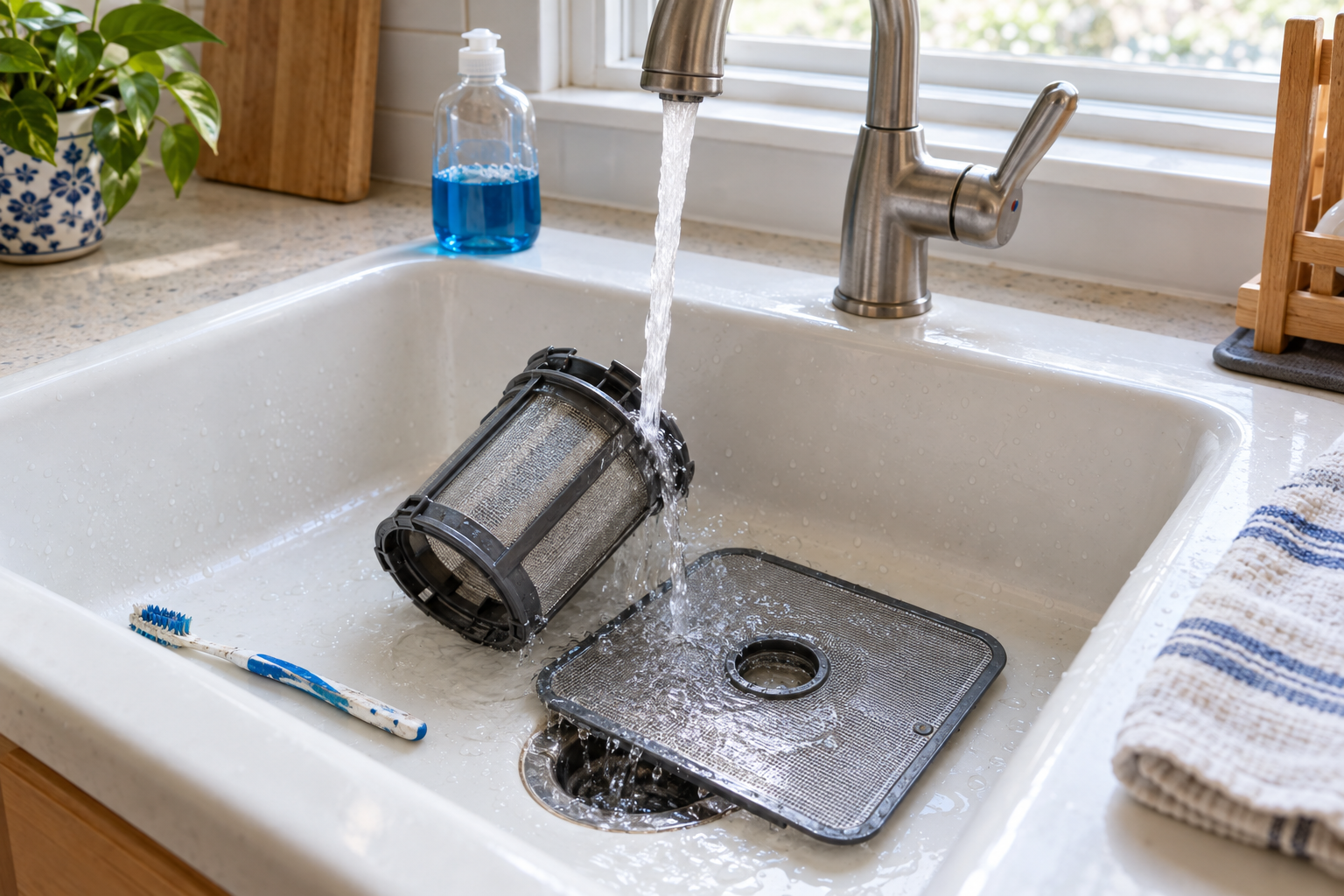
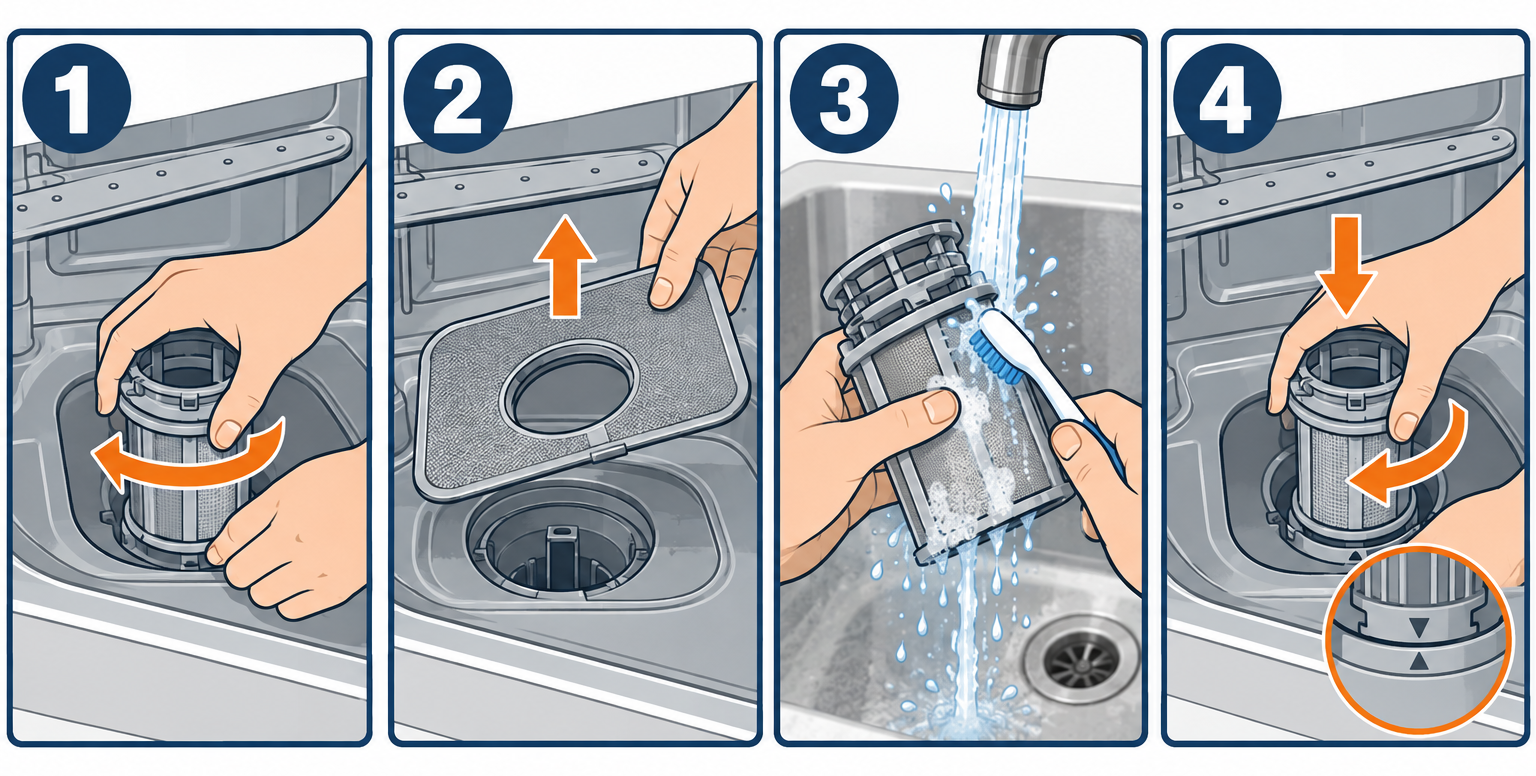
Pull out the bottom rack, twist the cylinder filter in the floor of the tub counterclockwise, lift it out with the flat mesh plate beneath it, and scrub both under hot water with dish soap and an old toothbrush. Wipe the sump opening, drop the filter back in, and twist it until the lock arrows line up. The whole job takes about ten minutes, costs nothing, and fixes most gritty-glass, bad-smell and slow-drain complaints on its own.
Quick steps: clean dishwasher filter
- Run the dishwasher empty if it has standing water, then unplug or switch off the breaker.
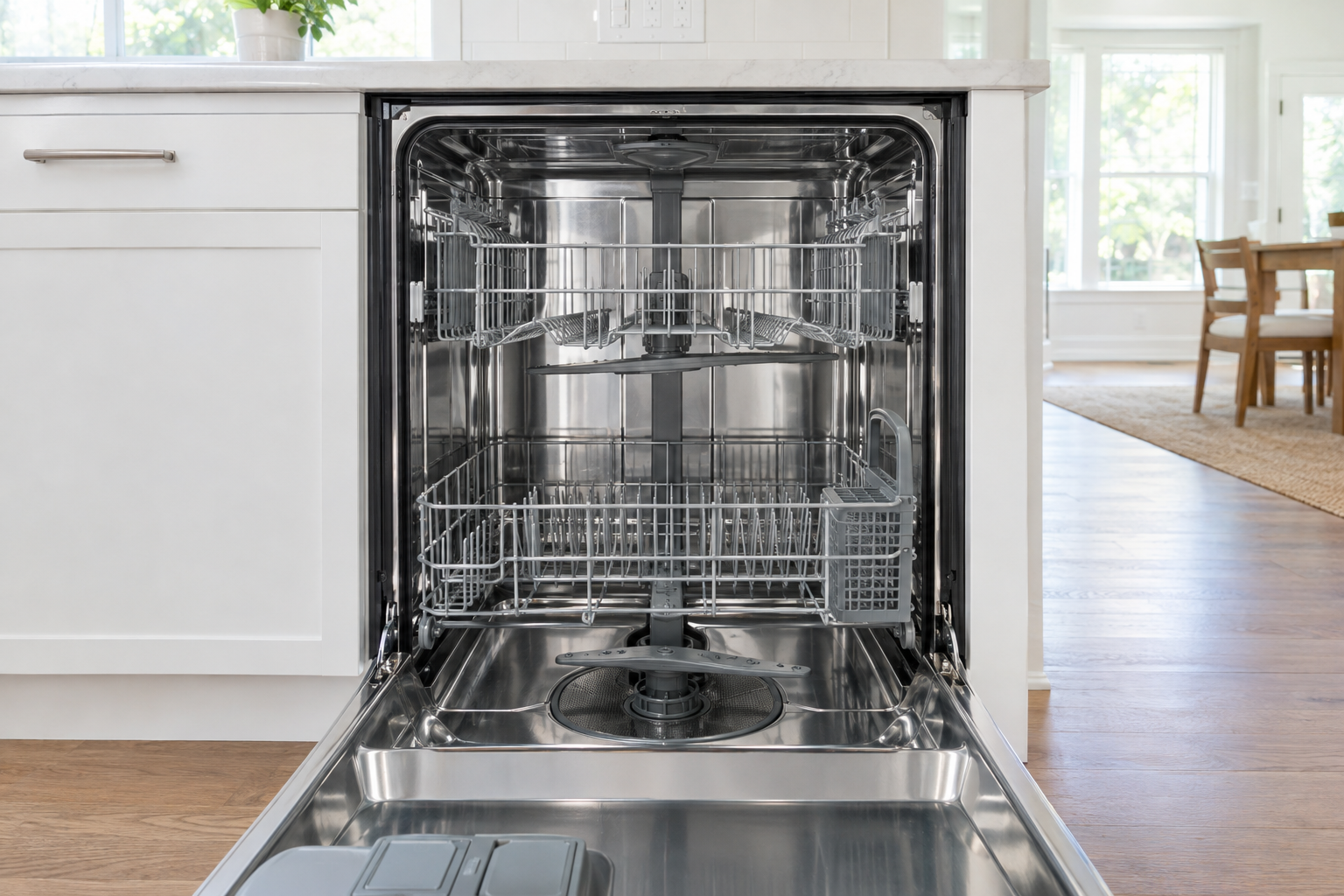
- Slide the bottom rack all the way out and set it on the counter.
- Twist the cylinder filter counterclockwise about a quarter turn and lift it out.
- Lift out the flat fine-mesh plate (and the coarse cup on Bosch and Miele).
- Rinse under hot water, scrub with dish soap and a soft brush, soak in vinegar if greasy.
- Wipe out the sump with a damp cloth and check for glass, pits or labels.
- Reseat the plate, drop in the cylinder, and twist clockwise until the arrows align.
- Push the rack back, restore power, and run a short rinse to confirm it drains.
Tools and materials
- Old toothbrush or soft nylon dish brush (no wire bristles)
- Dish soap (any brand)
- White distilled vinegar (about 1 cup for soaking)
- Baking soda (optional, for odors)
- Microfiber cloth or paper towels
- Flashlight or phone light for the sump
- Small bowl or sink stopper for soaking
- Nitrile gloves (optional, but broken glass hides in these)
- Replacement filter if the mesh is torn ($15-40 depending on brand)
Calculators for this job
Safety first
Unplug the dishwasher or flip its breaker before reaching into the sump. The wash pump impeller sits right under the filter, and broken glass, toothpicks and chicken bones collect in the mesh. Wear gloves if you have had a glass break in the machine.
Why the filter is the first thing to check
Nearly every dishwasher sold in the US since about 2010 uses a manual-clean filter instead of a grinder. Manufacturers switched because a mesh filter lets the machine run quietly on less water and electricity, but it means you take over the job the grinder used to do.
When the mesh clogs, the wash pump recirculates dirty water over your dishes. You get grit on glasses, a film on plates, and a sour smell that gets worse every day the machine sits closed. The drain pump also struggles to pull water through a packed filter, so you start seeing an inch of murky water in the bottom of the tub after a cycle.
The fix takes ten minutes. If you have never done it, there is a decent chance the filter has never been cleaned since the dishwasher was installed, and the first cleaning will be an eye-opener.
Signs your dishwasher filter needs cleaning
You do not need to wait for a schedule. Any one of these tells you the filter is overdue.
- Gritty specks or sand-like residue on glasses and the inside of cups
- A sour, swampy or rotten-food smell when you open the door
- Standing water in the bottom of the tub after the cycle ends
- Dishes on the bottom rack coming out dirtier than the top rack
- Cycles that run noticeably longer than they used to
- A drain-related error code, such as E24 on Bosch, 5C or 5E on Samsung, OE on LG, or F9E1 on Whirlpool-built machines
- Visible food, seeds or coffee grounds sitting on the mesh when you look under the bottom rack
The smell is usually the first symptom people notice, and it gets blamed on the whole “dishwasher inside” when the filter alone is the source. Clean the filter first, then clean the tub, door gasket and spray arms if the odor is still there.
Find out which filter type you have
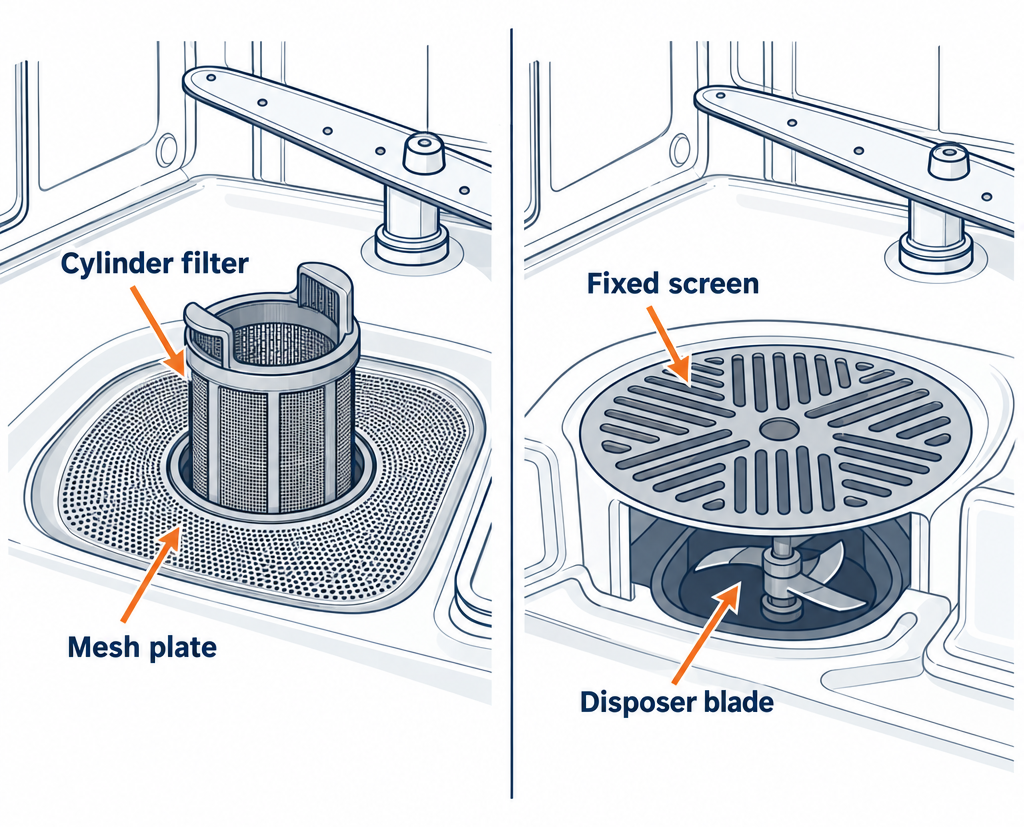
Two designs exist, and you need to know which one is under your bottom rack.
Manual-clean filter (most dishwashers since 2010)
Look in the floor of the tub, usually in the center or just behind the lower spray arm. You will see a round cylinder, often with a handle or finger grips molded into the top, sitting inside a flat plate of fine stainless mesh or perforated plastic. That is a manual-clean filter. Bosch, Miele, LG, Samsung, newer Whirlpool, KitchenAid, Maytag, Frigidaire and most newer GE models use this design.
Self-cleaning filter with a hard food disposer
Some dishwashers, mainly older GE, Maytag and a handful of current higher-priced GE Profile models, use a small grinder blade and a coarse screen in the sump. These machines are louder, typically in the 50 dB range instead of the low 40s, because the disposer runs during the wash. There is no filter to lift out, but the fixed screen still collects glass and labels, and it still benefits from a wipe-down a few times a year.
If you are not sure, pull the lower rack and look. A twist-out cylinder means manual. A flat fixed grate with no cylinder, on a machine that sounds like it is chewing something during the wash, means self-cleaning. The model number sticker on the inside edge of the door will confirm it if you look up the manual.
Where the filter sits and how it releases, by brand
Most filters release with a quarter turn counterclockwise, but the number of pieces and the lock markings vary. Use this table as a starting point and confirm against the arrows molded into your filter.
| Brand | Filter pieces | How it releases | What to watch for |
|---|---|---|---|
| Bosch | Three: cylinder micro filter, flat fine filter plate, coarse cup inside the cylinder | Twist cylinder counterclockwise until the arrows point to the unlock mark, lift straight up | Plate must sit flat under the spray arm hub or the cylinder will not seat |
| Whirlpool, KitchenAid, Maytag | Two: upper cylindrical filter, lower flat filter | Turn upper filter a quarter turn counterclockwise, lift out; lower filter slides out from under it | Lower filter has a tab that tucks under the cylinder seat; it goes in first |
| GE (manual-clean models) | Two: fine filter plate and an ultra-fine filter in the sump | Lift or twist the fine filter, then lift the ultra-fine filter from the sump cavity | Older GE with a hard food disposer have no removable filter |
| Samsung | One or two: cylinder with a flip-up handle, sometimes a mesh insert | Flip handle up, turn counterclockwise, lift | Handle must fold flat before the rack slides back in |
| LG | Two: center cylinder and mesh plate | Turn cylinder counterclockwise, lift; plate lifts next | Mesh plate is thin and bends easily |
| Frigidaire, Electrolux | Two on newer models; older units have a glass trap only | Twist and lift the cylinder | Glass trap on older units is a small cup you pull straight up |
| Miele | Three-piece combination filter with a handle | Turn handle counterclockwise, lift the whole assembly | Miele filters have a floating valve that must move freely after reassembly |
If your brand is not listed, or the filter does not budge with light pressure, look for a small padlock symbol or the words “lock” and “unlock” on the top of the cylinder. Never force it. A stuck filter is almost always turned the wrong direction or jammed by a toothpick wedged between the cylinder and the plate.
Step 1: Empty the tub and cut power
Run a short rinse or drain cycle if there is water sitting in the bottom. If the machine will not drain at all, bail the water out with a cup and soak up the last of it with a towel so you are not fishing in two inches of gray water.
Unplug the dishwasher if the cord is reachable under the sink, or switch off the breaker labeled “dishwasher” at the panel. Many dishwashers are hardwired to a 15 or 20 amp breaker and have no plug. Cutting power matters because some models can start a drain pulse when the door closes, and your fingers will be inside the sump for the next few minutes.
Let the tub cool for a few minutes if you just ran a cycle. Water in the sump can still be near 140°F right after a heated wash.
Step 2: Remove the bottom rack
Pull the lower rack all the way out until it stops, then lift the front wheels over the rail stops and carry it to the counter. On most machines the rack simply lifts off the rails at full extension. On some Bosch and Miele models you press a tab on each side rail first.
With the rack gone you have a clear view of the tub floor. Take a quick look at the lower spray arm while you are there. If it is caked with food or the holes are plugged, it comes off next, usually by lifting straight up or unscrewing a plastic nut in the center.
Pro tip
Snap a photo of the filter area before you take anything apart. It sounds obvious, but the flat plate on Whirlpool-built machines and the coarse cup on Bosch go back in a specific orientation, and the photo saves you a second trip under the sink for the manual.
Step 3: Twist out the cylinder filter
Grip the cylinder by its handle or the finger grips on top. Turn it counterclockwise about a quarter turn until you feel it release. On Bosch you will see two arrows line up at the unlock mark. On Whirlpool, KitchenAid and Maytag the arrow on the filter rim rotates from the locked icon to the unlocked icon.
Lift straight up. The cylinder will come out with a few tablespoons of water and whatever it has been catching. Hold it over the tub, not the kitchen floor, because the mesh usually has a layer of sludge that slides off the moment you tilt it.
Set it in the sink. Do not shake it over the sump, since anything that falls in goes straight to the pump intake.
Step 4: Lift out the fine filter plate
With the cylinder gone, the flat mesh plate underneath lifts out. On most brands it is just sitting in a recess and comes up with your fingers. On Whirlpool-built machines the lower filter has a tab that tucks under the cylinder seat, so slide it slightly toward the back before lifting.
Bosch and Miele also have a coarse filter: a small perforated cup that sits inside the cylinder. Pull it out and clean it separately. This is where the big stuff ends up: olive pits, chicken bones, the plastic ring off a milk jug, and on more than one occasion a whole almond.
GE’s manual-clean models have an ultra-fine filter that sits deeper in the sump cavity under the fine filter plate. Reach in and lift it straight up. It is usually a shallow cup with very fine mesh, and it is the part that catches coffee grounds and the sand from vegetables.
Take everything to the sink. You should now be looking at the open sump with the pump intake visible at the bottom.
Step 5: Scrub the mesh with soap and a soft brush
Rinse each piece under hot tap water first. Most loose food lets go immediately. Then squirt dish soap on the mesh and scrub with an old toothbrush or a soft nylon dish brush, working from both sides of the mesh so you push debris out rather than deeper in.
The cylinder needs attention on the inside as well. Angle the brush through the top opening and scrub the inner wall, then flush with water from the inside out. Hold it up to the light. Clean mesh is nearly see-through; clogged mesh looks gray and solid.
A few rules that save the filter:
- No wire brushes, scouring pads or steel wool. They tear the mesh and scratch the plastic frame.
- No bleach. It pits stainless mesh and degrades the plastic.
- No dishwasher. Running the filter through a wash cycle on the top rack sounds clever, but the heat warps the plastic frame and it will never lock properly again.
- Keep the water hot but not boiling. Boiling water can warp the frame the same way.
If the mesh is coated in a sticky orange or brown film that soap will not move, that is grease and hard water scale. Move to the soak.
Soaking the filter in vinegar
Fill a bowl with equal parts white vinegar and hot tap water, drop in all the filter pieces, and leave them for 15 to 30 minutes. Vinegar dissolves the mineral scale that traps grease on the mesh. After the soak, scrub again with dish soap and rinse. For a really neglected filter, sprinkle baking soda on the wet mesh after the vinegar soak, scrub, and rinse; the fizzing lifts the last of the odor.
Avoid soaking longer than an hour. Vinegar is mild, but repeated long soaks dull the plastic over time.
Step 6: Clean the sump and check for debris
Shine a flashlight into the sump cavity where the filter was sitting. You are looking at the opening to the wash pump and, off to one side, the drain pump intake. Both collect what the filter misses.
Wipe the cavity with a damp cloth and feel around the edges with a gloved finger. Common finds include shards of glass, bottle labels, broken toothpicks, pistachio shells and the occasional small plastic lid. Pull all of it out. A piece of glass against the drain impeller is the top cause of a dishwasher that hums but will not drain.
If you can see the drain impeller (on Bosch it sits under a small cover you unclip; on many others it is behind a grate), spin it gently with a finger. It should turn freely with a slight ratcheting feel. If it will not budge, something is wedged in it. Work it out with needle-nose pliers.
This is also the moment to clean the lower spray arm if it looked bad in Step 2. Lift it off, run it under the tap, and poke each hole with a toothpick until water sprays cleanly from every jet. Blocked arms are the second most common reason the bottom rack stays dirty after the filter is clean.
Pro tip
Dishwashers that drain into a garbage disposal often get blamed for a clog that is actually in the disposal. If water still sits in the tub after you clean the filter, run the disposal for 30 seconds with the water on. A full “sink disposal” blocks the dishwasher drain hose at the inlet nipple, and on a newly installed disposal the knockout plug may never have been removed.
Step 7: Reassemble and lock the filter
Reassembly matters more than people expect. A filter that is not fully locked lets food bypass straight to the pump, and on some models it will stop the lower spray arm from turning.
Put the pieces back in reverse order:
- Drop the ultra-fine filter (GE) or coarse cup (Bosch, Miele) back into its seat.
- Lay the flat fine filter plate in its recess. It should sit completely flat with no rocking. On Whirlpool-built units, slide the tab under the cylinder seat.
- Lower the cylinder into the center opening with the arrows at the unlock position.
- Turn clockwise a quarter turn until the arrows meet at the lock mark or you feel a firm stop. On Samsung, fold the handle down flat.
- Give it a light tug upward. A locked filter will not lift.
Replace the spray arm if you removed it and spin it by hand to confirm it turns freely without hitting the filter. Slide the bottom rack back onto its rails.
Restore power and run a rinse-only cycle, or the shortest cycle your machine has. Listen through the door. You should hear water spraying normally and, at the end, the drain pump running for 30 to 60 seconds followed by a quiet tub. Open the door. The floor should be damp but with no pooled water, and the filter should look exactly the way you left it.
Expected result
A clean filter restores the machine to the way it washed when it was new, assuming nothing else is wrong. Specifically you should see:
- No standing water after the cycle
- No sour smell when you open the door the next morning
- Glasses clear, with no grit or sandy feel inside
- Bottom rack dishes as clean as the top rack
- Cycle times back to the normal range for the program you selected
If grit on glasses continues after a clean filter and clean spray arms, the problem is usually hard water or detergent dosing rather than the filter. A rinse aid refill and a dishwasher cleaner tablet run on the hottest cycle handles that.
How often to clean a dishwasher filter
Most manufacturers tell you to clean the filter “regularly” and leave the interval to you. The honest answer depends on how many loads you run and how much food goes in on the plates.
| How you use the dishwasher | Clean the filter | Check the sump for glass |
|---|---|---|
| 7 or more loads a week, no scraping, lots of rice, oats or greasy pans | Every 2 weeks | Every 2 weeks |
| 4 to 6 loads a week, plates scraped but not rinsed | Every month | Every 2 months |
| 2 to 3 loads a week, plates scraped | Every 2 months | Every 3 months |
| 1 load a week or less, rinsed dishes, couple or single household | Every 3 months | Every 6 months |
| Self-cleaning filter with hard food disposer | Wipe the fixed screen every 3 months | Every 3 months |
Rice, oatmeal, seeds, coffee grounds and corn husks clog the mesh faster than anything else. If your household eats a lot of those, move one row up the table.
The easiest way to actually remember is to tie it to something you already do. Clean the filter the same day you change the furnace filter, or the first of the month when you run a cleaner tablet. Some newer Samsung, LG and Bosch models will prompt you to clean the filter in the app or on the display after a set number of cycles, which is helpful but not a substitute for checking after a glass breaks.
What it costs: cleaning versus repair
The cleaning itself is free. What costs money is ignoring it.
| Item | Typical US cost | Notes |
|---|---|---|
| Dish soap, old toothbrush, vinegar | $0-5 | Things you already own |
| Dishwasher cleaner tablets (Affresh, Finish, Cascade) | $6-10 per pack | Monthly use removes grease the filter misses |
| Replacement filter assembly | $15-40 | Order by model number from the manufacturer or a parts site |
| Replacement lower spray arm | $20-50 | Needed if the arm cracked or the nozzles are eroded |
| Service call and diagnosis | $80-150 | Most techs credit this toward the repair |
| Drain pump replacement, parts and labor | $150-350 | The most common outcome of a filter that was never cleaned |
| Wash pump or circulation motor replacement | $250-500 | Often not worth it on a dishwasher more than 8 years old |
A clogged filter does not break a dishwasher overnight. What it does is let glass and labels reach the drain pump, and the drain pump is a $150 to $350 repair that a monthly ten-minute cleaning prevents.
Cleaning a self-cleaning filter and hard food disposer
If you have the older grinder-style design, there is no cylinder to twist out, but the fixed screen in the sump still needs attention a few times a year.
Pull the bottom rack, then lift off the lower spray arm. On most GE and older Maytag units the arm lifts straight up or unscrews. Below it you will see a coarse plastic grate over the sump. Wipe the grate with a damp cloth and use a toothbrush to clear the slots. Shine a light through the grate and look for glass or labels sitting against the chopper blade.
Do not try to remove the chopper assembly yourself. It is held with a screw that is easy to strip, and the blade is sharp. If something is jammed in it and the machine has started making a grinding squeal, that is a job for a tech or, on a machine over ten years old, a reason to shop for a new dishwasher.
Run a cleaner tablet on the hottest cycle afterward. Grinder-style machines build up grease in the sump faster than mesh-filter machines because the macerated food goes everywhere before it drains.
Common mistakes that cause a callback
These are the things that bring a repair tech out to a dishwasher that only needed a cleaning, or that turn a cleaning into a real repair.
Running the dishwasher with the filter out
It is tempting to run a cycle without the filter to “flush the sump.” Do not. Food goes straight into the wash pump and drain pump. Bosch and Whirlpool both warn against it in the manual, and a single pistachio shell in the drain impeller is enough to jam it.
Putting the flat plate in upside down or off-center
The fine filter plate has a lip that sits in a recess. If it is upside down or rotated, the cylinder will seem to lock but will sit high, and the lower spray arm will catch on it. You will hear a rhythmic clunk during the wash. Pull the rack and check.
Forgetting the ultra-fine filter on GE
GE’s manual-clean models have two filters stacked. People clean the plate they can see and never find the ultra-fine filter underneath. If your GE still smells after a cleaning, reach deeper into the sump cavity.
Scrubbing with a scouring pad
Green scouring pads shred the fine mesh. Once the mesh has a hole, it stops filtering and you are buying a replacement. A toothbrush is the most aggressive tool you should use.
Ignoring a cracked filter frame
Check the plastic frame of the cylinder for cracks each time you clean it. Hairline cracks near the locking tabs are common on filters that have been forced. A cracked frame will not lock reliably. Replacements run $15 to $40 and install the same way as the original.
Not addressing the drain hose high loop
If the drain hose under the sink droops below the dishwasher’s inlet with no high loop or air gap, dirty sink water siphons back into the tub and refills the filter with sludge between uses. The fix is a hose loop fastened as high as possible under the counter, which is a ten-minute job with a zip tie and a screw hook.
Troubleshooting after cleaning
| Symptom | Likely cause | Fix |
|---|---|---|
| Water still stands in the tub after the cycle | Debris in the drain pump impeller, kinked drain hose, or clogged garbage disposal | Check the impeller spins freely, straighten the hose, run the disposal, confirm the disposal knockout plug is removed |
| Filter will not twist or lock | Flat plate seated wrong, toothpick wedged in the seat, or cracked locking tab | Remove everything, clear the seat, reinstall the plate flat first, replace the filter if a tab is broken |
| Rhythmic clunk during the wash | Lower spray arm hitting a filter that sits too high | Reseat the fine filter plate and relock the cylinder, then spin the arm by hand |
| Sour smell returns within a week | Grease in the sump, door gasket or drain hose, or heavy use | Run a dishwasher cleaner tablet on the hottest cycle, wipe the gasket, clean the filter every two weeks |
| Grit on glasses continues | Hard water scale, too much detergent, or blocked spray arm nozzles | Refill rinse aid, cut detergent dose, clear every arm nozzle with a toothpick |
| Drain error code persists (E24, 5C, OE, F9E1) | Pump blockage past the filter, failed drain pump, or blocked air gap | Clear the air gap cap on the sink deck, check the hose at the disposal, then test or replace the drain pump |
| Bottom rack dishes still dirty | Blocked lower spray arm or arm not turning | Remove and flush the arm, confirm it spins freely after reinstall |
| Filter mesh torn or frame cracked | Scouring pad damage or forced removal | Replace the filter assembly ($15-40), ordered by model number |
| Dishwasher hums but no water drains | Glass or a label jammed in the drain impeller | Cut power, remove the impeller cover, clear the debris with needle-nose pliers |
When to call a pro
Call an appliance repair tech if the drain pump hums but will not move water after you have cleared the impeller, if the wash pump makes a loud grinding noise, or if a drain error code stays on after the filter, hose and air gap are all clear. On a machine more than 8 to 10 years old, get a repair quote and compare it to the $500 to $1,300 cost of a new mid-range dishwasher with installation before you commit. Anything involving the hardwired electrical connection or a leaking water supply valve under the sink is also worth a licensed hand if you are not comfortable with it.
Keeping the filter cleaner between cleanings
A few habits stretch the interval and make each cleaning faster.
Scrape plates into the trash, but skip the pre-rinse. Modern detergents are designed to work on food soils, and a fully rinsed load confuses the turbidity sensor on many machines into running a short, cooler cycle. Scraping removes the bones, seeds and rice that clog the mesh while leaving the enzymes something to do.
Run the hot water at the kitchen tap until it is actually hot before you start the dishwasher. The first fill then comes in at temperature, grease stays liquid, and less of it sets on the filter.
Run a dishwasher cleaner tablet once a month with the machine empty, on the hottest cycle. Affresh, Finish and Cascade all make one and they cost roughly a dollar per use. It dissolves the grease film in the sump and drain hose that the filter cleaning does not reach.
Open the door an inch after the cycle finishes so the tub dries. A sealed, damp tub is where the smell grows between loads.
When a glass breaks in the dishwasher, stop and clean the filter and sump before the next load. Shards are small and sharp, and the drain impeller is the first thing they find.
FAQ
Do all dishwasher filters need to be cleaned?
Any dishwasher with a manual-clean filter, which is nearly every model sold in the US in the last 15 years, needs the filter cleaned by hand on a schedule. Dishwashers with a hard food disposer are called “self-cleaning,” but that only means the grinder breaks food small enough to drain. The fixed screen in those machines still collects glass and labels and should be wiped a few times a year. Pull the bottom rack and look: a twist-out cylinder means you clean it; a fixed grate with no cylinder means you wipe it.
Can I soak my dishwasher filter in vinegar to clean it?
Yes, and it is the best way to remove the greasy mineral film that dish soap alone will not lift. Use equal parts white vinegar and hot tap water, soak for 15 to 30 minutes, then scrub with dish soap and a soft brush and rinse. Do not leave it for hours, do not use bleach, and do not use boiling water, since all three can damage the plastic frame or the stainless mesh.
Is there a filter to clean on a dishwasher?
On almost every dishwasher made since about 2010, yes. It sits in the floor of the tub under the bottom rack, usually in the center or just behind the lower spray arm. It looks like a round plastic cylinder with mesh sides, set into a flat plate of fine mesh. Bosch, Whirlpool, KitchenAid, Maytag, LG, Samsung, Frigidaire, Miele and newer GE models all use this design. Older GE, Maytag and some current GE Profile models use a grinder instead and have no removable filter.
Is there a way to clean a dishwasher filter without removing it?
Not properly. You can run a dishwasher cleaner tablet or a cup of vinegar on a hot cycle, and that will dissolve some grease and reduce the smell, but it will not remove seeds, rice, glass or labels packed into the mesh. Those have to be rinsed and brushed out by hand. The filter twists out in about five seconds, so there is no real reason to skip it.
How do I know the filter is locked back in correctly?
The arrows or lock symbols on the top of the cylinder should line up at the lock mark, and the filter should not lift when you tug it. Spin the lower spray arm by hand to confirm it clears the filter, then run a short rinse cycle and listen for normal spray and a clean drain at the end. A clunking sound during the wash means the plate underneath is seated wrong.
What happens if I never clean the dishwasher filter?
The machine recirculates dirty water, so dishes come out gritty and cloudy. The smell builds until the whole kitchen notices it. Water starts standing in the tub after each cycle, and eventually debris reaches the drain pump and jams it. A typical dishwasher repair runs $100 to $300 in parts and labor, with a drain pump replacement often landing at the upper end of that range or above it, against a cleaning that costs nothing and takes ten minutes.
Should I replace the filter instead of cleaning it?
Only if the mesh is torn, the plastic frame is cracked, or the locking tabs are broken. A filter in good condition lasts the life of the dishwasher with regular cleaning. Replacements cost $15 to $40 and should be ordered by the model number printed on the sticker inside the door edge, since filters are not interchangeable between models even within the same brand.