To get rid of a mouse, set several snap traps baited with peanut butter along the walls where you see droppings, remove every food source the mice can reach, and seal any gap 1/4 inch or wider on the outside of your house. Traps clear the mice already inside, usually within one to two weeks, and sealing keeps new ones from replacing them. Skip either half and the problem comes back.
Quick steps: get rid of mice
- Find droppings, gnaw marks and rub marks to locate activity.
- Put all food, pet food and trash in sealed containers.
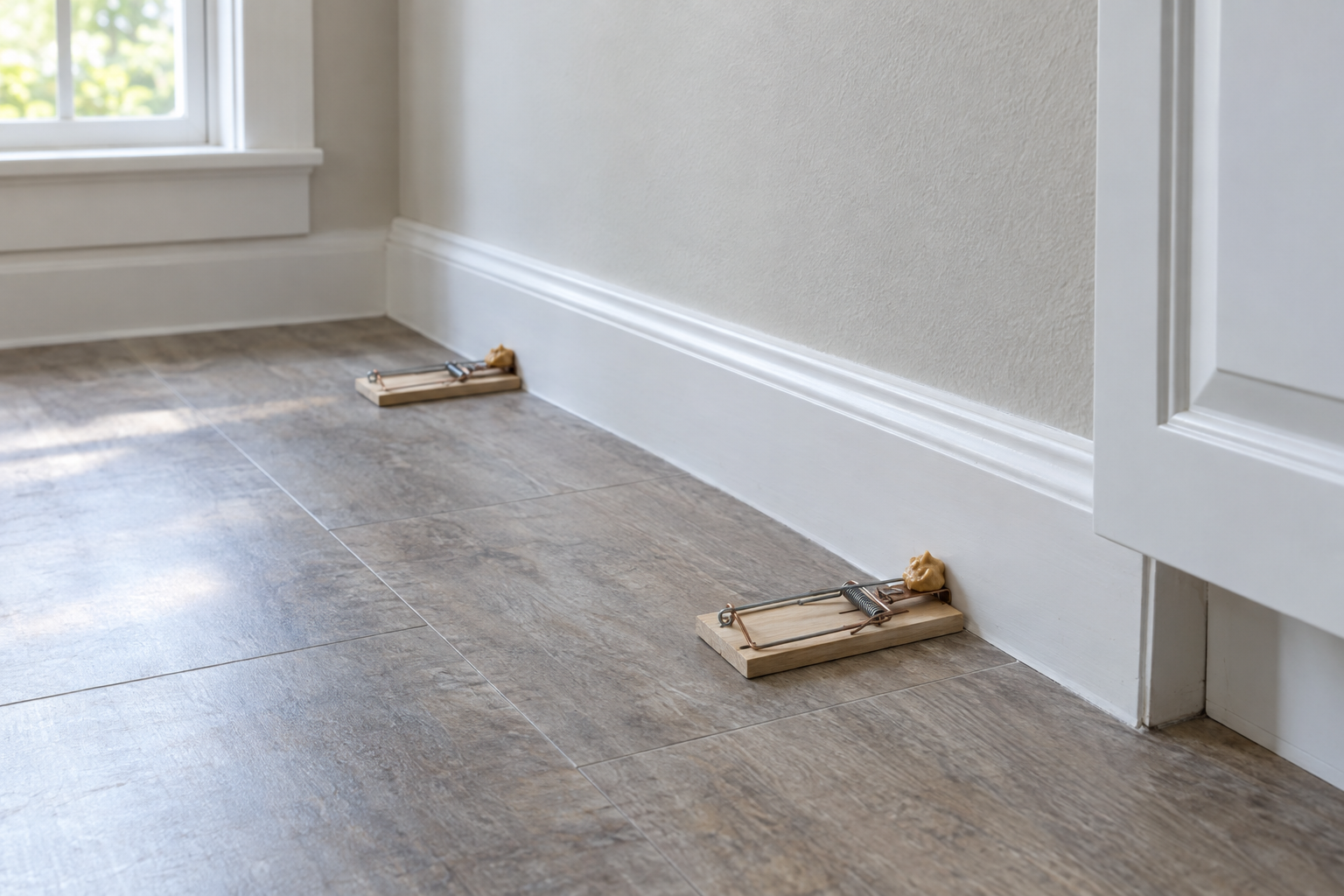
- Set 6-12 snap traps baited with peanut butter, trigger end against the wall.
- Check traps every morning and dispose of mice with gloves on.
- Seal exterior gaps 1/4 inch and larger with copper mesh, hardware cloth or sealant.
- Disinfect droppings and nests with a 1:10 bleach solution. Never sweep or vacuum them.
- Keep traps set until you go two weeks with no new catches or droppings.
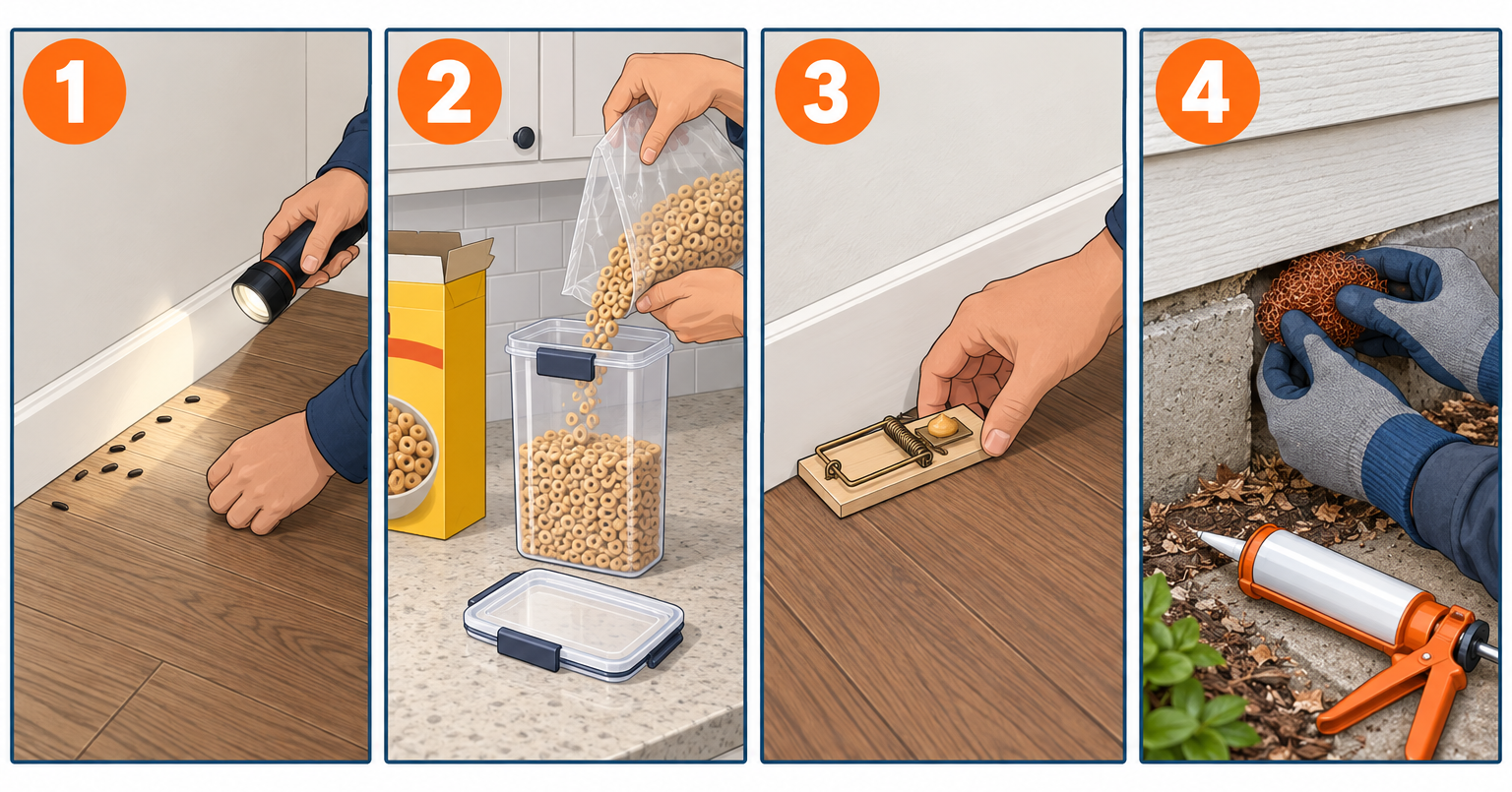
Tools and materials
- Snap traps (Victor Original or Tomcat Press ‘N Set style, 6-12 traps)
- Bait: creamy peanut butter or hazelnut spread, plus cotton balls in cold months
- Disposable nitrile or rubber gloves
- Flashlight and a small inspection mirror
- Copper mesh (such as Stuf-fit, 20 ft roll)
- 1/4-inch galvanized hardware cloth and tin snips
- Exterior-grade polyurethane sealant and caulk gun
- Door sweeps and garage door bottom seal as needed
- Household bleach, spray bottle, paper towels, zip-top bags
- N95 or P100 respirator for cleaning heavy droppings
Calculators for this job
Safety first
Wear gloves whenever you handle traps, mice or droppings, and never sweep or vacuum droppings, because that puts contaminated dust in the air. Keep traps and any bait stations where kids, dogs and cats can’t reach them.
Step 1: Confirm it’s mice and find where they travel
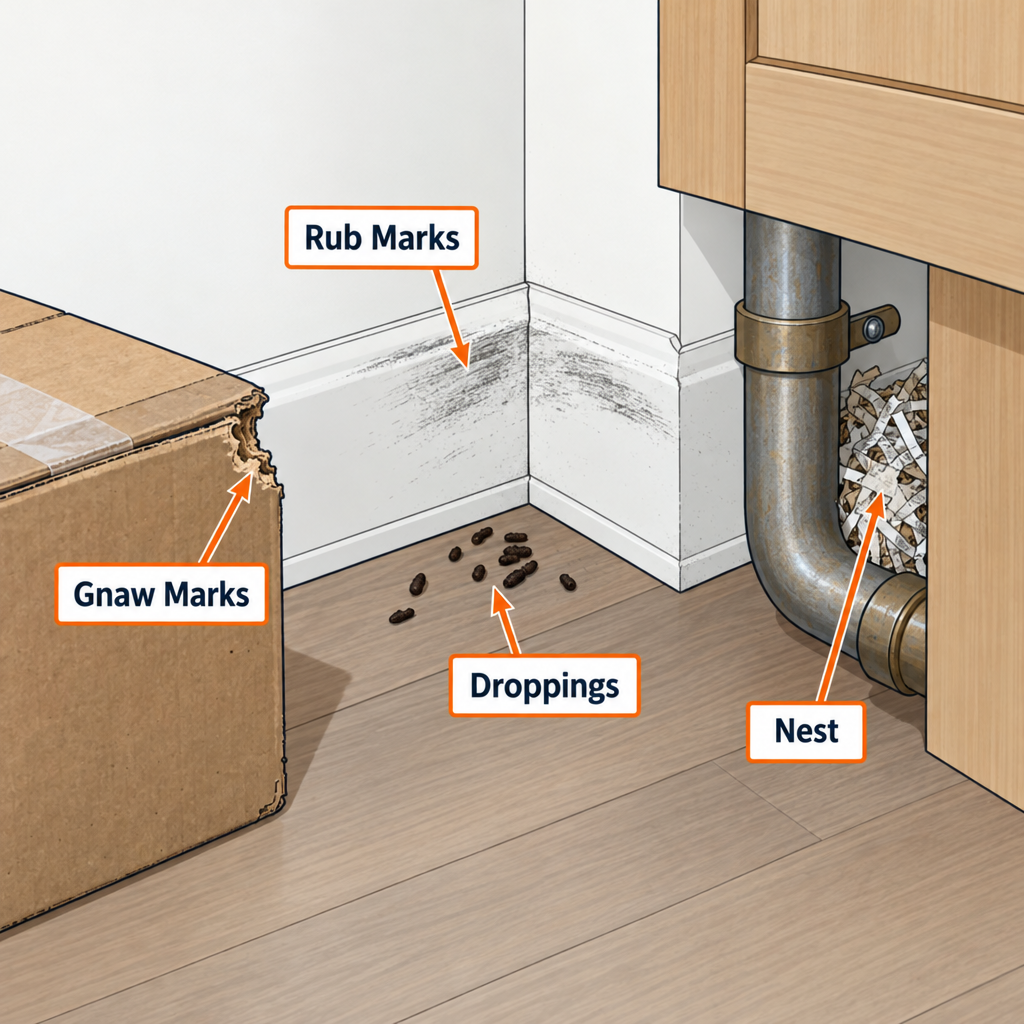
Before you buy anything, make sure you’re dealing with house mice and figure out where they’re running. Mice are creatures of habit. They forage close to the nest, often within 10 to 30 feet, and they hug walls because their whiskers guide them along edges. That habit is the whole key to trapping them.
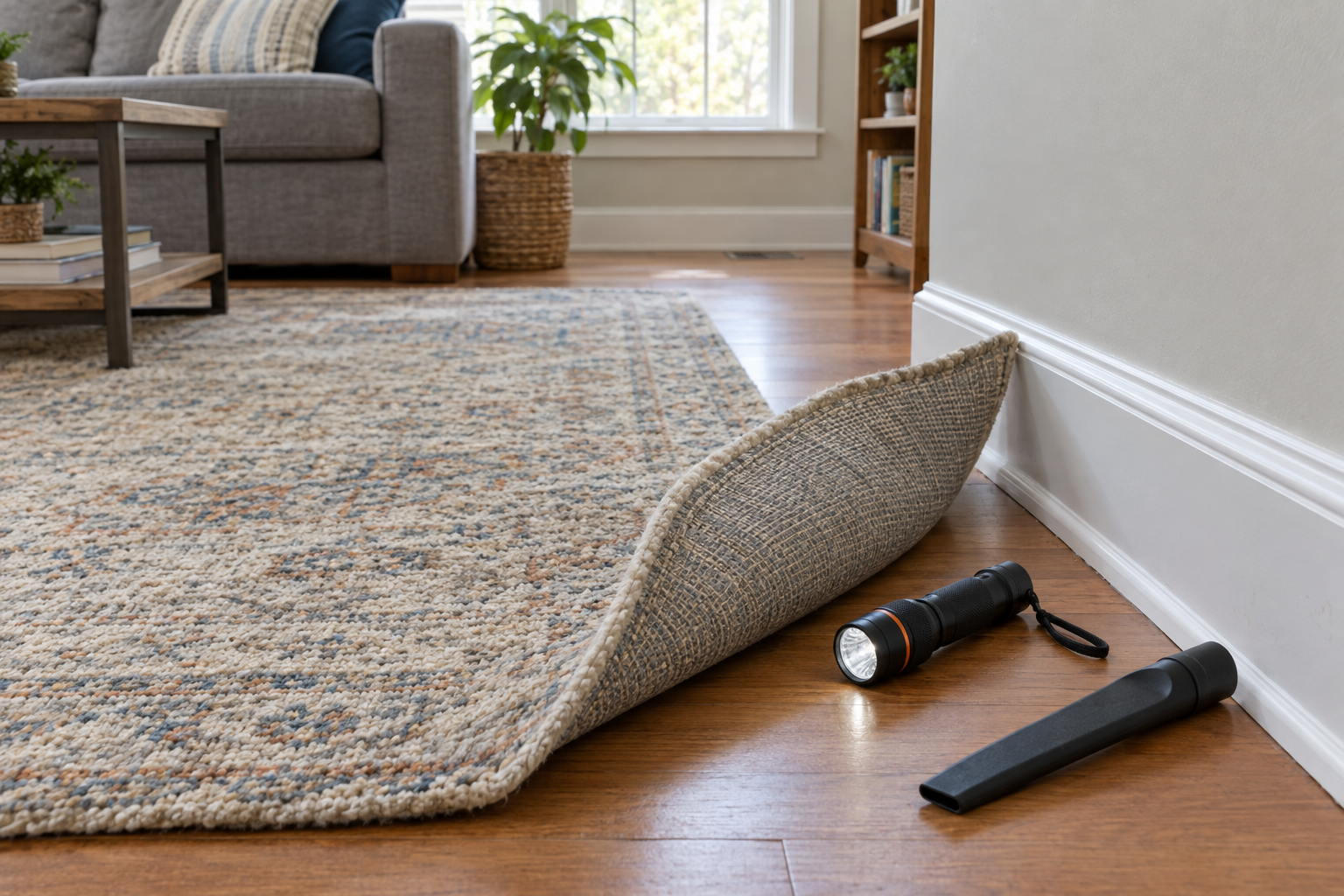
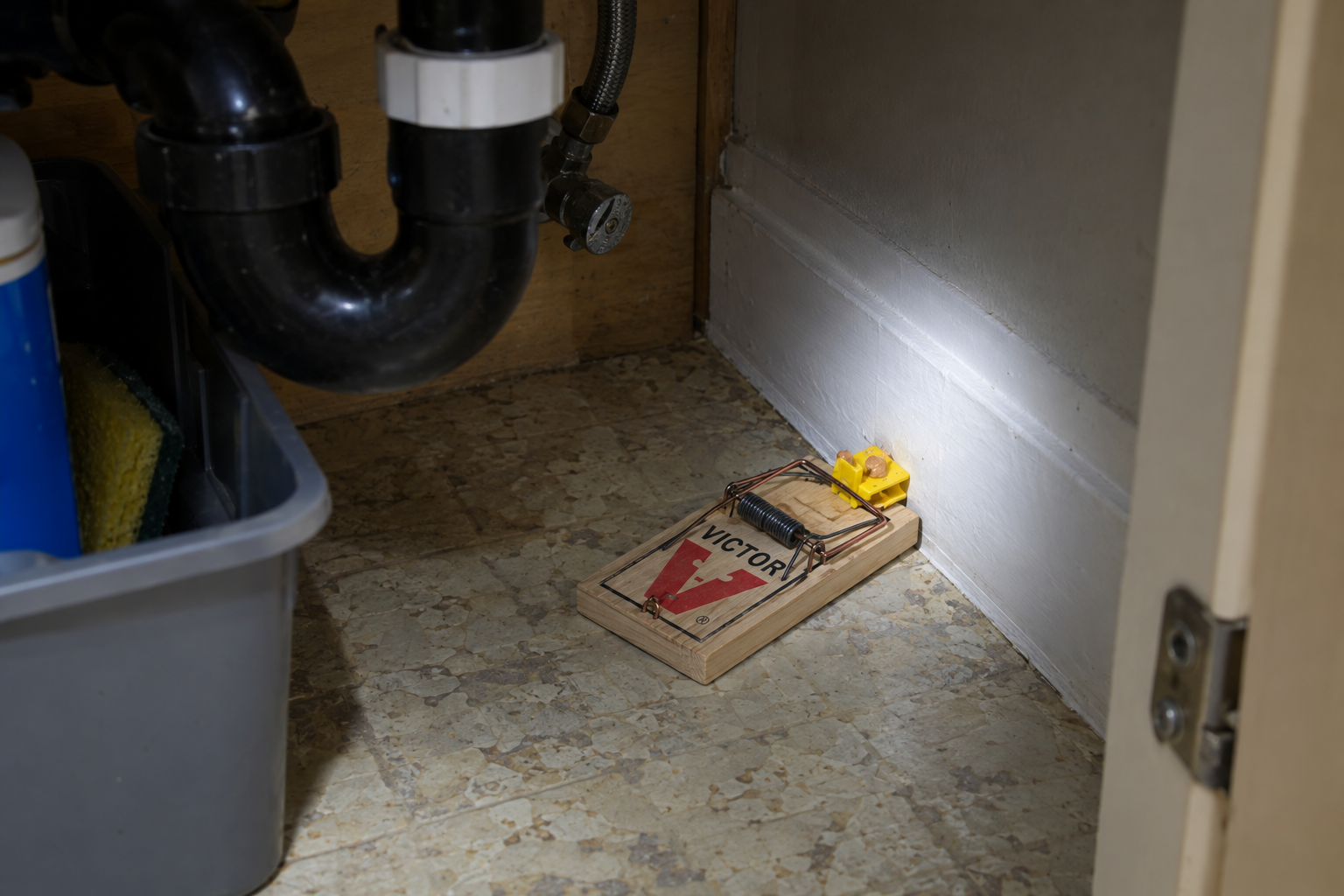
Grab a flashlight and check under the kitchen sink, behind the stove and refrigerator, inside lower cabinets, in the pantry, along garage walls, and around the furnace and water heater. Look for:
- Droppings: dark, rice-shaped pellets about 1/8 to 1/4 inch long with pointed ends. Fresh ones are shiny and soft. Old ones are dry and crumble.
- Rub marks: greasy gray smudges along baseboards and around holes where bodies brush the same spot repeatedly.
- Gnaw marks: small chew marks on food packaging, cardboard, wire insulation or wood corners.
- Nests: wads of shredded paper, insulation, fabric or pet hair tucked into drawers, wall voids or behind appliances.
- Sounds and smell: scratching in walls or ceilings at night, and a musky, ammonia-like odor in closed spaces.
| Sign | House mouse | Deer mouse | Norway rat |
|---|---|---|---|
| Body length (no tail) | About 2.5-4 in | About 3-4 in | About 7-10 in |
| Look | Dusty gray-brown all over | Brown top, white belly and feet, two-tone tail | Brown-gray, heavy body, blunt nose |
| Droppings | 1/8-1/4 in, pointed ends | Similar to house mouse | 1/2-3/4 in, blunt ends |
| Where you find them | Kitchens, wall voids, garages | Rural homes, sheds, cabins, garages | Basements, crawl spaces, ground level |
| Main health concern | Salmonella, LCMV | Hantavirus | Leptospirosis, bites |
If the droppings are half an inch or longer, you have rats, and you’ll need larger traps and stronger exclusion materials. If you live in a rural area and see white-bellied mice, assume deer mice and take the cleanup in Step 6 seriously.
Pro tip
Sprinkle a thin line of flour or baby powder along a suspect wall overnight. Tiny footprints and tail drags in the morning show you exactly where the runway is, which is where your traps go.
Step 2: Cut off the food
Traps work far better when the peanut butter is the best meal in the house. A mouse can live on a few grams of food a day and gets most of its water from what it eats, so crumbs under the toaster are plenty.
Move cereal, flour, rice, pasta, crackers, pet food and birdseed into hard plastic or glass containers with tight lids. Mice chew through cardboard and paper bags in minutes. Pick up pet bowls at night, wipe counters and stovetops, and pull out the stove drawer to clean the grease and crumbs underneath. Use a trash can with a lid, and take garbage out every evening while you’re trapping.
Check the garage too. Grass seed, dog food bags and birdseed stored in a garage feed more mice than most kitchens do.
Step 3: Set enough traps in the right places
Snap traps are the fastest, cheapest and most reliable method for a house mouse problem. They kill instantly, show you a clear result, and don’t leave a dead mouse rotting inside a wall. Our article on how to set snap traps for mice walks through each trap style in detail, but these are the rules that matter most.
Use more traps than you think. Set at least six for a light problem and 12 or more if you’re seeing droppings in several rooms. Place them 2 to 3 feet apart in hot spots and every 6 to 10 feet along longer runways.
Place them against the wall. Set each trap perpendicular to the wall with the trigger end touching the baseboard, so a mouse running the edge hits the bait head-on. You can also set two traps side by side, triggers facing opposite directions, to catch mice coming from either way.
Bait lightly. A pea-sized dab of peanut butter pressed into the trigger is enough. Too much lets the mouse lick it off without springing the trap. In fall and winter, a pinch of cotton ball or dental floss wrapped around the trigger works well, because mice are gathering nest material.
Wear gloves while baiting. It keeps your scent off the trap and protects your hands.
| Trap type | Typical cost | Pros | Cons | Best use |
|---|---|---|---|---|
| Wooden snap trap | About $1-2 each | Cheap, fast, proven | Takes practice to set, can snap fingers | Most homes, kitchens, garages |
| Plastic snap trap (Press ‘N Set type) | About $3-4 each | Easy to set, reusable, easy release | Bulkier | Beginners, anyone squeamish |
| Electronic trap (Victor M250S type) | About $25-40 each | Enclosed kill, indicator light, no handling | Batteries, higher cost | Homes with kids or pets |
| Live catch trap | About $8-20 each | No kill | Must check often, release is tricky | One or two mice, people who won’t kill |
| Glue trap | About $1-2 each | Cheap | Slow, inhumane death, catches pets and birds | Not recommended |
| Tamper-resistant bait station | About $10-25 plus refills | Low effort | Mice die in walls, pet poisoning risk | Exterior use by pros |
Skip glue boards. Mice can stay stuck for a long time before dying, they catch birds and pets, and some places have restricted them on humane grounds.
Why you shouldn’t use poison indoors
Since the EPA’s rodenticide rules took effect, consumer mouse poisons have to come in tamper-resistant bait stations, and the most potent second-generation anticoagulants aren’t sold for residential consumer use. Even so, poison is a bad indoor choice. The mouse eats the bait, crawls back into a wall void and dies there, and you get a smell that can last a couple of weeks. Bromethalin, a common consumer bait, has no antidote for pets. Use traps inside and leave baiting to licensed pros if you need it at all.
Step 4: Check traps every morning and dispose of mice safely
Mice are mostly active at night, so check traps first thing each morning. Most homes see catches in the first one to three nights if the traps are on the runways.
To dispose of a caught mouse, put on gloves and spray the mouse and trap with disinfectant or a bleach solution until wet. Lift the bar, drop the mouse into a zip-top bag, seal it, and put it in a second bag before it goes in the outdoor trash. Plastic traps can be disinfected and reset. Cheap wooden traps can go in the bag with the mouse.
If a trap has gone two or three nights with no activity, move it a few feet along the wall or to a new spot with fresh droppings. Traps sitting in the middle of the floor almost never catch anything.
Pro tip
When you catch a mouse, reset a trap in the exact same spot. The scent of the last mouse tends to draw the next one along the same runway, so productive spots keep producing.
Step 5: Find and seal every entry point
This is the step that actually ends the problem. A mouse can squeeze through a gap about 1/4 inch wide, roughly the thickness of a pencil, and can climb rough siding, brick and pipes. If you trap without sealing, new mice simply move in.
Walk the outside of the house slowly with a flashlight. Get low. Look at:
- Where AC lines, gas pipes, hose bibs, cable and electrical lines enter the wall
- Dryer vents and bathroom exhaust vents
- The gap between the foundation and the wood sill plate
- Garage door corners and worn bottom seals
- Gaps under entry doors (if you see daylight, a mouse can get in)
- Crawl space vents and access doors
- Roof returns, soffit gaps and spots where siding meets the roofline
- Open weep holes in brick veneer
Then repeat inside: under sinks where plumbing goes through the wall, behind the dishwasher and stove, around the water heater, and anywhere pipes or wires pass through the floor.
| Gap or opening | Best material | Approx. cost | Avoid |
|---|---|---|---|
| Pipe and wire penetrations under 1 in | Copper mesh packed tight, then sealant over it | $15-25 per roll | Expanding foam alone (mice chew it) |
| Larger holes and vent openings | 1/4-in galvanized hardware cloth or sheet metal, screwed in place | $15-30 per roll | Window screen (too flimsy) |
| Foundation cracks | Mortar or hydraulic cement | $10-20 per bag | Caulk on wide cracks |
| Gaps under doors | Door sweep with brush or rubber blade | $10-25 each | Weatherstrip foam |
| Garage door bottom | New bottom seal, rodent-guard corner plugs | $25-60 | Leaving torn seals |
| Dryer vent | Louvered dryer vent cover with a rodent guard | $15-35 | Fine mesh screens that trap lint |
| Brick weep holes | Plastic or stainless weep vents | $5-15 per pack | Mortar (traps moisture in the wall) |
Steel wool is the classic fix, but it rusts and mice can pull it apart. Copper mesh holds up better. Pack it in hard with a screwdriver, then cover it with sealant so it stays put.
Never block a dryer vent with fine mesh. Lint builds up behind it and creates a fire hazard. Use a vent cover made for dryers.
Step 6: Clean up droppings and nests the safe way
Mouse urine and droppings can carry salmonella and lymphocytic choriomeningitis virus (LCMV), and deer mice can carry hantavirus. The CDC’s cleanup method avoids putting any of that into the air you breathe.
- Open windows and doors and let the area air out for at least 30 minutes.
- Put on rubber or nitrile gloves. Wear an N95 or better respirator for heavy contamination or any deer mouse mess.
- Mix 1 part bleach to 10 parts water (about 1.5 cups of bleach per gallon), or use an EPA-registered disinfectant.
- Spray droppings, urine spots and nest material until soaked, and let it sit 5 minutes.
- Wipe it up with paper towels and bag everything.
- Mop or wipe the area again with disinfectant, then wash your gloved hands before removing the gloves.
Pull out old nests completely. Abandoned rodent nests attract other pests, including carpet beetle larvae that will move on to wool rugs and clothing. If mice were living under a leaky sink or in a damp crawl space, check for mold growth too and deal with the mold safely before you put things back.
Heavily soiled attic insulation is a different job. Don’t try to scrub it. It needs removing and replacing, which is usually work for an insulation or remediation contractor.
Step 7: Monitor, then keep them out for good
Keep traps set for at least two weeks after your last catch. When you go two full weeks with no catches and no fresh droppings, you can pull most traps. Leave two or three in the garage and under the kitchen sink as early warning.
Then make the outside of the house less inviting:
- Stack firewood off the ground and at least 20 feet from the house.
- Trim shrubs and ground cover back so there’s bare ground or gravel next to the foundation.
- Cut back tree branches that touch the roof.
- Keep birdseed, grass seed and pet food in metal or heavy plastic bins.
- Clean up fallen fruit, nuts and spilled seed under feeders.
- Fix leaky outdoor faucets and drainage problems near the foundation.
Mice push indoors hardest when temperatures drop in fall. A 20-minute walk around the house every September, checking seals and door sweeps, prevents most repeat problems.
Live traps and natural methods: what actually works
Catch-and-release traps work, but you have to do it right. Check them at least twice a day, because a trapped mouse can die of stress, cold or dehydration within a day. Release the mouse at least a mile from your house, ideally somewhere with cover, or it may find its way back. Be honest with yourself: a house mouse dropped into an unfamiliar field often doesn’t survive long. Check local rules before relocating any animal.
As for repellents, here’s what holds up:
- Peppermint oil: strong smell, short-lived effect. It fades in days and won’t drive out mice that already have a nest and a food source.
- Ultrasonic plug-in devices: weak evidence. Any effect tends to wear off as mice get used to the sound, and the FTC has warned makers of these devices about unsupported claims.
- Cats: a good mouser catches some mice and may discourage others, but a cat won’t seal your foundation and won’t reach mice living in walls.
- Mothballs: don’t. They’re registered for clothes moths in sealed containers, and the fumes aren’t safe to breathe in living spaces.
Natural methods are fine as a supplement once you’ve trapped and sealed. They don’t replace either step.
Mice in walls, ceilings and crawl spaces
If you hear mice inside a wall but don’t see them in rooms, they’re using the wall as a highway between an entry point and a food source. Find where the void opens: behind the stove, under a cabinet toe kick, around a plumbing access panel or in the basement rim joist. Set traps at those openings, then seal the outside entry.
Scratching overhead in the daytime usually means squirrels, not mice. Mice are active mostly at night. For ceilings, check the attic for droppings along the top plates and around recessed lights, and set traps there on the joists.
Troubleshooting
| Symptom | Likely cause | Fix |
|---|---|---|
| Traps never catch anything | Traps in open floor, too few, or food still available | Move traps flush to walls on runways, add more, remove all food |
| Bait gone but trap didn’t fire | Too much bait or trigger set too firm | Use a pea-sized dab pressed into the trigger, adjust sensitivity |
| Still catching mice after 3 weeks | Entry points not sealed | Re-inspect exterior at ground level and roofline |
| New droppings after sealing | Missed a gap, or mice sealed inside | Keep trapping inside, check garage and utility penetrations again |
| Dead animal smell in a wall | Mouse died in the void, often after poison | Locate by smell, cut a small access hole, or wait 1-3 weeks and use an enzyme odor eliminator |
| Scratching overhead in daytime | Squirrels or other wildlife | Call a wildlife control company |
| Mice keep returning every fall | Exterior habitat and worn seals | Clear vegetation and woodpiles, replace door sweeps and garage seals |
When to call a pro
Call a licensed pest control company that offers exclusion if you’re still catching mice after three weeks with entries sealed, if the entry points are on the roofline or second story, or if you find rat-sized droppings. Call an insulation or remediation contractor for droppings throughout attic insulation, and a wildlife control operator for daytime noise in the attic.
Here’s roughly what professional help costs in the US. Prices vary by region and home size.
| Service | Typical cost range |
|---|---|
| Inspection | Free to about $200 |
| One-time mouse treatment (trapping, 1-3 visits) | About $200-600 |
| Exclusion work (sealing entry points) | About $300-1,500+ |
| Quarterly or monthly service plan | About $40-70 per month |
| Attic insulation removal and replacement | About $1.50-$4 per sq ft |
To compare insulation quotes, you’ll need the attic area. Measuring it works the same way you’d calculate square footage of a room: length times width for each section, added together.
FAQ
What is the fastest way to get rid of mice?
Set a dozen snap traps baited with peanut butter tight against the walls where you find droppings, and remove every other food source the same day. Most people catch the bulk of their mice in the first three to seven nights. Seal entry points that same week, or new mice will take their place.
How do you encourage mice to leave?
Take away what they came for: food, water, nesting material and shelter. Seal food, fix leaks, clear clutter in garages and basements, and close gaps. Repellents like peppermint oil won’t make established mice abandon a nest, so pair habitat changes with trapping.
How do I get a mouse to go away?
For a single mouse, put out four to six snap traps or a couple of live traps along the wall where you’ve seen it, baited with a small dab of peanut butter. One mouse is rarely alone, so keep traps out for two weeks after the catch and check for entry gaps.
What is the 5 day mouse rule?
It isn’t an official pest-control standard. People use it two ways: leaving baited, unset traps out for a few days so mice get used to feeding there, or treating five days without new signs as a sign the problem is over. House mice are curious and usually take set traps right away, so pre-baiting is rarely needed. Five quiet days is too short to call it done. Wait two weeks.
Will mice leave on their own?
Rarely. A house with steady food and warm wall voids is ideal mouse habitat. Females can have several litters a year with about five or six pups each, and the young can breed at around six weeks old, so a couple of mice can become a real infestation within a few months.
How many mice are there if I see one?
If you see one in daylight or find droppings in more than one room, assume several. Daytime sightings can point to crowding or an established population, but unlike with rats, a mouse seen during the day doesn’t necessarily mean a large infestation.